
If a worker’s training lapses, that worker can lose site access, miss work, or be pulled from a task on the spot. In most cases, the fix is simple: know what expires, know what gets retraining after a job change or incident, and start renewals 30 to 90 days early.
Here’s the short version:
- I need to track two things at once: fixed renewal dates and event-based retraining.
- Some items renew every year like respirator fit testing and some hazard refreshers.
- Some renew every 2 to 3 years, like CPR cards or forklift evaluations.
- Some, like Hazard Communication or OSHA 10/30, may not have a federal expiration date, but site owners or employers can still require updates.
- Workers and employers both need records: training dates, topics, trainer info, and proof the worker passed any checks.
- Missed records can matter just as much as missed training.
OSHA Annual Refresher Training Requirements (What Employers Must Know)
sbb-itb-aa28329
Quick overview
A safe recertification plan usually includes:
- Refreshers for recurring training
- Retraining after new equipment, new hazards, or an incident
- Renewal paperwork for cards, fit tests, and other credentials
- Calendar reminders at 90, 60, and 30 days before expiration
- Task matching so workers only do jobs their current training covers
Quick comparison
| Item | Usual timing | What can force earlier action? | Who usually tracks it? |
|---|---|---|---|
| Forklift | Every 3 years | Unsafe use, near-miss, new truck type, changed conditions | Employer |
| Respirator fit test | Every year | New facepiece, fit issue, different respirator | Employer |
| Hazard Communication | No set federal refresher date | New chemical or new hazard info | Employer |
| First Aid/CPR | Every 2 years | Card expiration, site rule, role change | Worker and employer |
| Fall protection | Often every 2 years | New gear, changed site phase, near-miss | Employer |
| Confined space | Often set by employer | New space, changed hazard, audit issue | Employer |
| Lockout/Tagout | Often every 1 to 3 years | New equipment, changed procedure, incident | Employer |
| BCSP credentials | Every 5 years | Not enough points by deadline | Worker |
| CCM | Every 3 years | Renewal deadline and CE hours | Worker |
Bottom line: I’d treat recertification like a jobsite deadline. Put every date on one calendar, tie each worker to the right records, and check contract rules before mobilization. That avoids delays, failed audits, and workers being assigned to tasks their current training does not cover.
Common Safety Certifications and Typical Renewal Timelines
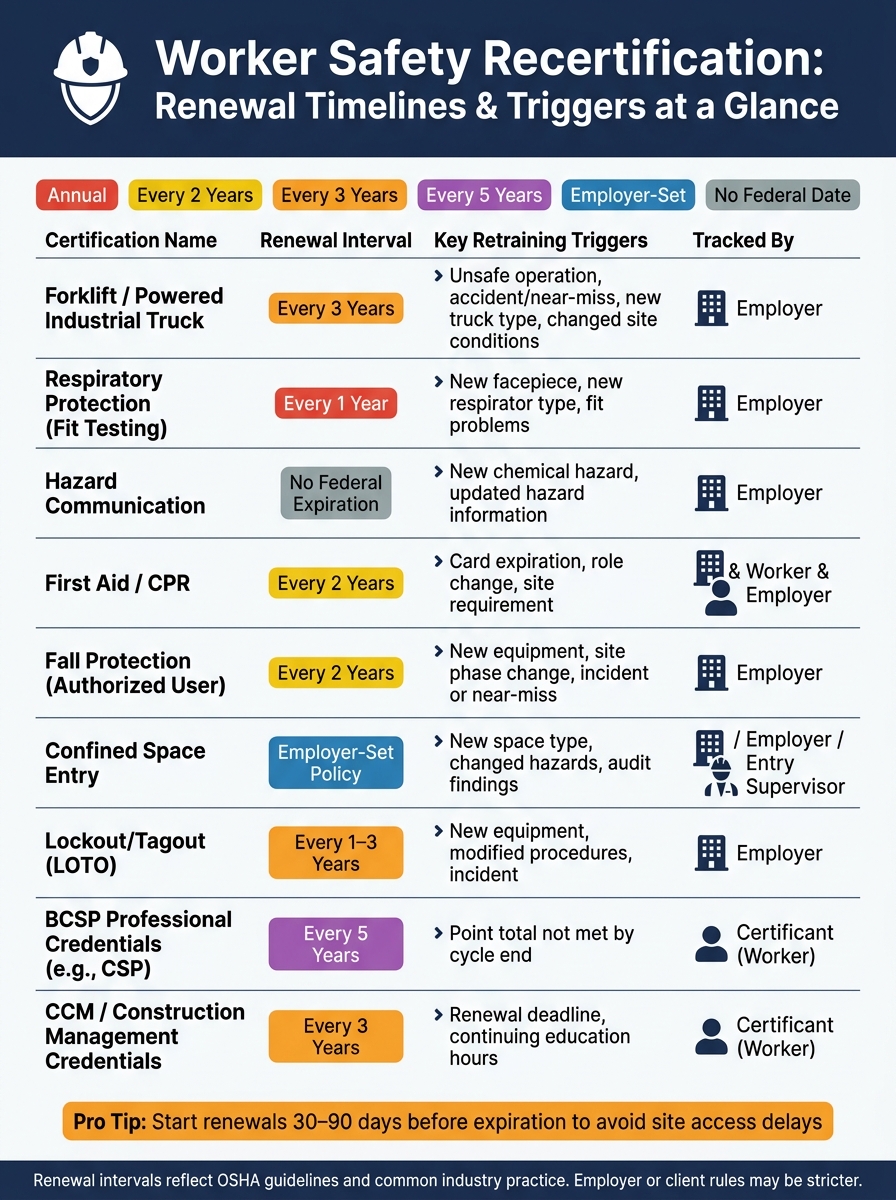
Worker Safety Recertification: Renewal Timelines & Triggers at a Glance
Safety credentials don’t all run on the same clock. Some need a yearly check-in. Others come up every few years. And some professional designations sit on longer continuing-education cycles. The key is knowing what follows a set calendar, what gets triggered by a change on the job, and what doesn’t federally expire at all but can still be limited by company or client rules.
That matters for both sides. Workers can avoid last-minute lapses. Employers can build cleaner renewal calendars and stop scrambling when a site asks for current records.
Use the table below to sort each credential by renewal cadence and retraining trigger.
| Certification Type | Initial Training Hours | Typical Refresher Interval | Retraining Triggers | Who Tracks It |
|---|---|---|---|---|
| Forklift / Powered Industrial Truck | Varies; training and evaluation required before operation | Every 3 years | Unsafe operation, accident/near-miss, different truck type, changed workplace conditions | Employer |
| Respiratory Protection (fit testing) | Varies; required before first use | Annually | New facepiece, new respirator type, inadequate fit or use | Employer |
| Hazard Communication | Varies by employer; training at initial assignment | No federal refresher schedule | New chemical hazard introduced, updated hazard information | Employer |
| First Aid / CPR | Provider-specific course length | Every 2 years | Card expiration, role change, or site requirement | Worker; employer tracks site requirement |
| Fall Protection (authorized user) | 4–8 hours | Every 2 years (common industry practice) | New equipment, site phase change, incident or near-miss | Employer |
| Confined Space Entry | 4–8 hours for entrants/attendants | Set by employer policy | New space type, changed hazards, procedural deviation found in audit | Employer / Entry Supervisor |
| Lockout/Tagout (authorized employee) | 2–8 hours | Every 1–3 years (common industry practice) | New equipment, modified procedures, inspection findings, incident | Employer |
| BCSP Professional Credentials (e.g., CSP) | Varies by credential | 5 years (point-based) | Point total not met by cycle end | Certificant |
| CCM / Construction Management Credentials | Varies | 3 years | Renewal deadline and continuing education completion | Certificant |
Hazard-Specific Training: Fall Protection, Confined Space, and Lockout/Tagout
These items tend to recertify based on hazard exposure and equipment changes, not just the calendar.
For fall protection, initial training for an authorized user usually runs 4–8 hours. Competent person courses often stretch to 16–24 hours or more, depending on the provider. Common industry practice, in line with ANSI/ASSP standards, points to retraining every 2 years.
Confined space training for entrants and attendants usually starts with 4–8 hours of instruction. Rescue personnel need more in-depth preparation. Many employers use annual or every-other-year refreshers for entrants, and rescue teams often complete at least annual practice drills so their response skills don’t get rusty.
Lockout/Tagout training often falls in the 2–8 hour range, depending on the role. An authorized employee who performs the lockout needs different instruction than an affected employee working nearby. Refreshers every 1–3 years are common.
Across all three, retraining can also be triggered by job changes, not just dates on a spreadsheet. That usually includes:
- New equipment
- Changed procedures
- Shifted hazards
- An incident or near-miss
Core Jobsite Training: Forklifts, Respiratory Protection, Hazard Communication, and First Aid/CPR
These credentials blend fixed renewal dates with employer-driven updates.
Forklift operators must be evaluated at least every 3 years under OSHA rules. But that 3-year point is a ceiling, not a finish line. If someone operates unsafely, has an accident or near-miss, starts using a different truck type, or works under changed site conditions, retraining may need to happen sooner. Many employers also line up other equipment-based training on that same 3-year rhythm because it makes scheduling easier.
Respiratory protection requires fit testing before first use and then annually after that. The fit test has to match the worker’s current facepiece. Switch the mask, change the respirator type, or run into fit problems, and the worker may need to be tested again.
Hazard Communication does not have a fixed federal refresher interval. Training is required at initial assignment and again when a new chemical hazard shows up or when current training no longer covers the risk well enough. In plain terms, if the hazard changes, the training needs to catch up.
First Aid/CPR cards are commonly good for 2 years, and many construction and energy contracts require current cards on site. A role change or site rule can also push someone into renewal sooner.
There’s one detail that trips people up: OSHA 10/30 cards do not expire federally, but employers and clients can still set their own renewal rules. So a worker may hold a card that stays valid under federal rules while still being told to retake the course for site access.
Professional Safety and Construction Credentials
Long-cycle certifications work a bit differently. The burden shifts away from site training and over to continuing education.
BCSP certifications run on a 5-year cycle. If the required points aren’t completed by the end of that cycle, the credential can lapse.
Construction management credentials such as the CCM follow a 3-year renewal cycle, with continuing education tied to renewal.
That’s a different setup from task-based safety training. Site training is something employers must provide, document, and enforce. Professional credentials put the renewal job on the individual certificant instead.
What Recertification Training Covers and How to Prepare
Once renewal dates are on the calendar, the job shifts from knowing the date to making sure each worker gets the right training, paperwork, and sign-off. A renewal date by itself doesn’t do much. What matters is whether the worker shows up with the right records and the right knowledge for the job. Before recertification begins, confirm the content, the records, and who needs to attend.
Required Training Topics by Hazard Type
Recertification content depends on the worker’s role. Each hazard type comes with a set of topics workers need to know and demonstrate.
Use this table to connect each renewal date to the exact topics the worker needs to cover.
| Hazard | Core Recertification Topics |
|---|---|
| Fall Protection | Hazard recognition (unprotected edges, floor openings, ladders, scaffolds, aerial lifts); harness and lanyard inspection; anchor point verification; fall clearance calculation; site-specific tie-off procedures; rescue planning |
| Confined Space | Space classification; atmospheric hazards (oxygen deficiency, toxic gases, flammable vapors); pre-entry and continuous monitoring; permit controls; ventilation; retrieval equipment; rescue coordination |
| Lockout/Tagout (LOTO) | Identifying all energy sources (electrical, mechanical, hydraulic, pneumatic, chemical, thermal); written energy control procedures; lock and tag placement; verification of zero energy (try-out); group lockout; contractor controls |
| Forklifts | Operating rules; stability and load charts; pre-operation inspection checklists; site-specific hazards; retraining triggers from incidents or near-misses |
| Respiratory Protection | Fit test procedures; respirator use and limitations |
Match renewal content to current duties, hazards, and equipment.
Records You Need to Keep
Training isn’t finished unless the records show that the worker understood the material. Attendance alone doesn’t clear that bar.
Employer records should include the training date, session length, topics covered, trainer name and qualifications, names and job titles of all attendees, signatures or digital attendance verification, and any evaluation results such as test scores, skills checklists, or observed performance. Some standards, including many fall protection rules, also call for a written certification record with the employee’s identity, training date, and a trainer or employer signature, kept for at least the length of employment or a set period such as 3 years.
Keep those records easy to access. That way, workers can be assigned without delay and audits can be answered fast. Workers should keep their own copies too, whether physical or digital, including certification cards, fit test records, medical evaluation documentation, and continuing education transcripts. If someone moves between job sites or employers, having those records ready can keep work from stalling.
A Step-by-Step Preparation Workflow Before Renewal Deadlines
Start the renewal process 30 to 90 days before expiration. That gives you room to deal with the usual problems: a class that fills up, a medical evaluation that takes time to book, or a fit test that has to be repeated.
1. Review prior training records
Collect each worker’s last training date, topics covered, and evaluation results before you schedule renewal.
2. Confirm current job duties
If a worker has picked up new tasks or is using new equipment since the last training cycle, the next recertification needs to cover those hazards too. Training has to match the worker’s current exposure.
3. Flag expiring credentials
Identify anything set to expire within 30, 60, and 90 days. Put required credentials first, especially those tied to regulations or contract terms. Also note any gaps where training was missed or left incomplete.
4. Log continuing education already completed
Record accepted continuing education hours with the date, topic, and provider.
5. Verify what the renewal actually requires
Check the exact renewal steps early. Some renewals only need classroom hours. Others may need a hands-on skills check, a medical evaluation, a fit test, a fee, or submission through an online portal. Doing this early helps avoid the last-minute scramble when a worker arrives on-site and one required step is still missing.
After that, put each deadline on a compliance calendar and assign the renewal task before it slips.
How to Track Deadlines, Stay Compliant, and Avoid Lapses
After you verify what each renewal requires, put every date into a shared compliance calendar. Once the renewal rules are clear, load each expiration date into one place and assign an owner to every credential.
An expired credential can delay site access, stop work, and expose the employer to citations, penalties, and liability.
A Practical Compliance Calendar for Employers and Workers
The goal is simple: spot every renewal window before it turns into a problem.
Build a calendar that treats renewals like project milestones: planned, assigned, and tracked. Start with every required certification for each role and note its renewal cycle, whether that’s annual, every 3 years, every 5 years, or set by the employer. Then line those cycles up with your project schedule.
A practical 12-month structure looks like this:
| Quarter | Focus |
|---|---|
| Q1 (Jan–Mar) | Annual refreshers such as first aid/CPR and employer-required hazard communication updates; schedule during slower winter periods |
| Q2 (Apr–Jun) | Equipment certifications such as forklifts and aerial lifts before peak construction season; site-specific orientations for summer projects |
| Q3 (Jul–Sep) | Specialized hazard training such as confined space and respiratory protection before fall outages and shutdowns |
| Q4 (Oct–Dec) | Multi-year credentials; annual records audit; next year’s training budget |
This kind of buffer gives you room for the stuff that always seems to pop up at the worst time: a class fills up, a medical evaluation takes longer to schedule than expected, or an owner onboarding rule shows up late. Set automated reminders at 90, 60, and 30 days before expiration for high-risk or harder-to-schedule credentials like respiratory protection fit testing or confined space rescue. For general training, alerts at 30, 14, and 7 days before expiration are a workable rhythm.
OSHA 10 and OSHA 30 cards do not federally expire, but employers, unions, project owners, and states may still require refreshers for site access. So your compliance calendar has to track contract terms and client onboarding rules, not just federal standards.
How ABLEMKR Supports Certification Tracking and Workforce Readiness

Centralized tracking helps cut down on missed expirations across multiple sites. ABLEMKR builds compliance tracking right into workforce deployment: each worker profile stores certifications, training records, and expiration dates, along with real-time credential status. When expirations are coming up, alerts let employers schedule renewals ahead of time. And because matching is tied to credentials, only workers with current, verified records are dispatched to each job site. That gives supervisors a clear view of gaps before mobilization starts.
Common Recertification Mistakes and a Final Checklist
Even with a compliance calendar in place, recertification can still fall apart when renewals, retraining, or recordkeeping slip through the cracks.
Mistakes That Lead to Expired or Invalid Credentials
One of the biggest problems is treating fixed-cycle renewals and trigger-based retraining like they’re the same thing. They’re not. Annual, biennial, and event-driven renewals need to be tracked as separate items.
A calendar helps, but only if each worker is tied to the right renewal rule, the right record, and the right trigger. If any one of those is off, the system can give you a false sense of security.
Another common miss: failing to retrain workers after a change in duties or hazards. A credential tied to one task doesn’t automatically carry over to a new task, a different machine, or a new respirator type. That gap can turn into a compliance problem fast.
Recordkeeping is another place where teams get tripped up. Missing sign-in sheets, evaluations, or trainer qualifications can sink you during an audit or investigation. If you can’t document the training, auditors will treat it as incomplete.
And here’s one more trap: assuming federal OSHA compliance is enough. In many cases, it isn’t. Project owners, clients, and state plans may set stricter rules than federal OSHA, including shorter renewal cycles, site-specific orientations, or third-party credentials. So even if a worker meets OSHA’s baseline, that worker may still be out of compliance for a given project.
Final Recertification Checklist
Use this checklist before mobilization, shutdowns, or renewal reviews.
| Step | Action |
|---|---|
| 1. Identify required credentials | List every certification required for each role and task, including site-specific orientations |
| 2. Confirm renewal intervals | Confirm which credentials renew annually, every 2 years, every 3 years, or only after a triggering event |
| 3. Verify records | Verify documented completion, competency checks, and task-specific authorization |
| 4. Schedule refreshers early | Book training 30–60 days before expiration |
| 5. Keep personal copies | Workers should keep digital or physical copies for gate checks and audits |
| 6. Match workers to authorized tasks only | Cross-check credentials against job assignments before mobilization and remove anyone whose training has lapsed |
Review contract terms and owner safety programs during project planning, not after mobilization starts. The strictest rule that applies – whether that comes from federal OSHA, a state plan, or a client site safety program – decides whether your crew can get on site.
FAQs
What counts as retraining?
Retraining is required when workers need to keep meeting safety standards because something has changed. OSHA requires it when job duties shift, new hazards or equipment are introduced, inspections show knowledge gaps, or workers apply safety procedures the wrong way.
Some certifications, such as HAZWOPER or NFPA 70E, also require regular refresher courses to stay valid. Miss those deadlines, and you can end up with compliance gaps. In some cases, workers may need to retake the original training.
Who is responsible for tracking renewals?
Employers are responsible for tracking worker certification renewals and keeping up with safety standards. Contracting companies need to handle this for their workers before they arrive on-site.
Many administrators use digital systems to keep records in one place, watch expiration dates, and send renewal reminders. That helps prevent compliance gaps, project delays, or penalties.
What records should I keep?
Keep accurate, centralized physical and digital copies of all safety certifications and training records. That makes it much easier to show compliance during an audit or inspection and helps you avoid fines.
Your records should include:
- Training dates, content, and topics covered
- Certificates, transcripts, and DOL wallet cards
- Employee, trainer, and evaluator names
- Equipment certifications, medical surveillance records, CDLs, drug test results, and verification history
As a general rule, OSHA requires training records to be kept for at least five years.


