
If I want the short answer: welding school gets me job-ready sooner, while an apprenticeship lets me earn a paycheck while I train.
Here’s the whole choice in plain English:
- Welding school
- Usually takes 6 to 12 months, and sometimes up to 2 years
- Costs about $5,000 to $41,250
- Often includes class time, lab practice, safety, blueprint reading, and welding processes like stick, MIG, TIG, and flux-core
- Works best if I want a set learning path and can cover school and living costs first
- Welding apprenticeship
- Usually takes 3 to 4 years
- Has no tuition in most cases
- Pays me from day one, often starting around 40% to 60% of journey pay
- Includes about 2,000 hours of jobsite training per year plus 144 classroom hours per year
- Works best if I need income now and want jobsite hours under working welders
- Main tradeoff
- School = less time to start applying for entry-level jobs
- Apprenticeship = more field hours, pay during training, and a direct line to union or contractor work
Welding School vs Apprenticeship: Cost, Time & Pay Compared
Welding School or Apprenticeship? Which One Is Better for Beginners?
sbb-itb-aa28329
Quick Comparison
| Factor | Welding School | Apprenticeship |
|---|---|---|
| Upfront cost | $5,000–$41,250 | $0 tuition in most cases |
| Pay while training | No | Yes |
| Length | 6 months–2 years | 3–4 years |
| Training style | Class + shop practice | Jobsite + class |
| Hours | Lab-based practice | ~2,000 OJT hours/year |
| Hiring path | Apply after graduation | Often tied to sponsor network |
| Best for | Faster start | Paid training + field time |
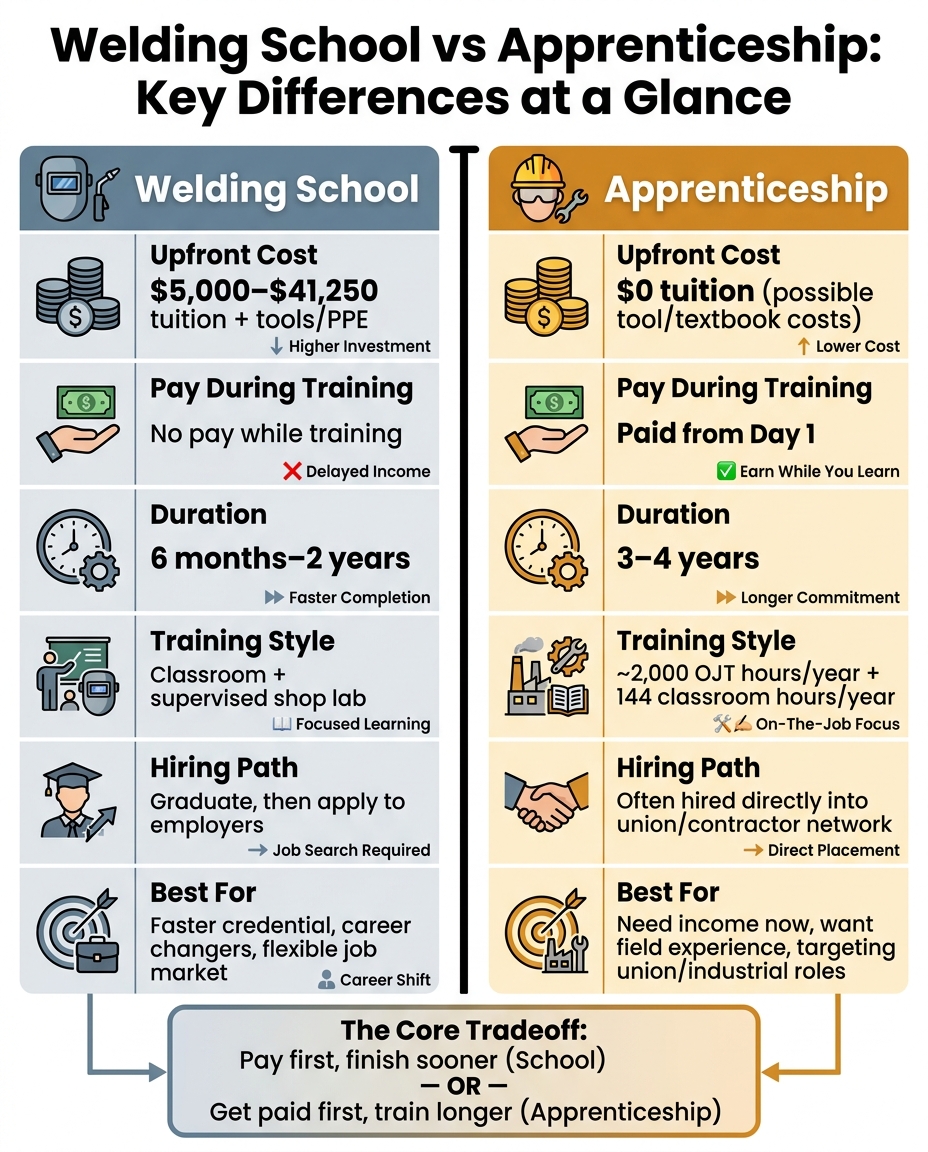
If I strip it down to one line, this is a choice between paying first to finish sooner or getting paid first and training longer.
Welding School: Structured Training With Upfront Cost
Welding schools and community colleges mix classroom lessons with hands-on shop time. You get a set path, clear instruction, and a place to practice before stepping onto a job site. The catch? You pay for that setup, and in most cases you won’t be earning while you train.
Programs usually come as certificates, diplomas, or associate degrees. A full certificate that covers several welding processes often takes 6 to 12 months to finish.
The cost can add up fast. Average tuition is about $11,439, plus around $1,348 for books and supplies. On top of that, students often need to buy PPE and basic tools before classes even begin. So the money goes out first, while wages usually wait until after graduation.
What Students Learn in School
In class, students learn the nuts and bolts of the trade: safety, metallurgy, blueprint reading, joint design, inspection, and trade math. Then the shop lab turns that book knowledge into hands-on practice.
That’s where things start to click. Students run beads, control heat input, and fix defects with an instructor watching and giving feedback. It’s a controlled setting, which matters. You can repeat the same weld again and again, clean up mistakes, and build muscle memory before the pressure of a live job site shows up.
Most programs teach the main welding processes, including:
- stick
- MIG
- TIG
- flux-core
- basic cutting
Many schools also line up their training with American Welding Society (AWS) standards. That can help students get ready for optional certification tests and employer weld tests.
When students finish, they usually leave with a certificate, diploma, or associate degree, along with paperwork they can show employers. For construction and energy companies, that paper trail can help. These employers often want welders who can read drawings, follow safety rules, and pass hands-on weld tests. School records can support that, especially when a job requires a practical test before hire.
Apprenticeships flip this model. Instead of school-first training, they put you on a job site and pay you while you learn.
Welding Apprenticeship: Paid Jobsite Training Over Several Years
If welding school starts in the classroom, apprenticeship starts on the jobsite. You get hired, work under experienced welders, and earn a paycheck while you learn. In most cases, there’s no tuition bill, although you may still need to pay for tools or textbooks.
Most welding apprenticeships in the U.S. last 3 to 4 years. They usually include about 2,000 jobsite hours and 144 classroom hours per year. The classroom portion covers welding theory, blueprint reading, safety codes, and process instruction. That training may come through union centers, community colleges, or employer partner schools, often in evening classes or week-long sessions.
These programs are usually backed by union locals, industrial contractors, and employer groups that hire for construction, energy, and heavy industrial jobs. Common sponsors include ironworkers, boilermakers, and pipefitters union locals, along with large industrial contractors and regional employer groups. The American Welding Society (AWS) also publishes national guideline standards for registered welding apprenticeships. In plain terms, the sponsor training you is often connected to the companies doing the hiring.
How Apprentices Build Skills and Wages Over Time
Apprentices don’t begin with the toughest welds. Early work often includes fit-up, tack welding, material prep, and basic SMAW or GMAW welds on structural steel or light fabrication. As they log more hours and improve, the work gets tougher. That can mean structural frames, pipe welds in refineries, shutdown and repair jobs in industrial plants, and later, welds that have to pass code under AWS D1.1 or ASME standards.
Pay usually moves up in steps based on completed hours and performance reviews.
| Apprenticeship Year | Hours Completed | Typical Wage (% of Journey Rate) | Example Hourly Pay* |
|---|---|---|---|
| Year 1 | 0–2,000 | 40–60% | ~$16/hr |
| Year 2 | 2,000–4,000 | 60–70% | ~$19–$22/hr |
| Year 3 | 4,000–6,000 | 70–80% | ~$22–$26/hr |
| Year 4 | 6,000–8,000 | 80–90% | ~$26–$29/hr |
*Based on about $32/hour at the journey level.
Apprentices also pick up jobsite discipline fast. That includes OSHA rules, hot work permits, shifting schedules, and production deadlines. School can teach process and technique. Apprenticeship teaches what it feels like when the work is live, the crew is waiting, and the weld has to meet code. That’s a different kind of readiness, and it helps explain the tradeoffs in the side-by-side comparison next.
Direct Comparison: Cost, Time, Training Mix, and Hiring Path
Here’s how the two paths compare on the points that matter most in construction and energy:
| Factor | Welding School | Apprenticeship |
|---|---|---|
| Total Cost | $5,000–$41,250 in tuition and fees | No tuition; possible tool/textbook costs |
| Pay During Training | None | Paid from day one; wages rise by year |
| Time to Completion | 6 months–2 years | 3–4 years |
| Hands-On Hours | Controlled shop practice and lab work | About 2,000 OJT hours/year |
| Classroom Hours | Heavy classroom and lab focus | 144 hours/year |
| Hiring Outcome | Entry-level job seeker after graduation | Often already attached to a contractor or union program |
The table tells the story pretty fast. School gets you in sooner. An apprenticeship lets you earn while you learn.
Cost and Pay During Training
The money difference starts right away.
With welding school, you pay upfront. Tuition and fees run from $5,000 to $41,250, and you usually won’t earn income through the program.
An apprenticeship works the other way. There’s no tuition, though you may still need to cover tools or textbooks. In exchange, you start getting paid from day one, and those wages usually go up each year.
Time to First Job and Type of Experience Gained
If your main goal is speed, school usually wins. Most programs take 6 months to 2 years, which can get you into the job market faster.
Apprenticeships take longer, usually 3 to 4 years. But that extra time comes with a lot more field time: about 2,000 OJT hours per year, plus 144 classroom hours each year.
That’s the big tradeoff. School gives you controlled shop practice and lab work. Apprenticeship puts you on live jobs, around other trades, under code rules, and on real deadlines.
School can help you land an entry-level shop role faster. But it doesn’t always move you straight into tougher industrial work. By the time an apprentice reaches journeyman status, they’ve already worked in jobsite conditions, handled coordination issues, and learned how to weld when pressure is part of the job. That kind of field background matters a lot on remote pipeline repairs and refinery shutdowns.
Hiring Channels in Construction and Energy
The hiring path is different too.
School graduates usually apply straight to contractors, fabrication shops, and staffing firms. Apprentices tend to come in through a union or employer-sponsored track, then move through that same network.
In many cases, apprentices don’t have to start from scratch after training. They often move straight into journeyman roles inside the same network.
That split leads to two pretty different career aims, which the next section covers.
Which Route Fits Different Career Goals
The right path depends on where you are right now: how much money you’ve saved, how soon you need a paycheck, and the kind of work you want to do over time.
Who Should Choose Welding School
The earlier comparison laid out the tradeoff. Here’s what that means in practice.
Welding school makes sense if you’re changing careers and can pay tuition and living costs before you start bringing in wages. It gives you structured training in core welding processes, safety, blueprint reading, and metallurgy. And it lines up with the cost and timeline points already covered.
School credentials also tend to carry well from one employer or region to another. That matters if you expect to move between contractors or shift to a different job market. If flexibility matters more to you than getting on a jobsite right away, school is often the better fit.
Who Should Choose an Apprenticeship or a Combined Path
If you need income NOW, an apprenticeship is usually the better move. You get paid from day one, and your wages go up as you log hours and hit program benchmarks.
Apprenticeships also fit people who already know which specialty they want to pursue. Programs run by unions or large contractors in structural steel, pipe welding, refinery shutdowns, and industrial maintenance build documented field experience over 3 to 4 years. By the time you reach journeyman status, you’ve worked through actual jobsite conditions, not just practice booths and lab work. That tends to fit employers and projects that care more about field-tested skill than speed.
A combined path can work well too. A short school program first can give you documented training hours, basic certifications, and enough hood time to start an apprenticeship with less of a learning curve. Workers who come in with that base often pass initial weld tests more easily and may earn trust sooner on production welds. If you’re aiming for pipeline repair, refinery shutdowns, or heavy infrastructure, pairing school credentials with apprenticeship hours can make your job profile stronger.
Conclusion: Key Differences to Remember
The main tradeoff is simple. Welding school can get you a credential in 6 months to 2 years, but you pay tuition upfront. That can range from $5,000 to $41,250, depending on the program, plus tools, gear, and living costs while you train. Apprenticeships work the other way around: you start earning from day one, and your pay goes up as you move forward. The catch is time. Reaching journeyman status usually takes 3 to 4 years.
The split isn’t just about money and timing. It’s also about how you learn.
School makes more sense if you want a set schedule, classroom lessons, and supervised lab work before stepping onto an actual job site. Apprenticeships are built around paid work in active job settings. You learn while dealing with shifting crews, changing conditions, and the day-to-day pace of the field. Most apprenticeship programs also include about 2,000 hours of on-the-job training per year.
That gap in training tends to matter most when it’s time to get hired. In construction and energy, journey-level employers often care most about logged field hours and certifications.
A short certificate can help you get into an apprenticeship more easily. For most people, the choice comes down to speed, pay, and field experience.
FAQs
Can I get hired without certifications?
Sometimes. But for most construction and energy jobs, hiring comes down to OSHA safety training, plus any role-specific licenses or equipment certifications the position calls for.
In practice, apprenticeships are the standard paid, on-the-job route. You work, build skills, and move toward the credentials the job requires at the same time. Pre-apprenticeship programs can help you get started, but employers still tend to hire people who already meet the role’s certification and compliance requirements.
How do I find a welding apprenticeship?
Start with the U.S. Department of Labor’s apprenticeship portal. It’s one of the best places to find registered apprenticeship programs in your area. You can also check local or state-backed programs, along with trade associations and unions that sponsor apprenticeships.
Pre-apprenticeship programs are a good way to build core skills before moving into a registered apprenticeship. They can help you get job-ready, pick up basic certifications, and gain early hands-on experience. Once you’ve built that base, ABLEMKR can help connect you with active, high-demand projects.
Is it smart to do school before an apprenticeship?
Yes – doing school before, or at the same time as, an apprenticeship can be a smart move.
It helps you build core skills, pick up useful credentials, and show employers that you’re serious about the trade.
Most apprenticeships take 3–5 years to reach journeyman level. The upside is simple: you get paid while you learn. That means you can build hands-on experience without the same student debt pressure that comes with a four-year college path.
Trade school or a pre-apprenticeship can also make the jump into the field a lot smoother. They can help you become job-ready, learn the basics faster, and improve your shot at getting into a registered apprenticeship.


