
If you need AM-ready workers for wind, solar, storage, or grid jobs, the path is simple: match current trade skills to AM roles, train for safety and quality, then track credentials before dispatch.
I’d sum the article up like this: 3D printing is becoming part of renewable energy work because it can cut lead times and waste. One wind blade mold study found about 50% less lead time and 25% less material waste. That means employers need workers who can run printers, read part files, handle materials, inspect parts, and work safely on energy job sites.
Here’s the full picture in plain English:
- The main AM roles are technician/operator, design engineer, process engineer, and maintenance technician.
- Workers do not need to start over. CNC operators, welders, millwrights, electricians, mechanics, engineers, and construction crews already have skills that carry into AM work.
- Training should focus on three things: machine use, safety, and quality records.
- Safety matters most with metal powders, heat, electrical systems, filtration, and lockout/tagout tied to both the printer and the energy site.
- Quality control is not optional. Workers need to track build settings, material batches, machine IDs, alarms, post-processing, and inspection results.
- Common training paths include SME, ASTM, community college certificate programs, and online university courses.
- Deployment is the last step. A worker is not job-ready until training, safety cards, and site clearances are current and easy to verify.
- The goal is a repeatable worker pipeline measured by time-to-qualification, time-to-deployment, first-pass quality, and retention.
What stood out to me is that this is not about replacing shop or field skills. It’s about adding AM skills on top of work people already know how to do. And when employers can connect training records to dispatch, they can put the right people on the right site with a lot less delay.
Underlined takeaway: <u>the article is about building a clear worker pipeline from current trade experience to trained, documented, site-ready AM labor in renewables.</u>
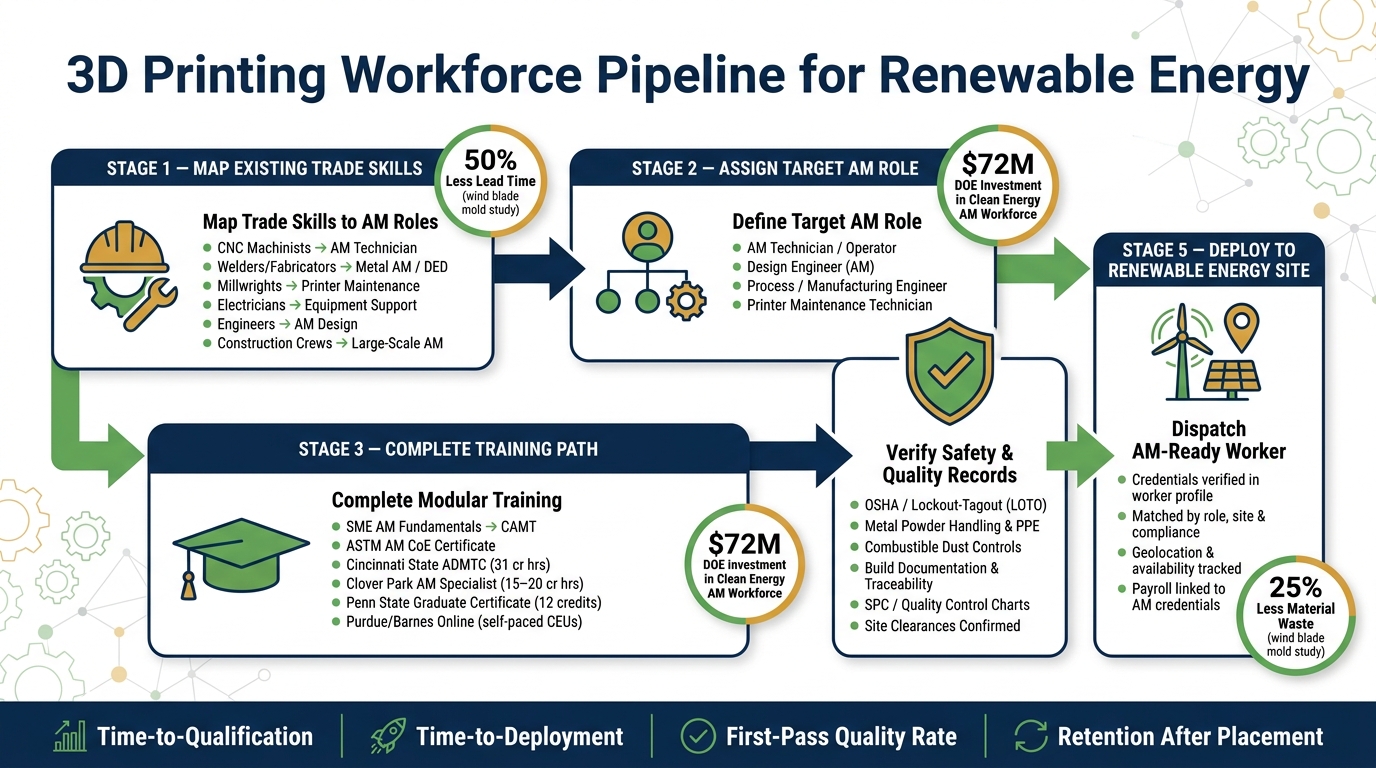
3D Printing Workforce Pipeline: From Trade Skills to AM-Ready Deployment in Renewables
Engineering Renewable Energy 3D Print Lab – Features
sbb-itb-aa28329
3D Printing Roles in Renewable Energy
In renewable energy, additive manufacturing work usually falls into four main roles. Each one connects to design, production, or keeping equipment running. That matters because these are the jobs where employers need people now, and where workers can focus their training.
Key Job Roles: AM Technician, Design Engineer, Process Engineer, and Printer Maintenance Technician
| Role | What They Do in Renewables |
|---|---|
| AM Technician / Operator | Runs printers, prepares build files, manages materials, monitors builds, and handles basic post-processing. |
| Design Engineer for Additive Manufacturing | Designs parts for additive manufacturing, including lattices, cooling channels, and consolidated assemblies. |
| Process / Manufacturing Engineer (AM) | Owns build strategy, parameters, throughput, cost, and qualification of new materials and processes. |
| Printer Maintenance Technician | Maintains printers, calibrates systems, and troubleshoots mechanical and filtration issues. |
Sandia‘s AMSIT project showed what this can look like in practice: printed blade-tip sections that combine erosion and lightning protection in one part. That’s a good example of why AM in renewables isn’t a one-person job. It takes design, production, and maintenance people working together.
How Existing Trade and Manufacturing Skills Transfer to AM Roles
The shortest path into these jobs often starts with skills people already use in plants, shops, and field work. So instead of starting from scratch, many workers can build on what they already know.
CNC machinists are a close match for AM technician roles. They already work with machine-code instructions, fixturing, tolerances, and dimensional inspection, which line up well with build setup and file prep.
Welders and fabricators bring metallurgy, heat control, and distortion control. Those skills matter a lot in metal AM post-processing and directed energy deposition equipment.
Millwrights and industrial mechanics fit well in printer maintenance roles because industrial AM systems use many of the same mechanical systems they already repair and service.
Electricians and controls technicians have a clear route into equipment support and in-process monitoring. Their background in PLCs, sensors, and power systems carries over well.
Mechanical engineers already in energy can move toward AM design work by adding training in topology optimization, AM design rules, and process-aware design.
Construction craft workers also have a place here. Experience with site logistics, heavy equipment, and safety procedures becomes more useful as large-scale concrete and polymer printing moves into wind turbine towers, foundations, and infrastructure pads.
Put simply, trade and manufacturing experience is the base layer for AM upskilling.
Core Skills, Safety, and Quality Requirements
The roles above come down to three training needs: technical operation, safety, and quality control.
Technical Skills: CAD Basics, Machine Parameters, Materials, and Post-Processing
Technicians don’t need to be design engineers. But they do need to read CAD files, dimensions, tolerances, and GD&T for parts such as turbine brackets or inverter housings.
Build orientation matters more than it may seem at first glance. It changes surface finish, support needs, build time, and even mechanical properties. That means operators need to choose setups that match the part’s load and finish needs. Support planning also matters. Workers need to decide where supports should go to prevent warping or distortion, and they need to think ahead about how those supports will be removed later. Those calls affect parts that face wind loads, vibration, or temperature cycling.
Layer settings also depend on the job. Thicker layers can work for non-critical mounting plates. But sealing surfaces on battery or hydrogen parts need finer resolution. Workers should follow standard work instructions, run sample builds, and check machine feedback such as melt pool data or extrusion pressure so they can catch problems early.
Post-processing is where most AM parts become usable. Machining, heat treatment, or surface finishing is often needed before installation. Workers should check critical dimensions with calipers, micrometers, and gauges. They also need to know why stress relief or aging cycles matter for metal parts used in rotating or pressure-bearing service. Blasting, tumbling, and coating can improve corrosion resistance and fatigue life for parts exposed to outdoor conditions or harsh service.
Material handling is a day-to-day skill, not a side task. Engineering polymers such as PA12 and PEEK need proper drying and storage to avoid moisture-related defects. Fiber-reinforced composites need close attention to print direction because fiber orientation changes stiffness under load. Metal powders such as 316L stainless, Inconel 625, and titanium alloys call for careful handling. Powder batch traceability, sieving procedures, and inert-gas handling are all part of the work.
Safety Training for Industrial Printers and Energy Facilities
AM safety is a core competency. Training should cover mechanical hazards, electrical systems, thermal exposure, airborne particles, PPE, hazard communication, SDS use, and lockout/tagout.
Metal powder handling carries the most risk during transfer, cleaning, and maintenance, when dust can become airborne. Workers need training on combustible dust controls, including:
- proper grounding
- explosion-proof vacuums
- HEPA filtration
- spill management that avoids compressed air or dry sweeping
On U.S. energy sites, AM safety training can’t sit in its own lane. LOTO procedures for printers need to account for all energy sources – electrical, thermal, pneumatic, and inert gas pressure – and they need to fit the site’s safety program. At a solar or wind facility, that also means coordinating with nearby live DC systems or high-voltage transmission equipment. Job hazard analyses and standard operating procedures should reflect both the AM equipment and the surrounding energy infrastructure.
Quality Control, Traceability, and Production Documentation
Documentation shows whether a part is ready to install.
Job travelers should stay with every build and record part identifiers, material batch numbers, machine ID, operator name, build parameters, and references to the right work instructions. Build reports should also record environmental conditions, any parameter deviations, alarms during the build, and post-processing steps, along with timestamps and the people responsible.
Workers should be able to spot incomplete fusion, delamination, warping, and cracks, then escalate defects fast. Familiarity with process monitoring data, such as build logs or layer imaging, helps technicians link machine anomalies to possible part issues before those issues reach inspection.
For multi-site renewable projects, consistent statistical process control (SPC) practices make a big difference. Operators should record key characteristics such as critical dimensions, surface roughness, or build time, and plot them on control charts. They also need to recognize out-of-control signals, like points outside control limits or sustained trends, and know the defined response – whether that’s machine maintenance, powder refresh, or parameter adjustment. Those are the competencies employers should map to certifications and short-course training.
These skills set up the training roadmap in the next section.
Training Programs, Certifications, and Upskilling Roadmaps
Those skills often need proof. That usually means a credential. From there, the goal is simple: match the right training to the jobs employers need filled right now.
Industry-Recognized Certifications and Certificate Programs
Start with credentials that line up with the target role.
The SME Additive Manufacturing pathway begins with Fundamentals and can lead to the Certified Additive Manufacturing Technician (CAMT) credential. It covers process methodology, materials, post-processing, and safety.
The ASTM AM CoE Professional Certificate Course in Additive Manufacturing is a good fit for process, quality, and engineering roles.
Community college programs can help people build job-ready skills through hands-on lab work. Cincinnati State‘s Additive Manufacturing Technician Certificate (ADMTC) covers equipment operation, troubleshooting, metals, thermoplastics, and safety. Clover Park Technical College‘s Additive Manufacturing Specialist Certificate offers stackable, technology-specific tracks in DED, FFF, PBF, or SLA.
If someone needs a self-paced online option, the Purdue University & The Barnes Global Advisors Online Additive Manufacturing Certificate Program awards CEUs per course and fits working professionals. For engineers moving into AM design or R&D, the Penn State World Campus Additive Manufacturing and Design Graduate Certificate is a 12-credit online option.
| Program | Target Role | Prerequisites | Duration | Delivery Mode | Primary Focus |
|---|---|---|---|---|---|
| SME Additive Manufacturing Fundamentals | Entry-level AM technician | Basic manufacturing literacy | Weeks of self-study | Exam | AM fundamentals |
| SME Certified Additive Manufacturing Technician (CAMT) | AM technician / production support | Associate degree in AM or related field, or 1+ years of manufacturing experience | Up to 6 months from application | Online proctored exam | Process methodology, materials, post-processing, safety |
| ASTM AM CoE Professional Certificate Course in Additive Manufacturing | Process and quality roles | Varies | About 1 month | Online or in-person | Full AM process chain, quality assurance, documentation |
| Cincinnati State Additive Manufacturing Technician Certificate (ADMTC) | AM technician | Varies by institution | About 31 credit hours | In-person with labs | Equipment operation, troubleshooting, metals, thermoplastics, safety |
| Clover Park Technical College Additive Manufacturing Specialist Certificate | AM specialist | Varies by institution | 15–20 credit hours | Lecture + lab | Stackable, technology-specific AM skills |
| Penn State World Campus Additive Manufacturing and Design Graduate Certificate | AM design engineer / R&D | Bachelor’s degree in engineering | 12 credits | Online | AM design, materials, process planning |
| Purdue University & The Barnes Global Advisors Online Additive Manufacturing Certificate Program | Engineers, managers, business professionals | Varies; geared to professionals | Self-paced | Online | AM fundamentals |
Used the right way, these programs can move workers from basic awareness to hands-on, job-ready practice.
Step-by-Step Upskilling Roadmaps for Incumbent Workers
Train first, then test. A staged path works well here: short awareness training first, then a formal certificate, then a national credential. That gives workers a way to build job-ready AM skills without taking a multi-year detour.
| Starting Role | Training Path | Target AM Role |
|---|---|---|
| Field construction / maintenance | CAD and 3D printing intro → community college AM technician certificate (Cincinnati State ADMTC or Clover Park) → SME Fundamentals → CAMT → NOCTI–America Makes Additive Manufacturing Essentials, a foundational AM skills credential | AM technician in a renewable energy facility |
| Machinist / CNC operator | Online AM fundamentals → design for additive manufacturing (DfAM) intro → CAMT preparation → ASTM AM CoE Professional Certificate Course in Additive Manufacturing | AM process engineer / advanced technician |
| Mechanical or electrical engineer | DfAM-focused training → Penn State World Campus Additive Manufacturing and Design Graduate Certificate → ASTM AM CoE Professional Certificate Course in Additive Manufacturing; America Makes AMTrain modules | AM design engineer in a renewable OEM |
| Production supervisor | ASTM AM CoE Professional Certificate Course in Additive Manufacturing → America Makes AMTrain and micro-learning modules | AM production supervisor / quality lead |
These paths tend to work best when credentials connect to verified worker records and job-site readiness. The next section shows how ABLEMKR can track those credentials and deploy AM-ready workers.
Using ABLEMKR to Track Credentials and Deploy AM-Ready Workers
After training and certification, the next step is deployment. That’s where things can slow down fast. If employers can’t verify AM credentials and send qualified workers where they’re needed, deployment becomes the bottleneck.
Connecting Training Records, Safety Compliance, and Job-Site Readiness
ABLEMKR can keep each worker’s AM credentials, safety records, and site clearances in one profile. That includes certificates, OEM training, OSHA, lockout/tagout, and site orientation, along with issue and expiration dates.
When a project opens, a supervisor can filter workers by role, site, and compliance status in seconds. No digging through spreadsheets. No guessing who’s cleared to go.
With credentials in one place, dispatchers can sort workers by role, site, and compliance status just as fast. Say an outage calls for a metal 3D-printed replacement bracket and a crew has to be on-site within hours. ABLEMKR’s geolocation and availability tracking help dispatchers find the closest AM technicians who are both qualified and compliant for that site.
If a worker has a lapsed certification, like an expired confined-space entry card, the system flags that person as not deployable until retraining is done. That keeps unqualified workers off-site and cuts down on last-minute surprises.
ABLEMKR also connects credentials to dispatch and payroll. AM-credentialed technicians are matched to roles based on verified training, and payroll reflects those assignments directly.
A simple workflow looks like this:
- Map AM credentials in ABLEMKR
- Build role profiles
- Dispatch matched crews
- Log field performance
Conclusion: Build a Repeatable Pipeline for 3D Printing Talent in Renewables
Once roles, skills, training, and deployment are set, the next move is simple: turn all of it into a repeatable pipeline.
Renewables need AM-ready workers now. And employers don’t need scattered, one-time classes. They need a training system they can run again and again. The best place to start is by mapping each trade background to the right AM role, then building a modular upskilling path from there using the roadmaps and credentials covered in this guide.
Training also has to do more than teach skills. It needs to produce workers who are safe, qualified, and ready for renewable job sites. That means readiness can’t be assumed. It has to be checked before placement. Credentials, safety compliance, and site clearances all need to be confirmed. The DOE‘s $72 million investment in clean energy advanced manufacturing workforce training shows that this kind of workforce infrastructure is being built at scale.
Deployment falls apart if no one can see who’s ready. ABLEMKR stores credentials, safety status, availability, and location in one worker profile, so managers can find and dispatch qualified AM technicians fast. That kind of visibility turns training into deployable labor.
A few metrics make it easier to see if the pipeline is doing its job:
- Time-to-qualification
- Time-to-deployment
- First-pass quality
- Retention after placement
When those numbers improve, the pipeline is working.
FAQs
How long does it take to become AM-ready?
There’s no single timeline for becoming AM-ready. Training can be as short as a boot camp or focused module, or as long as a multi-year program.
A lot of renewable energy credentials can be earned in a matter of weeks or months, which makes them a solid option if you want to keep working while you train. If you want deeper prep, apprenticeships usually take 2 to 5 years and blend classroom instruction with hands-on work.
Which trades transfer best into 3D printing roles?
Workers from energy, construction, and utility jobs often bring the best crossover skills for 3D printing roles in renewables.
That includes electricians, mechanical maintenance workers, general laborers, power-line crews, and equipment operators. They already know how to work with tools, follow job-site rules, and handle technical systems. With targeted training and apprenticeships, many can move into these roles without starting from scratch.
What credentials matter most before site deployment?
Before site deployment in renewable energy, workers need to put safety and role-specific certifications first. That’s what helps them meet compliance requirements and avoid problems once work begins.
The baseline credential is an OSHA-10 or OSHA-30 construction safety card.
For more specialized roles, the main credentials include:
- NABCEP PV Associate for solar
- GWO Basic Safety Training for wind
- Any required state electrical licenses
- Records of completed training modules or apprenticeship hours
It’s pretty simple: the base safety card gets you in the door, and the role-based credentials show you’re cleared for the job you’re there to do.


