
Construction waste can drain profit, slow the job, and cause compliance issues fast. In the U.S., C&D debris reached 600 million tons in 2018, and many contractors still lose 5% to 15% of materials on a job. For a contractor doing $3 million a year, that can mean roughly $126,000 to $144,000 lost each year.
If I want to cut waste, I keep the plan simple:
- Measure what leaves the site
- Set a diversion goal and a field KPI
- Write a job-specific waste plan
- Train every crew before work starts
- Use separate bins and clear signs
- Track tickets, contamination, and hauling costs
- Review results after closeout and fix weak spots
Waste control is not just about dumpsters. It affects material spend, tipping fees, schedule flow, site safety, and LEED or local diversion targets like 50% to 75%, with some places such as California requiring 65% on covered projects.
A few numbers make the case fast: mixed debris loads often cost more than sorted loads, separated streams can cut disposal costs by 30% to 50%, and one large contractor cut waste intensity from 4.1 to 2.8 kg per sq. ft. across 50 sites, saving $2.4 million in hauling costs.
Here’s the short version: I start with a waste audit, focus on the heaviest and most expensive materials, set up the site so sorting is easy, assign one person to own the data, and use post-job reviews to tighten estimating, ordering, and crew habits on the next project.
This guide breaks that process into clear steps you can use on active U.S. job sites.
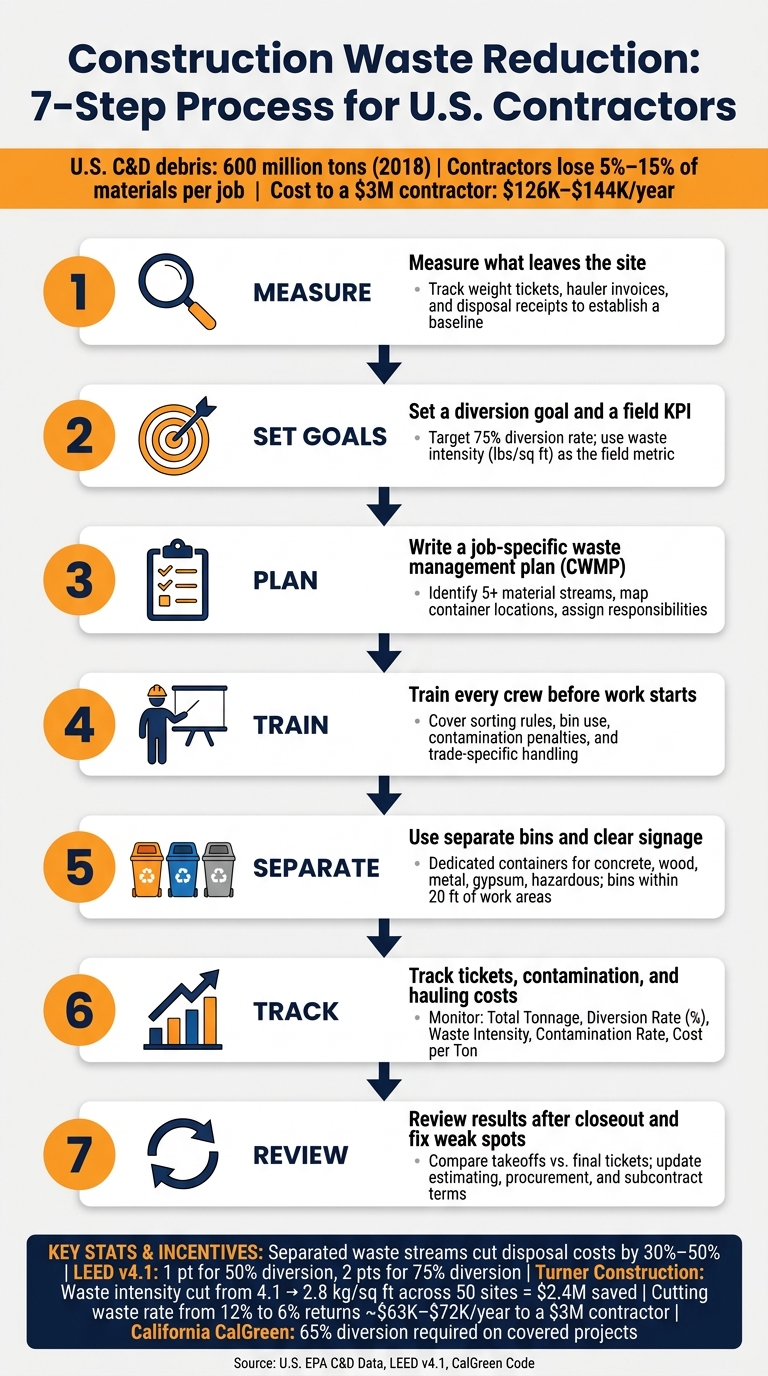
Construction Waste Reduction: 7-Step Process for U.S. Contractors
How To Reduce Waste On A Construction Site
sbb-itb-aa28329
Know Your Waste Stream and Set a Baseline
Before you try to cut waste, get clear on what your job site is throwing away and what that waste is costing you.
Common C&D Waste Types on U.S. Job Sites
On most U.S. construction and demolition job sites, concrete and asphalt dominate by weight. Nationally, they often make up more than 70% of total C&D tonnage. Metals take up less space in the overall waste mix, but they can be some of the best materials to separate because steel, copper, and aluminum can be sold to scrap yards.
The most expensive problem is usually mixed or contaminated loads. If wood scraps, drywall, and packaging all get tossed into one container, the entire load may be billed at a higher landfill tipping rate. In some cases, the load can be rejected altogether. Hazardous materials, including asbestos and lead-based paint, are handled under a different set of rules. They need certified handling and do not move through normal recycling channels.
| Material Type | Typical Share of Total Waste | Main Reuse or Recycling Options |
|---|---|---|
| Concrete & Asphalt | >70% | Crushed for aggregate, road base, or fill |
| Wood/Lumber | Project-dependent | Salvaged for blocking/bracing, chipped for mulch, or biomass fuel |
| Metals (Steel, Copper, Aluminum) | Low volume / High value | Sold to scrap yards for revenue |
| Drywall (Gypsum) | Common on many jobs | Recycled into new drywall or used as soil amendment |
| Masonry/Brick | Common on many jobs | Crushed for fill or cleaned for architectural reuse |
| Cardboard/Packaging | Low weight / High volume | Standard recycling streams |
| Hazardous materials | Variable | Certified disposal only |
U.S. Regulations, Local Rules, and LEED Requirements
Once you know what is in the waste stream, line that up with the rules that govern disposal and diversion. At the federal level, the main focus is hazardous materials. Diversion targets usually come from state and local rules, plus LEED job requirements.
California’s CalGreen Code is one clear example. It requires at least 65% diversion of C&D waste on covered projects. Across the U.S., many cities and counties set their own targets, often somewhere between 50% and 75%. Some also ban certain materials, such as clean wood, cardboard, and metals, from landfills.
For LEED projects, the targets are straightforward. LEED v4.1 awards 1 point for 50% diversion and 2 points for 75% diversion. To earn those points, the project needs a formal Construction Waste Management Plan (CWMP) that identifies at least five separate material streams. The paperwork matters just as much as the bins on site. You need to collect weight tickets, hauler receipts, and facility diversion reports throughout the job, and some project specs include financial penalties if contractors miss diversion goals.
Before you bid, check that your hauler can provide the weight tickets and diversion reports the project calls for. Finding out halfway through the job is an expensive mess to clean up.
With the rules mapped out and the material streams sorted, the next move is to turn that info into a job-specific plan.
How to Audit Waste and Build a Baseline
A waste audit usually starts with records you may already have on hand:
- Weight tickets from past jobs
- Container pickup logs
- Hauler invoices
- Disposal receipts
From there, figure out cost per ton by material type and look at which phases of the job are producing the most waste.
Diversion rate = (Total Waste Diverted ÷ Total Waste Produced) × 100.
Run that figure by phase of work and the weak spots tend to show up fast. For example, concrete recycling rates have reached 75% in major U.S. metro areas. If your concrete diversion is well under that mark, there’s likely room to tighten up your process. Contamination is another big issue. When recyclable material gets mixed with trash, it can become unusable and push fees higher.
It also helps to put one person in charge of waste data and training records. ABLEMKR can support that workflow. The payoff can be large. One contractor example shows how much this can change the numbers: Turner Construction cut waste intensity from 4.1 to 2.8 kilograms per square foot across 50 sites in 12 months, saving $2.4 million in hauling costs.
Use that baseline to set job-specific diversion goals and tracking targets.
Build a Project-Specific Waste Reduction Plan
Set Clear Goals and Pick the Right Metrics
Start with the audit baseline and set two simple targets: one project target for owners and one field metric for the superintendent. Focus first on the waste streams that cost the most in the baseline audit. For the overall project target, use 75% diversion unless the contract or local rule requires a higher number. For superintendents, waste intensity, measured in lb per square foot, is usually easier to use day to day. Other useful KPIs include total waste tonnage and disposal costs as a percentage of total project value.
Keep disposal cost in plain view by tracking it against material purchases. That makes waste easier to spot in the budget, instead of letting it hide in a single line item.
Once the targets are set, bake them into preconstruction choices and subcontract terms.
Stop Waste Before Work Begins
Most waste gets locked in before the first crew shows up on site. That’s why preconstruction matters so much. If you want to cut waste, this is where the big moves happen.
| Prevention Method | Planning Effort | Typical Cost Impact (USD) | Potential Reduction |
|---|---|---|---|
| Prefabrication | High | Initial investment; long-term labor savings | Up to 40%–90% |
| BIM Optimization | Medium to High | Software/training costs | 15%–32% |
| Standardized Dimensions | Medium | Neutral to savings | 10%–15% |
| Accurate Takeoffs | Low to Medium | Savings on procurement | 5%–10% |
| Staged/JIT Deliveries | Low | Potential small delivery fees | Reduces damage and theft waste |
| Design for Deconstruction | High | Higher design cost; offset by salvage value | 30% more material recovery |
Use this table to rank the prevention methods that give the best return for the job at hand.
BIM, prefabrication, and design for deconstruction help cut rework and off-cuts because they move more work into controlled conditions. That usually means fewer mistakes, less damage, and less material heading straight to the dumpster.
From there, turn those choices into site rules, crew responsibilities, and pickup schedules.
Write the Waste Management Plan, Contracts, and Staffing Model
A Construction Waste Management Plan (CWMP) takes project targets and turns them into rules people can actually use on site. At a minimum, the CWMP should identify target materials and diversion rates, map container locations, use picture-based signage for multilingual crews, separate hazardous handling, and assign responsibility for ticket and receipt collection.
A plan on paper won’t do much if the field team can’t follow it. Name a Waste Management Coordinator before the job starts. This person manages bins, schedules pickups, tracks diversion data, and catches contamination early.
Put diversion targets, sorting rules, and back-charge terms right into subcontract language.
Assign the coordinator before mobilization.
Execute Waste Reduction on Active Job Sites
With the baseline and CWMP in place, execution comes down to daily control in the field.
Train Crews and Assign Waste Responsibilities
Once the CWMP is set, every crew needs plain, job-site rules. Train each trade on sorting, bin use, and contamination penalties before work begins.
Use orientation, phase-based toolbox talks, and subcontractor enforcement to reinforce the rules as new trades arrive. Check dumpsters every day and trace contamination back to the trade that caused it, so the team can fix the issue fast.
The table below shows who owns what and what each role should focus on during training:
| Job Role | Waste-Related Duties | Recommended Training/Focus |
|---|---|---|
| General Contractor | Implementing the construction waste management plan, coordinating haulers, submitting diversion reports to owners | Regulatory compliance, LEED documentation |
| Site Superintendent | Enforce sorting procedures daily, manage bin placement, coordinate trades | Site logistics, safety/waste integration |
| Waste Coordinator | Check bins for contamination, log weight tickets, schedule pickups | Material identification, hauler management |
| Subcontractor/Foreman | Ensure their trade sorts correctly and completes daily cleanups | Trade-specific material handling and sorting rules |
| Laborer | Sort materials, clean work areas, maintain bins | Toolbox talks, visual aid recognition |
ABLEMKR can track training completions, so waste-related roles are approved before mobilization.
Set Up Containers, Material Flow, and Storage Controls
Bin placement matters just as much as bin count. Put containers close to the main work areas – within about 20 feet – so crews are less likely to toss material into the nearest mixed-waste container.
Use the bin color system and signage listed in the CWMP. At each container, post photos that show what can and cannot go inside. That small step can save a lot of sorting trouble later.
Set aside separate bins for high-volume streams such as concrete, clean wood, scrap metal, plasterboard, and hazardous materials. Sites that separate these streams on a steady basis can cut disposal costs by 30% to 50% compared with using one mixed-waste skip. Keep plasterboard dry and separate. If it gets mixed with biodegradable waste in a landfill, it can produce hydrogen sulfide gas.
Use the layout below as a starting point for labels and storage:
| Waste Stream | Recommended Container/Storage | Key Signage/Labeling Needs |
|---|---|---|
| Inert (Concrete/Brick) | Heavy-duty open-top skip | "Clean Masonry Only" with photos |
| Timber/Wood | Dedicated bin; keep dry | "Untreated Wood Only" – distinguish from treated lumber |
| Scrap Metal | Secure, smaller bin | "Metal Only" – list copper, steel, aluminum |
| Plasterboard/Gypsum | Covered bin | "No Mixed Trash" – highlight moisture risk |
| Hazardous Waste | Locked, UN-approved containers | "Hazardous Materials" – restricted access warnings |
| Salvageable Items | Clean, dry palletized area | "For Reuse/Donation" – do not discard |
Pull bins before they overflow. Overfilled containers lead to more contamination and more safety problems. Mobile apps can help crews upload photos of haul tickets and bin contents in real time, which keeps the project ready for LEED review or local compliance checks.
Cut Waste Through Daily Work, Reuse, and Salvage
Just-in-time delivery helps keep materials from sitting out on site, where weather, theft, and traffic can turn usable stock into waste. Order cut-to-length lumber and modular parts when possible to trim off-cuts.
Short cleanups after each task work better than one big cleanup at the end of the shift. When crews clean as they go, materials stay easier to sort and recover.
For demolition work, salvage before you swing. Coordinate with local salvage groups to remove doors, fixtures, and millwork before general demolition starts. On large projects, crush concrete on site to replace purchased fill and cut hauling costs.
Log contamination, salvage, and diversion data every day so the numbers can be compared with the baseline in the next section.
Track Results, Fix Weak Spots, and Apply What Works to Future Projects
Measure Waste Quantities, Diversion Rates, and Total Cost
Collect and digitize every weight ticket. That keeps the project ready for LEED reviews and local inspections. Then compare actual tickets against your baseline and CWMP targets to see if the plan held up in the field.
Five metrics give the clearest view of site performance:
| Metric | Best Use Case |
|---|---|
| Total Tonnage | Regulatory compliance and basic reporting |
| Diversion Rate (%) | Green building certifications |
| Waste Intensity (lbs/sq ft) | Benchmarking across projects |
| Contamination Rate | Training crews and managing subcontractors |
| Cost per Ton | Budgeting and financial auditing |
These numbers can pay off fast. Cutting waste rate from 12% to 6% can return about $63,000 to $72,000 per year to a $3 million contractor.
Use Post-Project Reviews and Training Data to Improve
After the job wraps, compare takeoffs with final tickets. That gap can tell you a lot. It shows where estimating, ordering, or cut-planning went off track. It also helps you spot sorting problems that looked small in the moment but added up over the project.
Keep the review centered on three trouble spots:
- Estimating
- Procurement
- Field sorting
Look closely at which trades caused the most contamination or rework waste. If the same subcontractor keeps showing up in the data, that’s not only a training problem. It’s a contract problem too. Build diversion targets and contamination penalties into future subcontracts based on what the review shows.
"By analyzing the data, contractors can see where their estimating assumptions differed from reality and identify areas for improvement. This feedback loop allows the company to refine its future waste management strategies."
- Nektar
Conclusion: What Contractors Should Standardize Going Forward
Treat every project review like an update to your playbook for the next job. Waste reduction works best when the process is clear from the start: know your waste stream, set measurable goals before work begins, prevent waste during preconstruction, train every crew on sorting and job duties, set up the site for clean separation, and track performance against the baseline through the full project.
The contractors that do this well don’t treat waste control as a one-off task. They build it into planning and field work. For firms running multiple U.S. projects at the same time, that means using standard templates, updating estimating spreadsheets after every job, and putting trained people in waste-heavy roles from day one.
FAQs
What waste should I track first?
Start with a waste audit. That gives you a clear picture of the main waste streams in each phase of the project. Begin with high-volume materials like concrete, brick, and soil so you can set a baseline fast.
Then track a few key items:
- materials that often get contaminated, like packaging and recyclables
- your waste diversion rate
- disposal costs as a share of total project value
Use hauler tickets, receipts, and internal logs to keep tabs on results and make changes when needed.
How do I set a realistic diversion goal?
Use a data-driven approach that fits your project scope and the materials on-site. Start with an audit to estimate total waste by volume and weight, check whether you need to meet certification standards like LEED, and make sure local recycling facilities can take each debris stream.
Put the focus on heavy materials first, especially concrete, masonry, and metal. Then set a clear target, such as the percentage of total weight diverted from landfills. From there, track actual results against your baseline and adjust as needed.
Who should own waste tracking on site?
The property owner carries final liability. But on most job sites, the general contractor handles day-to-day waste tracking.
That’s why the Construction Waste Management Plan needs clear role assignments from the start.
Someone has to own the process, including:
- Monitoring bins
- Coordinating pickups
- Reviewing hauler tickets
On larger projects, inspectors may also help verify compliance and keep audit trails in order.


