
If crews miss seismic details in the field, the design can fail where it matters most: on the jobsite. I’d boil this article down to one system: train by task, check the work before it gets covered, and keep records that match each inspection point.
Here’s the short version:
- Start with site safety first. Every worker should know Drop, Cover, and Hold On, evacuation routes, collapse zones, aftershock steps, and who can order shutdowns.
- Teach the “why” behind the detail. Crews don’t need engineering theory, but they do need to know why load paths, rebar spacing, embedment depth, and bracing layout cannot be changed in the field.
- Train by trade, not with generic talks. Rebar crews, steel crews, anchor installers, and MEP teams each need instruction tied to the exact drawings and details they will build.
- Use hands-on practice, not talk alone. In one cited training program, substructure knowledge went up 231%, foundation implementation scores improved 196%, and ground improvement understanding increased 189%.
- Set hold points before work disappears. The article focuses on checks at pre-work, installation, pre-pour, and final closeout so errors are found before they turn into rework or failed inspections.
- Match each check to proof. Use photos, torque logs, layout checks, pre-pour forms, inspection reports, and certification records so closeout does not become a paper chase.
- Keep worker status current. If a certification lapses, that worker should not be assigned to seismic-critical tasks until the record is fixed.
What I like about this piece is that it stays practical. It is not about theory-heavy seismic design. It is about how foremen, supers, and crews can turn drawings into field instructions, then prove the work was installed the right way.
That’s the whole message of the article: train, verify, document.
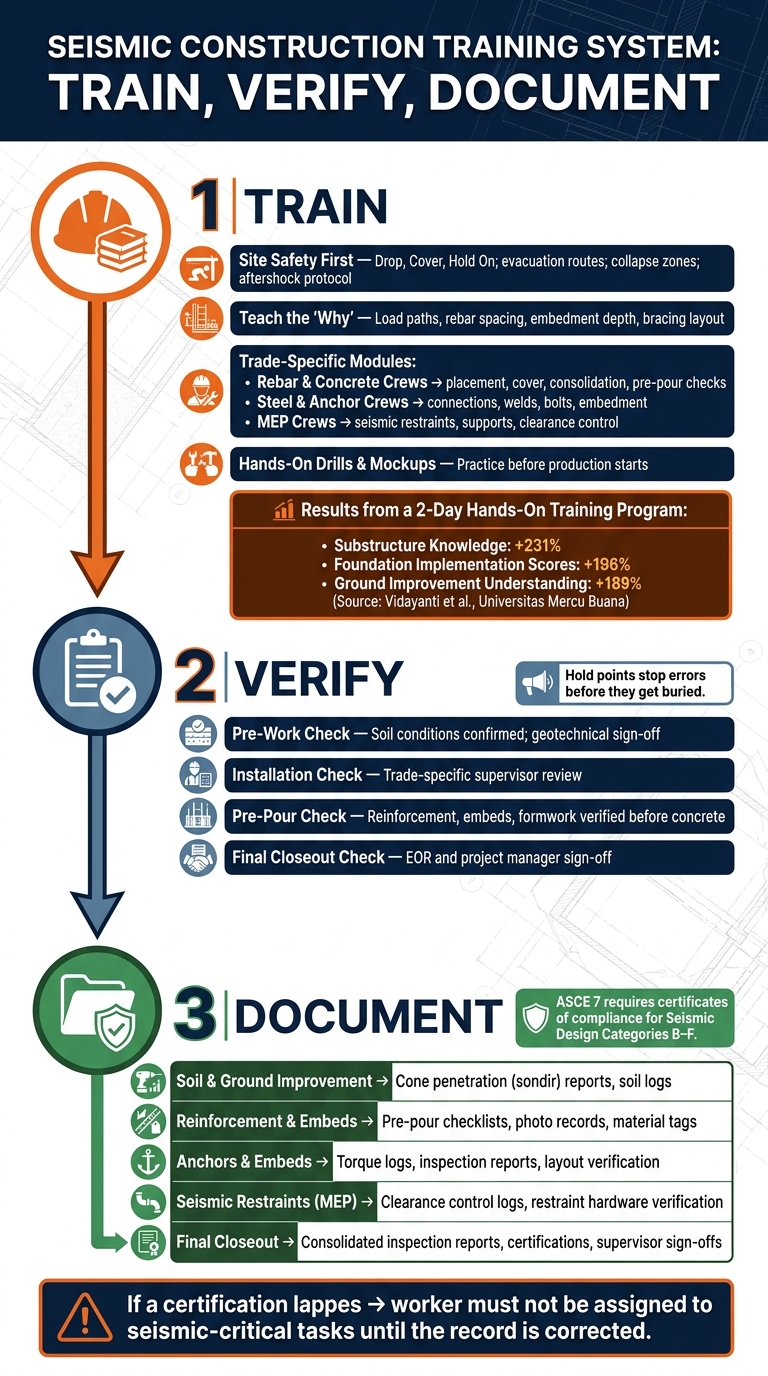
Seismic Construction Training System: Train, Verify, Document
Start with crew safety basics and seismic field concepts
Teach earthquake emergency actions before work starts
Every worker should know the emergency actions before the job starts. The first one is simple and non-negotiable: Drop, Cover, and Hold On. Drop to your hands and knees, cover your head and neck under a sturdy surface, and hold on until the shaking stops. As OSHA says, "Responding quickly and automatically may help protect you from injury." That kind of response comes from practice, not from hearing it once in a toolbox talk.
Before work begins, crews should also be clear on three site-specific points:
- Know the designated cover points and the clear areas away from glass, stored materials, and overhead hazards.
- Identify collapse zones near building entrances, where falling debris can hit workers.
- Follow the post-shaking sequence: check for injuries, expect aftershocks, and treat broken gas lines and damaged electrical systems as fire hazards.
If the site needs to be evacuated, use stairs, not elevators. Assign named people to handle post-shaking headcounts and equipment shutdowns, or use modern construction staffing to ensure you have reliable leads for these roles. Crews should also know exactly who has shutdown or evacuation authority on site. No guesswork. No mixed signals.
Explain the seismic concepts crews must build correctly
Workers don’t need to think like engineers. But they do need to understand why some details can’t be skipped, swapped, or "fixed later" in the field. The best way to teach that is to tie each rule to the part of the building it protects.
| Seismic Concept | What It Means in the Field |
|---|---|
| Ductility | Structural members can deform without sudden failure, so crews must install the specified details exactly. |
| Continuous load path | Walls, floors, and foundations must stay connected so forces can move through the structure without a break. |
| Reinforcement detailing | Rebar placement and spacing are controlled by the design, not by guesswork in the field. |
| Anchorage and embedment | Anchor bolts and similar fasteners need the specified embedment depth for the load they are meant to carry. |
| Bracing behavior | Diagonal braces must be installed as designed to handle both tension and compression. |
These ideas shape the installation details crews will practice next.
Convert drawings into clear worker instructions
Seismic drawings are made for engineers. Foremen have to turn them into directions crews can use on the job.
A simple way to do that is to pull the plan views, sections, and detail sheets tied to each task, then build a short checklist with the items that matter most: dimensions in feet and inches, required tolerances, hold points where work stops for supervisor signoff, and escalation steps for field conditions that don’t match the drawings. A hold point before a concrete pour, for example, lets the foreman check reinforcement placement before that detail disappears for good.
Foremen should have each worker repeat the dimension, tolerance, and hold point before starting. That small step helps make sure the drawing didn’t stay on paper.
Once crews understand the emergency response and the core seismic terms, the next step is trade-specific training on the exact installation work each crew will perform.
sbb-itb-aa28329
Earthquake Resistant Design Concepts Part A: Basic Concepts and an Intro to U.S. Seismic Regulations
Train by trade task so crews can execute details correctly
Once crews know the core seismic terms, the next step is simple: train them on the exact tasks they’ll install. That means trade-specific modules built around the work in front of them, with clear steps, tolerances, and inspection points.
Rebar and concrete crews: placement, cover, consolidation, and pre-pour checks
For rebar and concrete crews, the focus is on getting placement right before concrete covers anything up. Rebar crews must verify bar placement, spacing, and cover against the structural drawings before placement. Chairs and supports also need to keep the reinforcement in the correct position the whole time.
Before each pour, the foreman should inspect the forms and check embeds, formwork, and reinforcement, especially in congested areas. Those packed sections can be tricky. If consolidation isn’t done with care, the concrete may not fill the space as intended, or the steel can shift out of place. That’s why a pre-pour supervisor sign-off matters. It confirms the detail was checked before it gets buried.
The same task-by-task method applies to structural steel and anchor work.
Steel and anchor crews: connections, welds, bolts, and embedment
Steel and anchor crews need to verify anchor embedment, bolt installation, and weld requirements against the approved drawings. No connection should be released until it matches the specified detail. Close enough doesn’t cut it here.
Supervisors should confirm the required connection details are in place before the scope moves to the next crew. That check helps stop small misses from turning into expensive fixes later.
MEP crews: seismic restraints, supports, and clearance control
MEP crews need a separate module because piping, conduit, and equipment often fail in earthquakes. Their training should focus on approved restraints and the inspection points used to confirm proper installation.
Crews should follow the approved details for their scope, then verify the work with a hands-on check and supervisor sign-off. In plain terms, don’t just assume it looks right from a few feet away. Put eyes and hands on the install.
Use these task checks as the basis for drills and supervisor sign-off.
Run drills, verify competency, and document readiness
Use toolbox talks and hands-on mockups
A briefing by itself doesn’t show that a crew can build a detail the right way. The only way to know is simple: watch them do the work.
Start each shift with a short toolbox talk tied to that day’s scope, like anchor placement, brace installation, or congested rebar assemblies. Keep it tight and tied to the task right in front of the crew. Then move straight into a live mockup or hands-on demo before production starts. That’s where crews catch and fix mistakes early, before those mistakes show up in installed work. Use the exact same task the crew will handle on that shift.
One two-day integrated training program used participatory, hands-on methods to train construction workers on seismic substructures. The results were hard to ignore: substructure knowledge increased by 231%, foundation implementation scores improved by 196%, and ground improvement understanding rose by 189%. In plain terms, hands-on practice helped workers move from knowing the idea to doing the work correctly in field conditions.
"The integrated training model proved effective in enhancing both technical knowledge and practical skills, and it holds potential for replication in other earthquake-prone regions as part of community-based disaster risk reduction initiatives." – Desiana Vidayanti et al., Universitas Mercu Buana
Set supervisor sign-offs and refresher intervals
After a worker finishes a hands-on drill or mockup, the foreman or superintendent should check the result before clearing that worker for solo production work. Use a task-specific checklist, not a generic sign-off form, so the review matches the exact detail being installed.
Only clear workers after they complete the mockup correctly and pass the foreman’s checklist. If they miss the mark, don’t clear them for independent work yet. They need to meet the standard first.
Refreshers matter too. Build periodic re-verification into the training plan so workers stay current on the seismic details they’re expected to install. That helps keep the standard the same across the whole project. Once the crew passes, move that record into the pre-work verification checklist.
Mobilize qualified workers and track certifications
When speed matters, ABLEMKR helps contractors mobilize pre-vetted workers based on certifications, availability, and location. That gives teams real-time visibility into who is certified, who is cleared, and who is ready for seismic-critical work. Use that same status record to support the final inspection and closeout check.
Complete inspection, compliance, and closeout checks
Build a pre-work and pre-pour verification routine
Check seismic work before it gets covered or concrete gets poured. That’s the window when fixes are still simple, fast, and far less costly. These checks make sure crews installed the same details they were taught in training. Hold points help control that handoff.
Set hold points at four stages:
- pre-work
- installation
- pre-pour
- final closeout
For soil conditions and ground improvement, a geotechnical engineer or special inspector should sign off. For reinforcement and embeds, the special inspector and the Engineer of Record (EOR) should sign off before the pour. For anchors and other concealed items, verify installation before those items are covered. And don’t wait until the last minute. Schedule the geotechnical engineer, special inspector, or EOR before the work reaches the hold point.
Treat soil verification as a pre-work gate for foundation crews. On soft soils, confirm ground conditions before foundation work begins. Cone penetration tests (sondir) and soil logs set the baseline.
Document proof of compliance by task
Each hold point needs its own proof. The cleanest way to handle this is simple: match every hold point to one required record.
| Task | Verifier | Proof |
|---|---|---|
| Soil & Ground Improvement | Geotechnical / Special Inspector | Cone penetration test (sondir) reports, soil property logs |
| Foundation Implementation | Supervisor / Inspector | Layout verification, foundation depth logs, soil improvement records |
| Reinforcement & Embeds | Special Inspector / EOR | Pre-pour checklists, photo records, material tags |
| Anchors & Embeds | Special Inspector | Inspection reports, torque logs, layout verification |
| Seismic Restraints (MEP) | Inspector | Clearance control logs, restraint hardware verification |
| Final Closeout | Project Manager / EOR | Supervisor sign-offs, consolidated inspection reports, certifications |
Time-stamped photos, torque logs, and pre-pour checklists give you the paper trail needed for inspections and closeout. Keep those records sorted by task and linked to the exact hold point they support. If records are scattered, closeout turns into a scramble.
For nonstructural components and designated seismic systems in Seismic Design Categories B through F, ASCE 7 requires certificates of compliance and seismic qualification data as part of the permanent project record.
It also helps to use automated certification tracking. If a worker’s credential lapses, the system should flag it before that person is assigned to a seismic-critical task. That cuts out a common site problem: expired certifications slipping by until an inspector catches them in the field.
Conclusion: The training system that makes seismic work safer and easier to verify
A reliable seismic program runs on one sequence: train, verify, document. When training is done well, you see it in clean hold-point checks and complete records. Crews need to understand not just what to install, but why each seismic detail matters. Train by trade task, run hands-on drills, check competency with task-specific sign-offs, and build refresher intervals into the schedule. When that system stays consistent, seismic work becomes easier to verify and easier to close out.
FAQs
Who should sign off at each hold point?
At each hold point, sign-off should come from a qualified engineer or inspector who checks that the work meets seismic resistance standards.
That review should cover the load path, connection strength, and key structural components. They should also confirm that systems and elements are installed the right way before construction moves to the next phase.
How often should crews get seismic refresher training?
The sources do not give one fixed interval for seismic refresher training. What they do stress is regular practice, drills, and updates to earthquake preparedness plans.
So in day-to-day use, crews should get refresher training on a regular basis and follow company policy, local rules, and common industry practice. In many cases, that means refresher training every year or every two years.
What records matter most for seismic closeout?
The most important records for seismic closeout show one thing above all: load transfer. They need to prove that forces can move through the building as intended and that retrofits and nonstructural components will stay in place during seismic movement.
That usually means keeping clear records of the load path and the structural connections down to the foundation. It also includes seismic retrofit records, inspection reports, and test results for anchorage, bracing, and restraint systems.
These records should spell out the connection details and include inspection findings or test results that confirm compliance and expected seismic performance.


