
The short answer: I prevent thermal runaway in a battery energy storage system by building in layers of protection: slow heat spread, detect gas and heat early, isolate faults fast, and train crews before an event happens.
If I had to boil the whole article down, it would be this:
- Design the system to slow propagation
- Keep spacing, module seating, cooling paths, and rack layout exactly as tested and certified
- Use code-based clearances and UL 9540A data before changing spacing
- Keep exhaust paths and fire department access clear
- Control heat and gas before they build up
- Size ventilation for failure conditions, not just normal use
- Keep combustible gas below 25% of LFL with forced ventilation, or below 60% of LFL with continuous gas monitoring
- Route exhaust away from doors, walkways, air intakes, and muster points
- Use layered detection
- Watch temperature, voltage, current, smoke, hydrogen, and carbon monoxide
- Treat off-gassing as an early warning sign, because gas can appear minutes before smoke
- Place sensors based on gas behavior, with hydrogen sensors high in the enclosure
- Set clear alarm and shutdown steps
- Start with warnings and load reduction
- Move to rack or string isolation, stop charging, and switch to purge mode
- Escalate to full shutdown if gas, smoke, or heat shows spread
- Train people and inspect the site
- Teach crews to spot odors, haze, swelling, discoloration, hissing, and popping
- Use lockout/tagout and confirm safe entry with fixed sensors, portable gas detectors, and thermal imaging
- Inspect cooling, wiring, alarms, and sensors on a set schedule
One site lesson stands out: the 2019 McMicken BESS incident in Arizona showed that trapped gas and cascading cell failure can end in an explosion, not just a fire. That’s why I’d treat prevention as a system issue, not a single-device issue.
Bottom line: if you want to cut thermal runaway risk, focus on design, detection, shutdown logic, and crew response at the same time.
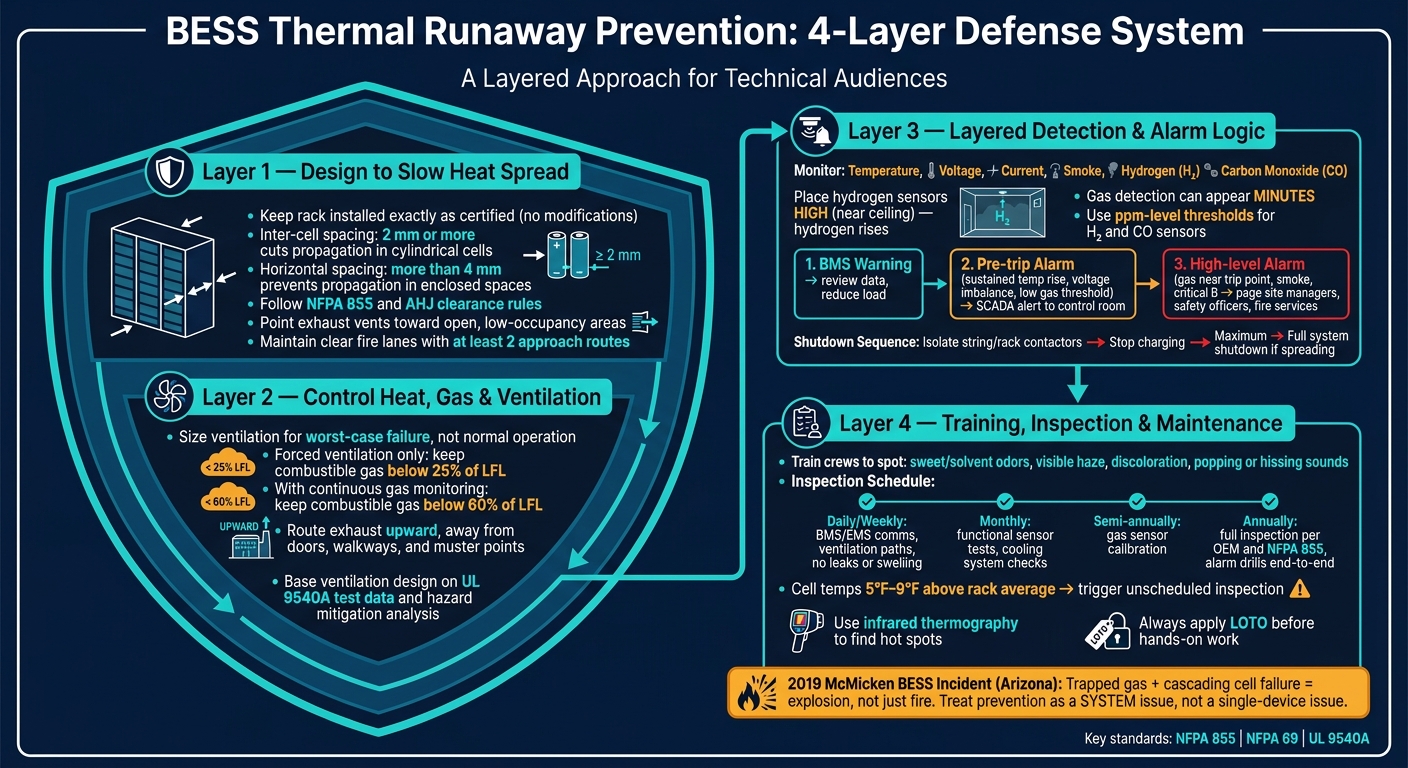
BESS Thermal Runaway Prevention: 4-Layer Defense System
Design the BESS to slow heat spread
The first layer of prevention is physical design. The goal is simple: slow heat transfer before controls need to step in. Spacing, orientation, and barriers can slow propagation and buy time for detection and response.
Use cell, module, rack, and container spacing to limit cascading failure
Keep the rack installed exactly as certified. That means no added brackets, no cable reroutes, no debris, and no changes to cooling, orientation, or module seating. Check the UL 9540A report to make sure the installed system matches the tested setup.
Spacing matters because it can delay heat transfer from one cell or rack to the next. Research on cylindrical cell modules found that 2 mm or more of inter-cell spacing cut propagation, with adjacent cells showing lower temperatures and better-preserved voltages. In enclosed spaces, more than 4 mm of horizontal spacing prevented propagation.
For container and rack spacing, follow NFPA 855 and AHJ rules. Only reduce clearances when test data and local code allow it. UL 9540A data can support tighter spacing, but only if it lines up with the system as installed. Before any retrofit starts, confirm all clearances with the AHJ.
Even good spacing can fall short if exhaust paths or responder access get blocked. Layout has to support venting and emergency response too.
Position units to keep ventilation exhaust and emergency access clear
Point exhaust, deflagration vents, and emergency outlets toward open, low-occupancy areas, not doors, walkways, air intakes, or muster points. Vent discharge should stay away from occupied zones and from any intake that could pull gas back into the site.
Keep fire lanes wide enough for apparatus, clearly marked, and free of obstructions. Where the site layout allows it, give responders at least two approach routes. If the layout changes, update site maps and pre-incident plans right away.
Once the layout slows heat spread, the next layer is early detection of heat, gas, and unusual electrical behavior.
sbb-itb-aa28329
Control heat, gas, and early warning signals
A smart layout can slow a failure. But after that, the next job falls to active controls.
BESS ventilation has to do two things well: remove heat during normal operation and purge gas during an emergency. When a lithium-ion cell goes into thermal runaway, it can release large amounts of hydrogen, carbon monoxide, and electrolyte vapors. In a sealed container, those gases can build up and create an explosion risk. Good ventilation helps buy time so detection systems and shutdown controls can step in before heat spreads from one part of the system to another.
Size ventilation and off-gas detection for worst-case conditions
If a cell fails, flammable gas needs to be detected and vented before anyone opens the enclosure. That means exhaust and ventilation can’t be sized around normal operation alone. They need to be based on hazard mitigation analysis and UL 9540A test data for the exact battery chemistry and system setup in use.
NFPA 69 sets clear limits here. With forced ventilation, combustible gas concentrations must stay below 25% of the lower flammable limit (LFL). If the system has continuous gas monitoring, the limit is below 60% LFL.
Exhaust routing matters too. Send it upward or toward open, unoccupied areas. Keep it away from doors, exit routes, and firefighter access points. In plain terms, you don’t want the purge path pushing danger toward the very people trying to leave the site or respond to it.
Monitor temperature, voltage, current, smoke, and gas in layers
No single sensor will catch every failure mode. That’s why layered monitoring matters.
A battery management system (BMS) tracks cell, module, and rack voltage, current, and temperature. On top of that, smoke detection, gas detection, and SCADA or EMS give site-level warning and visibility. Sensor placement also has to match the gas behavior. Hydrogen sensors should sit near the ceiling because hydrogen rises. Heavier hydrocarbon gases may call for low-mounted sensors, depending on the battery chemistry.
Gas detection can give a pre-flame warning minutes before visible smoke shows up in some lithium-ion failure modes. That’s a big deal. It means hydrogen and carbon monoxide sensors should use ppm-level thresholds and feed directly into alarms and control logic.
Supervisory controls should also trend data over time. A slow temperature climb or a recurring voltage imbalance might not look dramatic in one snapshot. Over days or weeks, though, it can point to a fault that’s starting to form.
Set alarms and shutdown logic to isolate problems fast
Alarm logic should move in three plain stages.
- A BMS warning or low-level gas alarm tells operators to review the data and cut load.
- A pre-trip alarm, triggered by sustained temperature rise, repeated voltage imbalance, or gas reaching low thresholds, sends site alerts through SCADA or EMS to the control room.
- A confirmed high-level alarm – such as gas nearing the trip point, smoke detection, or a critical BMS shutdown – should immediately page site managers, safety officers, and pre-arranged local fire services.
Shutdown logic should work in the same step-by-step way. First, isolate the affected string or rack by tripping its contactors, stop charging, and switch ventilation to maximum purge mode. If gas or smoke signals show the event is spreading, move to full system shutdown.
Remote isolation should be backed by lockout/tagout before anyone starts hands-on work. And crews should stay out of the enclosure until fixed sensors show gas levels below alarm thresholds, temperatures are stable, and the site safety officer clears entry. Before any physical inspection starts, use portable gas detectors and thermal imaging cameras to confirm conditions are safe.
Once the system has isolated the fault, the next step is on the people side: crews need training to respond the right way and confirm the enclosure is safe before work begins.
Train crews and inspect the system before small faults grow
Training and maintenance keep prevention steps working. Once controls isolate a fault, the next job is simple: make sure crews know what to do and make sure the system stays in good shape.
Train operators on warning signs, evacuation, and lockout/tagout
Operators should spot trouble before it shows up on an alarm screen. That starts with training crews to notice sweet or solvent-like odors near battery enclosures, visible haze or vapor, discoloration on cabinet surfaces, and odd sounds like popping or hissing. These signs can show up before BMS alarms do. If someone catches them early, the team has more time to isolate the fault before it spreads.
Roles need to be clear. Control room operators read BMS and SCADA alarms. Field technicians set exclusion zones, apply lockout/tagout, and verify de-energized conditions before work starts. Supervisors coordinate the response, notify the utility control center, and manage the incident command structure.
Site-specific drills matter because people need to know what these events can look like in real life. Off-gassing can come before smoke. Entry into an enclosure isn’t routine during an event; it requires a verified safe state.
Keep emergency procedures at the BESS enclosure. Drill evacuation routes, muster points, and re-entry criteria at least once a year. Those drills should cover suspected off-gassing, confirmed cell overheating, and container fire.
After crews know how to respond, inspections help keep small defects from turning into heat or gas events.
Inspect cooling, sensors, wiring, and alarms on a set schedule
Routine inspections catch slow-building issues that trend data may miss at first – or back up what the data is already hinting at. A tiered schedule works well: daily and weekly visual checks, monthly functional tests, and annual inspections aligned with OEM guidance and NFPA 855.
Weekly checks should confirm a few basics:
- BMS and EMS communications are healthy
- Ventilation paths are clear
- There are no signs of leaks, water ingress, or swelling near battery modules
For cooling systems, verify pump and fan operation, check coolant levels and hose fittings for leaks, and clean or replace air filters on the manufacturer’s schedule. In dusty or coastal sites, that may need to happen more often. Cell temperatures 5°F to 9°F above the rack average should trigger an unscheduled inspection.
Sensor calibration and alarm checks need their own place on the calendar. Gas sensors usually need calibration at least semi-annually. Key temperature sensors should be checked at least annually. Functional tests should simulate sensor inputs and confirm that signals reach the BMS, SCADA, and any remote monitoring centers or fire department notification systems. It also helps to run end-to-end alarm drills, from the first alert to operator response, to make sure alarms, notifications, and shutdown steps still work all the way through.
Wiring and connection inspections should look for abrasion, discoloration, melted insulation, soot or pitting at terminals, and corrosion on busbars and cable trays. Torque checks on terminal connections matter too. Infrared thermography is useful here because it can spot hot spots that a normal visual check may miss. And none of this work should happen without proper LOTO around live components.
BMS and SCADA trend reviews should stay on the regular agenda, not just come out when alarms start ringing. Recurring nuisance alarms on the same string, gradual rises in average cell temperature at a given load, or frequent coolant top-ups all deserve a closer look. Repeatedly restarting a BESS after major protection trips without finding the root cause is one of the fastest ways small faults turn into much bigger ones.
Conclusion: Build prevention around design, detection, and crew readiness
Thermal runaway prevention in a BESS depends on layered controls, not a single safeguard. It works best when design, detection, shutdown, and training all pull in the same direction.
But those controls don’t stay effective on their own. Crews need to test them, inspect them, and maintain them over time. BESS risk can shift as the asset ages, so it’s important to check the system across its full life cycle and confirm that the controls in place at commissioning still work the way they should.
Prevention is an ongoing process, not a commissioning-only task.
FAQs
What triggers thermal runaway in a BESS?
Thermal runaway in a battery energy storage system (BESS) starts when a battery cell gets too hot and kicks off a self-sustaining chain reaction.
A few things can set it off. Common triggers include mechanical damage, electrical failures like overcharging or short circuits, and thermal issues such as high ambient temperatures or poor ventilation. Water intrusion can also damage internal parts and add to the risk of failure.
How early can gas sensors detect battery failure?
Gas sensors can spot early signs of battery failure by tracking gases released during off-gassing, including hydrogen, carbon monoxide, and hydrogen fluoride.
That means operators can get an alert before a fire starts. And that early warning can buy time to shut the system down or evacuate the area before a system-wide thermal event takes hold.
When should crews evacuate a BESS site?
Crews should evacuate a BESS site IMMEDIATELY if there are signs of a potential thermal runaway event, including BMS alarms, gas threshold detection, or visible smoke.
Emergency plans need to spell out evacuation steps in plain language. During an incident, personnel should move to a safe distance – typically a 330-foot isolation zone – and stay upwind and uphill to lower exposure to toxic gases.


