
Hiring instrumentation engineers for oil and gas is hard because the job needs field skill, compliance checks, and fast site mobilization – all at once. If you miss on any one of those, projects slip, shutdowns last longer, and costs climb fast. In many industrial sites, unplanned downtime averages $260,000 per hour, and oil and gas facilities can lose $42 million to $149 million per year from downtime.
If I had to sum up the problem in plain English, it comes down to this:
- Too few people can step into live oil and gas sites and do the work right away
- Retirements are taking site knowledge out the door
- The role now covers more systems, from PLCs and SCADA to SIS and OT security
- Screening takes time, especially when employers must verify safety training, records, and site readiness
- Remote jobs and turnarounds make scheduling much harder
- One delayed hire can stall other crews and drag out startup or shutdown work
Here’s the short answer: I’d treat this as a staffing and mobilization issue, not just a recruiting issue. That means planning by project phase, checking technical fit with hands-on screening, keeping worker records in one system, and lining up regional talent before the job turns urgent.
A few numbers show why this matters:
- Refinery turnaround teams can grow from about 300 workers to more than 2,000
- Major turnarounds can cost $200 million+
- Delay costs can jump by 20% to 50%
- One refinery case cited losses of $1.2 million to $3 million per day beyond schedule
That’s the core issue: when instrumentation staffing is late or weak, the cost reaches far beyond one open seat.
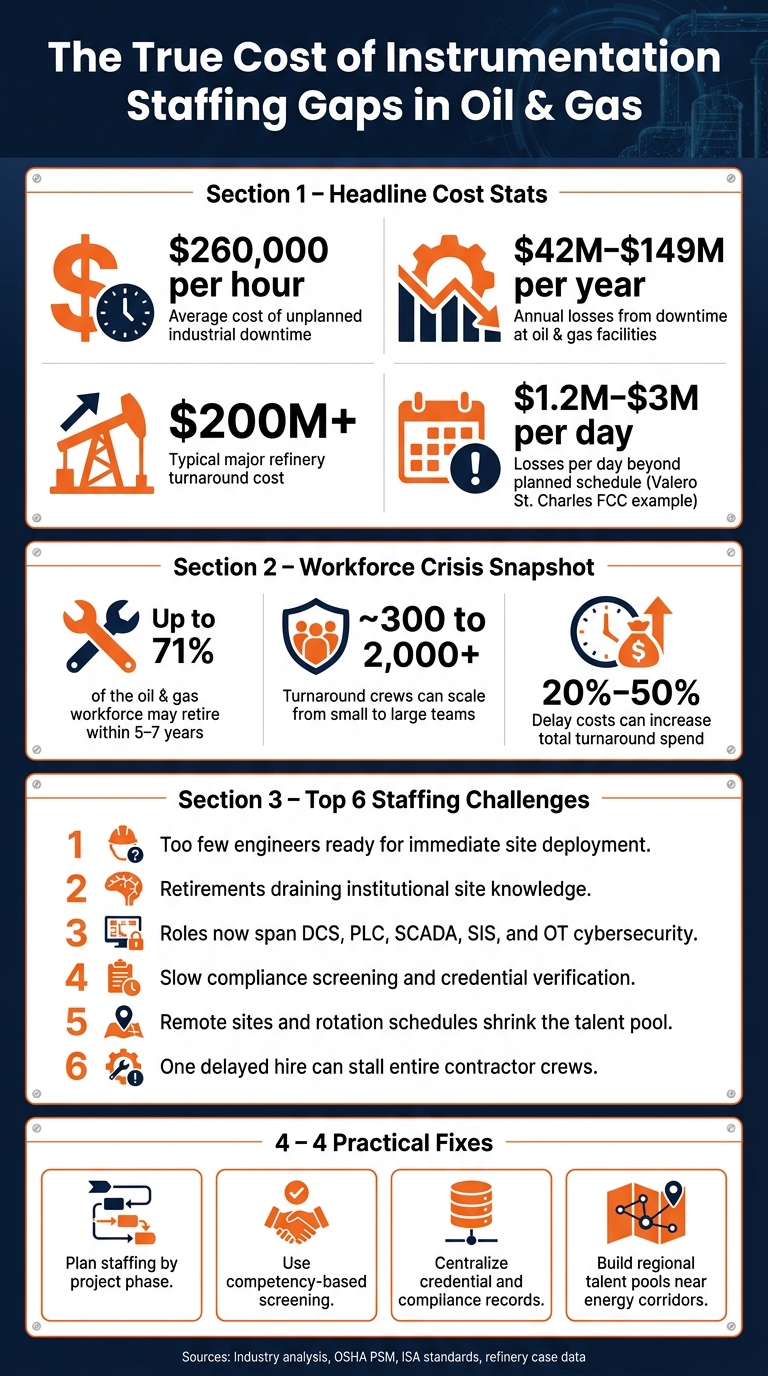
The True Cost of Instrumentation Staffing Gaps in Oil & Gas
In the Field Extras | The I&E Technician Walkthrough
sbb-itb-aa28329
Challenge 1: Talent Shortages and a Growing Skills Gap
Beyond the cost of a delayed hire, the biggest staffing issue is simple: there are fewer engineers who can walk onto an oil and gas site and contribute right away. The instrumentation engineering shortage in U.S. oil and gas is structural. It’s being pushed by retirements, tougher technical requirements, and competition from other industrial sectors chasing the same people.
Retirements and the Loss of Institutional Knowledge
The retirement wave is large. Industry analysis has warned that up to 71% of the existing oil and gas workforce may retire within five to seven years.
When those workers leave, they don’t just leave an empty seat. They take years of site knowledge with them. That includes site-specific alarms, control-system behavior, and field quirks that rarely show up in manuals. In most plants, that kind of know-how lives in the heads of senior engineers and technicians who picked it up over 20 or 30 years on site.
If they retire without a structured handoff, the impact hits fast. Troubleshooting slows down. Teams lean more on OEM support. Turnaround and commissioning risk climbs. In plain terms, every open role becomes tougher to fill, and every handoff matters more.
New Technical Skills Beyond Basic Instrumentation
At the same time, the experienced talent pool is shrinking, the role itself is getting tougher. Today’s job often stretches across DCS, PLC, SCADA, functional safety, industrial networking, and OT cybersecurity.
ISA also ties the cybersecurity life cycle to the safety life cycle for safety controls, alarms, interlocks, and SIS networks. So employers aren’t just looking for someone who knows instrumentation. They need people who can work across operations, safety, and automation on a live site without a long ramp-up. That’s a much smaller hiring pool.
How to Expand the Candidate Pool Without Lowering Standards
One practical move is to redefine the role around skills instead of paper credentials. Competency-based job profiles help employers assess people on observable skills, not rigid degree requirements or an exact number of years in a similar title. An E&I technician with strong PLC experience and a solid safety record may be a better fit than someone who checks old-school boxes but lacks hands-on site exposure.
Internal training paths matter just as much. Formal mentoring and shadowing programs let newer hires learn directly from senior engineers before that talent exits. That helps protect site knowledge and shortens the learning curve. It also helps to standardize troubleshooting notes, startup procedures, and loop check documentation in a central, searchable repository. If the process lives in one person’s memory, that’s a weak spot. If it lives in documented systems, the team has something to work from.
For faster deployment, ABLEMKR (https://ablemkr.com) surfaces pre-vetted workers whose certifications, safety training, availability, and location are already verified before mobilization. That gives employers access to qualified workers beyond local hiring pools.
Even when the right talent is out there, employers still need to get through compliance checks and mobilize people fast.
Challenge 2: Compliance, Technical Screening, and Site Readiness
After you widen the candidate pool, the next problem shows up fast: proving each person is qualified, cleared, and ready to work on-site.
Finding someone with the right technical background is only part of the job. The tougher part is making sure they can work at your facility under your regulatory duties without opening compliance gaps.
Standards, Codes, and Safety Responsibilities Employers Must Account For
OSHA PSM requires qualified staff, documented mechanical integrity, and proof that maintenance work is controlled and verified. If something goes wrong, weak qualification records can lead to penalties and litigation.
During hiring, employers need to check qualification records, hazardous-area knowledge, SIS competence, and site-specific safety training. The goal is simple: bring in people who can support design, commissioning, and maintenance while applying the right standard at the right point in the job.
Better Screening Methods for Instrumentation Roles
Resumes usually don’t tell the full story. Someone may claim SIS experience and still have never led a SIL determination, joined a HAZOP, or completed a proof test on a live safety loop.
That’s where structured technical screening helps. Give the candidate a fault scenario – say, a level transmitter producing erratic readings during a distillation unit startup – and ask them to explain how they’d diagnose the issue and restore the system safely. You can also review anonymized P&IDs and loop drawings to see whether the person understands signal paths, trip logic, and SIL requirements. Calibration exercises should also check proof-testing knowledge and recordkeeping discipline.
Using Workforce Systems to Speed Up Verification
Once you know how to screen people, the next choke point is speed.
Manual verification is slow and easy to mess up. Chasing paper files, emailing training providers, and checking site access cards one at a time can add days to mobilization. And those days cost money, especially before a turnaround or shutdown.
Centralized workforce systems cut that drag by keeping current records for certifications, safety training, medical clearance, drug testing, and site-specific onboarding in one place. When a project needs fast deployment, managers can quickly filter for workers who already match the compliance profile and send them out without delay.
ABLEMKR (https://ablemkr.com) is built around this approach, using mobile-first technology to match pre-vetted workers to job sites based on certifications, safety training, availability, and geo-location. Hiring teams can filter by credential status and past refinery or pipeline experience, while real-time visibility into worker status helps make sure only compliant workers are scheduled and dispatched. That helps cut mobilization delays for shutdowns, turnarounds, and remote jobs.
Challenge 3: Remote Sites, Turnarounds, and Schedule Pressure
Once credentials are checked, geography becomes the next bottleneck. The hard part is getting qualified engineers to remote sites on time, especially when those sites are hundreds of miles from the nearest city.
Instrumentation engineers at remote oil and gas sites often deal with extreme heat, corrosive conditions near process units, high-pressure systems, and rotations that keep them away from home for weeks at a time. For a lot of candidates, that’s the deciding factor. The talent pool shrinks fast because many qualified engineers would rather take metro-based roles with a normal commute and a more predictable schedule.
Things get worse when job posts are fuzzy about travel demands or rotation plans. That lack of detail doesn’t just shrink the pool. It slows mobilization and increases the odds of no-shows. A clearer approach works better. Be direct about PPE needs, lodging, shift rotations, and actual site conditions so candidates know what they’re walking into.
Turnarounds make the stakes much higher. Major refinery turnarounds can cost $200 million or more, and delays can push total costs up by 20% to 50%. One fluid catalytic cracker (FCC) turnaround at Valero‘s St. Charles refinery ran $39 million over 29 days, with losses estimated at $1.2 million to $3 million per day for each day beyond the planned schedule.
Instrumentation engineers are on the critical path here. A plant can’t return to service until sensors, transmitters, control loops, alarms, and safety instrumentation systems are checked and signed off. If even one or two qualified specialists are missing, other craft crews may end up standing by. That’s when a single vacancy starts costing far more than one open role. It ripples across the whole contractor workforce.
The better way to think about instrumentation staffing is as a mobilization problem, not just a hiring problem. In practice, that means:
- Keeping regional talent pools near major energy corridors
- Setting travel and per diem terms early
- Using mobile-first workflows so workers can confirm availability, finish onboarding, and get assignment details without lag
For example, Gulf Coast projects may offer about $100 per day in travel allowances to pull in workers from outside the area. ABLEMKR (https://ablemkr.com) matches pre-vetted workers by location, availability, and credentials to speed dispatch while keeping payroll and compliance work moving without slowing shutdown schedules.
More distance and more risk call for more pre-vetting, earlier travel planning, and tighter schedule visibility. Staffing has to be planned around site access, travel time, and turnaround dates from day one. That setup needs to be ready before the turnaround is even announced.
Solutions: Building a More Reliable Instrumentation Staffing Model
The fix is simple in theory, but it takes discipline in practice: move away from reactive hiring and toward phase-based planning, faster verification, and tighter mobilization.
Plan Staffing by Project Phase, Not Just by Open Role
Most instrumentation staffing issues begin well before a job post appears. When hiring starts only after a seat opens up, teams lose precious time. That makes it harder to verify credentials, confirm fit, and get the right person on-site before the project needs them.
A better approach is to map labor demand across each project phase – design, commissioning, turnarounds, and maintenance windows. Each phase calls for a different mix of instrumentation, controls, and field support. Planning this way helps teams spot gaps early, before they turn into schedule trouble.
That gives staffing leaders a more realistic picture of demand, cuts down on emergency hiring, and makes it easier to line up the right people before critical work starts.
It also helps ease turnover pressure. Fewer last-minute fire drills usually mean less stress on the team.
Improve Retention with Clear Career Paths and Better Work Conditions
Retention isn’t just about pay. In remote sites and turnaround work, experienced instrumentation professionals are more likely to stay when safety and security protocols are clear and enforced the same way every time.
Searchable documentation and clean handoffs also matter. They preserve institutional knowledge, reduce onboarding friction, and help teams troubleshoot faster when experienced people move on.
Employers can improve retention in another way too: give engineers work that feels current and worth doing. People tend to stay longer when the role offers:
- clear advancement
- modern systems
- stable rotation terms
Once staffing terms and knowledge transfer are clearer, technology can help speed up the remaining verification and dispatch work.
Use Workforce Technology to Improve Speed, Control, and Worker Communication
Manual staffing workflows – spreadsheets, email chains, and repeated credential checks – slow mobilization and make it harder to keep projects on track.
Clear data fields for verified credentials and work history help teams review people faster without giving up compliance control.
| Workflow Stage | Manual Workflow | With ABLEMKR |
|---|---|---|
| Mobilization | Slower sourcing and verification | Faster matching using pre-vetted worker profiles |
| Compliance Tracking | Manual credential checks | Real-time compliance status |
| Payroll Efficiency | Multiple systems and delayed processing | Connected payroll processing |
| Schedule Impact | Higher risk of staffing gaps | Better visibility into available workers |
| Worker Communication and Payment Reliability | Inconsistent communication and payment delays | Flexible access to opportunities and reliable payment support |
ABLEMKR is built around this model. It matches pre-vetted workers to job sites based on certifications, safety training, availability, and geo-location. That means employers can verify, dispatch, and pay crews faster while still keeping compliance control in place.
Conclusion: Key Staffing Risks and the Most Practical Fixes
Instrumentation staffing gets tougher when demand is reactive, knowledge walks out the door, and project timelines leave no room for delay. The strongest model plans by project phase, protects knowledge, and uses workforce technology to verify and mobilize crews faster.
FAQs
Why is staffing instrumentation engineers so difficult in oil and gas?
Staffing instrumentation engineers in oil and gas is tough because the industry is dealing with a shortage of specialized talent. A lot of experienced workers are nearing retirement, many are leaving the field, and there simply aren’t enough younger professionals coming in to fill the gap. That has narrowed the talent pipeline in a big way.
On top of that, these jobs often require certifications, licensing, and hands-on experience in regulated settings. Hiring gets even harder when you add lower labor mobility and rising demand for candidates who can handle both classic engineering work and newer technical skills.
What skills matter most for instrumentation roles today?
Today’s instrumentation roles call for a mix of hands-on mechanical know-how and solid digital skills. The core of the job usually includes instrument calibration, control system troubleshooting, precise monitoring, and day-to-day work with PLCs, SCADA, and remote diagnostics.
On top of that, workers need to understand regulatory compliance and know how to use data analysis to improve facility performance. Common certifications include NCCER, TWIC, OSHA 30, and ISA.
How can companies speed up hiring without risking compliance?
Companies can move hiring along faster without cutting corners on safety or compliance. The big shift is simple: replace manual steps with tech-driven workforce tools. Platforms like ABLEMKR give firms access to pre-vetted engineers whose certifications, safety training, and credentials are checked before they arrive on-site.
Automated matching speeds up selection by filtering candidates based on project needs, including OSHA 30-Hour training, API or ASME standards, and location. On top of that, digital onboarding and compliance tracking help teams deploy workers fast while staying audit-ready.


