
If you want a solar factory job, here’s the short answer: most roles focus on safe, repeatable line work, tight quality checks, and shift-based production. In the U.S., entry-level jobs often land around $17–$22 per hour, while maintenance and automation roles can reach $29–$45+ per hour, with night-shift pay adding about 6%–10% in many plants.
I’d break it down like this:
- Cell manufacturing = working with wafers, furnaces, coatings, and stricter process control
- Module manufacturing = building finished panels through stringing, layup, lamination, framing, testing, and packing
- Main jobs = operators, material handlers, quality techs, maintenance techs, automation techs, supervisors, and process staff
- Main skills = following SOPs, tracking data, spotting defects, safe material handling, and clean shift handoffs
- Main safety risks = moving equipment, glass cuts, chemical exposure, heat, and electrical energy
- Main path up = start on the line, cross-train, add OSHA or maintenance training, then move into higher-pay roles
This kind of work is less about heavy lifting and more about consistency, pace, and documentation. If I came from construction, warehouse work, utilities, or oil and gas, I’d likely already have part of the skill set: PPE use, shift discipline, forklift work, LOTO awareness, and crew communication.
A few points matter most before applying:
- Most plants run 3-shift or 4-shift schedules
- Basic line training often takes about 4–6 weeks
- Overtime can push yearly pay above base rates
- Cross-training can help move me into lead, quality, or maintenance work within 12–24 months
- LOTO, machine guards, and chemical rules are non-negotiable
| Area | What I’d Expect |
|---|---|
| Work setting | Indoor, climate-controlled factory |
| Pace | Repetitive, target-driven, team-based |
| Entry pay | $38,000–$46,000/year |
| Mid-level pay | $50,000–$70,000/year |
| Advanced tech pay | $60,000–$90,000+/year |
| Main training | Safety orientation, station training, shadowing, cross-training |
| Best carryover backgrounds | Construction, warehouse, utilities, oil and gas |
Bottom line: if I can follow procedures, work safely, keep records straight, and stay steady through long shifts, solar manufacturing can be a solid path with room to move up.
Solar energy job: photovoltaic panel production operator
sbb-itb-aa28329
Common Solar Manufacturing Jobs and Daily Tasks
Solar module plants depend on a small set of core roles to keep production moving, keep equipment running, and keep modules within spec.
Production Operators and Module Technicians
Production operators handle the day-to-day work on the line. They load materials, run layup and lamination stations, install frames and junction boxes, log data, and pass open issues to the next shift. Most shifts begin with a short handoff meeting that covers production targets, line status, and any quality or safety alerts from the previous crew.
At lamination stations, operators load the glass, encapsulant, cell strings, and backsheet. They confirm program settings on the HMI and keep an eye on cycle status. Framing work includes positioning aluminum frames, using pneumatic or hydraulic presses, and checking that corner joints sit flush. Junction box installation involves placing the boxes, running adhesive or potting systems, and connecting leads based on polarity markings.
Across the shift, operators scan barcodes and record output and scrap in the MES system. That data ties each module to its material lot, machine, and shift. By the end of the shift, they usually help with basic cleaning through 5S, count remaining work-in-progress, and hand off unresolved issues to the incoming crew.
Operators keep the line moving. Technicians, on the other hand, focus more on machine condition and process quality. In some plants, technicians also repair damaged cells instead of scrapping the entire module.
When production starts to drag or defect rates climb, maintenance, automation, and quality teams step in to keep throughput on track.
Maintenance, Automation, and Quality Roles
Maintenance techs start by checking utilities and interlocks. From there, they troubleshoot faults, replace worn parts, and carry out preventive maintenance.
Automation techs work on robots, conveyors, PLCs, and HMIs, making adjustments within approved procedures.
Quality staff check appearance, run flash, HiPot, and continuity tests, and use EL imaging to spot hidden cracks. Their results go straight into daily production stand-up meetings. That gives supervisors and engineers a clear basis for deciding whether to change process settings, retrain operators, or quarantine a suspect material lot.
Supervisors, Engineers, and Support Roles
Leads and supervisors usually open each shift by assigning workers to stations and making sure maintenance has cleared any open equipment issues. During the shift, they watch real-time output and scrap dashboards, move operators to ease bottlenecks, and call maintenance early when warning signs show up, like rising scrap or frequent short stops. Many U.S. plants also run brief production huddles every 2–4 hours. In those check-ins, supervisors, maintenance, quality, and logistics teams review key metrics and agree on immediate next steps.
Process engineers review line data and quality reports, approve changes to process settings, and plan improvement tests with production teams. Material handlers and logistics staff keep the line fed by staging glass, cells, frames, and packaging, scanning lots into MES, and removing scrap and empty pallets.
| Role | Main Tasks | Tools Used | Experience Level |
|---|---|---|---|
| Production Operator | Loads glass, runs layup and lamination, installs frames and junction boxes, logs data | HMI, MES terminal, vacuum lifters, barcode scanner | Entry-level (0–2 yrs) |
| Material Handler | Stages materials, operates forklift, scans inventory, removes scrap | Forklift, pallet jack, barcode scanner, MES | Entry-level (0–2 yrs) |
| Quality Technician | Runs visual inspections, flash testing, HiPot, EL imaging, logs defects | EL tester, flash tester, HiPot tester, calipers, MES | Mid-level (2–5 yrs) |
| Maintenance Technician | Fixes faults, replaces worn parts, handles preventive maintenance, logs work orders | Multimeter, torque wrench, CMMS, diagnostic tools | Mid-level (3–7 yrs) |
| Automation Technician | Tunes robots and conveyors, updates PLCs and HMIs, analyzes downtime | PLC software, HMI, robot teach pendant, CMMS | Mid-level (3–7 yrs) |
| Production Supervisor | Assigns staffing, tracks output, coordinates teams, reports shift results | MES dashboard, ERP, production reports | Senior (5+ yrs) |
| Process/Mfg. Engineer | Improves processes, adjusts parameters, analyzes data, optimizes yield | MES, ERP, statistical tools, lab equipment | Degreed (3–7 yrs) |
Across all of these roles, the same basics show up again and again: strong SOP discipline, awareness of equipment condition, and clean shift handoffs.
Skills Workers Need and How Prior Experience Carries Over
These jobs reward the same habits that matter in other industrial settings: following procedure, making clean handoffs, and keeping solid records.
Core Technical Skills for the Factory Floor
On a solar factory floor, the main skills are practical and process-focused. And the good news is that many tradespeople already use them every day.
Operators load materials, run equipment through touchscreens, inspect parts, measure output, and log defects or downtime. Basic electrical and mechanical awareness also matters. Workers need to know that solar cells and modules can carry voltage, spot pinch points on conveyors or moving parts, and understand when it’s time to call maintenance instead of trying to fix something themselves. Machine guards should be treated as fixed protection and should not be bypassed or removed.
Accurate records matter because they help trace issues and keep production within spec.
Static control and clean handling are also part of the job. If someone skips a grounding strap during wafer handling, cells can be damaged in ways that don’t show up right away. Good housekeeping and careful handling help protect product quality and cut scrap.
Entry-level operators usually reach basic proficiency in four to six weeks of on-site training.
Transferable Skills From Construction and Energy Work
Workers from construction, utilities, and oil & gas often bring more carryover than they expect.
Tool use and mechanical aptitude from construction or refinery work fit well in maintenance technician roles. That can mean adjusting conveyors, replacing belts, and helping with preventive maintenance on vacuum tools or robots. Industrial LOTO experience also carries into maintenance and some operator jobs. Shift-work experience tends to carry over well to rotating schedules too.
Forklift and load-handling experience from construction or warehouse jobs also fits solar manufacturing. Moving pallets, scanning inventory, and staging materials in sequence are familiar tasks for people who have already moved pipe, steel, or equipment on a jobsite.
U.S. solar workforce programs have pointed to this overlap directly. Georgia’s Quick Start training for Qcells, for example, was built around OSHA-based safety training and standardized work processes, which lines up with what construction and industrial energy workers already know.
The workers who get up to speed fastest usually come in with one or more of these basics.
| Background | Key Existing Skills | Best-Fit Solar Roles | How It Transfers |
|---|---|---|---|
| Commercial construction (carpenter, ironworker, foreman) | Hand and power tools, reading work plans, PPE discipline, crew coordination | Production operator, line lead, materials handler | Follows detailed instructions, uses tools safely, works to schedule |
| Industrial electrician / utilities | LOTO, energized-work procedures, troubleshooting, shift work | Maintenance tech, automation support, high-responsibility operator | Strong electrical safety habits, alarm response, work documentation |
| Oil & gas / refinery operator | Process monitoring, procedure-driven work, control-room systems, safety culture | Tool operator, lead operator | Runs by procedure, interprets alarms, stops work when needed |
| Warehouse / distribution | Forklift operation, inventory control, barcode scanning, shipping/receiving | Materials handler, inventory tech, shipping/receiving | Safe load movement, lot tracking, staging materials in sequence |
Soft Skills That Affect Safety and Quality
Technical skill may get someone in the door. Reliability and communication help keep the line safe and steady.
Attention to detail matters because small misses can turn into expensive defects. A misaligned frame or a failed barcode scan might look minor at first, but those issues can snowball. Pace matters too. If someone rushes through lamination or framing, defects may not show up until final test – or even later in the field.
Problem reporting is one area where field habits pay off fast. Workers who are used to stopping unsafe work often adjust well to stopping a solar line when a safety or quality issue comes up. Supervisors often notice that people from heavy construction or refinery backgrounds are willing to speak up early, and that helps protect both workers and product.
Reliability is simple but critical. Production runs on a tight schedule, and one missing operator at shift start can send problems down the whole line.
Workers who show up consistently, follow procedures, and keep clean documentation can move into lead or trainer roles within 12–24 months. The next step is understanding how training paths and pay factors shape that progression.
Training Paths, Certifications, and Pay Factors in the U.S.
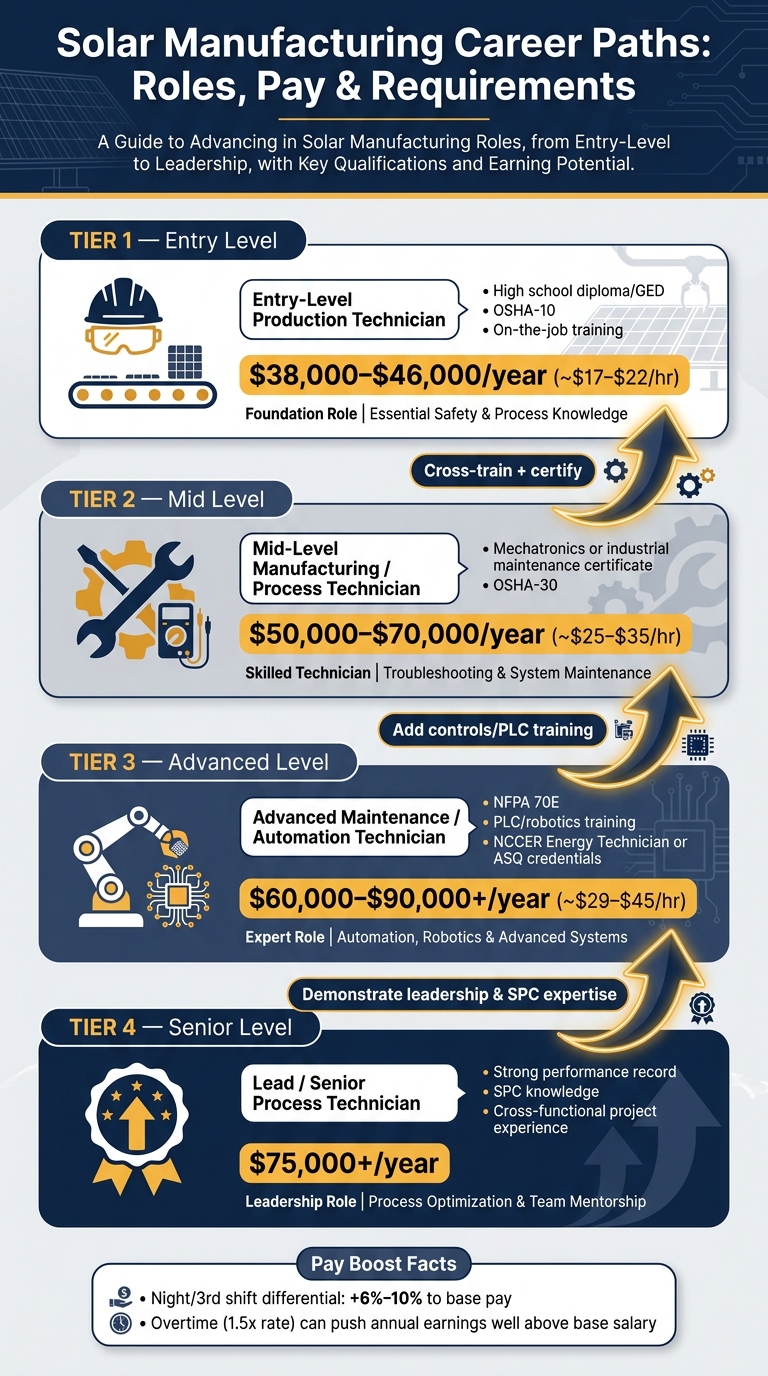
Solar Manufacturing Career Paths: Roles, Pay & Requirements
Once workers know the main jobs, the next step is figuring out how hiring, training, and pay tend to work in practice.
Entry-Level Training and On-the-Job Learning
No matter how someone gets hired, the early training path usually looks pretty similar: safety orientation, a walkthrough of the production process, and hands-on shadowing with an experienced operator before running a station alone. Employer training usually covers safety, documentation, and the procedures tied to each station.
A lot of workers also rotate across multiple stations, such as lamination, testing, and packaging. That gives them a better sense of the whole line and helps the plant fill gaps when staffing gets tight. It also matters for career growth. Cross-training can help workers move into lead-operator roles and earn more.
Short community college or certificate programs can also help. They give candidates a way to show they understand safety, documentation, and basic equipment readiness.
Moving Into Maintenance, Automation, and Engineering Support
After workers learn the basics on the floor, they can start building toward maintenance, automation, or process support.
Operators who show strong mechanical ability and solid problem-solving often move first into internal maintenance trainee roles. From there, the path usually includes community college classes in industrial maintenance or electromechanical technology. Those programs often cover motors and drives, PLC basics, hydraulics, and electrical fundamentals. Then vendor-specific training on robots or production tools helps fill in what classroom instruction doesn’t cover.
Workers aiming for automation technician roles usually build on the HMI experience they picked up on the production floor. After that, they add controls coursework, supervised programming edits, and OEM robot training. People moving toward engineering support or process technician work usually develop skills in statistical process control (SPC), root cause analysis methods like 5-Why, and yield data interpretation.
Credentials can also help speed up that move. Common examples include NFPA 70E, NCCER Energy Technician certifications, and quality credentials from ASQ.
Cross-training can open doors to quality, maintenance, automation, and supervision.
What Affects Pay and How Workers Find Opportunities
Pay usually comes down to a few main factors: role, shift, overtime, and location.
| Career Stage | Common Qualifications | Typical U.S. Pay Range |
|---|---|---|
| Entry-level production technician | High school diploma/GED, OSHA-10, on-the-job training | $38,000–$46,000/year (~$17–$22/hr) |
| Mid-level manufacturing/process technician | Mechatronics or industrial maintenance certificate, OSHA-30 | $50,000–$70,000/year (~$25–$35/hr) |
| Advanced maintenance/automation technician | NFPA 70E, PLC/robotics training, NCCER Energy Technician or ASQ credentials | $60,000–$90,000+/year (~$29–$45/hr) |
| Lead/senior process technician | Strong performance record, SPC knowledge, cross-functional project experience | Above $75,000/year |
Shift timing can make a noticeable difference. Night and third-shift differentials usually add 6% to 10% to base hourly pay. Overtime matters too. Pay at 1.5x the base rate can push yearly earnings well past base salary, especially during plant ramp-ups or equipment breakdowns.
Location also plays a big role. High-demand regions and high-cost states tend to post higher wages than lower-cost areas.
For workers who are ready to apply, ABLEMKR (https://ablemkr.com) helps match certifications, safety training, and location to open solar manufacturing jobs.
Certifications are one of the clearest ways workers can improve their odds. An OSHA-30, a mechatronics certificate, and a controls or quality credential can make a candidate more competitive for mid-level roles.
Safety Basics and Key Takeaways for New Solar Manufacturing Workers
Main Hazards and Everyday Safety Controls
After training and pay, the next thing most new workers want to know is simple: how do you stay safe every shift?
Solar manufacturing comes with a familiar set of plant-floor risks. The big ones are arc flash, electric shock, thermal burns, and chemical exposure. OSHA treats these as standard industrial risks on solar lines.
Here’s how those hazards usually show up, what workers use to control them, and which jobs tend to face them most often.
| Hazard Type | Where It Appears | Everyday Controls / PPE | Roles Most Exposed |
|---|---|---|---|
| Moving machinery / pinch points | Conveyors, stringers, laminators, robots | Fixed guards, interlocks, light curtains, e-stops, no-bypass rules | Production operators, module technicians, maintenance mechanics |
| Glass / sharp edges | Glass loading, layup, lamination, QC inspection | Cut-resistant gloves and sleeves, safety glasses, face shields | Line operators, quality inspectors, pack-out staff |
| Ergonomic strain / repetitive motion | Panel lifting, packaging, visual inspection | Lift assists, carts, team lifts, job rotation, neutral posture training | Line workers, warehouse and pack-out personnel |
| Chemical exposure | Cell etching, cleaning, encapsulation, coating | Chemical-resistant gloves, splash goggles, local exhaust ventilation, eyewash stations, SDS training | Cell process operators, coating/printing techs, maintenance staff |
| Electrical energy | Testers, powered tools, automation panels, energized equipment | Lockout/tagout (LOTO), insulated tools, voltage verification, restricted access | Electricians, maintenance techs, automation/controls specialists |
The worst mistakes usually happen during service, cleanup, and changeover. That’s when stored energy can still be sitting in the system, even if a machine looks idle.
Lockout/tagout is required before servicing any electrical, pneumatic, hydraulic, or stored-energy source. Operators need to know when a task crosses the line into servicing. Maintenance workers and electricians must lock, verify zero energy, and test before making contact.
Chemical areas have their own rules, and they’re not optional. Follow the SDS, wear the required PPE, and know where the nearest eyewash and emergency shower are before your first shift. On advanced cell lines, silane, arsine, and phosphine may be present. If a gas alarm goes off, treat it as an evacuation event.
Quality, Compliance, and Reporting Problems Early
On a solar line, safety and quality are tied together. Catching a problem early doesn’t just save product. It can also keep someone from getting hurt.
Defects that slip through turn into rework, extra handling, and more downtime. Barcodes, serial numbers, and batch tracking help teams trace defects back to a machine, shift, or lot. That makes root-cause analysis faster and helps stop the same error from showing up again. Clean, organized lines also cut down on slips, contamination, and process variation.
If you spot something unsafe – a missing guard, a leaking chemical line, or a jam in a dangerous spot – make the area safe only if you can do that without risk. Then contact a supervisor, EHS, or maintenance right away. Near misses should be reported the same way. U.S. safety law prohibits retaliation for reporting, and most plant policies require workers to speak up.
Key Points for Workers Starting in Solar Manufacturing
Workers coming from construction or energy often already have good instincts. The adjustment is that solar manufacturing is more repetitive and more tightly documented. The work repeats all shift, so precision matters more than brute force.
A few habits make a big difference:
- Know your hazards by role. Machinery, glass, chemicals, and electrical energy all call for different controls.
- Apply LOTO before servicing. Production pressure is never a reason to bypass a safety device.
- Report defects and near misses right away. A problem caught early is easier to control.
- Document accurately. Good records help the plant spot process problems before they happen again.
- Cross-train when you can. Learning more stations can open the door to more job options.
FAQs
Do I need factory experience to get hired?
No. In most cases, you don’t need factory experience to get hired for solar panel manufacturing-related roles.
A lot of entry-level jobs put more weight on safety training – like OSHA 10 or OSHA 30 – than on past factory work. Employers also often provide hands-on onboarding or job-specific training once you start.
That said, more technical manufacturing technician roles can be a different story. Those jobs may call for more familiarity with setting up, testing, and adjusting production machinery.
Which solar manufacturing role best fits my background?
Match your background to the main pathways. If you’ve worked in assembly, machinery, or technical manufacturing, Manufacturing Technician roles may be a good fit.
If your experience is in general labor, construction, or site prep, you may line up better with solar construction or equipment operator roles.
Have electrical experience, or want to work with grid systems? Take a look at Solar PV Installer or O&M Technician roles. ABLEMKR can help connect your certifications and past work to these jobs.
How fast can I move into higher-paying roles?
You can move into higher-paying solar roles faster than in many other career paths, but the timeline depends on the job.
With 1–3 years of experience, plus added certifications, you may step into roles like Solar Site Supervisor, Lead PV Installer, or Project Manager. That’s one reason solar appeals to people who want a clear path forward instead of waiting years just to get a shot.
Leadership roles usually take 5–10 years. If you want to move up sooner, focus on building strong technical skills, taking on leadership work when you can, and earning credentials such as NABCEP PV Associate.


