
Workers stay where they feel safe. On high-risk job sites, that matters as much as pay. With construction turnover often at 20% to 30% and some firms above 50%, even one weak safety program can lead to more quits, more retraining, and more lost time.
Here’s the short version: safety incentives can cut turnover when they reward safe actions workers can control – like hazard reporting, training completion, job briefings, and near-miss reporting. Programs tied only to “no injuries” can backfire because workers may stay quiet instead of speaking up. And when reporting feels risky, trust drops fast.
If I had to boil the article down, it comes to this:
- Pay alone won’t keep crews in place
- Workers watch how supervisors handle unsafe conditions
- Good incentive programs reward prevention, not silence
- Small rewards like $50 gift cards, meals, or PTO can help
- One study linked better safety and management practices to attendance moving from 88% to 94%
- Clear rules, equal enforcement, and protected reporting matter
- The best way to track results is through turnover, attendance, repeat bookings, assignment length, incident trends, and time-to-fill
- Using one system across sites helps keep rules and payouts the same
Bottom line: if you want lower churn, I’d treat safety incentives as a retention tool, not just a safety add-on.
Safety Recognition Programs That Work
sbb-itb-aa28329
How Safety Incentives Address the Root Causes of Turnover
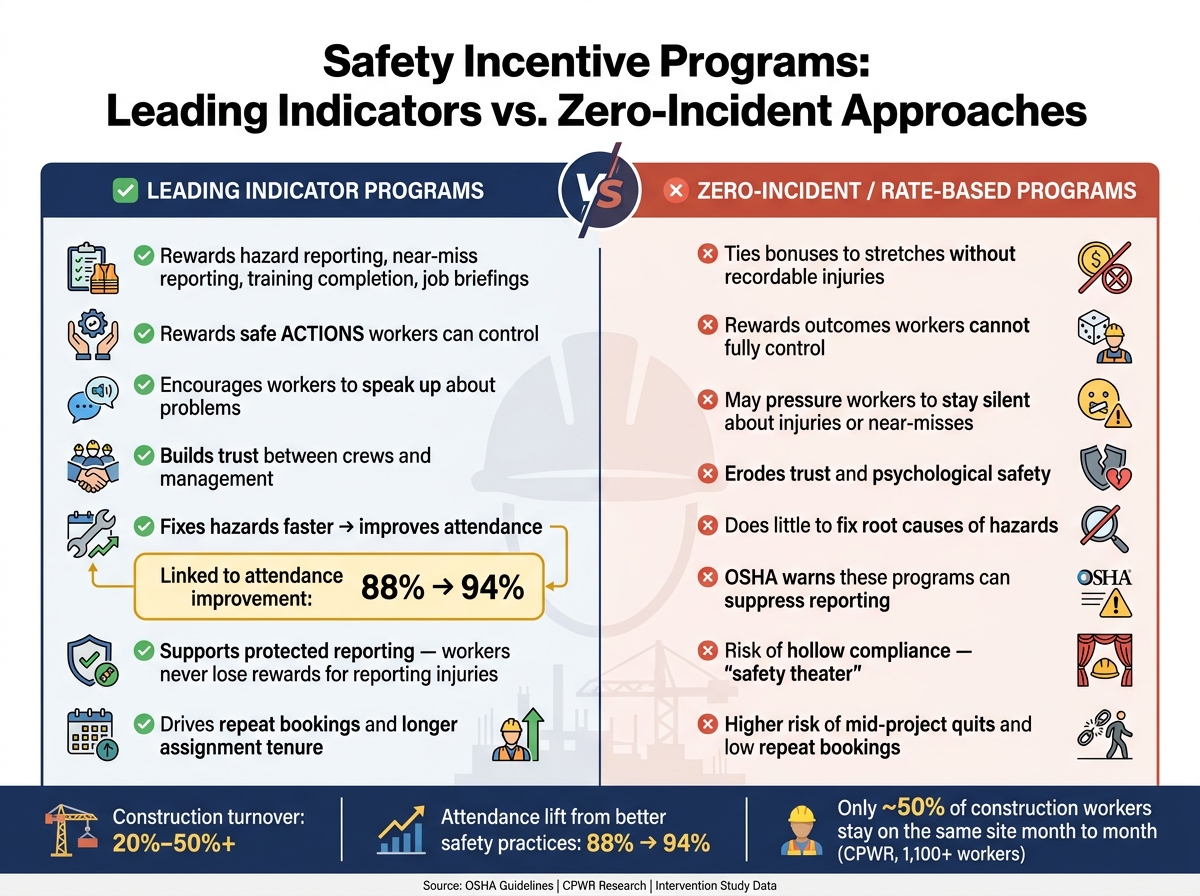
Safety Incentive Programs: Leading Indicators vs. Zero-Incident Approaches
Safety incentives work because retention starts with trust. These programs do a lot more than hand out gift cards or track days without an incident on a wall chart. The better programs reward hazard reporting, on-time training, and near-miss reporting. OSHA describes these as leading indicators: proactive, preventive actions that help predict and prevent injuries before they happen.
That distinction matters. Leading-indicator programs reward prevention, not silence. By contrast, old-school "zero-incident" or rate-based programs often tie bonuses to stretches without recordable injuries. OSHA has warned that if the reward is big enough, workers may stay quiet about injuries or near-misses to protect the bonus for themselves or their crew. That creates the exact kind of site no one wants to work on.
How Recognition Improves Morale and Day-to-Day Engagement
When workers get recognized for spotting a hazard or finishing safety training, management sends a clear signal: this is what we care about. That kind of recognition builds trust and helps keep people engaged day to day.
It also doesn’t need to cost much. Small, timely rewards like gift cards, crew lunches, extra paid time off, or training and certifications can reinforce the behavior behind them. Say a contractor offers $50 gift cards each quarter to workers who attend all required safety trainings and submit at least two near-miss reports. If the criteria are clear and the recognition is specific, workers are more likely to feel seen and respected.
How Safer Sites Lead to Better Attendance
There’s a direct connection between hazard control and showing up to work. When employers reward leading indicators like near-miss reporting, taking part in safety meetings, and fixing hazards on time, crews can spot problems and deal with them faster. Leading-indicator programs improve attendance by fixing hazards faster; zero-incident programs can suppress reporting and do little to solve the root cause.
One intervention study found that stronger safety and management practices moved average site attendance from 88% to 94%. That’s a meaningful jump, and it came from structural changes, not from simply telling workers to show up.
Rewards should stay tied to safe actions, such as:
- arriving on time
- completing job briefings
- following safe work plans
But employers should never dock or take away rewards because someone reports an injury or near-miss. OSHA guidance is clear on that point: incentives should not discourage reporting. When crews see that the rules hold up across the whole site, trust grows, and teams are more likely to stick together longer.
Why Workers Return to Sites Where They Feel Safe
In project-based labor across construction, energy, and industrial work, workers often have a choice about which contractor or site they want to return to next. A fair, visible safety incentive program sends a strong message: this employer is organized, consistent, and serious about worker well-being.
When workers see hazard reports lead to action, when safe behavior gets recognized by name, and when the same rules apply to everyone, they’re much more likely to accept the next assignment from that same employer. Repeat bookings – workers choosing to come back for more projects – are one of the clearest signs that a safety culture is doing its job. Repeat bookings show that workers trust the site enough to return.
How Safety Rewards Build Trust and Keep Crews Together
The next step is consistency: rewards only help retention when workers trust the rules. On high-risk sites, people can tell fast when a program is more for show than for day-to-day use. Research ties a stronger safety climate and higher trust to lower intent to leave.
Program Rules Must Be Clear and Applied Consistently
When enforcement shifts from one supervisor to another, trust falls apart. Crews notice when one shift gets one set of rules and another gets something else. That’s when a rewards program starts to feel hollow. Fair enforcement is what turns rewards into better retention, not just a box-checking exercise.
Put eligibility, earning criteria, point values, and payout timing in writing. Then repeat those rules during onboarding and in toolbox talks, so nobody has to guess. Supervisors should be trained to document their decisions and use the same standards across every crew and every shift.
Workers should never lose eligibility for reporting a hazard or injury. Say that plainly in the program rules. If people think speaking up will cost them, the whole thing breaks down. When reporting is protected, workers are more likely to trust the program and stay involved.
Once that trust is in place, the effect starts to show up in crew stability.
Stable Crews Mean Less Backfilling and Better Output
Teams that know each other tend to work better under pressure. They communicate faster, spot hazards sooner, and need less time to get familiar with equipment and site-specific procedures.
Backfilling all the time creates drag. It adds onboarding, retraining, and more risk while new workers get settled. Engaged workers also miss fewer shifts and report fewer incidents. Keeping experienced crews together helps with steady production and stronger safety results.
What to Measure to Confirm Retention Impact
If a safety rewards program doesn’t track outcomes, it can’t show whether it’s helping retention. The main numbers to watch are:
- Turnover
- Assignment length
- Repeat booking
- Attendance
- Incident trends
- Time-to-fill
Compare these before and after the program launches. Then break them out by site and supervisor. That makes it easier to see where the program is working and where it’s falling flat.
Looking at these numbers across sites also shows whether the program is cutting churn or simply adding cost. They become much more useful when every site tracks them in one system.
Using Workforce Technology to Run Safety Incentives Across Multiple Sites
Once you’ve set the incentive metrics, the next job is making sure the program runs the same way at every site. That’s where workforce tech helps. It puts the data behind incentive decisions in one place, so site teams aren’t making judgment calls from scattered records.
Why Tracking Training, Certifications, and Attendance Matters
When safety records sit in spreadsheets or paper logs, eligibility decisions get messy fast. One supervisor checks training dates by hand. Another skips that step. People working on different sites end up being treated differently, and trust in the program starts to slip.
A centralized system fixes that. When training completion dates, active certifications, shift history, and incident records all live in one record, supervisors can check eligibility in seconds using the same rules everywhere. If a worker completed confined space entry training, that credential appears the same way at every site. That keeps decisions fast and consistent.
Automated eligibility rules push this a step further. Instead of sorting spreadsheets by hand, a properly set up system can flag who qualifies based on pre-set criteria. The system also logs each decision, which makes bonus checks much easier for supervisors.
How ABLEMKR Keeps Incentive Rules Consistent Across Sites
That kind of consistency depends on using one system for eligibility, payouts, and rebooking.
ABLEMKR centralizes worker status, certifications, attendance, payroll, and rebooking history. That gives supervisors one record they can use to check eligibility, time payouts, and make future assignment decisions.
Data Points That Connect Safety Programs to Retention
These are the fields worth building into the system. Each one supports a clear workflow and connects to a turnover metric you can track.
| Data Field | Workflow Supported | Turnover-Related Metric Improved |
|---|---|---|
| Training completion dates | Compliance verification and incentive eligibility | Reduced early attrition from workers sent home |
| Active certifications | Automated job matching and role assignment | Higher repeat bookings for qualified workers |
| Incident reports | Safety monitoring and reward validation | Fewer incident-related quits |
| Attendance and shift completion | Reliability tracking and payroll integration | Fewer no-shows and mid-shift walk-offs |
| Payroll status | Bonus payout management and pay accuracy | Increased trust and fewer quits over pay disputes |
| Rebooking history | Talent pool management and preferred worker routing | Higher crew stability and longer average tenure |
When these fields are structured the same way across sites, employers can run reports to see whether safety incentive participation lines up with longer assignments and more repeat bookings. That makes site-to-site comparisons much easier and gives teams a clearer way to adjust the program.
Conclusion: Safety Incentives Cut Turnover When They Are Fair, Clear, and Measurable
Workers leave high-risk sites – and often don’t come back – when they stop trusting the jobsite. If the site doesn’t feel safe, if management doesn’t listen, or if rules seem to hit some people and not others, people walk. Higher pay by itself doesn’t fix that. What keeps people around is a site culture they can trust.
The strongest programs are fair, clear, and tied to behaviors workers can control. That means things like hazard reporting and pre-task planning, not vague goals or rules that feel out of reach. It also means protecting hazard and near-miss reporting instead of making people feel punished for speaking up. CPWR tracking of more than 1,100 construction workers found that only about 50% stayed on the same site month to month.
Once workers see safe behavior recognized, trust starts to grow. And trust is what turns recognition into retention. When safety rules and rewards are applied the same way across the board, workers are more likely to stay involved, show up on time, and take the next project phase or shutdown. That kind of stability cuts backfilling and helps output.
Keeping that same standard across multiple sites takes one system of record. ABLEMKR centralizes training, certifications, attendance, and compliance data so safety incentives stay consistent across sites. That consistency is what turns safety programs into lower turnover.
Safer crews stay longer. When workers see that safety comes first – and see it backed by clear incentives, protected reporting, and steady follow-through – they’re more likely to stay, return, and do the job well.
FAQs
What safety incentives work best?
The most effective safety incentives are tied to measurable compliance and day-to-day jobsite readiness. For example, some employers offer bonus pay to workers who accept dynamic scheduling.
These programs work best when they’re backed by real-time systems that confirm certifications and safety training, flag credentials that are about to expire, and support alerts or geo-fenced check-ins. That kind of setup can help cut injuries and claims, improve attendance, and build the trust that keeps workers on the job longer and coming back for repeat bookings.
How do we reward safety without discouraging reporting?
Reward safe habits that people can see and track, and keep incident reporting separate from discipline.
Recognize attendance, safety training completion, and zero incidents. Use digital checklists, incident reports, and anonymous surveys so workers can flag issues fast. Keep feedback centered on fixing hazards, not blaming people, so workers trust that speaking up won’t cost them.
How long does it take to see turnover improve?
Initial gains from workforce stability programs often show up within 3 to 6 months. At that point, workers tend to feel more supported, and the path to growth starts to look a lot clearer.
The full effect usually becomes visible after 12 to 18 months. That’s when mentored employees begin hitting key milestones and, in many cases, start helping guide others. Companies also often see a return on these investments in less than 5 months.


