
If I wanted the short answer, it would be this: the best certification depends on the job. For solar, I’d look at NABCEP. For wind, GWO. For energy efficiency, BPI. For grid and utility work, a lineworker apprenticeship completion credential. And for almost any jobsite, I’d start with OSHA 10/30 and NFPA 70E.
U.S. hiring in this space is moving fast. Solar PV installer jobs were projected to grow 50.5%, and wind turbine technician roles 60.7%. So if you’re picking a path, the main question is simple: which credential gets you on-site, fits your trade, and helps you move up?
Here’s what I’d focus on:
- NABCEP: best-known solar path, from entry-level PV knowledge to installer leadership
- GWO: the main wind safety track, with training for towers, rescue, and offshore work
- BPI: used in retrofit and weatherization jobs focused on cutting energy waste
- Lineworker completion credentials: built for utility, transmission, distribution, and interconnection work
- OSHA 10/30 + NFPA 70E: broad safety training often needed before trade work even starts
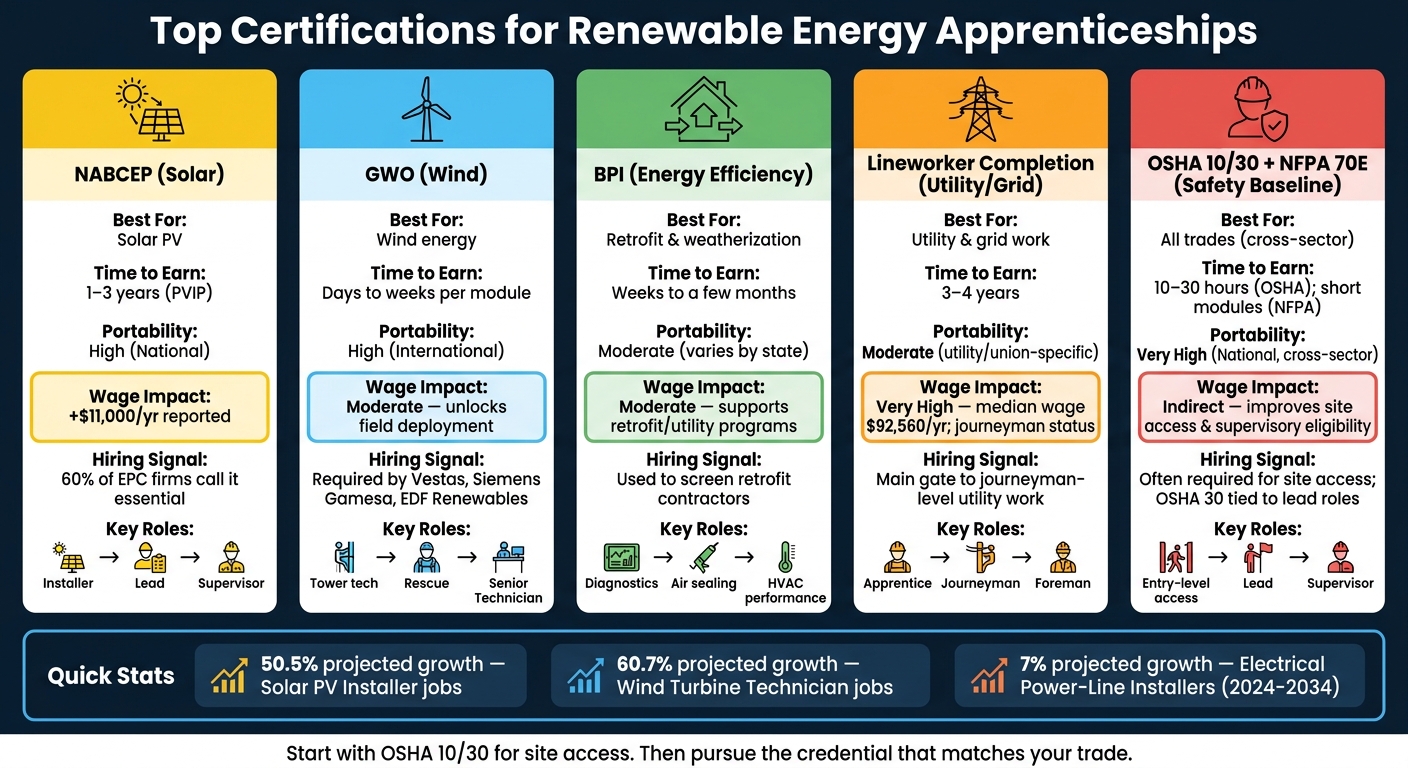
Top Renewable Energy Certifications Compared: NABCEP, GWO, BPI, Lineworker & OSHA
The Ultimate Guide to Launching your Solar Career with the NABCEP PV Associate (PVA) Credential
sbb-itb-aa28329
Quick Comparison
| Certification | Best fit | Time to earn | Main use | Hiring value |
|---|---|---|---|---|
| NABCEP | Solar | 1–3 years for upper-level certs | PV installation and system knowledge | Strong for lead and supervisor roles |
| GWO | Wind | Days to weeks per module | Tower safety, rescue, offshore, technical basics | Often needed before deployment |
| BPI | Energy efficiency | Weeks to months | Building diagnostics, insulation, air sealing | Best for retrofit and weatherization |
| Lineworker completion | Utility/grid | 3–4 years | Overhead/underground line work, switching, restoration | Main path to journeyman status |
| OSHA 10/30 + NFPA 70E | Cross-trade safety | Hours to a few days | Hazard awareness, LOTO, arc flash, shock safety | Often needed for site access |
My take: if you need broad access first, start with safety training. If you already know your trade, go straight to the credential tied to that field. The rest of this guide breaks down where each one fits, what it covers, and how employers use it.
1. NABCEP Solar PV Certifications
NABCEP (North American Board of Certified Energy Practitioners) is the top solar PV credential track in North America. It offers both Associate and Board certifications for solar workers.
Apprenticeship alignment
Most U.S. solar apprenticeships bring in NABCEP Associate material during the first 6 to 12 months. That usually happens after apprentices finish basic electrical safety and get some hands-on jobsite training. For many programs, the first big milestone is the NABCEP Photovoltaic Associate (PVA) exam.
Programs often build toward that exam with about 40 hours of PV coursework from a NABCEP Associate Registered Training Provider. Later on, usually near the end of a 2- to 4-year apprenticeship, apprentices work toward the PV Installation Professional (PVIP). By that point, they’ve usually built up solid field hours. Passing the PVA can also count toward 18 of the 58 required advanced training hours for the PVIP.
That step-by-step path matters. Employers aren’t just looking for someone who passed a test. They want people who can handle the exact tasks that come up during installation.
Core skills covered
NABCEP lines up with the daily work solar installers do on the job. That includes:
- Single-line diagrams
- Racking
- Inverters
- NEC-based DC/AC wiring
- Grounding and bonding
- Monitoring setup
Safety shows up all through the training, not as an afterthought. Apprentices learn fall protection, lockout/tagout, and safe DC/AC testing. The PVIP goes further, covering conductor sizing, overcurrent protection, rapid shutdown, and troubleshooting.
Employer recognition
NABCEP credentials carry weight with employers. Solar contractors, EPC firms, and utilities often list NABCEP as preferred or required for crew lead, site supervisor, and project manager roles.
In major solar markets like California, New York, and Texas, having a PVIP on a résumé can make a candidate more competitive. Some state incentive programs also give bonus points to projects staffed by NABCEP-certified professionals. That gives employers a direct reason to hire and move up certified workers. Certification-based workforce platforms can also use NABCEP status to place solar crews faster.
Career pathways
The PVA → PVIP → specialist path tracks well with how many solar careers grow: installer, then lead, then supervisor or project manager on commercial and utility-scale projects.
From there, specialty credentials such as the PV Design Specialist or PV Commissioning & Maintenance Specialist can open the door to design office work, engineering support, or O&M roles. Those jobs often come with steadier schedules and more responsibility. The PVIP’s ISO/IEC 17024:2012 accreditation also strengthens its standing as a recognized personnel certification.
Wind apprenticeships follow a different certification path, with more focus on turbine safety and technical rescue.
2. Global Wind Organisation (GWO) Safety and Technical Training
Where NABCEP checks solar installation skill, GWO sets the baseline for wind safety through stackable training modules. The Global Wind Organisation (GWO) uses a modular system that apprentices can build over time, usually starting with Basic Safety Training (BST) and Basic Technical Training (BTT).
Apprenticeship alignment
For many wind apprentices, GWO BST is the first formal credential they earn. In a lot of cases, they need it before they can step onto a tower or an offshore platform. The course usually runs 4–5 days – about 28–40 hours – and mixes classroom learning with hands-on drills.
Offshore programs also require the Sea Survival module. That training covers vessel transfers, man-overboard procedures, and cold-water survival.
BTT usually comes after BST in more structured training paths. It covers the basics of:
- mechanical systems
- electrical systems
- hydraulic systems
- installation and bolt-tightening
These BTT modules do not expire.
Core skills covered
BST’s five modules line up with the risks wind technicians deal with every day: First Aid, Manual Handling, Fire Awareness, Working at Heights, and Sea Survival.
This isn’t generic safety training. It’s built for wind work in remote, high-risk settings, including tower climbs, nacelle work, confined spaces, and offshore vessel transfers.
Employer recognition
Major wind employers – including Vestas, EDF Renewables, and Siemens Gamesa – either require or strongly prefer workers with GWO training. Job postings often list GWO BST or BTT as required or preferred. If a worker’s certifications aren’t current, deployment can get pushed back.
BST certificates are typically valid for two years. After that, workers need a refresher course to keep their status active.
ABLEMKR uses verifiable GWO credentials to match workers with wind roles based on training level and certification status.
Career pathways
After BST and BTT, apprentices can move into advanced modules tied to jobs with more responsibility. Advanced Rescue Training (ART) prepares workers for designated rescue duties on high-risk sites. Enhanced First Aid (EFA) supports on-site medical response roles. Control of Hazardous Energies (CoHE) covers lockout/tagout for electrical, mechanical, and hydraulic systems.
Because GWO credentials are modular and recognized across wind employers and projects, workers can build portable credentials as they move from one job to the next.
From there, energy-efficiency certifications shift the focus from turbine safety to whole-building performance.
3. Building Performance Institute (BPI) Energy Efficiency Certifications

Where GWO centers on safety at wind sites, BPI turns to building performance and energy loss.
BPI carries the most weight in retrofit and weatherization apprenticeships. In those roles, workers need to find heat loss, tighten the building envelope, and confirm energy savings. The credential shows hands-on skill in trade work like air sealing, insulation, basic HVAC performance, and building diagnostics.
That matters for the clean energy shift in a simple way: the less energy a building wastes, the less power it needs in the first place. So before new generation assets even come online, these skills help cut demand and reduce waste.
For employers, BPI signals that an apprentice can step into efficiency upgrade work without much supervision. Retrofit contractors and weatherization programs often use it to screen candidates for residential and light commercial jobs, where diagnostic accuracy and building-shell knowledge matter more than installation speed.
From building efficiency, the comparison next moves to utility lineworker completion credentials.
4. Utility Lineworker Apprenticeship Completion Credentials
Solar, wind, and grid-upgrade work still needs skilled lineworkers. Someone has to build, connect, and maintain the lines that move power from one place to another. So while BPI helps on the demand side, lineworker credentials support the grid-side work that renewable projects still rely on.
Apprenticeship alignment
Utility lineworker apprenticeships usually last 3–4 years and end with a portable, nationally recognized completion credential. In most cases, finishing the program leads to a DOL or state certificate, journeyman status, and sometimes college credit. Many programs also use NCCER-based curricula and a registry that makes employer verification easier and faster.
Core skills covered
Graduates are trained to take on the work employers need done in the field: overhead and underground line work, transformer installation, splicing, termination, and switching/tagging. That matters because the credential shows proven field ability across the jobs that keep utility systems moving, including construction, maintenance, interconnection, and restoration.
Employer recognition
For utilities, apprenticeship completion is the main gate to journeyman-level work. And because the credential is recognized across the country, it helps with multi-state hiring and deployment. That’s a big deal for renewable buildouts, where crews may need to move fast between interconnection projects, substations, transmission upgrades, and storm restoration in renewable-heavy corridors.
Electrical power-line installers and repairers earned a median annual wage of $92,560 in the U.S. Employment in that category is projected to grow 7% from 2024 to 2034, which points to a strong long-term job market.
Career pathways
After finishing the apprenticeship, workers often move into journeyman roles in distribution, transmission, or substation departments. From there, the path can lead into higher-voltage transmission, system protection and control, foreman roles, and project management.
Because DOL- and NCCER-tracked credentials are portable, workers can move among municipal utilities, investor-owned utilities, rural electric cooperatives, and line-construction contractors without much friction in how their qualifications are recognized.
These credentials also rest on the safety rules covered next in OSHA 10/30 and NFPA 70E.
5. OSHA 10/30 and NFPA 70E Safety Certifications
OSHA 10/30 and NFPA 70E are the baseline safety credentials for renewable apprenticeships. They aren’t trade-specific certs. Instead, they’re the first safety checks many renewable employers look for.
You’ll see them across construction and energy work, including solar, wind, utility, and efficiency jobs. They don’t replace NABCEP, GWO, BPI, or lineworker training. They sit alongside those certs and support work across almost every role.
Apprenticeship alignment
OSHA 10 is often the first safety credential an apprentice earns, usually right at the start of an apprenticeship. It’s built for entry-level workers who need to spot common jobsite hazards and avoid them.
OSHA 30 usually comes later, often in year 2 or 3, when an apprentice is moving toward a lead or supervisory role. On many union and public-works jobs, OSHA 10 is needed just to get on site, while OSHA 30 is tied to lead positions.
NFPA 70E covers energized-work rules that trade-specific training often doesn’t get into in enough detail. And because NFPA 70E is updated on a regular basis, apprenticeship programs need refreshers to keep electrical safety training current.
Core skills covered
OSHA 10 and OSHA 30 both cover the Focus Four hazards:
- falls
- struck-by
- caught-in/between
- electrocution
They also cover PPE, lockout/tagout (LOTO), hazard communication, and emergency preparedness. That lines up directly with the kind of work apprentices face on solar farm construction, wind turbine erection, and substation projects.
OSHA 30 goes further than OSHA 10. It adds more depth on incident reporting, hazard analysis, and site safety culture management.
NFPA 70E fills a gap that OSHA 10/30 can’t. It gets much deeper into arc flash and electrical shock protection. That training helps workers identify arc-flash boundaries, choose the right PPE, and apply LOTO before working on inverters, switchgear, PV arrays, and energized utility equipment. In those settings, de-energized-work rules aren’t just paperwork – they matter on the ground.
Employer recognition
These credentials are common screening requirements for employers in solar, wind, and utility work. Many public construction contracts and union agreements require at least OSHA 10, and some EPC firms require OSHA 30 for foremen.
NFPA 70E training is also showing up more often as proof that a worker is qualified in electrical safety, especially when the job involves exposed energized equipment.
| Certification | Target Audience | Training Length | Key Focus |
|---|---|---|---|
| OSHA 10 | Entry-level apprentices | 10 hours | General hazard recognition, site safety basics |
| OSHA 30 | Lead workers, supervisors | 30 hours | Hazard analysis, safety management, supervisory responsibilities |
| NFPA 70E | Electrical and utility workers | Varies | Arc flash, shock boundaries, energized work, LOTO |
Next, compare these credentials by hiring impact, training depth, and speed to deployment.
Strengths, Tradeoffs, and Hiring Value by Certification
These credentials don’t all do the same job. Some help a new worker get on-site fast. Others take years but lead to better pay and stronger long-term career paths. The right pick depends on the path ahead: solar, wind, energy efficiency, utility work, or broad jobsite safety.
Here’s a side-by-side look at fit, speed, and hiring value.
| Certification | Portability | Time to Earn | Focus | Wage / Advancement Impact |
|---|---|---|---|---|
| NABCEP Solar PV | High (national) | 1–3 years to PVIP | Technical | Strong – board-certified professionals report about $11,000 more per year; 60% of EPC firms consider it essential or very important when hiring |
| GWO Safety & Technical | High (international) | Days to weeks per module | Safety + Technical | Moderate – helps workers access wind field roles and senior technician jobs |
| BPI Energy Efficiency | Moderate (varies by state program) | Weeks to a few months | Technical | Moderate – supports retrofit work and utility efficiency programs |
| Utility Lineworker Apprenticeship Completion | Moderate (utility/union-specific) | 3–4 years | Technical + Safety | Very high – leads to journeyman status, strong base wages, and grid-side skills renewable projects still need |
| OSHA 10/30 & NFPA 70E | Very high (national, cross-sector) | 2–4 days (OSHA); short modules (NFPA) | Safety | Indirect – improves site access and employability; OSHA 30 and NFPA 70E are often expected for supervisory roles |
NABCEP has the clearest pay upside in solar. Board-certified workers report about $11,000 more per year, and 60% of EPC firms say it is essential or very important when hiring. That said, it’s not a fast-start credential. PVIP requires documented field hours, so beginners usually can’t knock it out right away.
GWO is much faster. A worker can finish modules in days or weeks, which makes it a strong fit for wind crews that need people ready for field deployment. It matters even more for work at height and offshore jobs. The downside is simple: its value is tied closely to wind and other high-risk settings.
BPI fits retrofit and weatherization work well. It also helps with utility efficiency programs. But outside those lanes, it doesn’t carry as much weight.
Utility lineworker apprenticeships ask for the biggest time commitment at 3–4 years. Still, the payoff is hard to ignore. Workers reach journeyman status, move into strong base wages, and build grid-side skills that renewable projects still rely on.
If speed matters most, OSHA 10/30 and NFPA 70E are often the first stack to get. They’re broad, fast, and recognized across sectors. These are not trade credentials, though. Think of them as table-stakes for access and hiring. Even so, OSHA 30 and NFPA 70E are showing up more often as expected credentials for supervisory and electrical roles across solar, wind, and utility work.
For employers, the hard part is knowing who can mobilize now, not just who looks good on paper. ABLEMKR keeps worker certifications, safety training, availability, and location in one place for faster mobilization.
Conclusion
Across these apprenticeship paths, the main thing is fit, speed, and jobsite readiness. The best certification comes down to the trade, the risks on that site, and how fast an apprentice needs to get to work.
The match has to be direct: NABCEP for solar, GWO for wind, BPI for efficiency, utility lineworker completion for grid work, and OSHA/NFPA 70E for site safety. Specialty credentials help line a worker up with the right trade. Safety credentials often decide whether they can get on-site in the first place.
OSHA 10/30 and NFPA 70E are the safety baseline across all of these paths. They’re fast to earn, and employers recognize them across construction, utilities, and industrial energy. That matters because these credentials affect how fast apprentices can get hired, deployed, and earn more – whether they want early access to jobs, a trade-specific path, or a move toward journeyman status.
Put simply, the right credential opens the right door. The wrong one slows deployment. For employers, ABLEMKR helps match certified workers to jobs based on skill, safety training, location, and availability.
FAQs
Which certification should I get first?
If you’re getting started in renewable energy or temporary power technical work, OSHA 10-Hour or 30-Hour Construction Safety is usually the first thing to get. On many U.S. energy job sites, it’s the basic safety card you need before you can even set foot on the project.
Once that’s in place, employers often want to see certifications tied to the work itself. For example, NCCER Industrial Maintenance Mechanic can help for mechanical roles, while NCCER Electrical is often a fit for work around energized systems.
Do I need certification before starting an apprenticeship?
No. You do not always need formal certification before starting an apprenticeship.
Registered Apprenticeship programs are designed to teach you on the job. That means you get hands-on training and classroom instruction while you work and earn pay.
That said, some entry-level roles or employers may want you to have a basic certification like OSHA 10 before you start. If a full apprenticeship feels like too much right now, a pre-apprenticeship program can help you build the basic skills and get ready for the next step.
Which certifications are most recognized by U.S. employers?
U.S. employers tend to put the most weight on certifications that prove three things: safety training, technical skill, and specialized expertise.
On the safety side, OSHA 10-Hour or 30-Hour Construction Safety is the go-to standard. In many cases, it’s the basic ticket for site access and a clear signal that a worker understands core job-site safety rules.
For hands-on roles, NCCER Industrial Maintenance Mechanic and Electrical credentials are widely recognized across the U.S. They show that someone is ready to work in the field, not just talk about the job in theory.
In renewable energy, NABCEP credentials are the standard for solar and energy storage positions. If a candidate wants to work in those areas, this is often the name employers look for first.
For more senior, planning-focused roles, the Association of Energy Engineers’ CEM and REP also carry a lot of weight. These certifications are well regarded for strategic and project management positions.


