
If you need energy storage technicians fast, the fix is simple: tighten the role, use the right hiring channels, test only day-one skills, and move compliance at the same time. Skilled trades hiring already averages 56 days, and even a short delay can push back commissioning, inspections, or site coverage.
Here’s the short version:
- Define the job first. Be clear on duties, voltage exposure, travel, on-call needs, and physical demands.
- Hire for baseline electrical skill and safety. BESS experience helps, but solid people from solar, wind, industrial maintenance, substations, or military technical work can often step in.
- Use the fastest source for urgent needs. Energy recruiting channels and pre-vetted labor pools can produce candidates in 24–72 hours. School programs are better for a 4–8 week bench build.
- Keep screening short. A 10–15 minute first call plus a 30–45 minute task-based screen is enough to filter for site fit, LOTO, meter use, and one-line reading.
- Run onboarding in parallel. Background checks, MVR, drug testing, cert review, and payroll forms should move together so people can be site-ready in 1–3 days.
A few numbers stand out:
- Skilled trades average time-to-hire: 56 days
- Urgent technician mobilization: 24–72 hours
- School pipeline timeline: 4–8 weeks
- Common travel radius: 50–75 miles
- Common overnight travel: 25%–50%
- Typical on-call rotation: 1 week in 4
- Common pay range in the article: $35–$55/hour
My main takeaway: don’t treat this like a general hiring process. Treat it like project staffing with safety gates. That is how you cut delay without lowering standards.
The article below walks through that plan from role setup to first shift.
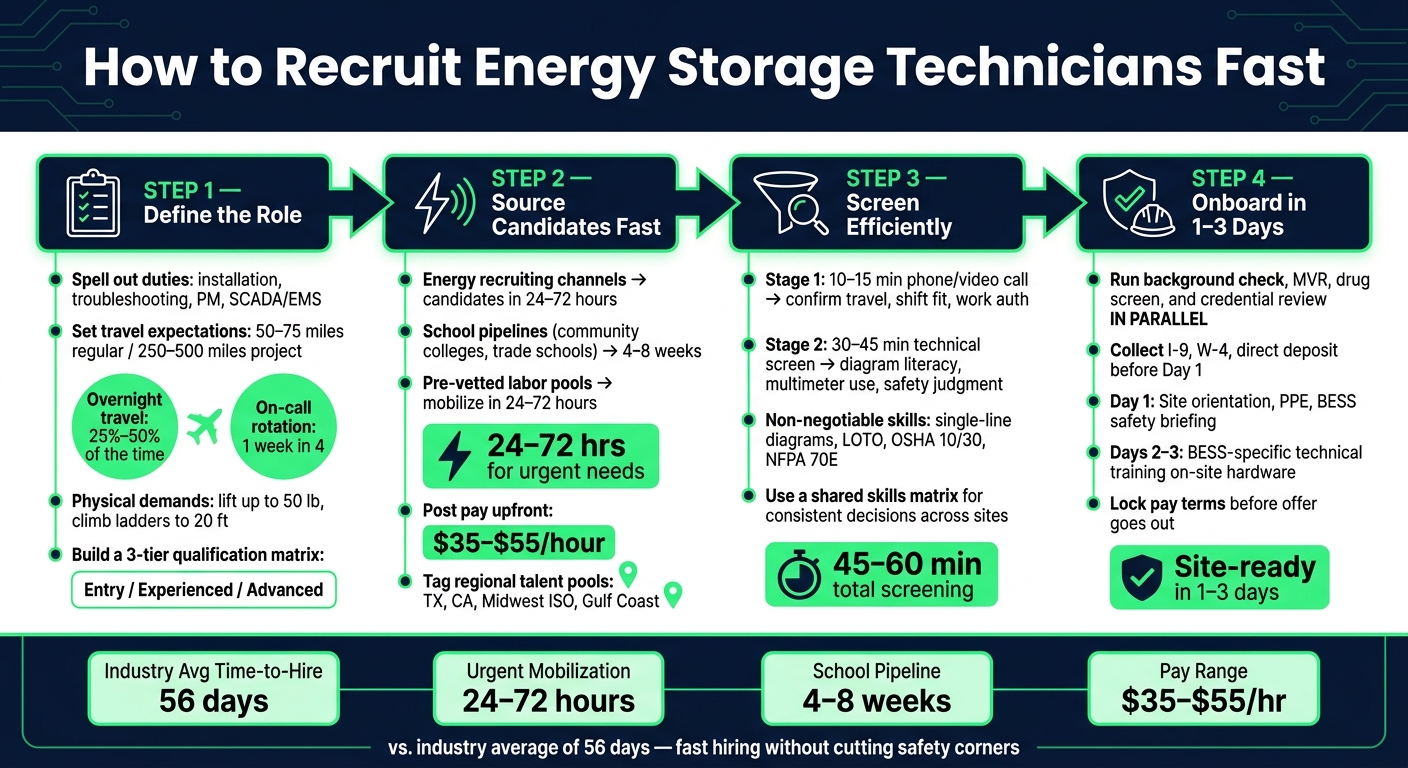
How to Recruit Energy Storage Technicians Fast: 4-Step Hiring Process
1. Define the Role Before You Start Recruiting
Define the role before you start sourcing. The more specific you are, the less time you waste on screening and bad-fit interviews. This role definition should also feed straight into the screening checklist in the next step.
List Exact Job Duties and Site Conditions
A solid profile should spell out four main task areas:
- Installation and commissioning: Mount and wire battery racks, pull and terminate DC and AC cabling, perform megger tests, verify polarity and torque, and run OEM start-up checklists.
- Troubleshooting: Read BMS and EMS alarms, diagnose DC and three-phase AC faults with a multimeter and clamp meter, and replace failed modules or contactors.
- Preventive maintenance: Handle visual inspections, HVAC checks, and battery state-of-health assessments.
- SCADA/EMS: Log into monitoring interfaces, acknowledge and escalate alarms, and follow SOPs for system shutdown and restart.
You also need to define the job site reality, not just the tasks. Travel may run 50–75 miles from the base site on a regular basis, with occasional trips of 250–500 miles for project mobilizations. Overnight stays may come up 25%–50% of the time. The schedule is usually Monday through Friday, 7:00 a.m.–3:30 p.m., with some evening or weekend work during commissioning or outages, plus an on-call rotation of 1 week in 4. Physical demands include lifting and carrying up to 50 lb on a frequent basis, occasional team lifts above 50 lb, climbing ladders up to 20 ft, and working in confined or elevated spaces.
Set Minimum and Preferred Qualifications
Now turn the job profile into must-haves and nice-to-haves. This is where a fuzzy role becomes a usable hiring filter.
Minimum qualifications:
- Valid driver’s license and U.S. work authorization
- Ability to pass a background check and drug screen
- Basic familiarity with low-voltage DC circuits, three-phase AC distribution, single-line diagrams, and safe use of a digital multimeter and clamp meter
- 1–2 years of hands-on experience in electrical, solar, industrial maintenance, or a related field; trade-school and military technical backgrounds should count even without direct BESS experience
- OSHA 10 within the first 30–90 days and documented LOTO training per OSHA 29 CFR 1910.147
Preferred qualifications:
- OSHA 30 and NFPA 70E training completed within the last three years
- Documented LOTO experience on 480V and higher equipment
- Associate degree in electrical technology or mechatronics
- OEM-specific BESS training from manufacturers such as Tesla, Fluence, or Powin
- Experience with SCADA/EMS platforms
- For utility-scale projects, experience commissioning or servicing systems above 600V AC or 1,000V DC
Qualifications Table for Quick Hiring Decisions
Use this matrix to screen based on project complexity. It works as the filter for sourcing and first-pass screening.
| Criteria | Entry-Level | Experienced | Advanced |
|---|---|---|---|
| Education | High school diploma or GED; trade school preferred | Trade/technical certificate or associate degree | Associate degree minimum; bachelor’s in engineering or equivalent preferred |
| Safety Certifications | OSHA 10 within 30–90 days; basic LOTO training | OSHA 30; NFPA 70E; documented LOTO on 480V+ | OSHA 30; NFPA 70E; state journeyman license or NABCEP certification; OEM BESS training |
| Technical Skills | Basic DC/AC understanding; tool use under supervision; reads simple single-line diagrams | Independent troubleshooting of DC and three-phase AC faults; comfortable with EMS/SCADA | Leads commissioning; interprets complex power quality issues; mentors technicians; HV/MV switching experience |
| Field Experience | 0–2 years in electrical, solar, or industrial maintenance | 2–5 years with some BESS or adjacent field exposure | 5+ years on utility-scale or complex BESS projects |
| Typical Project Fit | Small C&I BESS under close supervision | Mid-size projects with moderate complexity | Utility-scale, grid-connected, or NERC-regulated facilities |
sbb-itb-aa28329
2. Build a Sourcing Pipeline That Produces Candidates Quickly
Once the role is clear, the next step is building a pipeline that brings in qualified candidates fast.
Start with energy-sector channels. They usually cut screening time because the people in those channels already know site work, travel schedules, and the pace of field jobs. Your posting should spell out the details right away: site type, certifications, shift, travel, and pay. That means calling out things like utility-scale BESS, OSHA 10/30, NFPA 70E, state license, site badges, and $35–$55/hour. When the post is clear, qualified candidates often come in within 24–72 hours.
It also helps to think regionally. Technicians in active energy corridors such as Texas, California, the Midwest ISO region, and the Gulf Coast are already used to site-based work and travel. If you keep a regional talent pool tagged by certifications and availability, you can shrink urgent dispatch to 24–72 hours instead of dragging it out for weeks.
Use Energy-Focused Recruiting Channels and Training Pipelines
Community colleges, trade schools, and apprenticeship programs across U.S. energy corridors give you a steady mid-speed pipeline. Electrical technology and industrial maintenance programs often include renewable energy and battery-system training. In many cases, graduates already know DC systems, inverters, LOTO procedures, and basic troubleshooting.
Utilities have already funded community-college training pipelines, which makes these programs even more useful. A direct relationship with program coordinators can help you get in front of strong students before they hit the open market. Another smart move is sponsoring a lab module that mirrors BESS work, so students train on tasks that look like the job they’ll step into.
This channel usually works on a 4–8 week timeline, so it’s best for building your bench before the project starts.
Use ABLEMKR to Deploy Pre-Vetted Field Talent Faster
For urgent energy storage mobilizations or compliance-heavy projects, ABLEMKR can cut dispatch time.
If you’re dealing with an unplanned outage, a commissioning delay, or a safety-related retrofit, you submit the project details and ABLEMKR surfaces pre-vetted technicians who can mobilize within 24–72 hours. Embedded onboarding and compliance tracking handle document collection, safety records, and site access requirements in 1–3 days.
For planned work, the process looks a little different. You send a forecasted demand profile before ramp-up, and ABLEMKR builds a phase-specific technician pool – electrical, commissioning, and O&M – so candidates are ready as each phase starts.
Sourcing Methods Compared by Speed and Fit
Each sourcing channel fits a different hiring situation. Some are better for bench building. Others are built for short-notice field demand.
| Sourcing Method | Typical Time-to-Fill | Candidate Verification Level | Best Use Case | Suitability for Remote or Urgent Projects |
|---|---|---|---|---|
| School pipelines (community colleges, trade schools, apprenticeship programs) | 4–8 weeks | High on formal training; moderate on BESS-specific field readiness | Sustained workforce for recurring projects, O&M teams, entry-level roles | Low – better for planned deployments with lead time |
| Direct job outreach (industry job boards, regional recruiting) | 1–3 weeks | Variable; depends on employer’s own screening process | Mid-term hiring for known projects, expansions, or replacements | Moderate – works well with strong regional networks and fast screening |
| ABLEMKR workforce deployment | 24–72 hours (urgent); 1–2 weeks (larger crews) | High – pre-vetted with embedded certification, safety, and compliance tracking | High-demand, high-risk energy projects requiring fast mobilization and compliance assurance | Strong – geo-location and availability filters make it effective for short-notice or remote sites |
For urgent openings, use the fastest source first, then move those candidates into a short safety-and-skill screen.
3. Screen for Technical Skill and Safety Without Slowing Down
Move fast, but don’t wing it. Screen against the role definition and qualification matrix you already set. A focused two-stage screen helps you hire faster without cutting corners on safety or quality.
Run a Short First-Pass Screen
As soon as candidates come in from the fastest source, move them into a short screen. A 10–15 minute phone or video call is enough to confirm work authorization, travel readiness, shift fit, and whether they’re comfortable with outdoor work, remote sites, and high-voltage equipment.
This first pass should check the minimum qualifications from Section 1, then confirm the practical stuff that can make or break field work. A simple go/no-go checklist keeps the call tight and helps your team make the same call on the same facts.
Test the Skills That Matter on Day One
After that, use a 30–45 minute technical screen built around actual site tasks. Keep the focus on the work that affects safe startup, troubleshooting, and uptime.
Three areas matter most:
- Diagram literacy: Share a simplified single-line of a BESS – battery racks, DC combiner panels, inverters, transformers, and grid interconnection. Then ask the candidate to trace power flow, point out isolation points, and explain where LOTO would apply before work starts.
- Instrument use: Ask the candidate to walk through how they’d safely measure DC string voltage with a multimeter, including range selection, lead placement, and what they’d do if the reading looked wrong.
- Safety judgment: Give them a scenario like, "A battery container shows an active thermal alarm. What do you do before opening it?" Strong answers should mention checking BMS data, following site procedures, and refusing to skip safety steps even when the clock is ticking.
NFPA 70E specifies that only qualified persons may perform testing and troubleshooting on electrical equipment. That’s a big reason to use the technical screen to verify qualification before anyone gets near field work.
Skills Matrix for Consistent Hiring Decisions
A shared skills matrix helps keep hiring decisions aligned across sites. Use the qualification matrix from Section 1 as your baseline, then screen for day-one readiness.
| Skill / Behavior | Required Level | Assessment Method | Decision Rule |
|---|---|---|---|
| Read single-line/one-line diagrams | Working | Diagram exercise – trace power flow, identify isolation points | Non-negotiable |
| Use multimeter on DC/AC circuits up to 600 V | Working | Brief practical or verbal walkthrough with safety steps | Non-negotiable |
| Troubleshoot electrical faults (ground faults, contactor failures, BMS alarms) | Basic–Working | Fault scenario question | Required; gaps addressable in onboarding |
| LOTO procedure knowledge | Working | Scenario: "Walk me through locking out a BESS inverter cabinet" | Non-negotiable |
| OSHA 10/30 and NFPA 70E awareness | Basic | Certificate review + scenario-based safety question | Non-negotiable |
| Battery system fundamentals (SoC, thermal management, alarm types) | Basic | Use this row to separate core electrical competence from trainable BESS-specific knowledge | Preferred; trainable if electrical fundamentals are strong |
| Travel readiness and shift acceptance | Confirmed | Phone screen checklist | Non-negotiable |
OEM-specific gaps can wait until training. If a candidate clears this screen, they can move straight into compliance checks and site onboarding.
4. Close the Hire Fast With Streamlined Compliance and Onboarding
Once a candidate clears the skills matrix, the next slowdown is usually compliance and site access. The fix is simple: give each post-offer step one owner and one deadline. At this stage, speed comes from running tasks at the same time, not from adding more screening.
Verify Credentials, Background, and Pay Terms Quickly
As soon as the candidate accepts, move straight into document collection. Don’t run checks one after another. Run them in parallel.
The moment a candidate accepts a verbal offer, start the background check, credential review, and motor vehicle record check (MVR) at the same time if the job includes driving between sites. If your policy calls for drug screening, launch that in the same workflow too.
For credentials, confirm OSHA 10 or OSHA 30 cards, NFPA 70E training certificates, any state electrical licenses that apply, and OEM or manufacturer training records. Collect photos or PDFs in the onboarding portal at the offer stage so the safety coordinator can verify them once against issuer records.
Pay terms need to be locked in before the offer goes out, not during onboarding. Attach a one-page pay terms sheet to the offer letter that spells out:
- Base hourly rate
- Overtime rules
- Any shift differential for night shifts
- Per diem for remote projects
- Travel reimbursement terms
Have both parties sign it electronically. That cuts down on last-minute renegotiation that can push back the start date.
If you’re sourcing through ABLEMKR, workers carry pre-validated certification records and background check status in their profiles. That means your team is checking current status instead of building a compliance file from scratch.
Run a 1- to 3-Day Onboarding Workflow
The goal is site-ready work on Day 1, not just a finished paperwork file.
Before Day 1, have the technician complete Form I-9 Section 1, W-4, direct deposit authorization, and emergency contact forms electronically. USCIS requires employers to complete Section 2 of Form I-9 within three business days of the employee’s first day of work. Also send pre-work safety modules on NFPA 70E basics and company policy so they can finish them before arrival.
On Day 1, keep the focus on the site itself: facility layout, access routes, muster points, PPE rules, and a safety briefing on hazards tied to BESS – shock, arc flash, thermal runaway, LOTO, and confined space. NFPA 70E Article 320 applies to exposed stationary storage batteries exceeding 50 volts. Document the briefing with a supervisor sign-off.
Days 2–3 should cover BESS-specific technical training tied to the hardware on site. That includes start-up and shutdown sequences, alarm handling, monitoring interfaces, and emergency shutdown procedures. Match the depth of training to the role. Track completion by person and task before anyone works without supervision.
Onboarding Workflow Table With Owners and Timelines
| Step | Owner | Deadline |
|---|---|---|
| Verbal offer and pay terms confirmation | Hiring Manager | Same business day as decision |
| Offer letter + pay terms sheet sent and signed | HR | Within 4 business hours of verbal offer |
| Background check and MVR initiated | HR | Within 4 business hours of signed offer |
| Drug screen scheduled | HR / Safety Coordinator | Within 1 business day of signed offer |
| Credential verification (OSHA, NFPA 70E, licenses) | Safety Coordinator | Within 1–2 business days of signed offer |
| I-9, W-4, direct deposit, and emergency contacts collected | HR | Completed before Day 1 on site |
| Pre-work safety modules assigned and completed | HR / Technical Lead | Completed before Day 1 on site |
| Travel and lodging confirmed (remote sites) | Project Coordinator | At least 1 business day before start |
| Site orientation and safety briefing | Site Supervisor / Safety Lead | Day 1 on site |
| BESS-specific technical training | Technical Lead / Commissioning Engineer | Days 1–3 on site |
| Shift assignment and supervisor introduction | Project Manager | Confirmed before first on-site shift |
Use this sequence as the default handoff from offer to first shift. After each hire, review the table. If the same step keeps slipping – credential collection, drug screen scheduling, or travel booking – change the owner or add an automated reminder.
Conclusion: The Fastest Way to Recruit Energy Storage Technicians
Fast hiring comes from cutting process delays without cutting corners on safety or compliance. The four-step workflow – role definition, sourcing, screening, and onboarding – keeps every stage connected. Each step sets up the next, which is why the process moves faster when it’s mapped out from the start.
When that process is clear up front, vetted shortlists can be delivered in as little as 48–72 hours. But that kind of speed doesn’t happen by accident. It starts with defining the role before sourcing begins.
Key Points to Carry Into Your Next Hire
Write a precise job scope before you post anything. If the description is vague, you’ll pull in the wrong candidates and slow down every decision that follows. Treat safety credentials and electrical qualifications as pass/fail filters, not nice-to-haves. Then use the same skills matrix for every candidate so hiring decisions stay consistent across projects and across hiring managers.
The 1–3 day onboarding workflow only works when each step has a clear owner and a clear deadline. Spell that out early, then track each handoff so paperwork, safety orientation, and technical integration keep moving.
After each project, track your time-to-fill, time-to-site-readiness, and early safety incident rates. Those numbers show where your process gets stuck and where it moves well. Start workforce planning months before kickoff if you want shorter hiring cycles.
FAQs
What skills matter most for a fast hire?
Prioritize candidates with verified, current credentials that meet both safety and technical requirements. In most cases, employers look first for OSHA 10 or 30 for site access. After that, they often check for NCCER Industrial Maintenance or Electrical credentials as standardized proof of skill.
Role-specific certifications like NABCEP Energy Storage Installation Professional (ESIP) can also help confirm battery system experience. When documents are pre-verified and up to date, hiring moves with fewer delays and workers can be deployed right away.
Can technicians from solar or industrial roles transition into BESS work?
Yes. Technicians with solar or industrial experience can move into BESS work, especially if they already know electrical systems and safety procedures.
The shift makes sense. BESS projects are often built alongside solar farms, so the work overlaps in a lot of ways.
That said, BESS brings its own set of risks. Extra training helps technicians get ready for storage-specific electrical and thermal hazards. Common options include the NABCEP Energy Storage Installation Professional (ESIP) credential and advanced high-voltage training.
How can I speed up onboarding without risking compliance?
To make onboarding faster without slipping on compliance, swap manual HR tasks for digital, mobile-first workforce management platforms. These tools can check worker credentials, safety records, and training certifications against site rules, including OSHA standards, before anyone arrives on-site.
They can also monitor certification expiration dates in real time and start background checks automatically. That helps make sure only qualified, safety-cleared workers are sent out, while cutting down on admin work done by hand.


