
Real-time monitoring can cut risk on energy sites, but only when alerts lead to action. From gas sensors and wearables to cameras, SCADA, and digital twins, the pattern is clear: teams get better results when worker data, hazard data, and response steps work together.
Here’s the short version:
- Wearables can flag heat stress, fatigue, and body strain before someone gets hurt. One case showed a 62% drop in heat-stress incidents.
- Fixed gas sensors can spot exposure in confined spaces and log more events than manual checks. One rollout reported a 450% increase in documented gas exposure events.
- Location tracking helps with geofencing, lone-worker safety, and man-down alerts. One deployment cut response times by 76% and reached 99.7% zone compliance.
- Computer vision can spot missing PPE and unsafe movement near equipment. A 2026 deployment cut undetected violations by 80% and reduced manual monitoring time by 60%.
- SCADA and digital twins help teams see equipment issues and site risk in context, not just as isolated readings.
- The main weak spots are false alarms, bad connectivity, privacy concerns, and stale worker records.
- Contractor risk stands out: 81% of 2024 IOGP fatalities involved contractors.
The bottom line: live safety data matters most when the system knows who the worker is, where they are, what they’re cleared to do, and who responds when an alert fires.
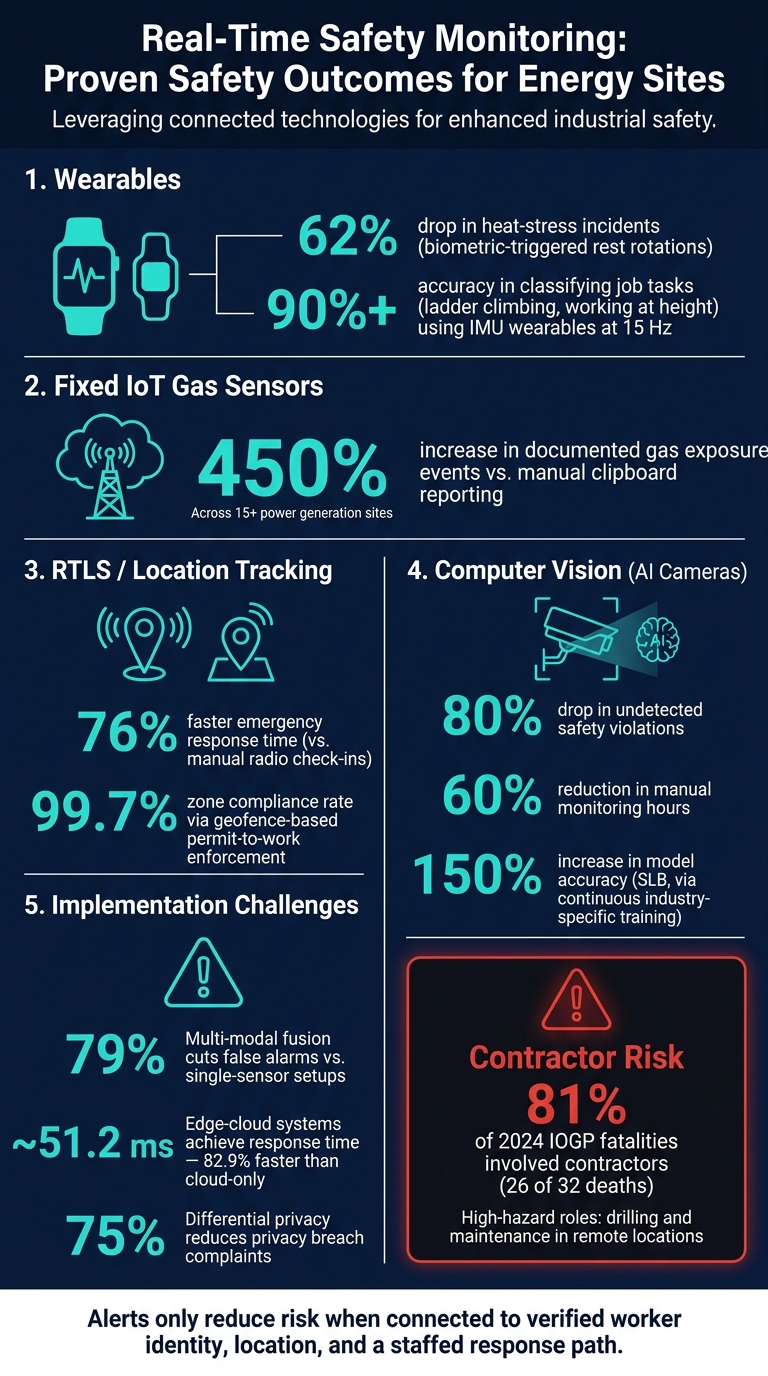
Real-Time Safety Monitoring: Key Stats & Outcomes for Energy Sites
What Research Shows About Wearables, IoT Sensors, and Location Tracking
Wearables for Exposure, Fatigue, and Ergonomic Risk
On energy sites, wearables now track heart rate variability, skin temperature, posture, and exposure in real time. And the research is moving past one-device setups. More teams are using multimodal systems that combine physiological, biomechanical, and site-condition data to cut down on false alarms.
That shift matters because single-signal wearables can miss early signs of heat stress and fatigue. One independent power producer saw a 62% drop in heat-stress incidents after biometric triggers were used to drive rest rotations inside its connected worker platform.
Fatigue monitoring works in much the same way. Inertial measurement units (IMUs) built into wearables can classify job tasks like ladder climbing and working at height with more than 90% accuracy, even at low sampling rates of 15 Hz. For safety teams, that kind of detail is useful. It shows ergonomic risk patterns across shifts before a musculoskeletal injury claim lands on someone’s desk.
Location data is what helps turn those signals into action.
Fixed Sensors and RTLS for Hazard Detection and Worker Positioning
If wearables show worker strain, fixed sensors show what the site is doing around them. In confined spaces like boiler interiors and turbine basements, connected sensors continuously monitor hydrogen sulfide, carbon monoxide, lower explosive limit, and oxygen levels. They also log cumulative exposure against shift limits and trigger evacuation when thresholds are crossed. Across more than 15 power generation sites, automatic IoT logging led to a 450% increase in documented gas exposure events compared with manual clipboard reporting.
Real-time location systems, or RTLS, add the next layer. GPS works well outdoors. BLE beacons help indoors. Ultra-Wideband (UWB) can push accuracy down to the sub-meter level in high-risk permit-to-work zones. In the same deployment, geofence-based permit-to-work enforcement reached a 99.7% zone compliance rate, while automated man-down detection cut emergency response times by 76% compared with manual radio check-ins.
In 2024, Mubadala Energy and SLB rolled out an integrated HSSE solution across offshore operations in Malaysia. Using SLB’s Lumi Operational Data Foundation, the project combined Edge AI for red-zone alerts, smartwatches for fatigue analytics, and flare stack sensors for GHG monitoring. The setup automated safety checks across 12 areas of a production platform.
Taken together, these studies fall into three practical layers: worker sensing, hazard sensing, and location tracking.
| Technology Type | Energy Use Case | Data Collected | Documented Safety Outcomes |
|---|---|---|---|
| Wearables (Watches/IMU) | Fatigue and heat stress monitoring | HRV, skin temperature, posture, 3-axis acceleration | 62% fewer heat incidents; 90%+ activity classification accuracy |
| Fixed IoT Sensors | Confined spaces and flare stacks | Hydrogen sulfide, carbon monoxide, LEL, oxygen levels, GHG levels | 450% increase in exposure logging; automated evacuation triggers |
| RTLS (GPS/BLE/UWB) | Lone worker safety and permit-to-work zones | Sub-meter worker/asset coordinates, geofencing | 76% faster emergency response; 99.7% zone compliance |
sbb-itb-aa28329
How Computer Vision, SCADA, and Digital Twins Expand Site Visibility
Computer Vision for PPE Compliance and Unsafe Behavior Detection
Computer vision expands site visibility beyond worker status and zone access into something more direct: what people are doing on site right now. AI-enabled cameras can spot missing helmets, gloves, boots, and safety harnesses in real time. They can also flag workers who are in the line of fire near heavy equipment.
Recent field use shows clear results. In May 2026, AcuPrism deployed an AI machine vision system for a major oil and gas company using Azure Databricks and Kafka for real-time PPE monitoring. The system led to an 80% drop in undetected safety violations and a 60% reduction in manual monitoring hours. Research also keeps pointing to the same places first: red zones and heavy-equipment corridors. Those areas should get CV coverage early because that’s where personnel exposure risk is highest.
That said, CV has limits. Motion blur, poor lighting, weather, and weak camera placement can all hurt accuracy. SLB tackled this with a six-stage implementation framework for worker and PPE detection on drilling rigs. By continuously training models with diversified, industry-specific data, SLB increased model accuracy by 150%.
SCADA and Digital Twins for Asset Integrity and Early Warning
After worker behavior, the next layer is equipment telemetry. SCADA continuously measures pressure, flow, temperature, and other process parameters across pipelines, plants, and utility assets. When readings move outside safe operating ranges, the system sends alerts.
Digital twins build on that stream of data by adding site context. Instead of staring at raw telemetry, operators get a live 3D mirror of the physical site. That view pulls together data from SCADA, IoT sensors, and video feeds at the same time, which helps with anomaly detection, predictive maintenance, and scenario testing before conditions get worse.
Put simply, SCADA tells you what the equipment is doing. Digital twins show where that activity sits inside the site and what’s nearby. SCADA can track equipment conditions, but it can’t show a worker’s position next to a hazard zone. Digital twins close that gap by placing worker location beside live hazard data, so operators can see risk in context.
What Studies Say About Implementation, Limits, and Workforce Readiness
Common Adoption Barriers Found in the Literature
The main problem isn’t getting more data. It’s turning alerts into fast, dependable action.
False alarms are one of the biggest roadblocks. Single-sensor systems often create noisy data, which makes teams less likely to trust what they’re seeing. Studies show that multi-modal fusion – combining vision, vibration, and RFID – can cut false alarms by up to 79% compared with single-sensor setups. That matters on the ground. If alerts go off too often for the wrong reason, people start tuning them out.
Connectivity is another weak spot, especially at remote U.S. energy sites. Cloud-only systems can add too much delay for live safety calls. By contrast, edge-cloud systems can bring emergency response times down to about 51.2 ms, which is 82.9% faster than cloud-only setups. In places where coverage drops in and out, pairing 5G with LoRaWAN can help keep the system online.
Privacy is also part of the picture. Workers are understandably careful about nonstop collection of biometric and GPS data. Differential privacy, which adds small data adjustments to lower the risk of identifying a person, has been shown to reduce privacy breach complaints by 75%.
Track response time, near-miss frequency, Red Zone breaches, and fault-warning speed.
Why Qualified Staffing and Compliance Data Matter in Real Time
Implementation depends on matching alerts to the right worker, role, and clearance.
Monitoring tools are only as good as the workforce data behind them. Studies show that real-time alerts become more useful when systems connect to worker identity, certifications, proficiency, and role-based permissions.
This is even more important for contractors. According to 2024 IOGP safety performance data, 81% of fatalities – 26 out of 32 deaths – involved contractors, many of them doing high-hazard work like drilling and maintenance in remote locations. One practical step is to verify credentials before mobilization instead of waiting until arrival.
Real-time alerts only work when worker identity, certifications, availability, and location data stay current. ABLEMKR matches pre-vetted workers to energy job sites based on certifications, safety training, availability, and geo-location, helping operators keep workforce records current. If a Red Zone alert fires, the system needs to know whether the worker nearby is cleared for that zone. If a fatigue sensor triggers, supervisors need current worker status and availability data right away.
The table below shows how each safety technology category maps to the workforce data it needs and the related deployment workflow.
| Safety Technology Category | Workforce Data Requirements | Deployment Workflow |
|---|---|---|
| Wearable Exposure/Fatigue | Biometric index (heart rate, temperature), shift duration | Match workers to shifts using current health and fatigue data. |
| RTLS / Location Tracking | Real-time GPS/UWB coordinates, certification level | Verify workers are certified for specific Red Zones before granting access |
| Computer Vision (PPE) | Worker identity, training records | Link PPE violations to individual profiles for targeted safety retraining |
| Fixed Sensors (Gas/Tilt) | Geo-location, emergency contact info | Alert supervisors based on proximity. |
[Source: 3]
These findings show that workforce readiness is part of the monitoring system itself.
Eyes on Safety – Real Time Monitoring and Connected Worksites
Conclusion: Key Findings on Risk Reduction in Energy Projects
The takeaway is pretty simple: real-time safety monitoring changes safety from after-the-fact reporting to live risk detection. Across the studies, systems that work together beat stand-alone tools because they connect hazard detection, worker location, and response in one live setup. But there’s a catch: technology cuts risk only when an alert leads to action.
An alert helps only if it reaches a staffed response path right away. So current workforce records aren’t just admin data. They’re part of the safety system.
Because 81% of 2024 IOGP fatalities involved contractors, live worker identity, certification, and location data matter. ABLEMKR helps keep certifications, training, and location data current so supervisors can respond to alerts fast.
Real-time monitoring lowers risk only when visibility, verified workforce data, and immediate response work together.
FAQs
How do you reduce false alarms?
Cut false alarms by moving away from isolated, fixed thresholds and toward connected systems that look at how multiple process variables behave together. Edge-based machine learning helps operators tell the difference between real fault patterns and nuisance alerts.
Modern systems also use sensor fusion, adaptive threshold management, and hazard detection linked to digital permit-to-work systems, so alerts stay relevant as site conditions change.
Which safety tools should sites deploy first?
Start with a reliable data architecture that connects core systems like SCADA and DCS feeds. That gives you the base for all real-time visibility.
Then focus on tools that automate compliance tracking, check worker certifications, and show live, geo-tagged dashboards. ABLEMKR can support mobile-first management of pre-vetted workers, which helps make sure qualified people are sent to high-risk sites with clear visibility into status, training, and location.
Why does worker data matter for alerts?
Worker data makes safety alerts a lot more useful because it turns passive tracking into action people can use.
Instead of just showing where someone is, real-time data like geo-location, certification status, and fatigue levels can trigger alerts before something goes wrong. That shift matters. It gives teams a chance to step in early instead of reacting after an incident.
It also helps make sure only authorized workers enter hazardous areas. On top of that, it supports faster emergency response, digital mustering, and a clear audit trail for safety compliance.


