
In 2026, solar manufacturing is shifting its focus from sheer production volume to ensuring higher quality and reliability. Recent audits reveal alarming declines in manufacturing standards, with 71% of factories receiving poor grades (C or D) and 87% of manufacturers experiencing failures in reliability tests. This trend poses risks for investors and utilities relying on long-lasting solar panels.
Key drivers of these issues include financial pressures, rapid factory expansions, and challenges with newer technologies like n-type TOPCon cells, which introduce unique degradation risks. To address these, manufacturers are adopting advanced inspection tools, updated testing protocols, and workforce training initiatives. For example:
- Inspection Tools: Electroluminescence (EL) imaging detects microcracks, while container loading monitoring (CLM) identifies packaging issues (47% of problems in 2025).
- Updated Standards: New protocols for UV-Induced Degradation (UVID) and Potential-Induced Degradation (PID) are being implemented to address emerging vulnerabilities.
- Workforce Training: Platforms like ABLEMKR help fill skill gaps in U.S. factories, which struggle with low yield rates and rework rates as high as 62%.
The industry’s pivot to quality-first strategies aims to reduce risks and build trust in solar technology’s long-term reliability.
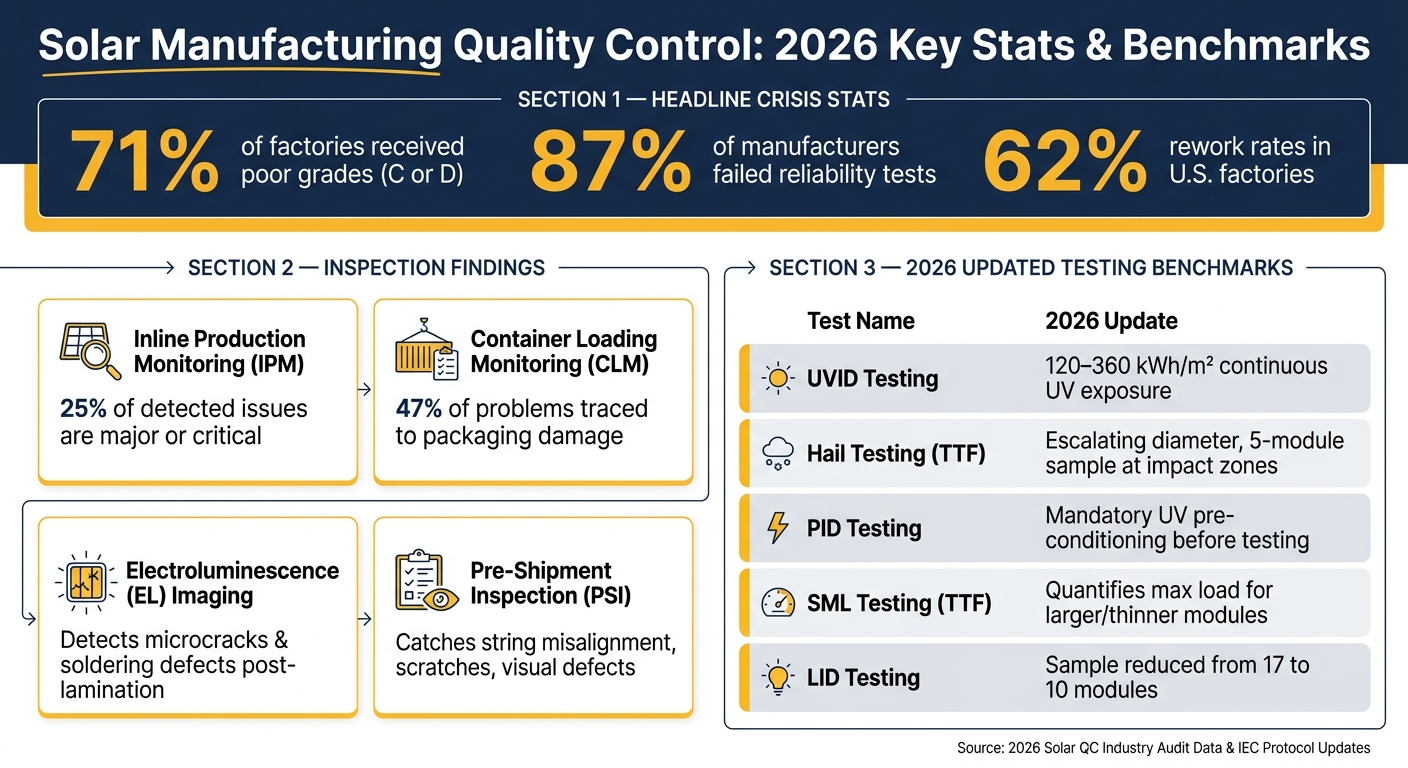
Solar Manufacturing Quality Crisis: 2026 Key Stats & Benchmarks
Solar Quality Control of PV Module Encapsulation #qualityassurance
sbb-itb-aa28329
2026 Quality Control Technologies in Solar Manufacturing
In 2026, solar manufacturers are leveraging cutting-edge inspection and testing methods to keep up with evolving module designs and stricter quality expectations.
Advanced Inspection Tools in Action
Modern tools like electroluminescence (EL) imaging have become crucial in identifying microcracks and soldering issues after lamination. Inline production monitoring (IPM) tracks defects during manufacturing and reveals that 25% of detected issues are classified as major or critical. Meanwhile, container loading monitoring (CLM) focuses on shipping integrity, with 47% of problems traced back to packaging damage.
| Inspection Type | Primary Focus | Key Defects Detected |
|---|---|---|
| Inline Production Monitoring (IPM) | Tabbing, stringing, and lay-up | Soldering defects, ribbon misalignment |
| Electroluminescence (EL) Imaging | Post-lamination cell integrity | Microcracks, cell cracks, inactive areas |
| Pre-Shipment Inspection (PSI) | Final module quality | String misalignment, scratches, visual defects |
| Container Loading Monitoring (CLM) | Packaging and logistics | Damaged packaging, improper stacking |
AI and Data Analytics in Quality Control
Real-time data from IPM systems allows manufacturers to spot and fix anomalies early, cutting down on costly repairs at later stages. Advanced analytics platforms now categorize defects as minor, major, or critical, feeding this data into factory performance metrics. This information is also vital for qualifying suppliers and managing risks across global supply chains. The goal is to create a continuous feedback loop, where inspection results directly inform and improve manufacturing processes.
New Materials and Testing Protocols
The widespread adoption of n-type TOPCon cell technology has led to significant changes in testing protocols. While TOPCon modules are less prone to light-induced degradation, they are more vulnerable to UV-Induced Degradation (UVID). To address this, standard UVID tests now require exposure levels of 120 kWh/m², a critical adjustment for ensuring reliability.
For Potential-Induced Degradation (PID) testing, manufacturers are increasingly incorporating UV stabilization or preconditioning steps. Without these measures, defects can slip through undetected. In 2025, the industry average for PID-related power loss was around 1%. However, current IEC standards were not originally designed for these advanced technologies, exposing a gap that the industry is actively working to close.
"Right now, there is a lot of focus on updating the UVID IEC standard, and the whole industry, including us and major test labs, are involved to make sure it works, not just for TOPCon but also for heterojunction and other technologies." – Ingrid Haedrich, Fraunhofer ISE
This push for updated standards highlights a recurring challenge in the industry. As Xinrui An of JTPV explains:
"It becomes a loop where improving the technology creates new reliability problems, and then you need to study those mechanisms further." – Xinrui An, JTPV
These advancements are reshaping quality control processes and redefining the expertise required for roles in this field.
Workforce Changes: Skills and Training for Solar QC Roles
Skills Now Required for QC Roles
The move toward advanced cell technologies is reshaping solar manufacturing – and it’s also transforming the skills needed for quality control (QC) roles. By 2026, QC workers will require a more specialized skill set to keep up with these innovations.
For starters, proficiency in electroluminescence (EL) inspection is a must. QC teams need to spot soldering defects, microcracks, and inactive cell areas that only show up after lamination. Additionally, expertise in reliability testing – like PID (potential-induced degradation), LID (light-induced degradation), and UVID (ultraviolet-induced degradation) – is becoming more critical. This is especially true for TOPCon modules, which face new UV degradation risks not seen in older p-type silicon designs.
Back-contact (BC) cells add another layer of complexity, requiring precise cell handling and new approaches to stringing and lay-up processes. Meanwhile, perovskite-silicon tandem cells demand mastery of scalable, uniform active layer deposition techniques. These advanced skills are essential to support the cutting-edge QC technologies that are reshaping solar production.
Amy Fang from InfoLink Consulting emphasized the growing importance of quality in this sector:
"A company’s ability to defend margins and cash flow amid high cost volatility and policy uncertainty will outweigh the significance of shipment rankings."
This shift in focus – from maximizing volume to prioritizing quality – has elevated the strategic importance of QC roles in solar manufacturing.
Where Training Gaps Are Showing Up
New U.S. solar factories are facing challenges with yield rates, lagging behind established manufacturing hubs in Asia. This disparity highlights a pressing need for better training.
One major issue is inadequate handling procedures, as seen in past packaging problems. Additionally, many workers are transitioning from unrelated industries and lack the specialized QC expertise required for solar manufacturing. Vijay Menon, COO of Navitas Solar, pointed out the consequences:
"Poor installation practices, improper handling, and unsafe maintenance… can lead to microcracks, damage, and early module degradation."
Another growing concern is soldering defects. Modern modules now feature more busbars and ribbons, increasing the complexity of soldering processes. Without proper training upstream – before critical steps like lamination – these defects are becoming more common.
Addressing these skill gaps is essential to maintaining high QC standards, and workforce platforms are stepping in to help.
How Workforce Platforms Support QC Outcomes
To close training gaps and improve outcomes, continuous oversight and better worker matching are key. Workforce platforms are playing a vital role in this effort.
Take ABLEMKR, for example. With over 95 GW of manufacturing capacity added to the U.S. solar supply chain since the Inflation Reduction Act, the demand for skilled QC labor is surging. ABLEMKR’s automated system connects manufacturers with workers who meet specific certifications, safety training, and location requirements. This ensures that the right expertise is available as production scales up.
Beyond staffing, ABLEMKR simplifies compliance tracking. Its embedded tools help manufacturers stay aligned with evolving standards, such as updated IEC protocols for UVID and PID pre-conditioning, without relying on manual processes. The platform’s real-time visibility also allows production managers to monitor adherence to standard operating procedures (SOPs), directly supporting the QC benchmarks discussed earlier.
For an industry navigating complex regulations like the Uyghur Forced Labor Prevention Act (UFLPA) and Domestic Content rules, having traceable, documented workforce data isn’t just helpful – it’s essential for compliance.
Updated Standards and Benchmarks for Solar Module Quality
Key Updates to IEC Standards
The rapid evolution of solar technology, particularly with TOPCon and heterojunction (HJT) modules, has outpaced existing IEC testing standards. Larger module formats and thinner glass now demand Test-to-Failure (TTF) protocols to measure stress thresholds accurately. Tristan Erion-Lorico, Vice President of Sales and Marketing at Kiwa PVEL, emphasized the need for these updates:
"As manufacturers have pushed toward larger modules and thinner materials, these sudden breakage events have made it clear that more rigorous and statistically meaningful testing is needed."
A key example is the updated Hail-TTF test, which evaluates five modules at impact-sensitive areas – like edges, corners, and junction boxes – using progressively larger hail diameters to determine breakage thresholds.
Another major change is in UVID testing. The new protocol applies continuous 120 kWh/m² UV exposure (and up to 360 kWh/m² for materials prone to degradation) to better simulate real-world conditions. This replaces older interim characterizations that often overlooked material vulnerabilities. Ingrid Haedrich from Fraunhofer ISE highlighted the industry’s focus on refining this standard:
"Right now, there is a lot of focus on updating the UVID IEC standard, and the whole industry… are involved to make sure it works, not just for TOPCon but also for heterojunction and other technologies."
For n-type stabilization, updated protocols now incorporate full-spectrum and UV-light soaking after Damp Heat and PID testing. This addresses metastability issues, which can appear as slow dark-storage degradation after Damp Heat, accelerated degradation after UV exposure, or recoverable PID-polarization effects.
Additionally, the sample size for LID testing has been reduced from 17 to 10 modules, reflecting lower degradation rates in modern n-type production.
These updated IEC standards are shaping the quality benchmarks that U.S. factories are now required to meet.
New Quality Benchmarks for U.S. Manufacturing
With the revised IEC protocols in place, U.S. manufacturers face new performance benchmarks. Domestic factories, often experiencing lower yield rates during capacity ramp-ups, must meet these standards to close performance gaps with more established global hubs.
| Test Category | 2026 Update | Purpose |
|---|---|---|
| UVID Testing | Continuous 120 kWh/m² exposure (up to 360 kWh/m²) | Targets UV degradation risks in TOPCon/HJT modules |
| Hail Testing (TTF) | Escalating diameter, 5-module sample at impact zones | Determines precise breakage thresholds |
| PID Testing | Mandatory UV preconditioning | Ensures accurate results by stabilizing modules |
| SML Testing (TTF) | Quantifies max load capacity | Addresses failures in larger, thinner designs |
| LID Testing | Reduced to 10 modules | Reflects lower degradation in modern n-type production |
The industrial average for power degradation in PID tests stood at around 1% in 2025. However, skipping UV preconditioning can push degradation rates above 5%, highlighting the importance of this step in obtaining accurate results.
Packaging issues remain another critical area. Damaged packaging accounted for 47% of all Container Loading Monitoring (CLM) findings in 2025. This underscores the need for stricter standard operating procedures (SOPs) in stacking and loading practices. Xinrui An of JTPV explained:
"It becomes a loop where improving the technology creates new reliability problems, and then you need to study those mechanisms further."
The updated 2026 standards aim to address this feedback loop by ensuring testing protocols evolve alongside the advancing technologies they are designed to evaluate.
Conclusion: Where Solar Quality Control Goes from Here
Key Takeaways from 2026 Trends
By 2026, quality has become more than just a goal – it’s a necessity for staying competitive. As Amy Fang from InfoLink Consulting explains, the industry is shifting from a "race for volume" to focusing on quality as a competitive edge. Manufacturers that prioritize rigorous testing, invest in skilled workers, and update their protocols are positioning themselves for long-term success.
Metrics like low inline defect rates and issues with packaging damage highlight the importance of better handling practices and workforce training. At the same time, audits reveal that even high-volume producers face inconsistencies in maintaining quality standards globally. These challenges mark a turning point for U.S. solar production, where committing to quality-focused strategies will shape the future.
What Lies Ahead for U.S. Solar Manufacturing
U.S. solar factories, still in their early stages of growth, have a unique opportunity to establish a foundation built on quality-first principles – avoiding the need to retrofit outdated processes later. Xinrui An of JTPV notes that the ongoing cycle of technological advancements and new reliability challenges shows no signs of slowing. With TOPCon technology now mainstream and perovskite tandem cells making strides, the industry must adapt by updating testing methods, enhancing technician training, and improving logistical rigor.
Platforms like ABLEMKR are becoming increasingly important as they help streamline skilled labor management and compliance tracking. For U.S. manufacturers scaling operations, embracing these tools and evolving quality standards will be critical to meeting the demands of a rapidly advancing solar market.
FAQs
Why are solar factory quality grades getting worse in 2026?
The quality of solar factory outputs is expected to decline in 2026. This drop is tied to rising raw material costs, persistent supply chain disruptions, and a shift in priorities. Instead of focusing on expanding production, manufacturers are concentrating on maintaining quality and staying operational. These challenges have resulted in production slowdowns and increased inventory levels, both of which are contributing to lower overall quality standards.
What new TOPCon reliability risks should buyers watch for?
In 2026, buyers need to keep an eye on new reliability challenges in TOPCon modules. These include potential-induced degradation (PID), UVID, microcracks, lamination defects, creepage and clearance violations, and problems related to cell metallization and bill of materials (BOM) control. These concerns underline the need for detailed quality checks when choosing solar panels.
How can U.S. factories fix QC skill gaps fast?
U.S. factories can tackle quality control (QC) skill gaps efficiently by focusing on a mix of technical know-how, ongoing process improvements, and utilizing real-time inspection data. These efforts directly contribute to better product reliability. Joining industry conferences that emphasize benchmarking and operational excellence can provide valuable insights. Additionally, adopting thorough audit practices and rolling out targeted training programs are key steps. Partnering with seasoned auditors and technology providers further accelerates skill development and strengthens QC results.


