
When Deepwater Horizon scaled past 47,000 workers, the main issue was not finding people. It was knowing who was trained, where they were sent, and what jobs they could do.
I’d sum up the case this way: NGO-industry teamwork worked best when each side had a clear lane. NGOs helped bring in local people, reached families facing language gaps, and supported workers with food, supplies, and local guidance. Industry handled training, crew setup, gear, and field assignments. Government agencies checked safety rules and worker health.
Here’s the short version:
- Industry trained and deployed crews
- NGOs connected the response to local communities
- Agencies tracked safety, records, and site access
- The weak point was worker visibility across a huge response
- The fix is to set up rosters, training, contracts, and drills before a spill
A few numbers make the point clear:
- More than 47,000 workers were active at peak
- About 25,000 volunteers joined the response
- More than 100,000 people were trained across the Gulf Coast
- OSHA made 4,200+ site visits
- NIOSH rostered 55,000+ workers
- By 05/21/2010, 10,000 workers had already been trained
If you want one lesson from this case, it’s simple: local outreach without crew control creates confusion, and crew control without local trust limits hiring. The best results came when NGOs opened doors in affected communities and industry turned that access into trained, paid, supervised labor.
That’s what this case shows in practice: recruit locally, verify every worker, track every assignment, and plan the system before the next spill starts.
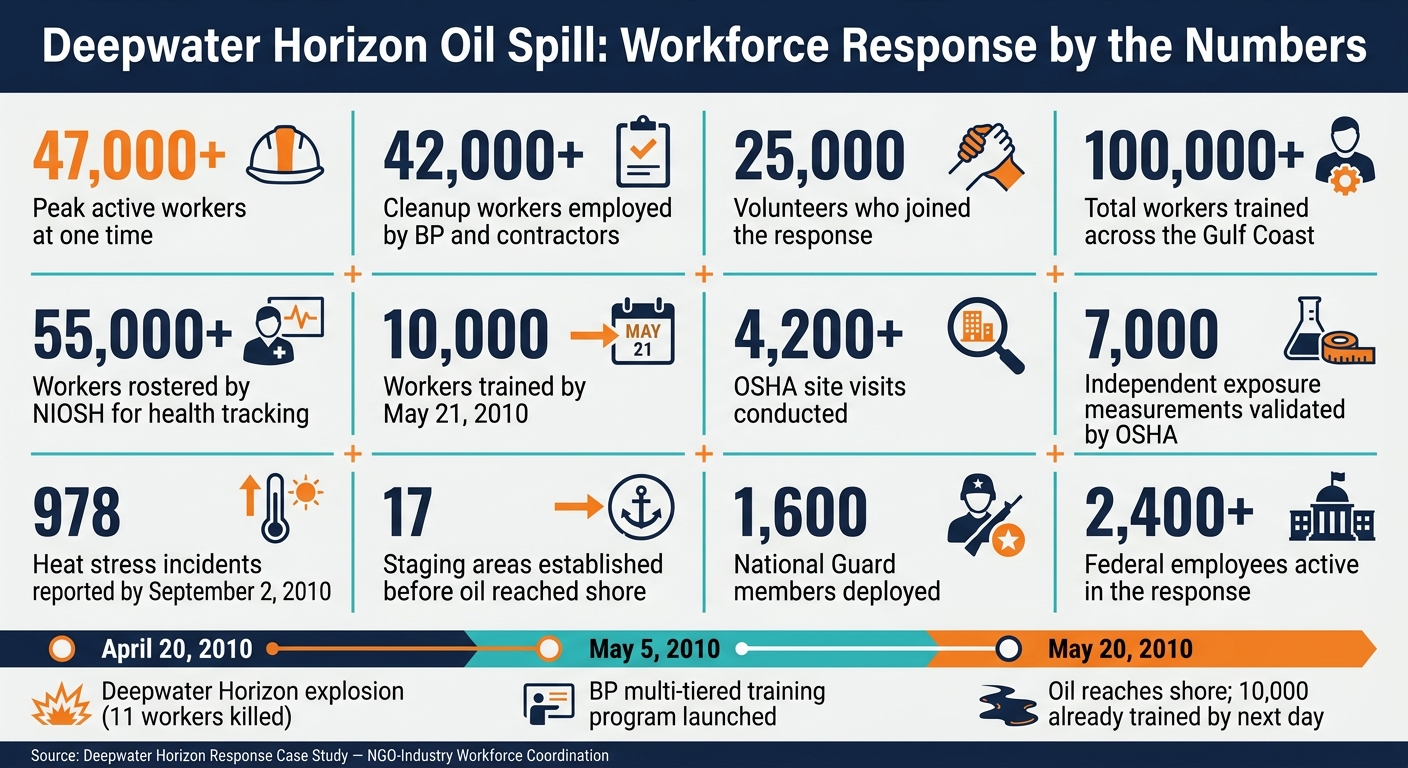
Deepwater Horizon Workforce Response: Key Numbers at a Glance
Case Background: Incident Conditions and Workforce Demand
Those big response numbers hinged on one thing: how fast teams could get people organized in the field.
The Deepwater Horizon explosion happened on April 20, 2010, killing 11 workers. The rig sank on April 22. Because the wellhead was about 45 miles offshore, responders had a short but meaningful window to build out 17 staging areas before oil reached shore on May 20. Even so, labor demand ramped up fast as the response spread.
Once the focus moved from source control to shoreline work, the need for labor grew far beyond offshore crews. The response expanded into shoreline cleanup, wildlife support, logistics, waste handling, vessel decontamination, transportation, and community outreach. At peak response, more than 47,000 workers were active, including over 42,000 cleanup workers employed by BP and its contractors, 1,600 National Guard members, and more than 2,400 federal employees.
Site Conditions That Drove Labor Demand
The first big driver was simple: crews needed backup because the heat was brutal. Along the Gulf Coast, temperatures often went past 100°F. That meant frequent work-rest cycles, which in turn meant more people were needed to keep operations moving. Even with steps in place to reduce risk, 978 heat stress incidents were reported by September 2, 2010.
Access rules and safety demands made staffing even harder. Remote staging areas, offshore vessels, and sensitive coastal zones each came with their own training and safety requirements. Workers had to be certified before deployment. BP started a multi-tiered training program on May 5, 2010, with:
- a one-hour orientation
- a four-hour shoreline course
- four- to eight-hour marine cleanup courses
By May 21, 10,000 workers had been trained. That total later grew to more than 100,000 across the Gulf Coast.
The makeup of the workforce added another layer of pressure. Many workers had little oil spill experience. Many also were not used to long shifts in extreme heat. On top of that, outreach had to work across language barriers. Multilingual staff, including Spanish and Vietnamese speakers, were sent to town halls and community meetings to reach immigrant residents and displaced fishing families.
The Workforce Coordination Problem
As the response grew, worker visibility became the main operational problem.
Training, deployment, and oversight were split across different groups at the same time. Federal agencies monitored safety and worker health. BP and its contractors handled training and crew deployment. OSHA sent 150 professionals across all 17 staging areas, carried out more than 4,200 site visits, and validated 7,000 independent exposure measurements.
The core issue was blunt but hard to solve: knowing who was trained, where each person was assigned, and what work each worker was cleared to do.
sbb-itb-aa28329
How NGOs and Industry Split Recruitment, Training, and Field Operations
Once worker visibility became the bottleneck, NGOs and industry started dividing the job by function. NGOs focused on community access and worker support. Industry took on training, supervision, and field deployment.
NGO Contributions: Local Trust, Community Access, and Worker Support
NGOs brought something industry couldn’t build fast: local trust. In places where the official response felt slow or far removed, local groups helped residents find a way into the formal response system.
That mattered a lot in communities with language barriers. NGO-led outreach to Spanish and Vietnamese-speaking fishing families and immigrant residents expanded the number of people who could be recruited and trained. NGOs also helped people stay involved by providing food, supplies, and advocacy for vulnerable residents working in the response. For many, that support made the difference between staying on the job and dropping out.
Industry Contributions: Skilled Crews, Training, and Field Operations
On the legal and technical side, industry turned trained workers into crews that could actually be sent into the field. That meant equipment, supervision, and structured work programs.
BP launched a multi-tiered training program on May 5, 2010, and used the Vessels of Opportunity (VoO) program to recruit local commercial fishermen, putting their boats to work in boom deployment and wildlife transport. OSHA personnel conducted over 4,200 site visits to verify training certification cards and keep workers not authorized to do hazardous work out of restricted zones.
Where Collaboration Created Measurable Workforce Gains
The biggest gains showed up when NGOs widened access to local workers and industry turned that access into certified deployment. NIOSH rostered over 55,000 workers during the Deepwater Horizon response, a health-tracking effort that would have been nearly impossible without coordinated intake across both sides.
Here’s what that split looked like in practice:
| Function | NGO Role | Industry Role | Workforce Benefit |
|---|---|---|---|
| Recruitment | Grassroots outreach and community trust-building | VoO programs and contractor networks | Fast scaling with local knowledge and community buy-in |
| Training | Volunteer orientation and community access | Technical certification and safety drills | Large workforces that meet safety rules |
| Worker Support | Food, supplies, and advocacy for vulnerable groups | PPE, equipment, and hourly wages | Better morale and income support for affected locals |
That split only held together because incident command and worker-tracking systems kept assignments visible in real time.
Workforce Systems That Made the Response More Effective
That split only worked because the basics were already set up: command, training, and worker records.
Incident Command, Area Committees, and Pre-Event Relationships
Command roles were in place before workers showed up. During Deepwater Horizon, the Unified Command structure cut confusion and sped up worker assignment by giving each group a clear line of reporting.
Pre-event relationships mattered just as much. Area contingency planning had already identified local contacts, available resources, and site-specific tactics for the first 24 hours of a spill. Regular drills helped keep that system sharp. Exercises like Spill of National Significance (SONS) 2010 gave agencies such as OSHA and the U.S. Coast Guard a chance to sort out roles and duties before a real disaster hit. When those ties were already there, groups like the Oiled Wildlife Care Network could move fast and join the response without delay.
Training, Compliance Records, and Real-Time Worker Tracking
Once workers moved through command channels, the next step was simple in theory but tough in practice: prove who was trained and cleared to work.
During Deepwater Horizon, workers received mandatory training certification cards, and OSHA staff checked them during more than 4,200 site visits. That process controlled access to restricted areas and kept unauthorized workers out of hazardous zones during a response that peaked at more than 47,000 people.
"Advance planning, immediate deployment, and collaboration across agencies helped ensure that the response operations resulted in no worker fatalities, and relatively few injuries and illnesses." – David Michaels and John Howard
Live roster tracking helped make that possible. Leaders needed to know who was certified, where each worker was assigned, and which tasks each person was cleared to handle. That was the operating backbone that kept the full response from drifting off course. ABLEMKR uses the same approach by matching cleared workers to jobs, tracking status, and keeping compliance visible in real time.
Lessons for Future Oil Spill Workforce Planning
The systems above lead to a plain rule: build staffing capacity before a spill starts. Deepwater Horizon and Prince William Sound show the same thing from two different moments in time. Spill response only works when workforce systems exist before the incident. And for large responses, joint planning matters far more than isolated staffing plans.
What Employers and Response Leaders Should Build Before the Next Incident
The most useful prep tool is pre-event contracting. These contracts sit at the center of workforce planning. Alyeska Pipeline Service Company, for example, holds contracts with about 350 local fishing vessels in Prince William Sound, with annual drills for boom deployment and skimmer operations. That setup works for a simple reason: the agreements, the training, and the trust are already there before anyone has to act.
Joint exercises matter just as much. When agencies, industry, and NGOs take part in Spill of National Significance (SONS) drills, they can work through role conflicts before a live incident puts everyone under pressure. Employers should also build standardized training modules, including:
- 1-hour orientations
- 4-hour shoreline courses
- 4- to 8-hour marine cleanup courses
Those materials should be ready in the main languages spoken by the local workforce, including Spanish and Vietnamese. Worker data also needs to stay current. Certifications, availability, and location should be maintained through pre-registered rosters and credential tracking so crews can be mobilized fast.
What the Case Means for Workers and Community Partners
Workers in a large spill response need more than a task list. They need clear role definitions and verified safety training before they step onto a worksite. During Deepwater Horizon, by May 21, 2010 – just one day after oil reached the shore – 10,000 workers had already been trained. That only happened because onboarding systems were already in place.
Community organizations should be part of planning from the start, not pulled in after the spill. Local groups such as Regional Citizens’ Advisory Councils hold trust that industry can’t build on short notice. They act as a bridge between local workers and industry deployment. That includes spotting language needs, helping with translation, and connecting responders with local fishing crews that know the shallow areas. Bringing these groups in early makes the whole operation work better.
Key Takeaways From the Case
These lessons come down to three priorities: recruit locally, verify credentials, and keep rosters current.
| Lesson Learned | Specific Workforce Action | Collaboration Role |
|---|---|---|
| Local knowledge is vital | Contract local fishing vessels (VOOs) for boom deployment | NGOs build trust; industry turns access into certified crews |
| Data gaps hinder safety | Implement pre-registered rosters and credential tracking | Industry provides hire lists; agencies and NGOs manage health tracking |
| Training must scale fast | Create tiered training from 1-hour orientations to 4- to 8-hour marine cleanup courses | Industry funds training; NGOs and agencies provide oversight |
FAQs
Why was worker tracking the biggest challenge?
Worker tracking was the biggest challenge because of the size of the response and the mix of workers on the ground. During major incidents, teams often included industry staff, government personnel, volunteers, and temporary contractors. With so many different groups involved, keeping one real-time record of who was on-site became difficult.
Without a centralized, automated system, rostering and compliance tracking often happened by hand. That slowed things down and made it harder to keep people safe, monitor health, and stay in touch across remote locations.
How did NGOs and industry divide responsibilities?
In effective oil spill responses, industry and NGOs usually divide responsibilities through close coordination. Industry takes care of large-scale operations, equipment, site cleanup, and incident command.
NGOs manage volunteer coordination, wildlife rescue, and animal rehabilitation, often under pre-established contingency plans. That setup helps each group focus on what it does best while staying aligned through centralized command structures.
What should be prepared before the next spill?
Before the next spill, organizations need to set up public-private partnerships and put clear governance in place. That means joint command centers, resource-sharing agreements, and performance metrics so people know who’s doing what, who has access to which assets, and how success will be measured when pressure hits.
They should also finish job hazard analyses, tighten health and safety programs, offer accessible training for diverse workforces, and build redundant communication protocols. If that fits the operation, ABLEMKR can help with fast mobilization of pre-vetted, properly certified crews.


