
If I had to boil this down to one point, it’s this: teams hit green building goals more often when leaders are strong at judgment, planning, and people skills.
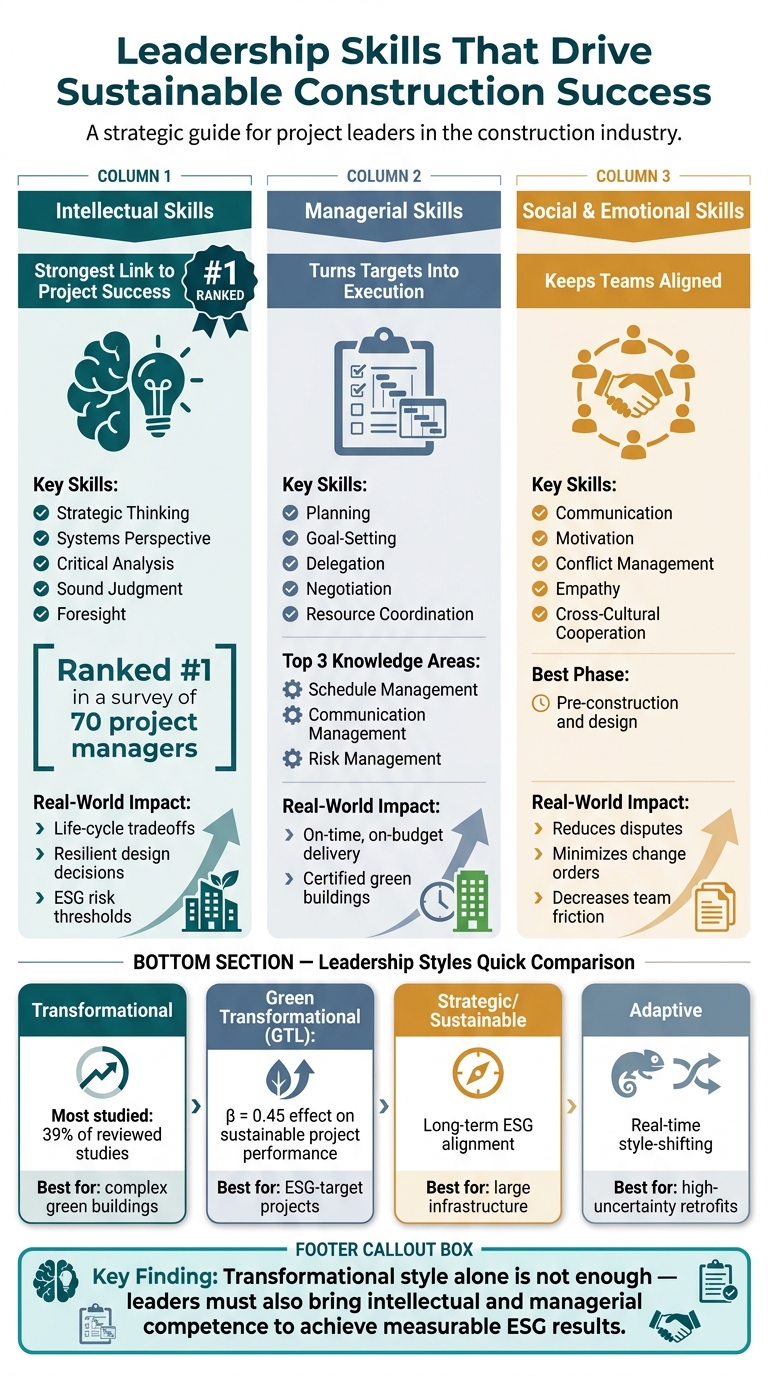
The research is pretty clear. In one survey of 70 project managers, the skill group with the strongest link to project success was intellectual skill. In a U.S. study across nine LEED projects, shared transformational leadership improved team performance by improving team integration. And in a review of past studies, transformational leadership showed up in 39% of the research.
Here’s the short version:
- Best skill group: clear thinking, systems view, and good judgment
- Next big factor: planning, coordination, and follow-through
- Also matters: communication, motivation, and conflict handling
- Best-used style: transformational leadership, especially when tied to green goals
- Big lesson: style alone is not enough; leaders also need solid technical and planning skill
- Where results show up most: compliance, waste, energy, water, and team execution on site
I’d read the findings this way: if you want better project results, don’t treat green targets like a side task. Put them into bids, schedules, scopes, site talks, and field decisions from day one.
A few points stand out:
- Leaders need to shift their approach by project phase
- Collaboration works well early in design and pre-construction
- More direct leadership fits high-risk field work
- Too much top-down control can hurt team input and problem-solving
- Training works best when firms can also place the right crews on site fast
Bottom line: the studies point to three skill groups again and again – intellectual, managerial, and social-emotional. The leaders who do best are the ones who can think through tradeoffs, keep work on track, and keep teams aligned when cost, schedule, and green targets pull in different directions.
Leadership Competencies for Sustainable Construction: Skills, Styles & Outcomes
CISL‘s Postgraduate Sustainable Built Environment Programmes
sbb-itb-aa28329
The Leadership Skills Studies Link Most Strongly to Project Success
Some teams turn sustainability goals into job-site results. Others stall out when cost, schedule, and coordination get tight.
Research points to three leadership skill groups behind that gap: intellectual, managerial, and social-emotional. Each one shows up in the day-to-day calls made by owners, general contractors, trade partners, and field supervisors.
Intellectual Skills: Strategic Thinking, Judgment, and Systems Perspective
Intellectual competence has the strongest statistical link to sustainability outcomes. In empirical studies, it ranks above managerial and transformational dimensions. That cluster includes strategic thinking, critical analysis, systems perspective, foresight, and sound judgment when the path ahead isn’t clear.
On a project, this is the skill set behind hard tradeoff calls. Think paying more up front for a high-performance envelope to cut energy use and future retrofit costs. Or picking flood-resilient design to lower long-term risk. One competency mapping study found eight behavioral competencies tied to better environmental performance in building projects, with strategic thinking and problem-solving among the most influential.
For owners and developers, the message is pretty direct: set ESG targets and risk thresholds on a life-cycle basis, not just on first cost.
Managerial Skills: Planning, Coordination, and Execution Under Constraints
Managerial skills are what turn sustainability targets into an execution plan. Studies show that planning, goal-setting, delegation, negotiation, and resource coordination are strongly linked to on-time, on-budget delivery of certified green buildings and sustainable infrastructure.
When teams build sustainability targets into the schedule, budget, and procurement plan from day one, those targets stop fighting with standard KPIs. Survey findings on sustainable construction challenges found schedule management, communication management, and risk management to be the top three knowledge areas tied to planning success. The same research also highlighted analytical thinking, decision-making, team working, delegation, and problem-solving as top skills.
General contractors and field supervisors carry much of this work. On site, that can mean phasing specialized installs without throwing off the critical path, while also handling just-in-time deliveries without losing productivity or safety.
Social and Emotional Skills: Communication, Motivation, and Conflict Management
These skills matter most in pre-construction, when design choices, materials, and sustainability commitments are still being set. Early-phase studies connect communication, planning and goal-setting, team building, and conflict management with sustainable project success.
This makes sense. Sustainable projects pull competing priorities into the same room. A high-efficiency HVAC system, for example, can affect unit prices, sequencing, and risk allocation all at once. In that moment, a leader has to explain the tradeoffs clearly and deal with tension head-on. If that doesn’t happen, the job can drift into disputes and change orders.
A literature review on sustainability leadership in construction identified eight shared competencies, including empathy, motivating others, foresight thinking, and cross-cultural cooperation. For trade partners and field supervisors working across mixed crews, these are the skills that keep collaboration working when sustainability demands start to create friction on site.
How leaders use these skills depends on the style they bring to the job site.
Which Leadership Styles Perform Best in Sustainable Construction
Research doesn’t point to one style that wins in every case. What it does show is more practical: some approaches work better at certain project stages and under certain site conditions. That’s how leadership style turns skill into day-to-day action on the job site.
Transformational and Green Transformational Leadership
Transformational leadership is the most studied style in sustainable construction, appearing in roughly 39% of reviewed studies. It’s tied to better team integration, green innovation, and sustainable project performance.
Green transformational leadership (GTL) takes that same approach and aims it at environmental goals. Leaders push teams toward environmental targets and inspire performance beyond expected levels of environmental performance. On a live project, that can mean setting measurable targets, supporting lower-carbon procurement, and making sure daily site decisions line up with environmental goals.
A 2025 study found a direct effect on sustainable project performance, plus an added indirect effect through ESG integration. GTL also shows positive links to green creativity and green procurement, and both help improve environmental results farther down the line.
Still, there’s a catch. Transformational traits by themselves have limited direct impact on specific sustainability criteria. The motivational side needs backup from solid technical and planning ability, especially systems thinking, risk assessment, and rigorous planning, if leaders want measurable ESG results.
Directing vs. Collaborating: How Leaders Shift Approaches on Complex Job Sites
Leaders in sustainable construction don’t stay in one lane for the whole project. The ones who perform best shift on purpose between collaborative and directive approaches based on project phase and risk level.
Collaboration fits design and pre-construction work. Directive leadership fits high-risk field work. When a project moves into heavy lifts, confined-space work, and tight sequencing around live utilities, a more direct style makes sense. Crews need clear guidance to stay safe and compliant, and sometimes a fast call is the only way to deal with an immediate risk.
That style should be temporary. Once the risk passes, leaders should move back to collaboration. Too much top-down control tends to shut down the initiative and problem-solving that sustainable projects rely on.
When crews are highly skilled and already know the sustainability procedures and technologies in play, shifting back to a collaborative style tends to pay off. It leads to better answers when unexpected field conditions show up.
Leadership Styles Compared: Behaviors, Contexts, and Measured Impact
| Leadership Style | Key Behaviors | Best-Fit Project Contexts | Measured Sustainability Impact | Limitations |
|---|---|---|---|---|
| Transformational | Vision-setting, coaching, intellectual stimulation | Complex green buildings, multidisciplinary teams | Strong links to green innovation, team integration, and sustainable project performance | Minimal direct effect on specific sustainability criteria without strong technical competence |
| Green Transformational (GTL) | Environmental goal-setting, green procurement advocacy, modeling pro-environmental practices | Projects with ESG targets, energy-efficient retrofits | Direct positive effects on environmental performance; β = 0.45 on sustainable project performance | Less effective without organizational support and training systems |
| Strategic/Sustainable | Long-term ESG alignment, stakeholder engagement, ethical trade-off decisions | Large-scale infrastructure, regulatory-heavy environments | Strong where organizational sustainability systems exist; supports balanced ESG outcomes | Highly context-dependent; requires organizational support to produce consistent results |
| Adaptive | Real-time style-shifting, empowering frontline teams, rapid field adjustments | Complex retrofits, high uncertainty, novel green technologies | Critical for managing disruptions without drifting from sustainability commitments | Less directly measured on ESG metrics; effectiveness depends on integration with structured approaches |
The clearest message from the research is simple: transformational and green transformational styles show the most consistent gains for sustainability. But they work best when leaders also bring the intellectual and managerial skills covered in the previous section. Strategic and adaptive styles matter when those approaches hit a wall, especially in governance-heavy settings or when site conditions change fast and the team has to recalibrate on the fly.
That leads straight into the next issue: which styles actually shift sustainability outcomes in practice?
How Leadership Skills Affect Sustainability Outcomes in Practice
The key issue isn’t which leadership style sounds best on paper. It’s which one leads to measurable sustainability results on the ground. The clearest patterns show up when leadership shapes site execution, compliance, and a project’s ability to handle disruption.
Where Studies Show the Clearest Gains: Environmental Performance and Compliance
The strongest and most steady link is between leadership competence and environmental performance. Leaders with strong intellectual skills – strategic thinking, systems analysis, and life-cycle thinking – are more likely to build environmental criteria into procurement, scheduling, and site logistics. In practice, that can mean choosing lower-carbon materials early and timing deliveries in ways that cut fuel use.
Ethical leadership also plays a big part in compliance. When project managers set clear environmental policies and back them up through toolbox talks and performance reviews, workers tend to follow through more consistently. Studies tie this to fewer EPA and OSHA citations, better permit compliance, and stronger audit documentation.
Research also shows that leadership competences can strengthen the link between environmental practices and overall sustainability performance, especially when teams are working on waste reduction, energy efficiency, and water conservation.
Where the Evidence Is More Mixed: Social and Economic Outcomes
Social outcomes are a bit messier. Leaders who involve workers and communicate clearly often see better engagement, more near-miss reporting, and stronger site compliance. Ethical leadership can also help build stakeholder trust by keeping communities informed about issues like noise, dust, and local hiring.
That said, the findings aren’t always consistent. Some studies show that leadership competences have only a limited effect on the link between social practices and overall sustainability performance. That suggests client requirements, union rules, and local regulations may carry more weight than leadership alone in some cases.
A similar pattern shows up in economic outcomes. Transformational practices can improve cost and schedule performance, but other studies find no clear effect on cost optimization or supplier negotiations.
Leadership Competencies Mapped to ESG and Resilience Outcomes
The table below sums up the most consistent patterns reported in the studies reviewed.
| Leadership Competency | Environmental | Social | Economic | ESG Integration | Resilience |
|---|---|---|---|---|---|
| Intellectual (systems thinking, strategic analysis, life-cycle thinking) | Strong | – | – | Strong | Strong |
| Managerial (planning, coordination, execution) | Strong to moderate | – | Strong to moderate | – | – |
| Social and emotional (communication, motivation, conflict management) | – | Moderate | – | Moderate | Moderate |
| Ethical and responsible (transparency, accountability, role modeling) | Strong | Moderate | Limited | Moderate | Strong |
| Transformational / green transformational (vision, green goal-setting, inspiration) | Strong | Moderate | Moderate | Strong | – |
_ – = no distinct effect reported._
These differences in outcomes point straight to the leadership development priorities U.S. firms should build next.
What U.S. Firms Should Do Next
Leadership Development Priorities for Construction and Energy Teams
The biggest gains come from intellectual and systems thinking skills, so that’s where firms should begin. Research shows these skills have the strongest link to sustainable project success.
For project managers handling green buildings, utility upgrades, or heavy infrastructure, that means getting comfortable with ESG frameworks, life-cycle thinking, and the way early design and procurement choices shape long-term cost and environmental results.
It also means bringing sustainability into the day-to-day work, not treating it like a side issue. Firms should build it into schedules, subcontractor scopes, and procurement requirements. Then they should train leaders on ESG basics, risk, and stakeholder communication.
For most U.S. firms, a practical 12-to-24-month roadmap looks like this:
- Diagnose skill gaps among project managers and field leaders
- Deliver 8–16-hour courses on ESG basics, risk and resilience, and stakeholder communication
- Tie ESG KPIs to leadership reviews
Why Workforce Deployment Systems Matter for Sustainable Execution
Training alone won’t do the job if the right crews aren’t ready when it’s time to build. Skill development works only when firms can put qualified people in place to carry out the plan.
Workforce deployment systems help leaders move sustainability plans from the office to the jobsite. They make it easier to place certified workers on site fast and track compliance in real time. That kind of fast, compliant mobilization turns leadership plans into actual on-site results.
Conclusion: The Leadership Skills That Matter Most
The research reviewed here points again and again to intellectual, managerial, and social-emotional competencies as the base for sustainable construction success. But plans only matter if crews can carry them out in the field. Sustainable results depend on qualified workers, clear compliance visibility, and fast mobilization when it’s time to execute.
FAQs
Which leadership skill matters most for green building success?
Clear communication matters most. In construction work with lower waste and energy use, leaders need to turn complex systems, shifting rules, and project goals into plain, workable steps.
That keeps teams aligned, helps each trade understand what’s expected, and cuts down on costly delays, rework, and safety problems. Technical skill matters, but communication is what gets the job done.
When should leaders use collaborative versus directive leadership?
Leaders should take a team-based approach to planning, risk management, and safety talks. When workers are part of the decision-making process, they’re more likely to share ownership, work better together, and help cut incident rates.
A directive style works best in high-risk or unpredictable situations. In those moments, leaders need to give clear instructions on scope, sequence, and quality. They also need to act fast to stop work or respond to hazards, equipment failure, or severe weather.
How can firms turn sustainability goals into jobsite execution?
Firms can close that gap with a more structured approach to workforce development and digital tools. Start with skills audits to spot missing capabilities in areas like heat pump installation, mass timber, and BIM. Then use competency-based training to build those skills in a clear, practical way.
ABLEMKR can help put that plan into action by matching pre-vetted, certified laborers to project needs. That makes it easier for teams to stay compliant and share updated requirements and safety protocols in real time.


