
These two certifications are not interchangeable. If the job disturbs lead paint during renovation in a pre-1978 home or child-occupied facility, you usually need EPA RRP certification. If the job’s purpose is to permanently remove or reduce a lead hazard, you need lead abatement certification.
Here’s the short version:
- RRP = renovation, repair, and painting work
- Abatement = permanent lead hazard reduction
- RRP training is often 8 hours
- Abatement training is often 16 to 32+ hours, based on role
- RRP firms need separate firm certification
- RRP renewal is often every 5 years
- Abatement renewal is often every 3 years
- The wrong credential can lead to fines, stop-work orders, failed inspections, and rework
If I’m replacing windows, cutting painted trim, or remodeling in a pre-1978 building, I should think RRP. If I’m on a project ordered to fix a lead hazard for good, I should think abatement. That one decision shapes the training, supervision, paperwork, and cleanup rules for the whole job.
Quick Comparison
| Topic | Lead Paint Certification (RRP) | Lead Abatement Certification |
|---|---|---|
| Main purpose | Lead-safe renovation work | Permanent hazard reduction |
| Common users | Contractors, painters, remodelers, maintenance staff | Abatement workers, supervisors, inspectors, risk assessors |
| Training length | 8-hour initial course | 16–32+ hours by role |
| Firm certification | Yes, separate for RRP firms | Often role/state-based licensing or approval |
| Renewal | 5 years | Usually 3 years |
| Applies when | Work disturbs lead paint during renovation | Job is meant to remove or control the hazard for good |
So if you want the simple rule, it’s this: match the credential to the job’s purpose, not the worker’s title.
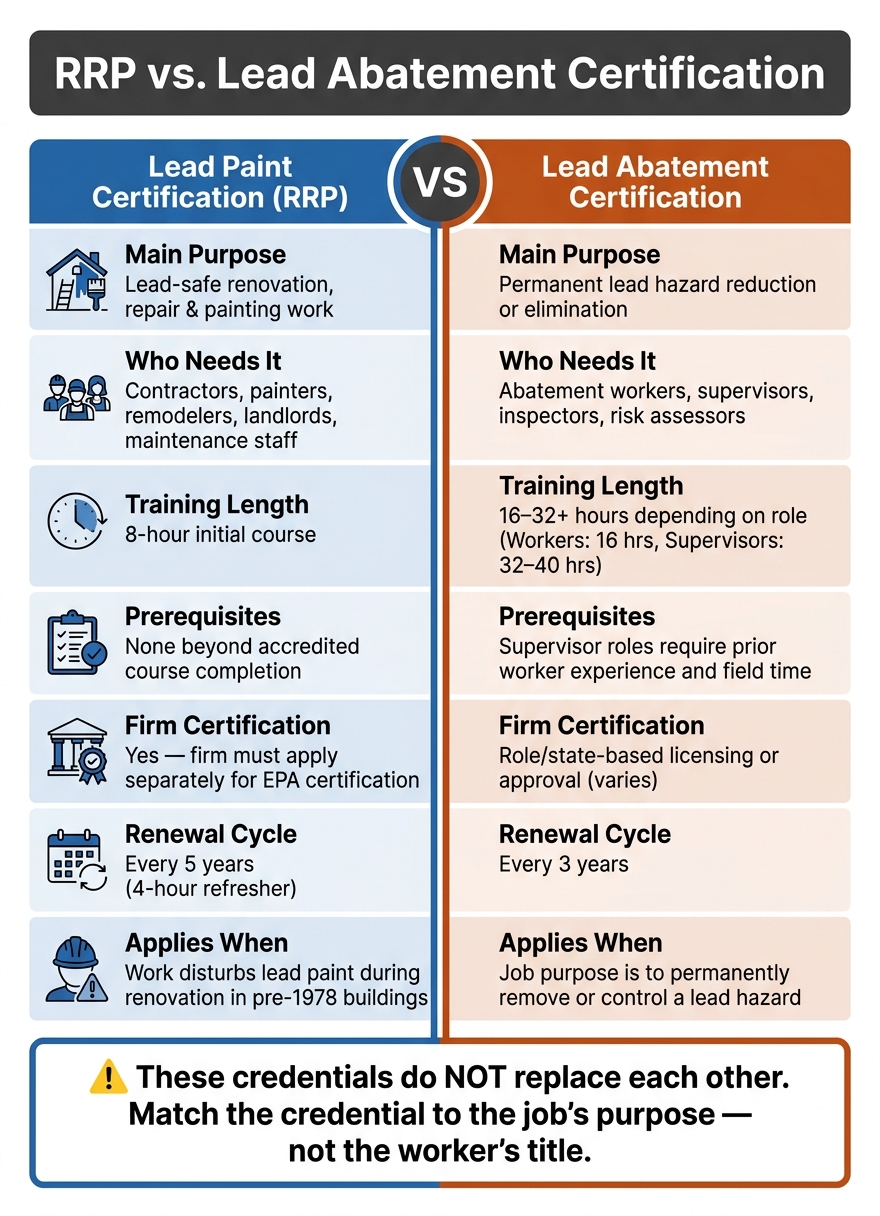
RRP vs. Lead Abatement Certification: Side-by-Side Comparison
The Difference Between Lead Abatement and Renovation
sbb-itb-aa28329
What Each Certification Covers
RRP covers renovation work that may disturb lead paint. Abatement covers work meant to permanently reduce a lead hazard.
Lead Paint Certification for Renovation, Repair, and Painting Work
EPA RRP certification applies when a contractor disturbs painted surfaces in pre-1978 housing or child-occupied facilities, such as daycares and preschools. The big idea is simple: if the job can stir up lead dust, the crew has to work in a way that keeps people safe.
Take a window replacement in a 1960s apartment. That kind of job can release lead dust into the air and onto nearby surfaces. So the crew needs to contain the area, control dust, protect occupants, and clean up the space the right way. RRP training covers those day-to-day jobsite practices, along with the paperwork needed to document compliance.
The firm itself must be certified, and at least one certified renovator must direct the work. Initial training is an 8-hour course, and the credential stays valid for 5 years before a 4-hour refresher is required.
That’s different from abatement. With RRP, the goal is safe renovation work. With abatement, the goal is to reduce the hazard itself.
Lead Abatement Certification for Permanent Hazard Reduction
Lead abatement certification applies when the work is meant to permanently reduce or eliminate a lead hazard. That can include removal, enclosure, encapsulation, or soil remediation where permitted.
In many cases, abatement follows lead-hazard findings, such as an elevated blood lead level in a child. That makes the work more serious and more tightly defined. It’s not just about doing the job safely. It’s about fixing the hazard in a lasting way.
Because of that, abatement certification is role-specific. Common roles include abatement worker, supervisor, inspector, risk assessor, and project designer. Each role comes with its own training path and level of authority under state or local rules.
Training time reflects that split in responsibility. Abatement worker training typically runs 16 hours, while supervisor training is around 32 hours, since supervisors oversee permanent hazard reduction work and carry more responsibility.
That difference in purpose shapes the training, supervision, and approval rules that come next.
Side-by-Side Comparison of the Two Credentials
EPA treats RRP and abatement as separate programs, each with its own certification track and rulebook. On the jobsite, that split matters.
Scope, Training, and Regulatory Use
Start with the purpose of the project. If the work is meant to permanently eliminate a lead hazard, it calls for abatement. If lead paint comes up as part of renovation, repair, or painting work, it falls under RRP.
The training gap is also hard to miss. RRP renovator training is an 8-hour course built around day-to-day jobsite procedures. Abatement training goes much deeper. Worker courses run 16–24 hours, and supervisor courses can go up to 32 hours, with more focus on rules, hazard-control methods, and coordination for clearance testing.
Here’s how the two credentials compare in practice:
| Feature | Lead Paint Certification (RRP) | Lead Abatement Certification |
|---|---|---|
| Work intent | Lead-safe renovation, repair, and painting | Permanent lead hazard reduction or elimination |
| Who needs it | General contractors, painters, plumbers, electricians, landlords | Abatement workers, supervisors, inspectors, risk assessors |
| Training intensity | 8-hour initial course | 16–32+ hours depending on role |
| Prerequisites | None beyond completing the accredited course | Supervisor roles require prior worker experience and field time |
| Exam/application steps | Complete course, pass exam; firm applies separately for certification | Complete training, pass exam, submit application with documentation |
| Renewal cycle | Every 5 years | Typically every 3 years |
One point trips people up all the time: these credentials don’t replace each other.
An abatement-certified contractor doing standard renovation work in a pre-1978 home still has to follow RRP rules, including pamphlet distribution, containment, and recordkeeping. On the flip side, an RRP-certified renovator can’t take over a state-mandated hazard elimination project without the right abatement credential.
Use the wrong certification, and the job can slide into compliance trouble fast, including stop-work orders.
Training Requirements and Which Certification to Get
Typical Training and Approval Steps
Once you know what kind of work you’re doing, the next step is simple: line up the right training and approval path for that job.
For RRP work, the path starts with an 8-hour EPA-accredited course. It covers containment setup, HEPA vacuum use, cleanup verification, and recordkeeping. At the end, you take an exam. If you pass, your course completion certificate serves as proof of renovator training.
Abatement training goes further. Workers usually complete 16 hours of training, while supervisors usually complete 32 to 40 hours. After that, candidates pass an exam and submit an application. For supervisor roles, field experience may also be required.
There’s also one paperwork step that trips up a lot of contractors: if a firm performs RRP work, it must apply separately for EPA firm certification. That’s in addition to having at least one certified renovator assigned to each covered project.
Matching the Right Certification to the Job Role
Match the credential to the work, not the title. That’s the part people mix up.
A painter working in a 1962 duplex needs RRP renovator certification. But if that same painter is working on a lead hazard control project, they need abatement worker credentials instead.
Here’s the quick match-up:
| Job Role | Credential Needed |
|---|---|
| Painter, remodeler, window installer, maintenance tech (pre-1978 buildings) | EPA-certified renovator (RRP) |
| Abatement crew on hazard control projects | Lead Abatement Worker |
| Site supervisor overseeing abatement plans or occupant protection plans | Lead Abatement Supervisor |
| Inspector or risk assessor | Certified Lead Inspector / Risk Assessor |
The rule stays the same on every covered job: the credential needs to fit the work being done.
Conclusion: Match the Credential to the Work
RRP lead paint certification covers renovation, repair, and painting work that may disturb lead-based paint. Lead abatement certification applies when the main goal of the job is permanent lead-hazard reduction.
That line matters. If you use the wrong credential, you can run into compliance trouble right away. The result can be civil penalties, stop-work orders, failed inspections, and costly rework.
Before training anyone or sending a crew to the site, verify which rule applies to the project. Check the rules for the exact job and location before work starts. Some states run their own EPA-authorized programs and add licensing rules on top of the federal ones. In some places, you also need proof of lead certification before certain building permits will be issued.
Keep certification records current, confirm credentials before assigning crews, and track state and local rules.
With that paperwork handled, the final check is simple: match the credential to the work, not the worker’s title or past experience.
FAQs
How do I know if my project is renovation or abatement?
It depends on the goal. Lead abatement means the permanent removal of lead-based paint or other lead hazards. That work calls for a specialized 40-hour certification.
If your project disturbs painted surfaces during standard renovation, repair, or painting, it usually falls under the EPA’s RRP rule. In that case, the focus is on specific containment and safety practices, not total removal.
Do I need both worker and firm certification for RRP jobs?
Yes. For qualifying RRP projects, both the firm and the individual worker must meet EPA certification requirements.
The firm must be an EPA-certified firm. And anyone doing the work must either be a certified renovator or be trained by one for the tasks they perform.
Can state or local rules change certification requirements?
Yes. Federal EPA lead-safe rules set the baseline, but state and local agencies can add extra requirements. That might mean a certain abatement license, added paperwork, or renewals that happen more often.
In some places, licensing doesn’t even sit with the state. A city or county building department may handle it instead. ABLEMKR helps teams track worker credentials and local compliance rules, so they can meet the standards for that area before they arrive on-site.


