
IoT can help cut accidents, near-misses, and response time on U.S. construction sites – but only when crews trust the alerts and supervisors act on them.
From the research in this article, I’d boil it down like this: connected wearables, location tags, air and heat monitors, and shared dashboards can help spot falls, heat strain, fatigue, and worker-equipment risks sooner. In field use, some projects reported 35% fewer accidents, 73% to 79% fewer near-misses, and response times cut by about 75%. But weak signals, short battery life, false alarms, and privacy concerns can limit results fast.
If you just want the main takeaways, here they are:
- Wearables track things like motion, heart rate, body temperature, and impacts
- RTLS tracks where workers and equipment are on site
- Sensors watch heat, dust, gas, humidity, and noise
- Dashboards pull those feeds into one place so teams can respond faster
- Best results tend to come when companies use these tools together, not one at a time
- Biggest jobsite issues are alert fatigue, dead zones, hardware wear, and worker pushback on data use
- OSHA fit is simple: IoT supports safety programs and records, but it does not replace required controls
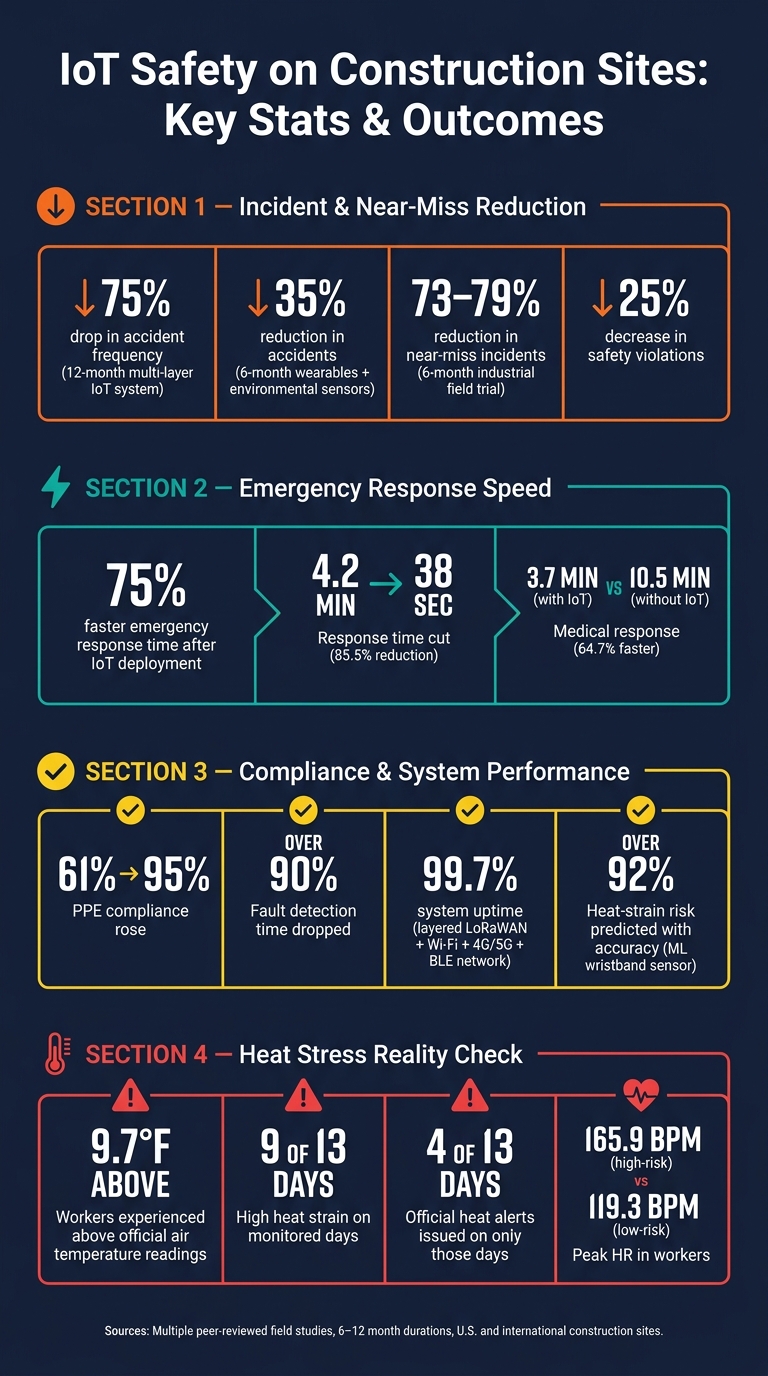
One point stood out to me: site heat can be much worse than the forecast says. In one road-work study, workers faced temperatures up to 9.7°F higher than official air readings, and high heat strain showed up on 9 of 13 days, while public heat alerts were issued on only 4 days.
| Tool | Main job | What it helps detect |
|---|---|---|
| Wearables / smart PPE | Monitor the worker | Falls, fatigue, strain, heat stress |
| RTLS | Track movement and proximity | Equipment-worker conflict, danger-zone entry |
| Site sensors | Monitor jobsite conditions | Heat, air quality, noise, gas exposure |
| IoT platform | Combine alerts in one view | Multi-risk response and recordkeeping |
So the short version is this: IoT helps most when it turns safety data into on-site action. That means better routing, break timing, hazard-zone control, and crew decisions – not just more data on a screen.
Construction Safety Intelligence Platform: Vision AI, IoT, LiDAR, Drone & Edge AI for Zero Accidents
sbb-itb-aa28329
The main IoT tools used for worker safety on construction sites
Four IoT layers do most of the heavy lifting for construction safety: wearables, RTLS, environmental sensors, and integrated platforms. On a jobsite, each one watches a different part of the risk picture. Together, they line up with the main hazards on site: falls, struck-by events, heat stress, fatigue, and exposure.
| Technology | Primary Use Case | Data Captured |
|---|---|---|
| Wearables & Smart PPE | Falls, fatigue, ergonomics | Motion, posture, heart rate, body temperature, impacts |
| RTLS | Struck-by prevention, zone alerts | Worker/equipment position, proximity events |
| Environmental Sensors | Heat stress, air quality, noise | Temperature, humidity, dust/particulate exposure, gas concentration, noise |
| Integrated Platforms | Multi-hazard risk management | Combined feeds from wearables, RTLS, and environmental sensors |
Put simply: wearables monitor the worker, RTLS tracks movement, and sensors watch the environment.
Wearables and smart PPE for falls, fatigue, and ergonomics
Smart helmets, vests, wristbands, insoles, smart footwear, and sensorized clothing can track motion, acceleration, posture, heart rate, body temperature, and impact events. That gives supervisors worker-level visibility without forcing major changes to the site setup.
Studies show that wearables help detect falls, spot early signs of fatigue, and flag repetitive or awkward movements tied to musculoskeletal strain. That makes them a strong fit for three of the biggest site risks discussed in this article: falls, fatigue, and ergonomic strain. Some smart helmets use EEG and machine-learning models to flag drowsiness and fall risk. Smart footwear uses sole sensors for fall detection and movement tracking, while smart watches can detect falls, track location, and trigger emergency calls.
RTLS for worker location and hazard-zone alerts
RTLS systems place tags on workers and equipment, then use site infrastructure to estimate position in real time. RFID is often used for zone-level identification. BLE works well for broader zone alerts. UWB comes into play when tighter precision is needed. In indoor construction settings, UWB can reach sub-meter positioning, and research says that level of accuracy is enough for most safety monitoring needs.
This matters most for struck-by prevention and equipment-worker collision risk near cranes, heavy equipment, and road work zones. In those settings, RTLS can alert both workers and vehicle operators in real time. One UWB-based road-worker safety system used safety cones to set safe zones and issued warnings or alarms when a worker moved outside those boundaries.
There is a catch, though. Steel, concrete, and heavy equipment can interfere with RTLS signals and reduce precision in dense structures. And because continuous tracking can feel like someone is always looking over your shoulder, privacy concerns come up fast. Data use needs clear limits, and workers need to know what is being tracked and why.
Location data tends to matter most in shifting work zones, tight access points, and areas with heavy equipment.
Environmental sensors and integrated monitoring platforms
Fixed and mobile sensors track heat, humidity, dust, gas, and noise to support heat-stress, respiratory, hearing, and confined-space monitoring. When these sensors stay fixed in place or remain unobtrusive, they tend to add less friction on site.
Integrated platforms pull data from wearables, RTLS, and environmental sensors into one dashboard. These systems often run over 5G, Wi‑Fi 6, or LoRa. That setup helps supervisors see overlapping risks at the same time. For example, a worker dealing with heat stress near moving equipment is a very different situation from a worker dealing with only one of those issues. By combining feeds, teams can respond to heat stress, fatigue, and proximity risk together in real time, with attention staying on the work instead of bouncing between devices.
What recent studies report on safety outcomes
IoT Safety on Construction Sites: Key Stats & Outcomes
The results look good, but they’re not uniform from one jobsite to the next. Studies show clear safety gains from IoT use, yet the size of those gains shifts based on site conditions, how well the system is built into daily work, and whether crews actually use it every day. So it would be a mistake to treat any one number as the standard for every site.
| Technology used | Site context | Key safety outcomes | Study scope / duration |
|---|---|---|---|
| IoT wearables + environmental sensors | Large infrastructure | 35% reduction in accidents; 25% drop in safety violations | 6 months |
| Sensor network + connectivity + analytics | Multi-layer system | 75% drop in accident frequency; PPE compliance rose from ~61% to nearly 95%; fault detection time dropped by over 90% | 12 months |
| Wearables + environmental sensors | Industrial field trial | 73–79% reduction in near-misses; emergency response time cut by ~75% | 6 months |
| Wearable biosensors | Construction sites | Heat strain tracked through group heart-rate data | 834 workers |
| Wearable HR + skin temperature sensors | Summer construction | High-risk group: max HR of 165.9 ± 16.1 bpm vs. 119.3 ± 16.0 bpm in the low-risk group | 61 workers |
| Necklace temperature loggers + smartwatches | Road construction | Workers experienced up to 9.7°F above official air temperature; high heat strain on 9 of 13 monitored days | 7 workers |
| Wristband biosensor + ML | Construction workers | Heat-strain risk predicted with over 92% accuracy | |
| Smart band, GPS, LoRa, fuzzy logic | Indoor and outdoor construction | Less than 1% error in reliability testing; satisfactory on-site user feedback | |
| UWB RTLS | Road/railway maintenance | Real-time location tracking used to indicate whether workers were inside predefined danger zones |
The biggest improvements tend to show up when teams combine worker data, location data, and site-condition data. Put those together, and safety stops being just a dashboard exercise. It starts shaping crew routing, hazard controls, and supervisor response in real time.
Incident reduction and faster emergency response
The strongest results often come from studies that used several IoT layers together instead of relying on a single device. A 12-month observational study of a multi-layer IoT safety system reported a 75% drop in accident frequency. In that same study, PPE compliance climbed from about 61% to nearly 95%, and fault detection time dropped by over 90%. That’s a big shift, not just in incident counts, but in how fast the system spotted trouble.
A separate six-month infrastructure project using wearables and environmental sensors reported a 35% reduction in accidents and a 25% decrease in safety violations. Different site, different setup, smaller gains – but still a solid improvement.
Response speed also got better in multi-site testing. One industrial study across three manufacturing sites found that emergency response times fell by around 75% after IoT deployment. The same study reported a 73–79% reduction in near-miss incidents over six months. The pattern is pretty clear: faster detection usually leads to faster dispatch.
That said, these gains don’t happen by magic. They depend on steady signals, low false alarms, and workers sticking with the system day after day.
Monitoring heat stress and fatigue in the field
Heat is one of the clearest uses for physiological wearables on U.S. construction sites, especially in summer and in hotter regions. A study of 61 construction workers using continuous wearable sensors found a statistically significant gap in peak heart rates between high-risk and low-risk workers: 165.9 ± 16.1 bpm versus 119.3 ± 16.0 bpm. That’s the kind of difference a supervisor can act on if the data comes in live, instead of after the shift is over.
Another study makes the point even more sharply. A pilot study of 7 road construction workers across 13 monitored days found that workers experienced temperatures up to 9.7°F above official air temperature readings. In plain terms, what workers felt on site was often hotter than what the public forecast suggested.
High heat strain showed up on 9 of those 13 days, while official heat alerts were issued on only 4 dates. So public alerts missed more than half of the high-strain days workers actually faced. For U.S. contractors, that’s a useful gut check: weather reports can miss what’s happening at ground level, especially near asphalt, equipment, and low-airflow work zones.
Performance limits found in field testing
No IoT setup works perfectly in the field, and the studies are pretty open about the weak spots. Battery life keeps coming up as a problem. Frequent transmissions and multi-sensor setups can drain devices long before a 10- to 12-hour shift ends, which forces a trade-off between detailed data and enough runtime to last the day.
Connectivity is another issue. Complex jobsites still create dead zones, interference, and dropouts, so layered networks are often needed instead of a one-network fix. One 12-month study using LoRaWAN, Wi-Fi, 4G/5G, and BLE in a layered setup maintained about 99.7% system uptime. That result shows what’s possible when the network is built with backup paths instead of wishful thinking.
False alarms may be the biggest day-to-day headache. A proximity alert triggered by a harmless movement, or a fatigue warning caused by noisy sensor data, can wear people down fast. Once workers and supervisors stop trusting the alerts, real warnings can get brushed off too.
Across RTLS options, the trade-offs are fairly clear:
- UWB gives the tightest accuracy, often below one meter, which makes it a better fit for narrow danger zones near heavy equipment.
- BLE works better for broader zone alerts, though it’s more prone to interference.
- RFID still has a place in access control and PPE tracking, but it isn’t built for continuous, high-accuracy positioning.
Those field limits affect adoption, day-to-day use, and how much people trust the alerts they receive.
Challenges, compliance, and workforce adoption
IoT only works on a jobsite when teams can connect it, keep it running, and use it every day. That sounds simple, but field conditions decide whether alerts get trusted and whether supervisors do anything with them. The chain is pretty clear: system reliability → worker acceptance → compliance value.
Connectivity, durability, and alert fatigue
Coverage gaps are common on large, remote, or enclosed jobsites. Steel, concrete, distance, and enclosed work areas can all interfere with signals. That’s why firms usually rely on a mix of controls instead of betting on one network alone: pre-construction coverage surveys, hybrid edge-gateway architecture, and mesh repeaters in weak zones.
Durability is a different issue. Dust, moisture, vibration, and tool impacts can wear down sensors much faster than lab testing suggests. In the field, even small hardware problems can chip away at confidence in the data. Scheduled inspections, calibration checks, and modular device designs can help keep systems usable, especially when a damaged sensor module can be swapped without taking the whole setup offline.
Then there’s alert fatigue. If thresholds are too sensitive or rules get too complicated, crews start tuning alerts out. And once that happens, the alerts that matter can get ignored too. Running small-crew pilots before full deployment and tuning thresholds against actual task profiles can cut down on that problem.
| Challenge | Common cause | Practical mitigation |
|---|---|---|
| Connectivity gaps | Steel/concrete structures, remote sites, enclosed spaces | Pre-construction coverage surveys; hybrid edge-gateway architecture; mesh repeaters in weak zones |
| Sensor failure / drift | Dust, vibration, moisture | IP-rated ruggedized hardware; scheduled calibration and maintenance routines |
| Alert fatigue | High event volume, complex rules | Small-crew pilots; tiered alerting (informational / caution / critical); geofence tuning |
| Model generalization | Models trained on limited conditions | Ongoing threshold review; manual back-up procedures when IoT underperforms |
Privacy, data ownership, and worker acceptance
After reliability comes acceptance. Workers have to be willing to wear the devices, carry them, and let the system collect data. Resistance tends to show up when location or biometric data could affect discipline, pay, or job security. And the effect is immediate: if devices stay in lockers or get left behind, the system develops blind spots and alerts get weaker.
Roughly two-thirds of workers were willing to share physiological and environmental data with management, but a large minority opposed sharing because of privacy concerns and distrust over how the data would be used. Acceptance was higher when the data was plainly tied to safety outcomes, not productivity tracking, and when workers could point to visible results like adjusted break schedules or re-marked hazard zones. In union settings, these data-use issues often come up during negotiations.
Studies point to a few safeguards that help: role-based access controls, data minimization, encrypted transmission and storage, and limited retention periods tied to OSHA or company recordkeeping rules. Clear written policies matter too. So do toolbox talks that spell out exactly what is being collected, why it’s being collected, and who can see it.
How IoT supports OSHA-aligned safety management
Once teams are using the system, the same data can support permit logs, exposure records, and incident review. IoT adds live monitoring and documentation, but it supports – not replaces – OSHA-required controls.
For fall protection (29 CFR 1926 Subpart M), wearables can detect sudden vertical acceleration that lines up with a fall and log near-miss events when workers approach unprotected edges without proper equipment. For confined-space safety, location and atmospheric sensors can track worker presence and time inside permit-required spaces, send automated alerts when atmospheres reach unsafe levels, and produce entry and exposure records that connect straight to permit documentation. For heat illness prevention, platforms that combine ambient heat-index data with physiological signals can recommend breaks and hydration schedules during the shift – and document those recommendations across the workday.
A fall-detection wearable does not replace fall protection. A heat-stress dashboard does not replace a written heat-illness plan. Used well, these tools help show that required controls are active – and that link matters when IoT data starts shaping workforce deployment decisions.
Conclusion: What the research means for safer workforce deployment
IoT systems – wearables, RTLS badges, environmental sensors, and integrated dashboards – give site teams real-time visibility into worker location, health indicators, and hazard exposure. The biggest gains happen when that data shapes day-to-day safety calls, not when it just sits on a screen. You can see that most clearly on active job sites.
Recent field trials show much faster emergency response. One multi-layer IoT deployment cut average incident response time from 4.2 minutes to 38 seconds, an 85.5% reduction. Another wearable-based system helped medical teams reach injured workers in an average of 3.7 minutes, compared with 10.5 minutes on sites without IoT – 64.7% faster.
Still, devices by themselves don’t produce those results. Teams with clear escalation rules, tuned alert thresholds, and trained staff do better than teams that treat IoT like a simple plug-and-play fix. Research also warns that poor integration can lead to alert fatigue and weak adoption. Data helps only when crews trust the system and know how to respond to what it shows.
The rules around data use matter just as much. Workers are more likely to wear devices and buy into the system when they’re told what is being collected, who can see it, and that the purpose is safety and compliance – not productivity tracking. That’s not a small detail. It’s the difference between a system people accept and one they work around.
Once teams trust the data and act on it, IoT starts doing more than flagging risk. It becomes a signal for staffing and mobilization. If RTLS logs show repeated worker-equipment close calls during a certain phase, managers can bring in more experienced crews or change the work-zone layout before the next phase starts. If wearable data points to rising heat stress or fatigue, that can shape shift design, task rotation, and break schedules.
That’s where workforce deployment comes in. ABLEMKR can use these signals to match pre-vetted workers to site conditions based on certification, safety training, availability, and location. When IoT data defines what a project needs and deployment tools help send the right qualified workers to the site ready for those conditions, the gap between safety insight and safe execution gets a lot smaller.
FAQs
How much can IoT improve construction safety?
IoT can improve construction safety by moving teams from a reactive approach to a more proactive one. Instead of waiting for something to go wrong, crews can spot risks as they happen and act right away.
Some automated monitoring systems have cut site accidents by up to 95% with real-time alerts and constant oversight.
Reported results also include:
- a 15% drop in work-related illnesses
- a 63% decrease in heat-related medical emergencies
When connected to workforce management systems, IoT can also help make sure qualified, pre-vetted workers take on high-risk tasks.
Which IoT tools matter most on construction sites?
The most important IoT tools for construction safety include drones, wearables, and jobsite sensors.
- Drones help inspect hazardous or hard-to-reach areas without putting workers in harm’s way.
- Wearables can track heart rate, hydration, and fatigue, which helps crews spot signs of strain before they turn into injuries.
- Sensors monitor air quality, noise, and structural vibration, giving teams a clearer picture of site conditions as they change.
AI cameras and GPS geofencing add another layer of oversight. They can flag violations, restrict access to danger zones, and improve compliance documentation.
What can cause IoT safety systems to fail on site?
IoT safety systems don’t always work smoothly on construction sites. A few common problems tend to get in the way: high upfront costs, data security risks, and trouble connecting with older project management tools.
There’s also the issue of reliability. Bad weather, tall buildings, and dense urban layouts can interfere with signals. When that happens, teams may deal with false alerts or missed notifications, which can chip away at trust in the system.
On top of that, privacy concerns and the extra training required can make workers less willing to use these tools day to day.


