
Construction needs more workers, and the fastest way to expand the talent pool is to fix how hiring works. I’d boil this article down to five moves: reach more communities, clean up job ads, open apprenticeship paths, track each hiring step, and extend the same standards to subcontractors.
Right now, women hold only about 10% to 14% of construction jobs, and fewer than 5% of hands-on craft roles. At the same time, construction faced 396,000 open jobs in March 2022 and was expected to need about 723,000 new workers each year through 2026. That gap points to a simple problem: if you keep hiring from the same circles, you keep getting the same limits.
If I wanted the short version, it would be this:
- Expand outreach beyond referrals and word of mouth
- Use job ads with plain, job-based language
- Create pre-apprenticeship and apprenticeship routes
- Track applications, interviews, hires, and retention by group
- Set the same expectations for subcontractors and suppliers
These steps do not mean quotas or special treatment. They mean a hiring process that is easier to review, easier to document, and more likely to bring in qualified people who might otherwise never apply.
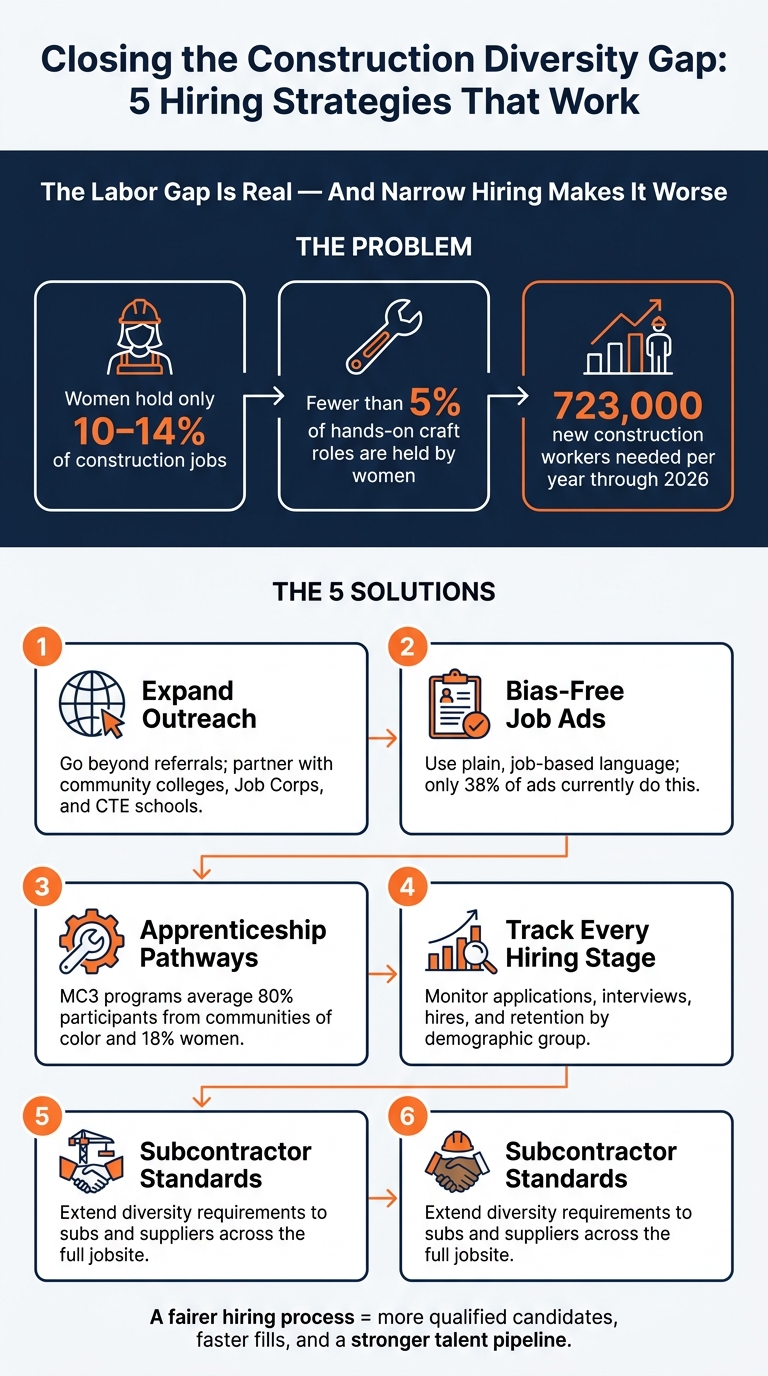
Construction Diversity Gap: Key Stats & 5 Hiring Fixes
Improving diversity in construction teams
sbb-itb-aa28329
Quick Comparison
| Method | Main Goal | What It Fixes | What To Watch |
|---|---|---|---|
| Outreach to underrepresented groups | Bring in more applicants | Overreliance on the same networks | Source tracking, response rates |
| Bias-free job descriptions | Improve who applies and moves forward | Vague or coded screening language | Consistent criteria, job analysis |
| Apprenticeship pathways | Help people become job-ready | Limited access to skilled trades | Entry rules, completion rates |
| Data and hiring systems | Show where drop-off happens | Hidden problems in screening or interviews | Adverse impact checks, recordkeeping |
| Subcontractor diversity programs | Extend hiring efforts across the jobsite | Same vendor pool on every project | Bid lists, spend data, workforce data |
For me, the core takeaway is simple: construction hiring gets better when it is more open, more consistent, and tied to real job requirements instead of habit.
Why Diversity Hiring Matters In Construction
Diversity hiring matters in construction for a simple reason: the labor pool is getting smaller, but the work isn’t slowing down.
When companies open their hiring efforts to women, veterans, career changers, community college graduates, and people from related fields, they give themselves more room to hire. That means more candidates, faster fills, and less reliance on the same small set of contacts.
This isn’t just a recruiting idea. It’s an operations move too.
Construction firms that build talent pipelines beyond the usual sources can pull from a larger candidate pool. That can improve fill rates, cut time-to-hire, and give teams more staffing flexibility across multiple job sites. Workers from adjacent industries, like manufacturing and utilities, can also be a strong fit, especially when their skills transfer well to construction roles.
The approach has to fit the labor market. An urban firm might get better results from apprenticeships and job fairs. A rural contractor may need to work more closely with county workforce agencies, local schools, and nearby employers. The goal stays the same. The hiring channels change based on where the company operates.
A documented, compliant hiring process also helps on another front: it can lower legal risk and support fair selection decisions.
1. Expand Outreach To Underrepresented Communities
Construction hiring still leans hard on word of mouth, crew referrals, and familiar subcontractor networks. That keeps the same talent circles turning. Expanding outreach means going past those usual channels and making a clear effort to connect with people who have often been left out of construction hiring pipelines – women, Black and African American workers, Hispanic/Latino workers in skilled and supervisory roles, veterans, people with disabilities, and returning citizens. The point is simple: open the door to more qualified candidates.
A good place to start is where people already train, learn, and apply.
Pipeline Reach
Build steady partnerships with community colleges, CTE high schools, Job Corps centers, and pre-apprenticeship programs. Done well, those relationships create a reliable flow of prepared candidates instead of a last-minute scramble when a role opens.
These programs matter because they turn outreach into people who are ready to work. Boston’s Building Pathways program is a strong example: in under four years, more than 125 low-income participants graduated, over 85% entered union apprenticeships or jobs in 17 trades, and more than half were women.
The message matters just as much as the place you post it. In Massachusetts, Minuteman’s "Build It!" pre-apprenticeship drew 72% women when outreach directly invited women and used images of women workers. When that stopped, women’s participation fell to 17%.
Once people enter the funnel, the next challenge is helping them stay.
Retention Pathway Support
Outreach widens the funnel. Retention protects the time and money spent getting people in the door. Structured onboarding, mentorship, and clear paths for growth – from laborer to skilled trades to foreperson – can help new hires stay through the first 90 to 180 days.
Some barriers have nothing to do with skill. Transportation, childcare, and stipend support can make the difference between someone dropping out and someone sticking with the job.
EEO/OFCCP Alignment
For covered contractors, outreach also needs to be documented. For federal contractors and subcontractors, outreach is a compliance duty under Executive Order 11246 and OFCCP rules. Those rules require good-faith recruitment of women and minority workers, documentation of those efforts, and tracking of outcomes. The OFCCP’s participation goal for women is 6.9% of work hours on covered projects – targets, not quotas.
This tends to work best when outreach, selection, and recordkeeping are handled as one process, not three separate tasks. Keep a current source list, send written opening notices to community organizations, schools, and training groups, and record responses.
2. Write Bias-Free Job Descriptions And Selection Criteria
Once outreach brings people in, the job post does the next part of the work: it signals who feels invited to apply.
That matters more than a lot of teams think. Gendered language can push people out before screening even begins. Neutral wording tends to increase applications, yet only 38% of ads use it.
Job-Related Fairness
Before writing the posting, do a basic job analysis. Get clear on the role itself: the core tasks, required certifications, physical demands, and the actual working conditions. Then make sure every qualification in the ad maps back to those points.
In plain terms, the posting should describe the job as it is, not the kind of personality someone imagines fits it.
A laborer role should say "able to lift 50 lbs. and work outdoors in varying weather" instead of leaning on vague, personality-heavy wording. A welder opening should say "1–3 years of welding experience or equivalent training; AWS certification preferred" instead of "extensive experience required."
Watch for gender-coded terms like competitive, dominant, aggressive, and fearless. Those words can screen people out for no good job-based reason. Use neutral, behavior-based phrasing instead, such as:
- able to work in a fast-paced environment
- comfortable making decisions under time constraints
The point isn’t to make the ad sound softer. It’s to make it more accurate.
It also helps to use plain language, mobile-friendly formatting, and clear pay ranges. Those choices can cut down on self-screening, where good candidates opt out because the post feels unclear or not meant for them. An EEO statement that mentions apprenticeship pathways, non-discrimination, and support for diverse candidates can also broaden the response pool. If the role includes training, mentorship, promotion paths, accommodations, or return-to-work support, say so – but only if those options are actually part of the job.
EEO/OFCCP Alignment
For federal contractors, selection criteria need to be job-related and tied to business need under the Uniform Guidelines on Employee Selection Procedures (UGESP). In practice, that means documenting why each qualification is there and using the same interview questions and scoring rubrics for every candidate.
Here’s the simple test: if application diversity goes up but interview diversity stays flat, the problem likely sits in screening, not in the posting.
Clear criteria help here too, especially when apprenticeship screening needs to stay consistent.
3. Build Apprenticeship And Pre-Apprenticeship Pathways
Once a job posting is fair, the next hurdle is training access. A bias-free posting can get people to apply. An apprenticeship pathway helps them become qualified. For many underrepresented workers, the issue isn’t lack of interest. It’s lack of access. That’s why a structured pathway matters.
Pipeline Reach
The programs that move the needle don’t sit back and wait for applicants. They go out and meet people where they are. That usually means working with community colleges, workforce boards, YouthBuild USA, ACE Mentor Programs, and union apprenticeship committees to reach candidates outside the usual referral circles.
Programs built around the Multi-Craft Core Curriculum (MC3), which was developed with union building trades, have averaged 80% participants from communities of color and 18% women since 2016. The U.S. Department of Labor’s American Apprenticeship Initiative (AAI) found that 90% of pre-apprentices were from underrepresented workers, compared with 61% of AAI registered apprentices and 46% of all registered apprentices across the national population.
Job-Related Fairness
Entry requirements should match the work itself. If a pre-apprenticeship program is meant to teach the basics, then candidates should not need prior trade experience just to get in. What they do need is basic construction math, safety awareness, and the physical ability the role calls for, within ADA limits.
Clear process rules help here. Standardized scoring rubrics, published timelines, and retest options can cut down on arbitrary barriers for qualified candidates.
Retention Pathway Support
Getting people in the door is only part of the job. Building a steady workforce means helping them finish. Women and workers of color often complete apprenticeships at lower rates than they enter them, which means early progress can drop off before journeyman status. And if people enter but don’t complete, labor shortages don’t get solved.
Support after entry can make a big difference, including:
- Structured mentorship
- Peer cohort intakes
- Transportation assistance
- Childcare referrals
- Exam prep support
Oregon research found that 31.5% of women of color apprentices and 21.7% of white women apprentices entered construction through a pre-apprenticeship program. That points to something simple: the pathway works best when support doesn’t stop on day one.
EEO/OFCCP Alignment
For federal contractors, apprenticeship programs are covered by the same equal opportunity rules as direct hiring. In plain terms, that means documenting outreach sources, keeping applicant flow records by demographic group, and checking completion data on a regular basis so gaps show up early.
Each candidate should go through the same process, be judged with the same job-related criteria, and have the same access to support. If one group is dropping out at higher rates, screening and support should be adjusted.
4. Use Data, Compliance Frameworks, And Technology To Track Hiring Outcomes
Once outreach and apprenticeship pipelines are in place, the next step is simple: measure what happens. Hiring gets better when you can see where people fall out of the process and fix those points. That means tracking the full hiring funnel, not just the final hire count.
Pipeline Reach
Track which sources lead to applications, interviews, and hires by demographic group. Collect voluntary self-identification data at the application stage so you can compare who entered the pipeline with who got hired. That makes it much easier to spot which outreach efforts are paying off and which ones need work.
Job-Related Fairness
Review each screening step to make sure it is job-related, consistent, and documented. Run adverse-impact checks at every stage. If a selection rate falls below 80% of the top group, that is a signal to review the process.
If you use AI-assisted screening tools, don’t treat them like a black box. Document why the tool is being used, test for bias across demographic groups, and confirm that it predicts job performance.
Retention Pathway Support
Hiring data tells only part of the story. You also need to track retention, promotions, training access, discipline, and separations by demographic group. In construction, useful measures include:
- First-year retention
- Safety-training completion
- Movement from entry-level labor into skilled craft or foreman roles
Those numbers show whether people are just getting in the door or if they have a fair shot at moving up.
EEO/OFCCP Alignment
Private employers with 100 or more employees, along with covered federal contractors, must file EEO-1 reports and keep OFCCP records. Covered construction contractors must also document good-faith efforts when women or minorities are underutilized. That is about documented effort, not quotas.
Build a clear paper trail from application to hire. Keep job descriptions, postings, applicant self-identification forms, interview notes, scorecards, selection reasons, non-selection reasons, and headcount snapshots in one central system.
Platforms like ABLEMKR can bring hiring, onboarding, certifications, and compliance records into one place. And when that data sits in one dashboard, it becomes much easier to read and act on.
5. Build Subcontractor And Supplier Diversity Programs
Diversity doesn’t stop with your direct hires. On large projects, a big share of the on-site workforce works for subcontractors, not the prime contractor. So if your effort ends with your own team, you’re only reaching part of the jobsite. A broader subcontractor and supplier base also helps on big jobs because it adds bench strength and cuts reliance on the same small group of vendors.
Pipeline Reach
Start with a written diversity policy for procurement and subcontracting. Use prequalification forms to gather data on ownership and workforce makeup. Then ask larger subs to use similar practices and include certified diverse vendors on their bid lists.
You can find subs and suppliers through DBE (Disadvantaged Business Enterprise) directories, state DOT small business registries, and local minority business councils. On federally funded projects, make sure bid solicitations reach certified firms and match DBE and MBE/WBE participation goals.
Once diverse firms make it into the bid pool, the next step is simple: keep selection grounded in the work itself.
Job-Related Fairness
Use objective, job-related standards in every subcontractor prequalification and bid review. Focus on skills, certifications, and past performance. Then review those standards from time to time to make sure they aren’t filtering out minority- or women-owned firms without a job-based reason.
Every subcontract should also include EEO and nondiscrimination clauses. And there needs to be a check on the work itself: diverse subs should be doing real, contract-level work, not just serving as pass-through entities.
Winning one bid helps. Getting steady work is what keeps firms in the game.
Retention Pathway Support
Retention gets stronger when you give work to subs that put money and time into apprenticeship and skills training. It also helps to pair newer workers with experienced journeyworkers and use multi-project agreements that give diverse firms steadier work instead of one-off chances.
The day-to-day basics matter too:
- Fair scheduling
- Predictable pay
- Safe working conditions
- Help with bonding, insurance, estimating, and compliance
That kind of support can make the difference between a firm staying in the bid pool or dropping out.
EEO/OFCCP Alignment
Add the required nondiscrimination clauses to subcontracts and purchase orders. Collect aggregate workforce data from subs by race/ethnicity, gender, disability, and veteran status. Then review that data every quarter to see whether diverse firms are taking part in the work in a meaningful way.
Tables To Make The Advice More Actionable
These tables help turn the five strategies into repeatable hiring checks.
Use them as working templates, not set-in-stone documents. The point is to make hiring easier to review, easier to measure, and much harder to leave to guesswork.
Outreach Channel Comparison
Start by comparing your outreach channels side by side.
| Channel | Target Group(s) | Engagement Model | Diversity Impact | Relative Cost | Tracking Notes |
|---|---|---|---|---|---|
| YouthBuild USA / ACE Mentor Program | Youth, high school students, low-income candidates | Internship, pre-apprenticeship | High | Low | Track conversion from program completion to apprenticeship placement |
| Community colleges / trade schools | Career changers, local talent | Apprenticeship, direct hire | Medium–High | Low–Medium | Track the number of hires from each program annually |
| Women-in-construction organizations (e.g., NAWIC, MAGIC camps) | Women | Career fairs, mentorship | High | Varies | Track women’s share of craft and supervisory hires |
| Helmets to Hardhats / Veterans in Piping | Veterans, transitioning service members | Direct hire, apprenticeship | Medium | Low | Track veteran applications and hires |
| Minority contractor associations | Black, Hispanic/Latino, and other minority candidates | Networking, referrals | High | Low | Track hires and contracts awarded |
| ABLEMKR | Pre-vetted workers with certifications, safety training, and geo-location matching | Direct hire, flex-to-perm | Medium–High | Varies | Track source per hire and certification fit |
This kind of comparison helps you see where each channel fits. Some are better for early pipeline building, like YouthBuild USA or ACE Mentor Program. Others are more direct, like ABLEMKR or Helmets to Hardhats.
Biased vs. Inclusive Job Description Wording
Next, standardize posting language and screening.
Small wording choices can shape who applies and who gets screened out. This table gives hiring teams a simple before-and-after reference.
| Phrase to Avoid | Inclusive Alternative | Bias Risk Addressed |
|---|---|---|
| "Strong/able-bodied worker" | "Able to perform the physical requirements of the role with or without reasonable accommodation" | Disability, physical ability bias |
| "Must be a native English speaker" | "Must be able to communicate effectively in English on the job site" | National origin bias |
| "Ability to lift 50 pounds" | "Able to move equipment weighing up to 50 lbs, with or without reasonable accommodation" | Disability bias; ADA alignment |
| "He/she will manage the crew" | "You will manage the crew" or "The candidate will manage the crew" | Gender bias |
| "Foreman" | "Site supervisor" or "crew lead" | Gendered job title |
| "10+ years of experience required" | "Demonstrated proficiency in specific tasks or certifications, such as OSHA 30 or NCCER" | Experience barrier |
| "Qualified/competent workers" | "OSHA 10 certified" or "Licensed journeyman" | Vague criteria enabling résumé inflation |
| "Ability to stand for entire shift" | "Ability to remain in a stationary position for the entire shift" | Disability bias |
Add EEO and accommodation language to every posting.
Hiring Metrics Tracking Table
Then, track whether each stage is working.
One dashboard is usually enough if it covers the full hiring path. If applications look diverse but hires do not, something is breaking between screening, interviews, and offers.
| Stage | Total Count | % from Underrepresented Groups | Target/Benchmark | Frequency | Owner |
|---|---|---|---|---|---|
| Applications received | – | – | Internal goal | Monthly | Talent Acquisition |
| Interviews conducted | – | – | Reflects applicant pool | Monthly | HR Manager |
| Offers extended | – | – | Reflects interview rate | Monthly | HR Manager |
| Hires | – | – | Internal goal | Quarterly | Project HR Lead |
| Promotions / role changes | – | – | Proportional to workforce | Annually | Project Executive |
| Voluntary turnover (within 12 months) | – | – | Below company average | Annually | HR Manager |
Break results out by craft, supervision, project management, and office. You can also add a notes/actions column to flag issues like revising interview panel composition or expanding outreach to community colleges.
Subcontractor Diversity Strategy Table
Finally, extend diversity into subcontracting and procurement.
That matters because hiring progress can stall if supplier and partner networks stay the same year after year. This table gives you a clean way to track who gets invited, who gets work, and how spend shifts over time.
| Trade / Category | Ownership Status | Certification | Annual Spend | % of Total Spend | Short-Term Action (3–12 months) | Long-Term Goal (1–3 years) |
|---|---|---|---|---|---|---|
| Electrical | Minority-owned (MBE) | DBE certified | – | – | Add at least one certified MBE to the bid list for the next project | Increase MBE electrical spend over time |
| Concrete | Woman-owned (WBE) | WBE certified | – | – | Identify two additional WBE concrete suppliers in the region | Build a larger WBE share across concrete contracts |
| HVAC | Veteran-owned (VOSB) | SBA VOSB certified | – | – | Include in bid solicitations for all projects over $1 million | Establish a multi-project agreement with at least one VOSB HVAC firm |
| Safety training vendors | Small business | State-registered | – | – | Host a vendor outreach event with a local minority business council | Develop ongoing capacity-building support for bonding and compliance |
Report diverse spend and awards quarterly. On federally funded projects, align this table with your DBE and MBE/WBE participation goals and include it in your EEO/OFCCP documentation.
These tables feed the reporting and technology workflows covered next.
How Technology Can Support Fairer Construction Hiring
Once hiring standards are set, technology helps teams use them the same way every time. In construction, hiring has often leaned on informal networks and loose interviews. That kind of process is hard to review and easy to tilt in the wrong direction. Technology brings the same rules to each step.
When every applicant moves through the same job template, qualification checklist, and interview questions, hiring decisions are easier to explain and review. Platforms that keep worker profiles, certifications, licenses, and training records in one place can also cut down on missed opportunities. A qualified candidate is less likely to get passed over because a document is buried in an email thread or stuck in a filing cabinet. The point is simple: make the process fairer and easier to check, while cutting back on the subjective gatekeeping that informal networks often create.
There’s also a plain access issue. More than 80% of construction workers don’t have regular desk access. Smartphone-based platforms help close that gap. Workers can upload credentials, finish onboarding tasks, and apply for open roles without needing a computer or inside connections. They shouldn’t need office access just to have a fair shot at a job. That also helps move credential submission along faster.
ABLEMKR matches pre-vetted workers to job sites based on certifications, safety training, availability, and location. That can speed up hiring, but just as important, it makes the process easier to review.
Of course, software doesn’t fix bias on its own. Technology is only as fair as the standards behind it. That’s why teams still need to review job requirements, check automated filters, and train managers to use the same standards each time, based on the same job-related criteria used in postings and scorecards.
Conclusion
Taken together, these steps turn hiring into a repeatable system. Improving diversity in construction hiring comes down to five practical moves: outreach, job descriptions, apprenticeship pathways, data tracking, and subcontractor standards should all run through the same process. When that happens, the work gets clearer, more structured, and easier to measure. A contractor can start with a simple step: review current job postings and swap vague requirements for skills-based criteria tied to certifications and safety training.
The business case is plain. The labor gap turns a narrow hiring pipeline into an operational risk. Expanding outreach through community colleges, workforce boards, veterans’ transition programs, and pre-apprenticeship partners gives companies a larger pool of qualified candidates when projects ramp up.
Once metrics are defined, software makes them easier to collect and review. Setting quarterly targets and checking progress during project start-up and closeout meetings turns diversity hiring into a measurable operational goal. Platforms like ABLEMKR can support that work by connecting pre-vetted workers to job sites based on certifications, safety training, availability, and location, while also centralizing worker profiles, certifications, and compliance records.
When subcontractors follow the same standard, the whole project benefits. Requiring diversity commitments in bid documents helps carry that standard across the full project.
Companies that make hiring more open, structured, and data-driven are in a better position to build stronger crews, deliver complex projects on schedule, and develop a lasting talent pipeline. That means stronger hiring, steadier delivery, and a pipeline that can hold up over time.
FAQs
How can small contractors improve hiring diversity?
Small contractors can widen their hiring pool by focusing on skills-based hiring and writing job descriptions that feel open and welcoming. That shift matters. If a posting reads like it was built for one narrow type of candidate, plenty of good people will skip it before they even think about applying.
It also helps to build relationships early. Partnering with local high schools, trade schools, and groups like the ACE Mentor Program can bring in people who may not have been on a contractor’s radar before. Over time, that creates a broader talent pipeline instead of the same small circle of applicants.
Once people join, support matters just as much as recruiting. Competitive, transparent benefits, paired with mentorship and clear career paths, can help new hires feel like they belong and see a future with the company. That kind of support can make a big difference in keeping diverse talent for the long haul.
What hiring metrics should construction firms track first?
Start with metrics that show both hiring speed and hiring quality:
- Time to hire
- Cost per hire
- Quality of hire
- Retention rate
- Interview-to-placement ratio
- Application drop-off rate
- Source of hire
These metrics help construction firms spot bottlenecks, track recruiting performance, and improve hiring over time.
How do you improve diversity hiring without using quotas?
Improve diversity hiring without quotas by taking a proactive, skills-based approach. The focus should stay on inclusive practices, not headcount targets.
That starts with the job post itself. Strip job descriptions down to the skills that matter most, and cut extra requirements that can screen out good people for no good reason. Use neutral, outcome-focused language so candidates know what success looks like instead of trying to decode buzzwords.
Hiring teams should also widen where they look. Don’t rely only on the same colleges, job boards, or referrals. Reach out to trade schools, apprenticeship pipelines, and mentorship programs. That opens the door to people who may not have the “standard” background but can do the work.
It also helps to hire for potential, not just polished resumes. Build training programs and clear internal career paths so people can grow into the role. A strong work ethic, willingness to learn, and job-fit skills often tell you more than pedigree ever will.


