
A full crew does not mean you have the right skills. If even one worker lacks the right license, safety training, or job-ready experience, your project can face delays, overtime, rework, or compliance trouble.
Here’s the short version: I identify skill gaps by defining project needs, checking current worker skills, scoring the gap, ranking the biggest risks, and fixing them with training, redeployment, hiring, or contract labor. That matters because skill gaps can cost about $22,000 per worker per year, and 76% of U.S. employers say skilled hiring is hard.
If I wanted a simple way to explain it, I’d put it like this:
- Step 1: List the roles, skills, licenses, and safety training the project needs
- Step 2: Build a verified record of who can do what right now
- Step 3: Compare required skill levels to current skill levels
- Step 4: Rank gaps by schedule, safety, and compliance risk
- Step 5: Close gaps with the right staffing move and review again every six months
What this article helps you do:
- Spot missing skills before mobilization
- Check whether workers are qualified and available
- Cut labor overruns and avoid patchwork staffing
- Keep crews aligned with OSHA, MSHA, and site rules
This is not about adding more people. It’s about matching the work to the people who can do it safely and on time.
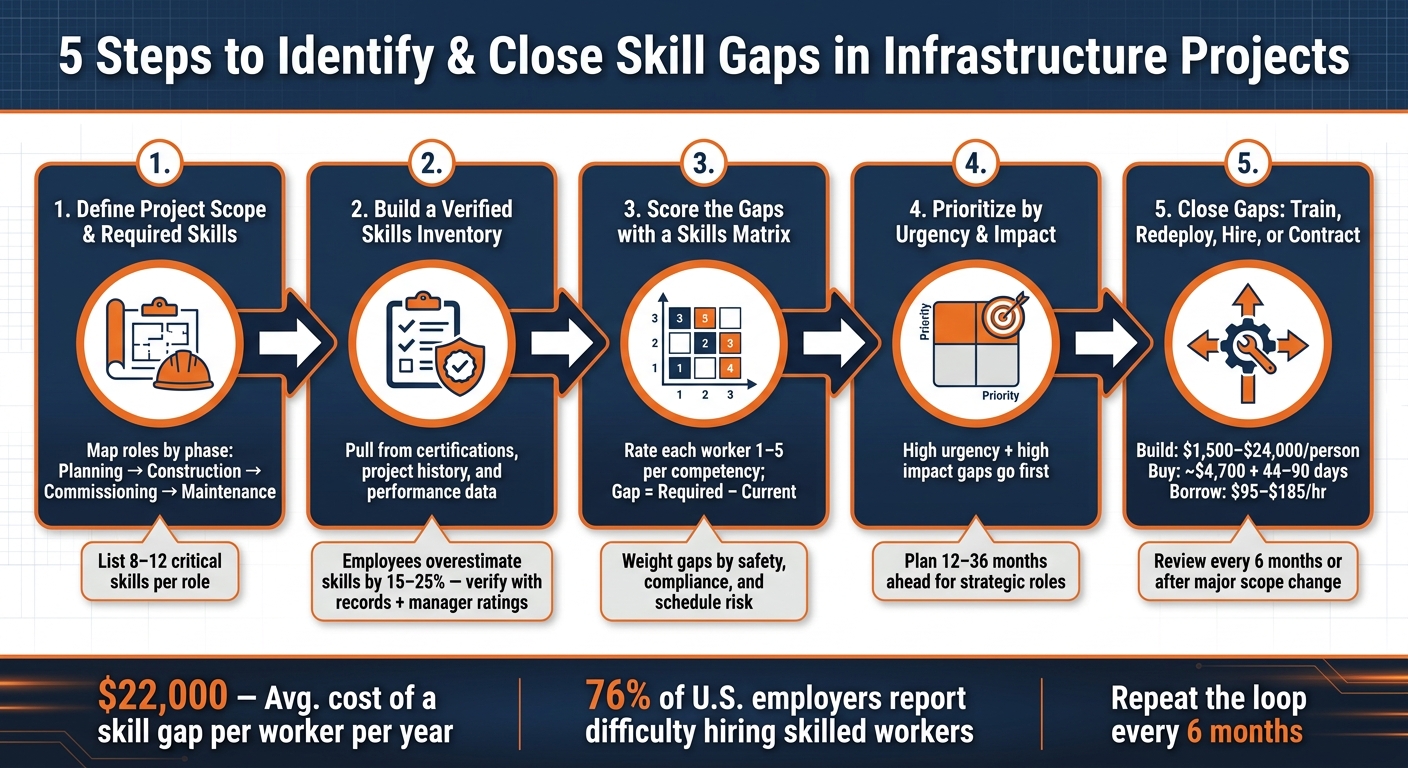
5 Steps to Identify & Close Skill Gaps in Infrastructure Projects
How to Conduct a Skills Gap Analysis| Step-by-Step Guide
sbb-itb-aa28329
Step 1: Define Project Scope, Critical Roles, and Required Skills
You can’t measure gaps until you define the full scope. Start there.
Before you assess skills, spell out the project scope: asset type, phase, location, schedule, and regulatory rules. Build that scope around local labor supply, union rules, licensing, and prevailing wages. That scope becomes the baseline for Step 2.
Map Roles by Project Phase
Workforce needs change as a project moves through its lifecycle. Planning and pre-construction usually need civil engineers, estimators, project managers, BIM technicians, and data analysts. Construction and mobilization shift the focus to electricians, welders, equipment operators, safety specialists, laborers, and pile-driver operators. Commissioning and maintenance bring in HVAC technicians, water treatment operators, and environmental engineers.
Then turn each role into a set of skills and credentials you can check. The table below shows critical roles and key requirements across each phase:
| Project Phase | Critical Roles | Key Skills & Certifications |
|---|---|---|
| Planning | Civil Engineers, Estimators, Project Managers, BIM Technicians, Data Analysts | CAD/GIS, STEM, data analysis, CCM certification |
| Construction | Electricians, Welders, Equipment Operators, Safety Specialists, Laborers, Pile-driver Operators | AWS welding qualifications, CDL, OSHA 30, MC3, IBEW training |
| Commissioning | HVAC Technicians, Safety Specialists | EPA Section 608, SCADA familiarity, safety records |
| Maintenance | Water Treatment Operators, Environmental Engineers | State-issued licenses, LEED, MSHA training |
Use the pre-construction phase to spot which roles are hardest to fill in your target region and where one missing person could create the most risk.
Build a Role-Based Skills Taxonomy
Once roles are mapped by phase, break each one into the exact skills it needs. Group those skills into three tiers: foundational (digital literacy, communication), functional (role-specific technical abilities like SCADA operation or BIM use), and leadership (safety oversight, crew management, stakeholder coordination).
Keep the wording specific. Instead of saying "data skills", say "ability to build and interpret dashboards in Power BI." Instead of "safety knowledge", say "OSHA 30 certification". Clear labels make it much easier to assess people fairly and match them to the work. For each role, list 8–12 critical skills.
Set Target Proficiency Levels Before Hiring or Deployment
A skill list by itself won’t tell you much. You also need to define what "qualified" means for each skill. In practice, a four-level scale works well:
- Level 1 (Basic) – Fundamental awareness of the skill
- Level 2 (Working) – Ability to perform tasks with supervision
- Level 3 (Advanced) – Ability to perform tasks independently and guide others
- Level 4 (Expert) – Strategic understanding and ability to innovate or lead the field
Not every skill needs expert-level ability on day one. Mark each one as critical, developing, or non-essential. Those labels make the next step much more concrete when you compare current staff against project demand.
Step 2: Build a Verified Inventory of Current Workforce Skills
Once your role-based skills taxonomy is set, the next step is simple: find out what skills your workforce has right now.
That means using current, verified records, not old HR files or guesswork. You need one up-to-date view of who is on hand, where they are, and whether their credentials are still active. After that, verify the data with records, manager input, and testing.
Gather Data from Certifications, Training, and Field Experience
Pull data from at least three sources if you want a clear picture.
Start with objective records, such as:
- OSHA training completions
- State-issued licenses
- Equipment-specific training completions
- Registered apprenticeship records
Then add project history. Look at the assets or equipment people have operated, the phases they worked on, and the roles they held. After that, bring in performance data like incident trends, quality-of-work records, and productivity KPIs. That helps you see actual ability, not just what shows up on paper.
It also helps to split skill from availability. Someone may have the right skill and still be tied up on another assignment. Or they may have the experience but hold an expired certification. Your inventory needs to track both at the same time.
Verify Records and Standardize Skill Data
Self-reported data on its own isn’t enough. Research shows employees typically overestimate their own skill levels by 15–25% on average in self-assessments. So instead of taking self-ratings at face value, pair them with manager evaluations and objective checks, such as skills testing or certification review for regulated roles.
Just as important, keep inventory reviews separate from pay decisions. When workers think their pay depends on the outcome, they hide weak spots, which defeats the purpose.
Standardization matters just as much as verification. Use the same naming across your workforce. Don’t label the same credential as “safety training” in one record and “OSHA compliance” in another. A shared skills taxonomy keeps data comparable across crews, contractors, and job sites in different states. Assign clear ownership and update the inventory every six months. Once the data is standardized, add current assignment status so the inventory shows who can mobilize now.
Use Deployment Data to See Who Is Available and Job-Ready
Track credentials, training, and location in one live inventory so crews are deployed only when they are qualified and available. ABLEMKR maintains verified worker profiles that combine certification records, safety training completions, and location-based availability in one place. That gives project teams real-time visibility into which pre-vetted workers are qualified, compliant, and within range.
A verified inventory only matters if you can compare it against project demand.
Step 3: Assess Proficiency and Calculate the Gaps
Once your skills inventory is built and checked, the next step is simple: measure what people can do against what each role calls for, then put a number on the gap.
Rate Proficiency with a Skills Matrix
Now turn the inventory into a scorecard you can compare across teams. A skills matrix lets you rate each worker against each required competency. Put the required competencies across the top, team members down the side, and score each person on a consistent 1–5 scale, where 1 means basic and 5 means expert.
That same scale needs to hold across every crew, subcontractor, and job site. If one team treats a “3” like solid journeyman-level work and another treats it like beginner-plus, your data falls apart fast.
To score people with some rigor, pull from more than one source:
- self-assessments
- foreman or manager ratings
- objective skills tests
- certification records
The key point is simple: use evidence, not judgment alone. And use the same scoring rules for every crew, subcontractor, and site.
Identify Gaps by Role, Project, and Location
Once each skill has a score, compare what the job needs with what the workforce has right now. Calculate each gap as required proficiency minus current proficiency. So if a role needs a 4 and a worker is at a 2, that creates a 2-point gap. Then weight that gap by how many workers it affects and how critical that skill is to the project.
Not every gap should jump to the top of the list. Put more attention on the ones tied to safety, compliance, and near-term milestones. Location matters too, especially when licensing rules or site-specific requirements make it hard to move workers from one place to another.
Compare Gap Visibility Methods: A Side-by-Side Table
How you see the gaps matters almost as much as how you calculate them. The tracking method you use shapes how fast leaders can spot issues and do something about them.
| Method | Scalability | Data Freshness | Fit for Multi-Project Programs |
|---|---|---|---|
| Spreadsheets | Low – hard to manage across multiple sites | Manual; often outdated | Poor; prone to version control issues |
| Skills Matrices (Static) | Medium – good for individual crews | Periodic; updated after reviews | Fair; useful for localized task tracking |
| BI Dashboards | High – aggregates data from multiple sources | Near real-time; automated syncing | Excellent; provides regional and program-wide views |
| Workforce Analytics Tools | Very High – handles thousands of workers | Automated; real-time monitoring | Best; supports enterprise-wide continuous monitoring and predictive mapping |
For a single-crew job, a spreadsheet or static matrix may do the job. But on multi-site programs, manual tracking can slow things down at the worst time. Pipeline corridors, utility buildouts, or mine development across several states need tools that update on their own and show gaps before they hit the schedule.
ABLEMKR helps with this by keeping worker profiles linked to certifications, safety training, and location, so teams can see gaps as part of how crews are matched and deployed.
Steps 4 and 5: Prioritize Actions, Close Gaps, and Build a Repeatable Process
Choose the Right Response: Train, Redeploy, or Hire
Once the gaps are clear, rank them by urgency and impact. Then pick the fastest fix for each one.
A simple 2×2 grid works well here: urgency on one axis, project impact on the other. Start with the gaps that are both urgent and high impact, especially if they slow down milestones or create safety or compliance risk. For longer-range planning, rank the skills you’ll need over the next 12–36 months.
Then match each gap to the best response: build, buy, redeploy, or borrow.
Use upskilling when the gap is close to what your team can already do and the schedule has room for training. Internal upskilling usually costs $1,500 to $24,000 per person, depending on how deep the skill needs to go.
Redeployment is often the fastest move when you already have a qualified worker who can shift into a higher-priority role.
Hiring fits best when the gap is permanent and central to the work. Plan for a 44- to 90-day lead time and about $4,700 in average recruitment costs before salary.
Contracting makes sense when the deadline is immediate or the skill is highly specialized. Senior U.S.-based technical contractors often bill $95 to $185 per hour.
For the gaps that can’t wait, it often makes sense to train and recruit at the same time.
Compare Response Options: A Side-by-Side Table
Use the table below to compare speed, cost, and fit at a glance. These ranges are common planning assumptions.
| Response Option | Typical Timeframe | Approx. U.S. Cost | Risk Level | Best-Fit Project Phase |
|---|---|---|---|---|
| Upskilling (Build) | 3–18 months | $1,500 – $24,000 per person | Low | Pre-construction / Long-term O&M |
| Hiring (Buy) | 44–90 days | ~$4,700 (recruitment only) | Moderate | Early planning / Growth phases |
| Redeployment | Immediate | Internal transfer cost | Low | Project transition / Close-out |
| Contracting (Borrow) | 2–4 weeks | $95 – $185/hr | Higher | Peak execution / Niche deadlines |
Conclusion: The 5-Step Method to Keep Projects Staffed and Compliant
Once the first round of fixes is moving, turn the work into a repeatable process.
The five steps work as a loop: define demand, inventory current skills, score the gap, act, and repeat. Each step informs the next one. Re-run the analysis every six months, or right after a major scope change or a new project phase.
For operators managing multiple sites, this process gets stronger when it’s tied to live deployment data. For multi-site operators, ABLEMKR links certifications, safety training, availability, and location so qualified workers can be matched and mobilized faster.
FAQs
How often should I review skill gaps?
Review skill gaps during the pre-construction or bidding phase so you can spot labor shortages before crews arrive on-site.
Then update your forecasts and assessments weekly so you can keep up with shifts in workforce demand. That gives you a clearer view of gaps 6 to 12 months in advance, with enough time to recruit, train, or work with providers like ABLEMKR.
What counts as proof of a worker’s skills?
Proof of a worker’s skills usually comes from two places: formal credentials and shown experience.
That can include certifications and licenses, past project work, technical training records, verified job history, and direct evaluations such as skills tests, manager reviews, performance reviews, and self-assessments.
Which skill gaps should I fix first?
Put the biggest focus on skill gaps that hit key project milestones and regulatory compliance. If a lot of team members are missing a core skill, fix that first before you spend time on gaps that affect fewer people or lower-stakes work.
Spotting these needs during pre-construction or bidding gives you more room to act. You can train your crew, bring in new talent, or line up specialized support through ABLEMKR.


