
If I want NABCEP ESIP, I need three things first: OSHA 30, 58 hours of storage training, and 6 Project Credits from the last 2 calendar years. That is the core rule.
Here’s the short version:
- I need OSHA 30 for construction
- I need 58 training hours tied to energy storage
- I need 6 Project Credits
- My project records need to show decision-making work
- The exam has 70 multiple-choice questions
- The top exam areas are Installation (30%) and Design (25%)
- After I pass, I renew every 3 years with 30 CE hours
This is not a beginner credential. It is for people already working on battery storage projects and helping with design, permits, code review, safety, commissioning, or closeout.
A few numbers matter most:
- 40 hours usually come from advanced storage installation training
- Up to 18 hours may come from approved extra training or a NABCEP PV Associate credential
- Training must be from the last 5 calendar years
- Small systems can count as 1 credit, mid-size systems as 2, and 1 MWh+ systems as 3
Here’s the fastest way I would think about it: check eligibility, match my work to the JTA, build a clean application packet, then study by exam weight.
| Item | What I need |
|---|---|
| Safety training | OSHA 30 Construction |
| Advanced training | 58 hours |
| Project experience | 6 Project Credits |
| Project timing | Last 2 calendar years |
| Exam format | 70 multiple-choice questions |
| Renewal | Every 3 years |
| CE for renewal | 30 hours |
If I’m missing even one part, my application can stall. So the smart move is to gather training records, OSHA proof, project documents, and role letters before I apply.
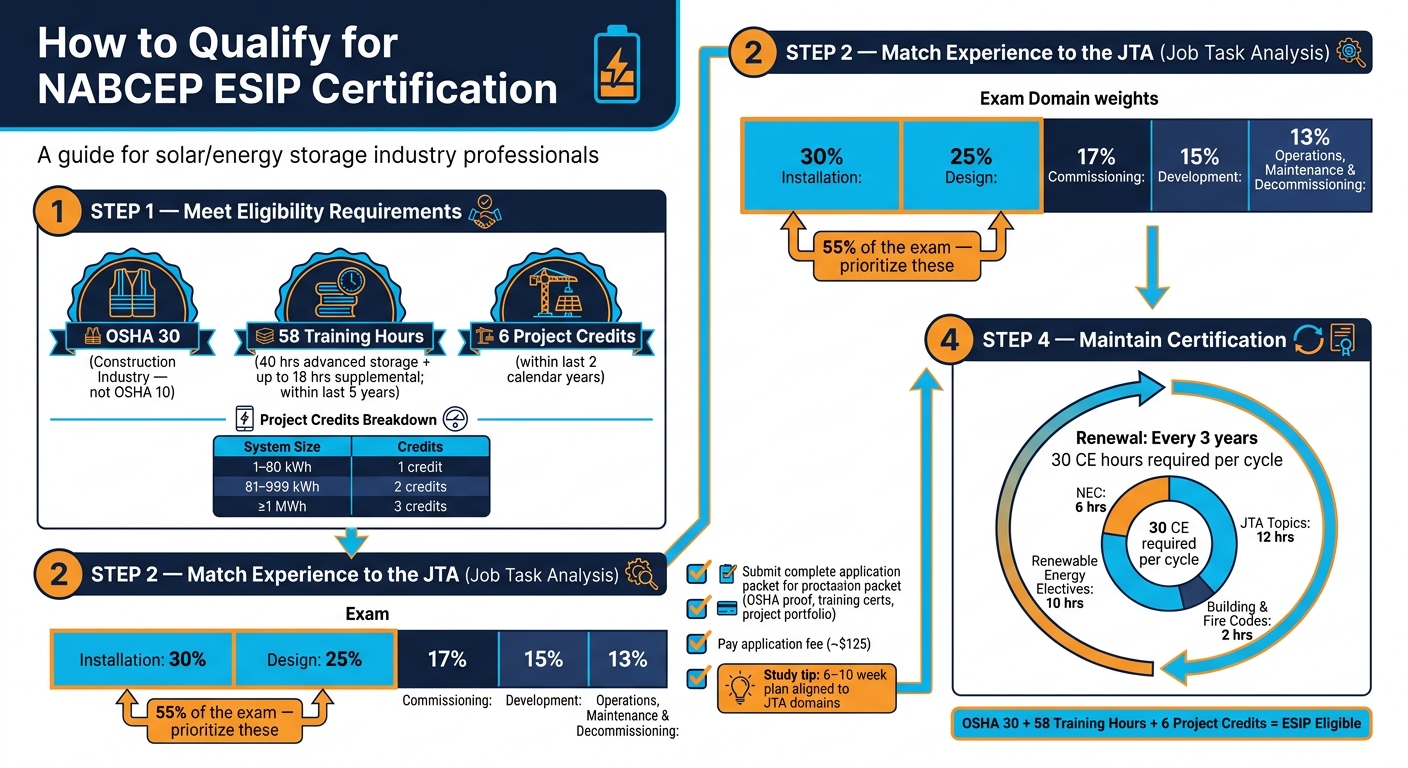
NABCEP ESIP Certification: Step-by-Step Qualification Roadmap
Everything You Need To Know: NABCEP Energy Storage Installation Professional (ESIP) Certification
sbb-itb-aa28329
Step 1: Meet the ESIP Eligibility Requirements
Before you apply, make sure you meet all three requirements: OSHA 30 construction training, 58 hours of advanced energy storage training, and at least 6 Project Credits from projects completed within the last 2 calendar years. If even one piece is missing, your application can get held up.
Complete OSHA 30 and Confirm Your Safety Documentation
NABCEP requires at least 30 hours of OSHA Outreach Training Program for the Construction Industry, or an approved state or provincial equivalent – not OSHA 10 and not general industry training. That distinction matters.
When you upload proof of completion, the document should show:
- Your name
- Course type
- Total hours
- Training provider
- Completion date
Keep that file clean and easy to read.
Once your safety paperwork is in order, move on to your energy storage training hours.
Finish the Required 58 Hours of Advanced Energy Storage Training
The 58 hours usually break down into 40 hours of advanced energy storage installation training plus up to 18 hours from approved supplemental training or an active NABCEP PV Associate credential.
There’s also a timing rule: all training must be completed within five calendar years before you submit your application.
Pick courses that line up with the JTA. That usually means topics like NEC Articles 706 and 480, UL 9540/9540A, battery safety, and fire-code rules. In plain English, you want training that matches the work you’ll be tested on.
Save every certificate, and keep your hour totals together in one file. It sounds simple, but it saves a lot of scrambling later.
After that, turn to your project history and check how NABCEP counts your field experience.
Document Your Project Experience and Decision-Making Roles
NABCEP measures project experience in Project Credits based on system size:
| System Capacity | Project Credits |
|---|---|
| 1–80 kWh | 1 credit |
| 81–999 kWh | 2 credits |
| ≥1 MWh | 3 credits |
You need at least 6 Project Credits from projects completed within the last 2 calendar years.
For each project, gather the records that back up your role and the job itself:
- Permits
- Final AHJ inspection report
- One-line diagram or design document
- A letter describing your decision-making role
Those records should show that you didn’t just work on the project – you had a hand in the decisions behind it.
With that paperwork ready, you can line up your background against the ESIP Job Task Analysis.
Step 2: Compare Your Experience to the ESIP Job Task Analysis
Once you’ve confirmed that you’re eligible, line up your background against the ESIP Job Task Analysis (JTA). NABCEP treats the JTA as the exam blueprint, so it should shape both your study plan and your self-check.
Review the Five ESIP Exam Domains
The JTA breaks the exam into five domains. Each one accounts for a set share of the 70 multiple-choice questions.
| Domain | Exam Weight |
|---|---|
| Development | 15% |
| Design | 25% |
| Installation | 30% |
| Commissioning | 17% |
| Operations, Maintenance & Decommissioning | 13% |
Use those weights to decide where to spend your time. Installation and Design add up to 55% of the exam, so they deserve early attention, especially if most of your experience comes from field work.
Find and Close Gaps in Training and Work History
Go through each JTA task and rate your experience as strong, moderate, or little/no exposure. Then back up each rating with specifics: the project, your role, system size, and location. Put more focus on decisions you made yourself, not just work you carried out under someone else’s direction.
A lot of candidates find weak spots in commissioning and code-based design. The fix is pretty direct:
- Get hands-on exposure to commissioning work and document what you did
- Help with design reviews and single-line diagrams
- Study NEC, building and fire codes, UL 9540, and commissioning best practices
Before you apply, write down your dates, hours, and job duties. That record will make the application packet much easier to put together.
Once you’ve mapped the gaps, use that list to build both your application packet and your exam study plan.
Step 3: Submit Your Application and Prepare for the Exam
Assemble a Complete Application Packet
Use the requirements from Step 2 to pull together the same records you’ll submit and study from. The easiest way to do this? Gather everything before you log into NABCEP’s portal, so you can send it in one go.
Your packet should include your personal information, OSHA 30 documentation, advanced training records, and a project portfolio. Make sure your personal details match your government-issued ID exactly: legal name, date of birth, mailing address, email, and phone number. For each project record, line it up with the decision-making work you documented in Step 2.
Here are the main details to check before you submit:
- OSHA 30 proof must show the course title, provider, and completion date. OSHA 10 does not qualify.
- Training certificates should clearly show advanced energy storage content, provider, contact hours, and completion date.
- Project descriptions should show decision-making responsibility, such as equipment selection, design choices, or commissioning oversight.
For each qualifying project, include the system size, commissioning date, your role, and backup records like permits, inspection reports, or signed installation agreements. Then double-check that your qualifying work adds up to at least 6 Project Credits.
Once your packet is ready, submit it and move on to exam scheduling.
A complete packet gets you approved; a targeted study plan gets you ready.
Schedule the Exam and Build a Study Plan
After NABCEP approves your application, it sends the notice you need to book the exam. The application fee is about $125. Check NABCEP’s latest materials for the current exam fee.
The ESIP exam is a timed, computer-based test given at a proctored center or an approved remote-proctoring site. Bring a valid government-issued photo ID that matches your application exactly, and plan to arrive 30–45 minutes early for check-in.
Start with the domains where you were weakest in your Step 2 review. A 6- to 10-week study plan built around the JTA usually makes the workload feel a lot less messy. Use your JTA gap list to decide where to spend more time, then lean on your course materials to shore up weak spots.
Take the official practice test early so you can see where you stand. Then take another full-length test 1 to 2 weeks before exam day.
Step 4: Maintain Your ESIP Certification and Keep Credentials Organized
Once you pass the exam, the job changes a bit. Now it’s about staying on top of renewal deadlines and keeping records clean enough for an audit.
Track Continuing Education and Renew Every Three Years
ESIP renews every three years and requires 30 hours of approved continuing education during each renewal cycle. Those 30 hours break down into specific topic areas, so you can’t just collect random courses and call it done.
| CE Category | Required Hours |
|---|---|
| National Electrical Code (NEC) | 6 hours |
| ESIP Job Task Analysis (JTA) topics | 12 hours |
| Building and fire codes | 2 hours |
| Renewable energy electives | 10 hours |
You also need to submit an employer letter that confirms your current renewable energy work and role.
A simple tracking system goes a long way here. For each course, log the title, provider, date, hours, CE category, and certificate file. The main goal is to track your renewal cycle and expiration date, not just dump files into a folder and hope for the best.
Set a calendar reminder 6 to 12 months before your expiration date. That gives you time to review your CE totals and spot any missing hours before renewal sneaks up on you.
That process gets much easier when your credentials live in one digital system instead of scattered across inboxes, downloads, and paper files.
Use Digital Credential Tracking for Energy Storage Workforce Readiness
Digital tracking keeps OSHA 30, ESIP, and CE records in one place, ready for audits and renewal checks. If you’re a contractor running more than one crew, ABLEMKR lets employers filter workers by certification status, including NABCEP ESIP and OSHA 30. Automated expiration alerts show which credentials are coming due.
That means managers can check certification status, expiration dates, and field readiness fast. Workers can also upload CE certificates straight from the field with the mobile app.
Conclusion: The Direct Path to ESIP Qualification
Keep your CE current, renew on time, and store credentials in one organized system so you’re ready for the next project.
FAQs
What if I only have OSHA 10?
OSHA 10 is a solid starting point if you want to work in energy storage. It can help you qualify for entry-level technician and apprenticeship roles while you build the hands-on, on-site experience employers look for.
If your goal is the NABCEP Energy Storage Installation Professional certification, you’ll need OSHA 30. That said, OSHA 10 still gives you the basic safety training to get started and begin building experience before you take that next step.
How do I prove a decision-making role?
Submit documented proof of your relevant experience through the NABCEP Candidate Eligibility Form. Your documentation should clearly show the part you played in the planning, coordination, and execution of energy storage installations.
Focus on work that shows you handled:
- Budgets
- Timelines
- Technical requirements
- Overall project oversight
- Regulatory compliance
The goal is to make it easy for reviewers to see what you were responsible for and how closely your experience matches the eligibility requirements.
What training counts toward the 58 hours?
To qualify for the NABCEP Energy Storage Installation Professional certification, candidates need 58 hours of training in total.
That training breaks down into:
- 18 hours in general solar energy
- 40 hours in advanced installation or PV training
At least 40 hours of the total must come from an accredited training provider.


