
Real-time job matching uses AI and machine learning to instantly connect job seekers and employers. It analyzes job descriptions, worker profiles, skills, and experience to find the best match in seconds. This is especially useful in industries like construction and energy, where staffing needs are urgent and unpredictable.
Why It Matters
- Faster Hiring: Reduces time-to-hire from weeks to minutes.
- Improved Precision: Matches workers to jobs based on skills and certifications.
- Transparency: Workers see pay rates and job details upfront; employers access verified profiles.
- Cost Savings: Automates tasks like screening, payroll, and compliance.
How It Works
- Data Collection: Gathers and organizes details like skills, experience, and certifications.
- Machine Learning: Learns from past hiring patterns to predict the best matches.
- Smart Search: Understands the context of job requirements and candidate profiles for better alignment.
- Scoring: Ranks candidates based on skills, experience, and compatibility.
- Feedback Loop: Improves accuracy over time with employer and worker feedback.
Benefits vs. Challenges
| Aspect | Benefits | Challenges |
|---|---|---|
| Speed | Quick matches for urgent needs | Requires accurate data input |
| Cost | Saves on administrative expenses | High setup and integration costs |
| Quality | Verified workers and detailed profiles | Risk of algorithmic bias |
| Transparency | Clear pay rates and job expectations | Privacy concerns over data handling |
Key Example: ABLEMKR
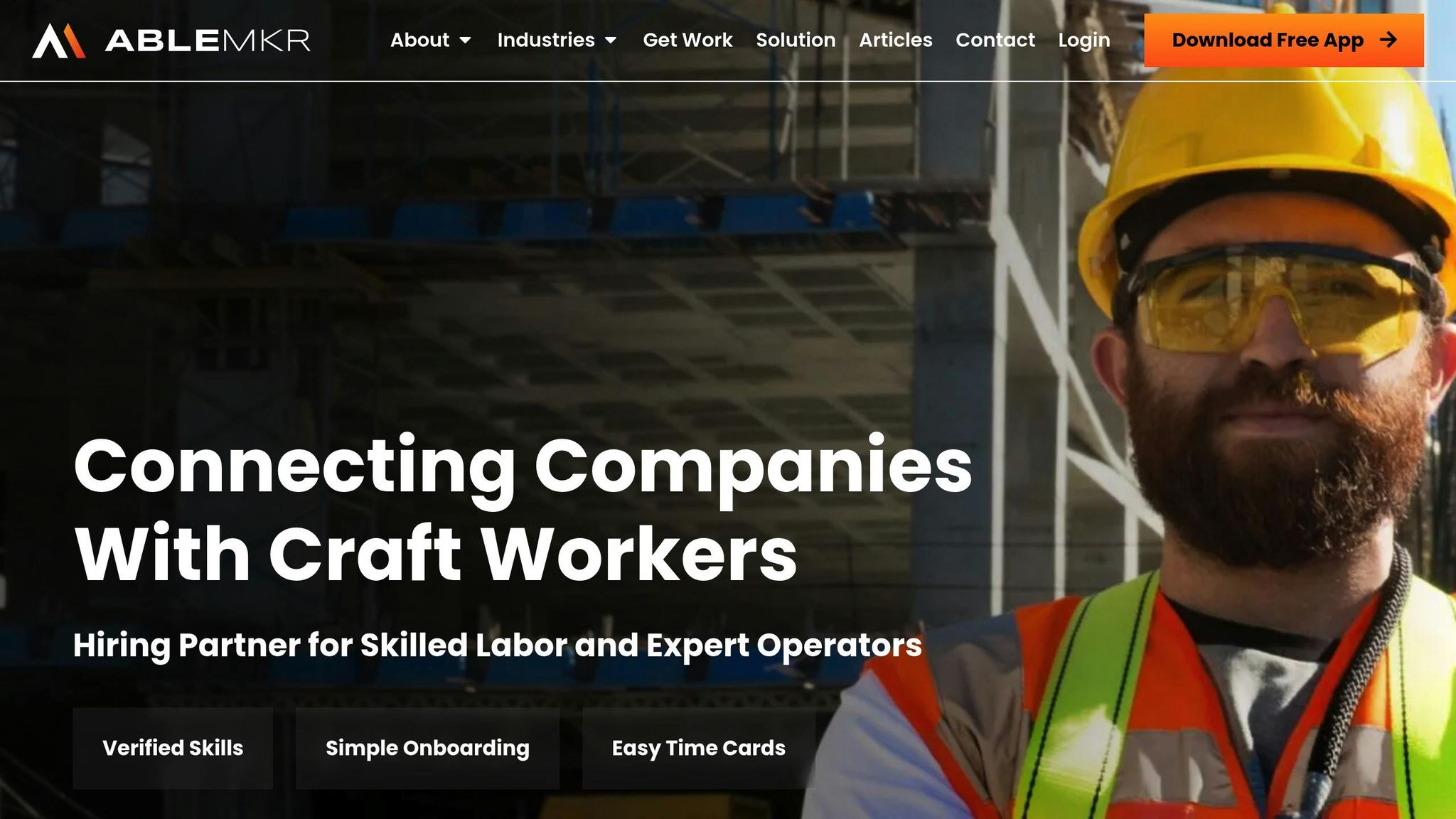
ABLEMKR is a real-time job matching platform for construction and energy. It connects workers and employers through features like verified profiles, transparent costs, and automated onboarding. Employers can scale their workforce quickly, while workers gain control over their schedules and job choices.
Real-time job matching is transforming staffing by making hiring faster, smarter, and more efficient. Whether you’re an employer or a job seeker, it’s reshaping how people connect with opportunities.
Core Components of Real-Time Job Matching Algorithms
Real-time job matching algorithms are built on three key components that work together to deliver accurate matches in seconds. These systems handle large volumes of data, learn from past patterns, and interpret context to efficiently connect job seekers with opportunities. Together, these elements form the backbone of real-time matching, setting the stage for the machine learning processes discussed later.
Data Collection and Organization
At the heart of any effective matching system lies robust data collection and organization. These algorithms pull information from various sources to build detailed profiles of job seekers and available roles.
For job seekers, the system gathers data on skills, work experience, education, certifications, and specific competencies. This includes technical expertise, years in specific roles, and verified credentials. In industries like construction and energy, it might also include safety certifications, equipment operation licenses, or specialized training records.
On the employer side, the algorithms break down job postings to identify essential skills, qualifications, and educational requirements. They distinguish between mandatory qualifications and desirable attributes, ensuring a more tailored match.
Once collected, the data is standardized to ensure consistency. For example, a "project manager" role at one company can be matched to candidates with "project management" experience, even if the terminology differs. Natural Language Processing (NLP) plays a key role here, parsing job descriptions and candidate profiles to identify and categorize relevant skills. For instance, if a job posting mentions "electrical work", the system connects it to related skills like "wiring", "circuit installation", or "electrical troubleshooting" in candidate profiles.
This systematic approach has real-world impact. Today, 40% of businesses use AI to source and engage talent, and staffing firms leveraging automation are twice as likely to see revenue growth. This makes the matching process faster and more effective, especially for time-sensitive hiring needs.
Machine Learning and Pattern Recognition
Machine learning takes the raw data collected and transforms it into actionable matching decisions by identifying patterns in past hiring data. These algorithms learn from historical outcomes to improve future recommendations.
Using historical data, machine learning algorithms predict how well a candidate might perform in a specific role. They analyze factors like job tenure, performance ratings, and project completion rates to identify traits of successful hires. For example, if electricians with certain certifications consistently excel in renewable energy projects, the system learns to prioritize those qualifications for similar roles.
This learning process is continuous. As the algorithm processes more data, it becomes better at identifying trends and refining matches. It doesn’t just check qualifications – it evaluates overall compatibility. Feedback from employers and insights from successful hires further enhance the algorithm’s accuracy.
By combining pattern recognition with smart search techniques, the system aligns candidate profiles with job requirements in a way that goes beyond surface-level matching.
Smart Search and Context Matching
The most advanced part of real-time matching involves understanding the context behind job requirements and candidate qualifications. Smart search technologies go beyond keywords to grasp the deeper relationships between job descriptions and profiles.
These systems analyze job postings and candidate data to capture subtle context and meaning. For example, a candidate with extensive "equipment repair" experience might be a great match for a "maintenance technician" role, even if the exact title doesn’t appear in their profile.
AI-powered search engines also account for variations in terminology and data, ranking candidates based on relevance. Employers can filter results by location, experience, skills, and education to find candidates who meet both technical and geographic requirements.
Over time, these systems learn user preferences, tailoring matches to the traits employers consistently prioritize. They also generate summaries explaining why a candidate is a good fit, making it easier for hiring managers to review options.
The benefits are clear. Candidates matched through these systems are 17 times more likely to apply. With 64% of hiring managers struggling to find qualified candidates and spending an average of 13 hours per position searching for talent, smart search and context matching deliver much-needed efficiency, especially for urgent staffing needs.
How Real-Time Matching Works Step by Step
Real-time job matching operates with a seamless process, transforming the information provided by employers and job seekers into instant, accurate matches. From the moment a job is posted to when candidates are notified, powerful algorithms work tirelessly behind the scenes to make connections within seconds.
The Matching Process
The process kicks off when employers and job seekers submit detailed profiles. Employers provide comprehensive job descriptions that outline required qualifications, specific skills, and even details about the company’s work environment. On the other side, job seekers share their qualifications, work experience, relevant certifications, and specialized training.
Once this data is collected, advanced machine learning algorithms and natural language processing take over. These technologies analyze the information, going beyond simple keyword matches to understand the deeper relationships between skills and terms. For instance, if a construction company posts a role for an electrical technician, the system evaluates candidates based on their experience, certifications, location, and availability to find the best fit.
The system also incorporates real-time job market data, adjusting its criteria based on current trends. Technologies like Big Data Analytics, AI, and Cloud Computing enable the system to stay updated and make smarter matches.
Scoring and Ranking Systems
After identifying potential matches, the system assigns scores or ranks to candidates. This scoring process helps prioritize candidates, presenting the most suitable options to recruiters or hiring managers. The scoring considers various factors like skills, experience, education, and alignment with company values. A typical scoring formula might look like this:
Candidate Score = (Skills Weight × Skills Score) + (Experience Weight × Experience Score) + (Education Weight × Education Score) + (Cultural Weight × Cultural Score).
Different matching systems specialize in various areas of focus:
| System Type | Primary Focus | Best Use Cases | Accuracy Range |
|---|---|---|---|
| Skills-Based | Technical skills | Engineering, IT, specialized trades | 75–90% |
| Cultural Fit | Personality & values | Sales, customer service, management | 65–80% |
| Predictive Performance | Success indicators | Executive, strategic roles | 70–85% |
| Hybrid | Full assessment | Most professional positions | 80–95% |
These systems don’t just stop at matching; they also predict long-term success. Automated systems can process over 1,000 resumes per hour, with success rates ranging from 70–85%. Scores are often presented on a scale of 0–100 or 1–10, making it easy for hiring managers to identify top candidates quickly. Additionally, the system provides transparency by explaining why certain candidates scored higher, helping recruiters make informed decisions.
Feedback and Algorithm Improvement
What sets real-time matching systems apart is their ability to learn and improve over time. By analyzing successful placements and incorporating recruiter feedback, these systems refine their criteria to deliver better matches in the future. They adapt to the specific preferences and hiring patterns of each employer.
This improvement process relies on continuous data analysis and performance reviews. Machine learning algorithms adjust to new data, while cloud computing ensures real-time updates to meet evolving requirements. Feedback loops are also critical, as they help identify and address any biases before they affect hiring decisions.
The benefits of these systems extend beyond efficiency. Automated candidate matching can deliver an ROI of 200–400% within the first year, making it an investment that pays off significantly for companies looking to streamline their hiring processes and find the best talent efficiently.
Benefits and Challenges of Real-Time Job Matching
Real-time job matching is reshaping staffing in the construction and energy industries. By connecting employers and workers quickly, it streamlines hiring processes but also comes with some hurdles. Let’s dive into the advantages and challenges to better understand how these systems work.
Key Benefits of Real-Time Job Matching
Gone are the days of waiting weeks – or even months – to fill a position. Real-time job matching connects skilled workers to jobs in just minutes, a game-changer for industries like construction and energy where tight deadlines are the norm. For example, these systems can help meet urgent project timelines by significantly reducing hiring delays.
Transparency is another big plus. Workers can view detailed job postings that include pay rates and verified ratings before applying. On the flip side, employers gain access to verified worker profiles, complete with skills assessments, certifications, and performance ratings.
"What you see is what you get. Worker ratings, detailed job postings, and a no-surprises payment structure are our version of ‘measure twice, cut once.’" – ABLEMKR
By automating tasks like paperwork, scheduling, and coordination, companies can focus on their core operations instead of being bogged down by administrative work.
Another major advantage is the ability to find qualified workers on demand. Between August 2023 and July 2024, the construction industry averaged 382,000 job openings every month. Real-time matching helps fill these gaps by quickly pairing employers with workers who meet specific skill requirements.
These systems also use AI to improve accuracy. Instead of relying on simple keyword searches, advanced algorithms understand how different skills relate to each other, making it easier to identify workers whose experience can transfer to new roles.
But while the benefits are clear, there are challenges that need to be addressed for these systems to reach their full potential.
Implementation Challenges
Despite the advantages, there are obstacles to overcome. One of the biggest issues is data quality. The effectiveness of these systems relies on detailed, accurate profiles from both workers and employers. Outdated or incomplete information can lead to mismatches and frustration for users.
Algorithmic bias is another concern. While nearly every Fortune 500 company now uses AI hiring tools, research shows that these systems can unintentionally replicate human biases if trained on flawed data.
Privacy and security are also critical. Workers may worry about how their personal information – like employment history, skills assessments, and performance ratings – is stored and shared.
Additionally, while technology excels at matching technical skills, it often struggles with softer aspects like teamwork, adaptability, or whether a worker will thrive in a specific environment. Over-reliance on these systems might overlook these human factors.
Finally, integrating real-time matching platforms with older software systems can be tricky, creating technical headaches for some companies.
Benefits vs. Challenges Comparison
Here’s a quick breakdown of the advantages and challenges from both the employer and worker perspective:
| Aspect | Benefits for Employers | Benefits for Workers | Implementation Challenges |
|---|---|---|---|
| Speed | Fill roles in minutes, not weeks | Find jobs instantly | Requires accurate, high-quality data input |
| Cost | Lower administrative costs | Reduced job search expenses | High initial setup and integration costs |
| Quality | Access to skilled, verified workers | Transparent job details and ratings | Risk of algorithmic bias |
| Flexibility | Quickly scale workforce as needed | Choose from multiple opportunities | Dependence on technology and tech issues |
| Transparency | Clear worker qualifications and ratings | Upfront pay rates and job requirements | Privacy concerns over data handling |
The construction industry’s current struggles – where 89% of firms report difficulty filling positions and 61% experience delays due to labor shortages – underscore both the potential and the challenges of real-time job matching.
For companies, success hinges on tackling issues like data accuracy, ensuring fair algorithms, and protecting worker privacy. Workers, on the other hand, can maximize the benefits by creating detailed, up-to-date profiles and learning how these systems operate. ABLEMKR’s approach focuses on these critical areas, aiming to balance efficiency with fairness and data security.
sbb-itb-aa28329
ABLEMKR’s Real-Time Job Matching System
ABLEMKR is tackling one of the construction industry’s biggest headaches – staffing shortages. With 72% of construction firms struggling to find workers and one in five construction professionals relying on staffing agencies, ABLEMKR’s mobile-first, real-time job matching system provides a much-needed solution.
ABLEMKR Key Features
At the heart of ABLEMKR is a platform that prioritizes transparency and efficiency. It offers verified worker profiles, giving contractors detailed insights before making hiring decisions. Unlike traditional staffing agencies, ABLEMKR lets employers review complete worker profiles, including performance ratings, so they can hire with confidence.
The process is simple. Workers fill out their profiles directly in the app and are instantly matched with job opportunities based on their skills, availability, and location. Real-time notifications ensure workers and contractors can act quickly when opportunities arise.
Cost transparency is another standout feature. Workers see exact pay rates, while contractors benefit from real-time invoicing and clear cost breakdowns. The platform also automates tedious tasks like onboarding, insurance, payroll, and taxes, saving everyone time and effort.
For added flexibility, ABLEMKR’s hourly-to-hire model allows contractors to scale their workforce from hourly workers to full-time hires. Workers, in turn, can take control of their schedules and rates, giving them greater autonomy.
Benefits for Employers and Workers
ABLEMKR’s approach directly addresses the common frustrations of construction staffing. Contractors gain access to qualified workers on demand, while the platform takes care of payroll and administrative tasks, lightening their workload.
"ABLEMKR allows us to bid on projects that we wouldn’t be comfortable bidding on as a company alone. It gives us the confidence we need in knowing that they can supply us with all of the personnel we need to execute the work if we get the job." – Brandon, Exhibau
"This company was such an amazing vendor for us! They allowed us to pick and choose workers, seeing their profile and experience FIRST, not just sending us whoever they had on the lot. We choose the person and the schedule." – Nick, Glow
ABLEMKR in Action
The platform’s impact is clear in real-world applications. For example, CVE Tech reported a 20% improvement in worker quality after adopting ABLEMKR, along with the convenience of weekly real-time invoicing and cost transparency.
Using ABLEMKR is straightforward. Contractors set up profiles and specify their staffing needs, including required skills, project timelines, and budgets. The system’s algorithm then identifies workers who match those criteria based on their skills, availability, and location.
The platform also includes a feedback system where contractors rate workers, creating a continuous improvement loop for future matches. Once both parties agree to a match, ABLEMKR handles all the administrative work – W2 paperwork, workers’ compensation, and payroll processing – eliminating the typical hassles of staffing.
For urgent needs, the platform’s real-time notifications ensure contractors can connect with qualified workers quickly. Its mobile-first design means workers can accept jobs on the go, even while working on other projects. ABLEMKR’s system is designed to deliver fast, accurate matches that simplify the entire staffing process.
Conclusion
Key Takeaways
The combination of data, machine learning, and smart algorithms is transforming the way employers connect with workers. These tools streamline the process by instantly matching candidates to jobs based on skills, location, and availability. The impact is clear – 40% of businesses now use AI to source and engage talent, while staffing firms leveraging automation are twice as likely to see revenue growth. This technology also minimizes manual screening and speeds up the process of identifying qualified candidates.
Automation is particularly valuable for industries that need to scale their workforce quickly to meet project demands. For example, the construction sector, which consistently faces staffing shortages, has seen notable improvements thanks to these advancements.
These technological strides pave the way for ABLEMKR’s innovative approach to staffing.
ABLEMKR’s Industry Position
Taking full advantage of these advancements, ABLEMKR is redefining staffing solutions for the construction and energy industries. The platform uses real-time matching technology combined with full-cycle workforce management to tackle the unique challenges these sectors face.
What sets ABLEMKR apart is its comprehensive, end-to-end approach. Beyond matching workers to jobs, the platform handles critical tasks like worker verification, compliance, and payroll processing. This holistic solution is especially important for industries where safety and skill verification are non-negotiable.
With its mobile-first design and transparent pricing, ABLEMKR is positioned as a leader in the shift toward on-demand staffing. As more industries adopt advanced staffing models and prioritize efficiency, platforms like ABLEMKR that emphasize transparency and reliability are poised to dominate the market.
FAQs
How does real-time job matching work, and how does it ensure accurate matches?
Real-time job matching leverages machine learning algorithms to pair job seekers with opportunities that fit them best. These algorithms dive deep into data – like skills, experience, preferences, and hiring trends – to find matches that truly align with both candidates and employers.
What makes machine learning so powerful here is its ability to learn and improve over time. By analyzing past matches and their outcomes, it fine-tunes the process, making future recommendations more precise. With the capacity to process thousands of data points instantly, this technology streamlines the hiring process, delivering job connections that feel accurate and personalized.
How does ABLEMKR protect my personal information during real-time job matching?
ABLEMKR prioritizes your privacy by implementing robust measures to protect your personal information during real-time job matching. These measures include data encryption to keep your information secure, anonymization to safeguard your identity, and strict access controls that limit access to sensitive data to authorized personnel only.
The platform also adheres to key data protection regulations like GDPR and CCPA, ensuring your information is handled ethically and transparently. These efforts aim to minimize security risks, protect your privacy, and foster confidence in the platform.
How do real-time job matching algorithms ensure fair and unbiased hiring?
Real-time job matching algorithms aim to create a fairer hiring process by tackling potential biases head-on. This involves cleaning up the data to eliminate any biased elements, fine-tuning the algorithm during its development to ensure equity, and carefully reviewing results to address any unexpected imbalances.
By taking these measures, these algorithms strive to make hiring more inclusive, bridging the gap between workers and employers while emphasizing fairness and equal opportunities for everyone.


