
Digital tools are transforming how construction and energy workers learn on the job, addressing challenges like safety risks, high costs, and outdated methods. Here’s why they’re game-changers:
- Safety: Virtual reality (VR) creates risk-free environments for practicing hazardous tasks, reducing workplace accidents by 45%.
- Efficiency: Mobile apps deliver quick, on-demand lessons, cutting training costs and improving retention by up to 20%.
- Personalization: AI tailors training to individual needs, boosting engagement by 60% and cutting repetitive tasks by 35%.
- Accessibility: Workers can access training anytime, reducing travel and downtime while keeping projects on track.
Platforms like ABLEMKR combine workforce management with digital tools, streamlining training, tracking progress, and matching workers to roles that fit their skills. With labor shortages and rapid tech adoption, these solutions are no longer optional – they’re necessary for staying competitive.
LMS for Construction Industry | Top Construction Learning Management System for Online Training
Problems with Traditional On-Site Training
While effective training is essential, traditional methods often create serious obstacles that hinder companies from delivering the education their teams need. These challenges don’t just inconvenience – they directly affect safety, productivity, and the efficiency of projects.
Location and Access Problems
Construction and energy projects frequently operate across remote and scattered job sites, making it incredibly difficult to gather workers in one place for training. Workers often face long travel times, scheduling conflicts, and logistical barriers, which all contribute to low attendance rates.
Adding to the issue, traditional training methods often limit the number of participants per session. Evie Rogers, Inbound Marketing Specialist at findcourses.com, points out:
"By limiting the number of participants, you limit the skill development of your team."
This means companies must hold multiple sessions to train their entire workforce, significantly driving up costs and complicating schedules. On top of that, these sessions often fail to cater to the diverse learning styles and needs of workers, further reducing their effectiveness.
High Costs and Time Limits
The financial and time demands of traditional training methods are another major drawback. Recent figures show that training costs per learner range from $954 to $1,207, with smaller companies facing even steeper expenses of $1,678 per learner.
These costs go beyond the training itself, piling on expenses for logistics, facilities, and travel. Additionally, pulling employees away from their day-to-day responsibilities disrupts productivity, leading to delays and operational setbacks.
The effectiveness of these investments is also questionable. Studies reveal that 70% of employees lack critical skills, and a McKinsey survey found only 25% of employees believe their training improved their performance. This raises doubts about whether traditional methods deliver a meaningful return on investment.
Safety Risks and Uneven Knowledge Transfer
Traditional training methods also pose significant safety challenges, particularly in high-risk fields like construction and energy. Paradoxically, hands-on training often requires workers to face hazardous conditions to learn how to navigate them safely.
This is a critical concern, as unsafe behaviors and environments are responsible for about 90% of workplace accidents. In 2018, the construction industry’s occupational injury death rate reached 0.113 per thousand workers. Many of these incidents stem from inadequate safety knowledge, with workers often failing to implement proper safety measures. Traditional training struggles to address this because safety information is often fragmented and inconsistent.
Compounding the issue is the natural forgetting curve: people forget 50% of new information within an hour, 70% within 24 hours, and 90% within a week. This makes one-time training sessions insufficient, especially in safety-critical environments.
Another challenge is the lack of accessible training materials. The EASE organization highlights this gap:
"Perhaps one of the biggest problems with employee training is that training materials aren’t readily accessible to employees on the job."
Without immediate access to training resources, workers may be unprepared to handle unexpected or dangerous situations. These limitations underscore the pressing need for digital solutions that can overcome the shortcomings of traditional training methods.
How Digital Tools Change On-Site Worker Training
Digital tools are transforming on-site worker training by offering practical, safe, and flexible alternatives to traditional methods. Tools like VR, mobile apps, and AI combine to create a more engaging and effective training experience, filling gaps left by older approaches.
Virtual Reality (VR) and Simulation Platforms
Virtual reality provides immersive environments where workers can safely practice complex tasks, helping them gain confidence and learn faster. For example, Walmart used VR to train employees on operating its Pickup Tower equipment, cutting the training time from 8 hours to just 15 minutes – a 96% reduction. Similarly, Sprouts Farmers Market onboarded thousands of new hires during the pandemic using VR, slashing onboarding time by 81% from 4 hours to just 45 minutes.
VR doesn’t just save time – it enhances learning retention. When Sprouts tested their company values, 48% of VR-trained employees recalled all six values perfectly, compared to only 3% of those trained traditionally. That’s a 16× improvement in retention.
Safety training is another area where VR shines. Verizon used immersive simulations to prepare retail associates for armed robbery scenarios, teaching them to stay calm and prioritize safety. After the training, 97% of Verizon’s 22,000+ frontline workers felt more confident handling dangerous situations. Across industries, companies using VR training have reported a 275% increase in employee confidence and a 30–50% boost in retention rates.
The financial benefits are equally impressive. Intel’s VR-based corporate training course projected a 5-year ROI of 300%, with 94% of participants eager for more VR-based learning. Greg Smith, a project manager at Conewago, shared how VR cut crane training costs significantly:
"Using the simulator, we were able to cut crane training costs by around $30,000 per operator."
Mobile Apps and E-Learning Modules
Mobile learning delivers quick, on-demand lessons that workers can access during breaks or downtime. These bite-sized modules, often just 3–5 minutes long, improve retention by up to 20% while keeping productivity intact.
Mobile apps are versatile. They can simplify complex topics into manageable lessons, provide real-time troubleshooting guides, or even gamify the learning process to encourage participation. For field workers, mobile platforms are especially valuable, offering immediate access to training without the need for travel, venues, or printed materials. Organizations can also update training content instantly, ensuring employees always have the latest information.
Another advantage is scalability. Mobile platforms make it easier to roll out training globally, bypassing logistical challenges. Built-in analytics allow companies to track completion rates, monitor effectiveness, and identify knowledge gaps in real time, ensuring continuous improvement.
AI-Driven Personalization and Skill Assessments
AI takes training a step further by personalizing the experience for each worker. By 2025, 75% of businesses worldwide are expected to adopt AI-driven training solutions. These systems can improve employee engagement by up to 60%, with 72% of workers finding AI-based tools more engaging than traditional methods.
AI analyzes performance data to deliver customized training, offering ongoing feedback to address weaknesses and develop skills. It can also automate up to 50% of repetitive training tasks, reducing costs by up to 35% while improving outcomes. For example, machine learning has been shown to cut manual grading time for short-answer questions by 73%, according to research in the International Journal of Artificial Intelligence in Education.
Companies like IBM and DHL are already leveraging AI to enhance workforce development. IBM’s AI-based platform evaluates employees’ skills and learning preferences, offering tailored career development plans. DHL uses AI to match employee competencies with available roles, guiding staff toward relevant training while helping managers fill positions more effectively.
Josh Bersin, a global HR expert, highlights the transformative potential of AI in training:
"AI is not just an enhancement to training programs – it is the future of workforce development."
sbb-itb-aa28329
How Digital Tools Solve Common Training Problems
Digital tools, such as VR and mobile learning platforms, are revolutionizing on-site worker training by addressing long-standing challenges like accessibility, safety, and efficiency. These solutions tackle traditional barriers and bring training directly to the job site.
Better Access and Less Downtime
Gone are the days of scheduling headaches and travel delays. Digital tools let workers access training materials anytime, right at the job site. This not only reduces interruptions to ongoing projects but also ensures employees can learn on demand.
The U.S. Bureau of Labor Statistics reports that 60% of construction injuries happen during a worker’s first year on the job. Digital tools combat this by providing instant access to safety protocols and equipment training, helping new workers stay safe from day one.
Take iConstruct Pro, for example. It allows companies to create "digital twins" – virtual replicas of physical assets – that store important information like maintenance schedules and troubleshooting tips. These digital resources empower apprentices and new tradespeople to handle complex tasks with confidence.
Additionally, platforms like KayaAI help companies predict delays and streamline processes through automation, boosting both productivity and efficiency.
By removing access barriers, these tools pave the way for safer and more effective training experiences.
Improved Safety Through Risk-Free Training
Virtual reality (VR) offers a game-changing way to train workers for high-risk scenarios. In a VR environment, employees can practice handling hazardous situations without the real-world dangers, learning from mistakes in a safe setting.
Companies using VR training report 45% fewer workplace accidents compared to traditional methods. On top of that, VR-based training can improve employee performance by up to 70%.
For example, Ford uses VR to enhance safety during machinery operation, cutting accidents by 70%. Similarly, Laing O’Rourke leverages VR for safety training, leading to significant reductions in workplace accidents and improved site safety. Chevron utilizes VR to simulate offshore drilling emergencies, giving workers hands-on practice in lifelike scenarios.
"VR places your employees directly in the scenario, whether it’s navigating a chemical spill, operating heavy machinery, or responding to a fire…this hands-on experience builds muscle memory and confidence, ensuring they know exactly what to do in real emergencies."
By enabling immersive, risk-free training, VR strengthens workforce readiness for real-life challenges.
Consistent Training and Real-Time Progress Tracking
Digital platforms ensure every employee receives the same high-quality training, eliminating inconsistencies often found in instructor-led sessions. They also simplify tracking certifications and compliance, making it easier to meet regulatory requirements.
Learning Management Systems (LMS) and tracking tools monitor worker progress in real time, identifying gaps before they become safety risks. Companies with strong training programs see 218% higher earnings per employee, yet 53% of HR managers still report skills gaps in their teams.
Automation plays a key role here. Training modules can be assigned immediately, while compliance features send alerts for expiring certifications. Real-time tracking keeps learning paths efficient by spotting bottlenecks early.
Automated reporting also simplifies compliance documentation, providing clear insights into training data. Certification trackers ensure completed courses and renewals are logged accurately, reducing risks like non-compliance. This is critical, as 60% of organizations report data breaches tied to third-party vendor compliance failures.
"The best training reports need to be compiled in visual dashboards. Most solutions do this but not for custom data, the system that can read LnD custom reports wins. Systems have to be able to do more than just output a CSV file."
- Alexander Salas, Certified T&D Professional, Technical Trainer, and ID
Using ABLEMKR to Support Digital Training
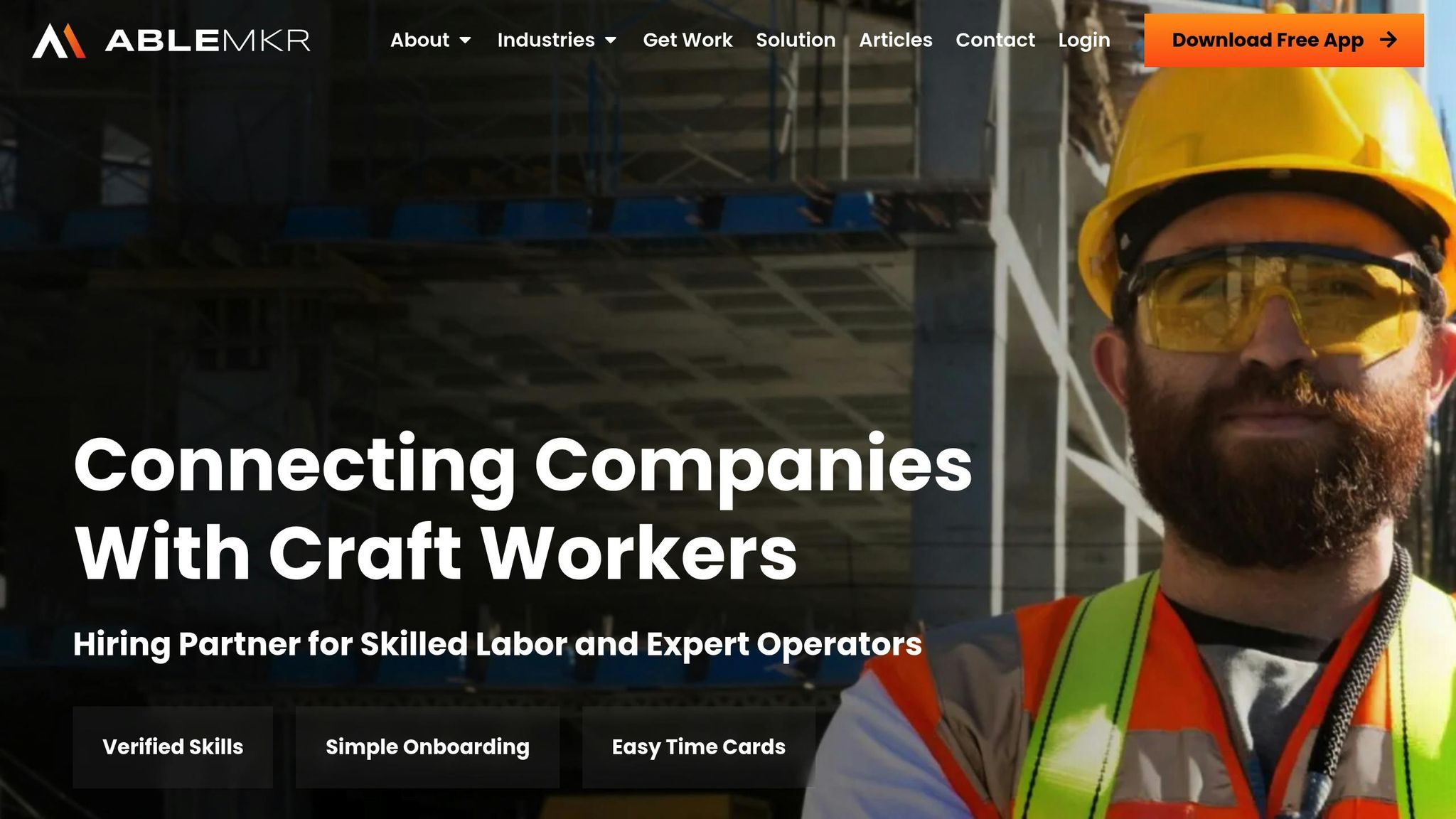
ABLEMKR is a workforce management platform designed to make on-site training and upskilling more efficient through digital tools. It connects companies with skilled craft workers while providing the necessary infrastructure to support ongoing learning and development. This digital approach promotes targeted, continuous training.
Unlike traditional staffing methods, which often rely on manual processes, ABLEMKR uses technology to create a more transparent and efficient system. By integrating verified worker profiles, mobile accessibility, and automated matching systems, the platform ensures that training opportunities are tailored to individual skill levels.
Key ABLEMKR Features for Training
ABLEMKR’s digital framework is built around verified worker profiles, which play a critical role in delivering focused and effective worker development. The platform continuously vets and screens workers to match customer-specific requirements, ensuring that training efforts are directed toward those who meet necessary skill standards.
The platform’s mobile features enhance training by offering real-time logging and digital timesheets. With the ABLEMKR app, workers can log hours in real time, giving supervisors instant visibility into performance and progress. This level of transparency encourages accountability and enables immediate feedback.
Another standout feature is automated job matching, which aligns workers with opportunities that fit their current skills and growth potential. Companies can submit requests for workers, and the system generates targeted training opportunities accordingly.
ABLEMKR also simplifies the onboarding process for new workers entering training programs. The platform handles administrative tasks such as insurance, payroll management, and payroll taxes, reducing delays and allowing training to begin without unnecessary hurdles.
By addressing challenges like accessibility, safety, and compliance, ABLEMKR demonstrates how digital tools can transform on-site training.
Supporting Continuous Training Through Digital Tools
ABLEMKR’s features are designed to promote continuous skill development by offering flexible and scalable workforce solutions. With thousands of workers already enrolled – and new ones joining daily – the platform creates an environment where ongoing learning is a priority.
The system’s flexible workforce solutions let businesses adjust their workforce size as needed, which extends to training programs. This adaptability allows companies to scale upskilling efforts to meet project demands or seasonal needs.
To ensure training commitments are met, ABLEMKR includes built-in accountability tools. A transparent rating system enables both workers and employers to evaluate training effectiveness and pinpoint areas for improvement.
The mobile app acts as a central hub for coordinating training activities. Workers can use it to view schedules, communicate with supervisors, and track their skill progress. By enrolling through the app and sharing their resumes, workers can be matched with roles that offer tailored training opportunities.
Finally, continuous vetting and screening processes ensure that workers maintain their skills and stay aligned with industry standards. This approach helps both workers and employers stay ahead in an ever-evolving job market.
Conclusion: Using Digital Tools for Workforce Development
Digital tools have reshaped on-site worker training, tackling challenges that have historically hindered workforce development in industries like construction and energy. The impact is clear: companies using digital learning tools report a 72% higher employee retention rate compared to those that don’t. Similarly, strong onboarding programs can boost retention by 82%.
Take IBM as an example. By shifting to online training, the company saved $200 million and increased productivity by 10%. For businesses operating with tight budgets, these savings can be reinvested in workforce development or equipment upgrades. And with the global corporate e-learning market projected to hit $60 billion by 2027, it’s evident that digital training tools are here to stay.
Personalized learning is another game-changer, leading to a 24% improvement in employee performance for organizations that implement it. For industries like construction, where labor shortages are critical, these tools are more than helpful – they’re essential. By early 2025, 94% of construction firms reported difficulties filling open positions, with the sector needing 439,000 new workers just to meet demand. Complicating matters, 92% of jobs today require digital skills, yet about 33% of workers lack basic digital proficiency. Bridging this gap is no longer optional; it’s urgent.
Platforms like ABLEMKR are stepping up to meet these challenges. By integrating training with workforce management, ABLEMKR addresses both operational and training gaps. Features like verified worker profiles, mobile access, and continuous skill tracking make learning a seamless part of daily operations. These tools drive productivity gains, with technology-driven workflows improving labor productivity by 30–45% in field operations. ABLEMKR’s automated job matching and skill assessment features ensure companies can immediately benefit from these advancements.
Adopting digital workforce development requires ongoing learning, precise performance tracking, and flexible management. ABLEMKR provides the foundation to support this shift, helping companies build skilled, engaged, and productive teams while addressing critical labor shortages in construction and energy.
The numbers don’t lie. With proven benefits and an increasing demand for skilled workers, the time for companies to embrace these tools is now. The future of workforce development is digital, and those who adapt quickly will lead the way.
FAQs
How do digital tools like VR and mobile apps make on-site worker training safer and more efficient?
Digital tools like VR and mobile apps are reshaping on-site worker training by providing immersive, hands-on simulations. These simulations let workers safely practice managing dangerous scenarios, improving their ability to recognize risks and reducing the likelihood of workplace accidents. The result? Safer job sites and a workforce that’s better equipped to handle challenges.
What’s more, these tools offer personalized training experiences and track progress in real time. This ensures that each worker gets instruction tailored to their specific needs. By simplifying the training process, these technologies not only enhance safety but also make on-site operations more efficient.
How does switching to digital training tools impact the cost of upskilling on-site workers?
Switching to digital training tools for upskilling on-site workers can cut costs in a big way. Instead of relying on old-school methods like physical classrooms, printed handouts, or travel for training sessions, companies can save up to 44% or more on their training expenses.
What’s more, digital tools bring scalability and flexibility to the table. They make it easier to train large teams quickly and customize content to meet specific needs. This approach not only stretches budgets further but also lets employees build new skills without disrupting daily work routines. It’s a practical solution for companies looking to invest in their workforce over the long haul.
How does AI-driven personalization make training more effective for construction and energy workers?
AI-powered personalization is reshaping how construction and energy workers are trained by customizing learning experiences to match each individual’s needs, skills, and pace. By addressing specific areas for improvement, this approach makes skill-building quicker and more effective.
Unlike the standard "one-size-fits-all" training methods, AI adapts content and feedback in real time. This keeps workers engaged and motivated, improving the overall learning experience. The result? A workforce that’s better equipped to handle on-site challenges, leading to higher productivity and readiness on the job.


