
If a spill is an emergency, HAZWOPER rules apply. If it’s minor and safe for trained staff to clean with normal PPE, it usually does not. That is the main line OSHA uses under 29 CFR 1910.120 and 29 CFR 1926.65.
If I had to boil this article down fast, I’d say this:
- Spill size alone does not decide the rule
- The main question is whether the release is incidental or an emergency
- Emergency response roles each need different HAZWOPER training
- 24-hour and 40-hour HAZWOPER are not the same as emergency response role training
- Some workers need an annual 8-hour refresher, while others must maintain skills each year through drills, tests, or reviews
- Employers must check training, fit testing, medical clearance, PPE, and site-specific instruction before sending anyone out
A few points stand out right away. OSHA ties HAZWOPER spill response to hazard level, control of the release, exposure risk, and whether evacuation or outside help is needed. The article also lays out five emergency response roles: Awareness, Operations, Technician, Specialist, and Incident Commander. On top of that, it covers site setup, including hot, warm, and cold zones, decon, air monitoring, and written response plans.
Here’s a short side-by-side view:
| Topic | Plain answer |
|---|---|
| Incidental spill | Small release that trained staff can clean safely with routine procedures |
| Emergency release | Uncontrolled or threatened release with health, fire, explosion, or IDLH risk |
| 24-hour / 40-hour HAZWOPER | Usually for hazardous waste site cleanup or limited site work |
| 8-hour operations training | For responders who contain from a safe distance and do not stop the leak at its source |
| 24-hour technician/specialist/IC training | For workers who stop releases, give chemical support, or lead the response |
| Annual updates | 8 hours for many site workers; yearly skill maintenance for emergency responders |
Bottom line: I’d use this guide to figure out when OSHA treats a spill as an emergency, who is allowed to respond, what training level fits each task, and what records an employer should verify before dispatch.
HAZWOPER Emergency Response for Chemical Spills
sbb-itb-aa28329
The OSHA Rules That Govern HAZWOPER Spill Response
OSHA’s main spill-response rule is 29 CFR 1910.120. This rule sets the employer duties that kick in when a release becomes an emergency. It applies to hazardous waste site operations, RCRA-regulated treatment, storage, and disposal facilities, and emergency response to releases or substantial threats of release of hazardous substances, wherever they occur.
Put simply, this is the rulebook that shapes how a compliant spill response is set up and run on site.
29 CFR 1910.120 and Emergency Response Duties
Before any spill response work starts, employers need a written safety and health program that identifies, evaluates, and controls site hazards and response procedures. That written program is the backbone of the job. If people are walking into a dangerous scene, they need more than general instructions – they need a plan that spells out what can go wrong and how to deal with it.
For emergency response, 1910.120(q) also requires a written Emergency Response Plan. That plan must cover likely scenarios, roles, communications, evacuation routes, decontamination, and emergency medical support.
HAZWOPER also requires three controlled zones:
- Exclusion zone
- Contamination reduction zone
- Support zone
Along with those zones, employers must set up controlled access, buddy checks, site communications, and emergency alerts. PPE has to be chosen based on hazard evaluation, air monitoring, chemical properties, and exposure routes. Depending on the conditions, responders may need air-purifying or supplied-air respirators, chemical-resistant suits, gloves, and other protective gear. Decontamination procedures must be planned before operations begin and built into the site response plan.
Covered employees must also receive medical surveillance. That includes baseline and annual exams, plus exams after exposure ends, after overexposure, or after a related injury or illness.
Emergency Releases vs. Incidental Releases
Here’s the practical split: not every spill turns into a HAZWOPER emergency. Some releases stay within normal workplace duties. Others cross the line and trigger the full emergency-response rules.
| Checkpoint | Points to Incidental | Points to Emergency |
|---|---|---|
| Control | Contained and manageable with available materials | Spreading or requires specialized equipment |
| Health hazard | Low exposure risk, no IDLH concern | Toxic exposure, fire/explosion risk, or IDLH possible |
| Evacuation needed | No | Yes, or outside responders are required |
| Training/PPE | Standard PPE and routine procedures are sufficient | Advanced PPE and HAZWOPER-trained responders are required |
Use these checkpoints to decide whether the spill stays within normal duties or triggers HAZWOPER response. Once the spill is classified, the needed HAZWOPER training level follows.
HAZWOPER Training Levels and Spill Response Roles
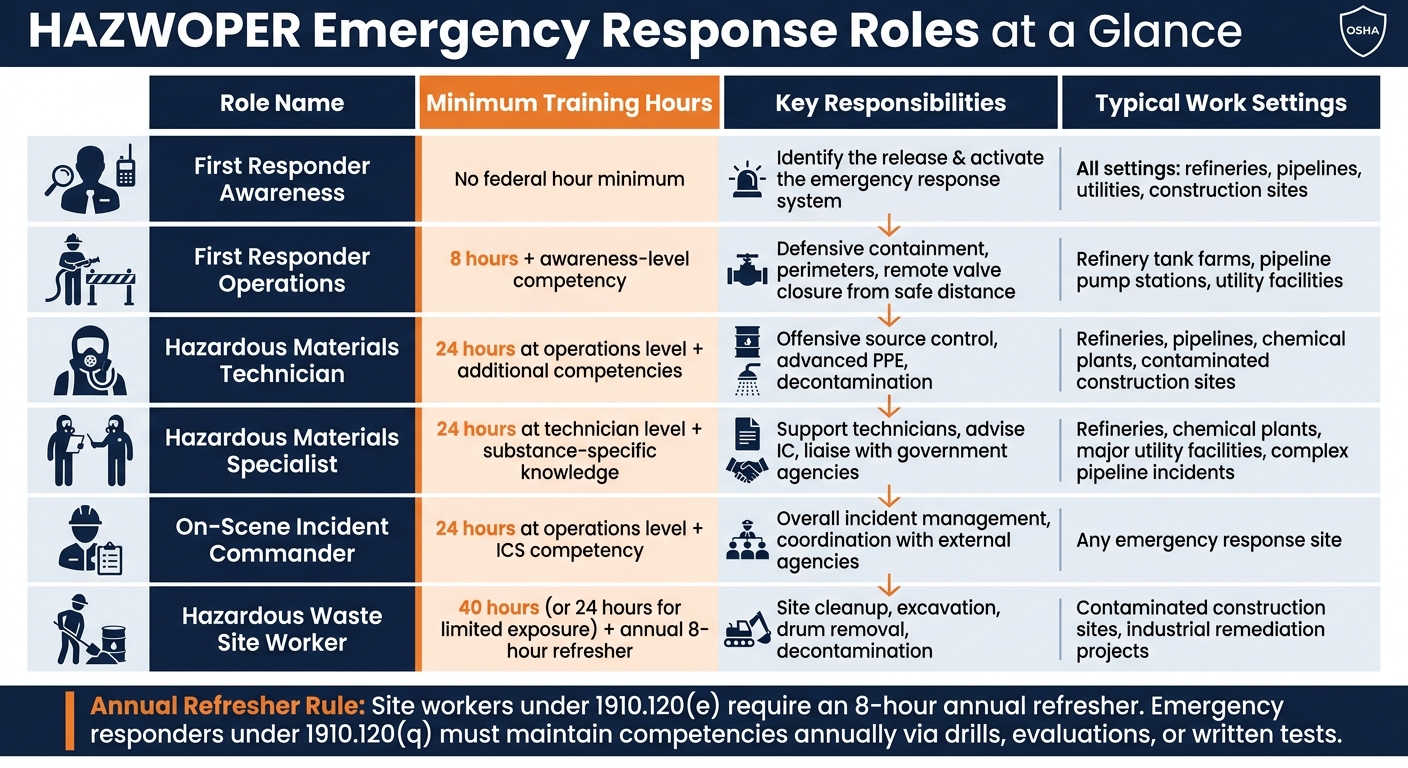
HAZWOPER Emergency Response Roles: Training Requirements & Responsibilities
After a spill is classified, the next step is simple: assign the right people to the right job. HAZWOPER training sets the line between who can observe, who can contain, who can stop the release, and who can run the response.
Common Spill Response Roles
OSHA recognizes five HAZWOPER emergency response roles that line up with ICS. Awareness-level personnel identify and report the release. The other roles take part in the response itself.
First Responder Awareness personnel spot the hazard and notify the right people. They do not handle spill control or cleanup.
First Responder Operations personnel work in a defensive role. They protect people and property from a safe distance by using containment, setting perimeters, and closing remote valves. They do not try to stop the release at its source.
Hazardous Materials Technicians move into source control. Their job is to stop the release at the source. Hazardous Materials Specialists bring substance-specific knowledge to technicians and the IC. They also often serve as technical liaisons with government agencies during more difficult incidents.
The On-Scene Incident Commander (IC) leads the response, sets objectives, works with outside agencies, and makes sure operations stay within the emergency response plan.
Put plainly: the job sets the training requirement, not the other way around.
24-Hour, 40-Hour, and 8-Hour Refresher Requirements
Training hours depend on the worker’s role.
Workers who do full-time hazardous waste site cleanup or remediation usually need 40 hours of initial HAZWOPER training, plus supervised field experience. That path is separate from emergency response roles. Workers with limited or occasional site involvement may qualify for 24-hour training instead.
For emergency response roles, the minimum training follows the position:
- First Responder Operations: at least 8 hours plus awareness-level competency
- Hazardous Materials Technicians: at least 24 hours built on the operations level, plus extra competencies in specialized PPE, advanced control and containment, and decontamination
- Hazardous Materials Specialists: at least 24 hours built on the technician level, plus substance-specific knowledge and liaison duties
- On-Scene Incident Commanders: at least 24 hours built on the operations level and competency in ICS and emergency response planning
Annual refresher training matters just as much as the initial course. For hazardous waste site workers under 1910.120(e), OSHA requires an annual 8-hour refresher. For emergency responders under 1910.120(q), OSHA requires annual maintenance of competencies, but employers can document that through drills, evaluations, or written tests instead of using a fixed 8-hour class.
The table below condenses the role-to-training split.
Role-to-Training Comparison Table
| Role | Minimum Training | Key Responsibilities | Typical Work Settings |
|---|---|---|---|
| First Responder Awareness | Awareness-level competency; no fixed federal hour minimum | Identify the release and activate the emergency response system | All settings – refineries, pipelines, utilities, construction sites |
| First Responder Operations | 8 hours plus awareness-level competency | Defensive containment, perimeters, and remote valve closure from a safe distance | Refinery tank farms, pipeline pump stations, utility facilities |
| Hazardous Materials Technician | 24 hours at the operations level plus additional competencies | Offensive control of the release, advanced PPE, and decontamination | Refineries, pipelines, chemical plants, contaminated construction sites |
| Hazardous Materials Specialist | 24 hours at the technician level plus substance-specific knowledge | Support technicians, advise the IC, and liaise with government agencies | Refineries, chemical plants, major utility facilities, complex pipeline incidents |
| On-Scene Incident Commander | 24 hours at the operations level plus ICS competency | Overall incident management and coordination with external agencies | Any emergency response site |
| Hazardous Waste Site Worker (cleanup/remediation) | 40 hours, or 24 hours for limited exposure roles, plus annual 8-hour refresher | Site cleanup, excavation, drum removal, and decontamination | Contaminated construction sites, industrial remediation projects |
What HAZWOPER Training Covers and How Spill Response Works on Site
Once a spill is classified, HAZWOPER training moves from theory to action.
Core Skills Taught in HAZWOPER Courses
HAZWOPER training teaches workers how to spot hazards and respond without making a bad situation worse. That includes hazard recognition, chemical identification and behavior, basic toxicology and exposure routes, PPE and respirator selection and limitations, air monitoring, site control and exclusion zones, decontamination procedures, and site safety and health plans (HASPs).
The hands-on part is where this starts to stick. Workers practice using PPE, reading Safety Data Sheets (SDS), reading placards, and running through decontamination drills. OSHA-related training guidance and industry materials put a lot of weight on supervised field experience and showing competence, not just sitting through classroom hours.
Air monitoring needs its own spotlight. Workers learn when high vapor or dust levels, oxygen deficiency, or unknown contaminants are a sign to stop work or notify the emergency coordinator once readings hit action levels.
Those skills feed into a set response sequence on site.
Step-by-Step Spill Response Under HAZWOPER
Once a spill becomes an emergency response event, training decides who can enter, who can contain the release, and who runs the scene. A compliant spill response follows a clear sequence.
A worker who sees a release stops work, moves to a safe location, and notifies the emergency coordinator. From there, responders isolate the area by setting a perimeter, shutting down ignition sources if it can be done safely, and using wind direction plus SDS data to mark out an initial hot zone.
Once the incident commander and safety officer have enough information, they set the three-zone layout:
- The hot (exclusion) zone is the contaminated area. Only personnel with the right training, PPE, and task assignment can enter.
- The warm (contamination reduction) zone is where workers leave the hot zone and go through decontamination.
- The cold (support) zone is the clean area used for command, medical support, and logistics.
Workers leaving the hot zone must decontaminate before they exit, and contaminated clothing and equipment must stay controlled on site. Decon lines are set up upwind and uphill of the hot zone when possible, and traffic moves one way – from hot to cold, through decon.
After containment, the site team documents exposure data, medical follow-up, incident reports, and lessons learned for the HASP or response plan.
That job-by-job view is what employers need to verify before sending crews out.
Job Type and Exposure Matrix
The same HAZWOPER rules do not look the same for every worker. Cleanup crews, facility responders, and site leaders may all fall under HAZWOPER, but the training level, tasks, and exposure pattern can differ a lot. The table below maps job category to HAZWOPER level, typical spill tasks, and expected exposure risk.
| Job Category | HAZWOPER Level | Typical Spill Tasks | Exposure Profile |
|---|---|---|---|
| Environmental remediation worker | Hazardous waste site worker training | Excavating contaminated soil, drum handling, groundwater treatment, decon support | Extended, lower-intensity exposure managed with engineering controls and PPE |
| Facility emergency responder | Emergency response training by role, from operations through incident command | Rapid hazard assessment, zone setup, offensive source control, plugging and patching | Higher short-term exposures, fire/explosion risk, and complex chemical scenarios |
| Construction worker on a contaminated site | 24-hour or 40-hour HAZWOPER, depending on anticipated exposure | Excavation in impacted soil, utility installation through contaminated areas, demolition of structures with hazardous residues | Intermittent exposure tied to specific work phases such as breaking ground or disturbing old piping |
Managing HAZWOPER Staffing, Compliance, and Recertification
How Employers Verify Credentials Before Assigning Spill Work
Once a worker’s HAZWOPER role is set, the next step is simple: verify that the person is current before dispatch.
Before assigning spill work, employers should confirm:
- The HAZWOPER level required for the assignment
- Current refresher training or documented competency, as required
- Site-specific training for local chemicals, hazards, and emergency procedures
- Any respirator fit test, medical clearance, and PPE training needed for the job
If refresher training has lapsed, document the delay and do not assign the worker until training or competency is current.
A centralized training matrix helps teams catch expired credentials before dispatch. That’s often where multi-site employers spot gaps early, before those gaps turn into violations.
How ABLEMKR Supports Certified Workforce Deployment

That check gets a lot easier when credential data lives in one place. ABLEMKR matches pre-vetted workers to spill-response jobs based on certification, safety training, availability, and location.
When employers post a spill response job, they can list the exact HAZWOPER level required, along with site needs like TWIC, H2S training, or ISNetworld. With built-in credential tracking, supervisors can confirm a worker’s HAZWOPER status, fit test records, and site-specific training before dispatch, not after the worker arrives on site.
Key Takeaways for Spill Response Readiness
For fast mobilization, dispatch decisions should rest on current credential data, not memory or manual checks. Confirm the right HAZWOPER level for the role, verify refresher or competency status, and make sure recordkeeping can stand up to an audit before sending any worker to HAZWOPER-covered spill response or cleanup work.
FAQs
How do I know if a spill is incidental or an emergency?
An incidental spill is a small spill that does not create a serious safety or health risk for nearby employees. It also isn’t likely to turn into an emergency in a short amount of time. In most cases, this means minor leaks or drips that workers can clean up on their own with standard supplies, such as spill kits.
An emergency spill is different. It’s large enough, dangerous enough, or both, that it calls for specialized training, advanced containment methods, or even evacuation. In some cases, it can put people at immediate risk of serious injury or death.
Which HAZWOPER training level do I need for spill response?
The required HAZWOPER training level depends on the spill response work and your role. For large emergencies and hazardous waste operations, OSHA requires 24 to 40 hours of initial training.
General workers usually need 40 hours plus three days of field experience. Occasional site workers typically need 24 hours plus one day of field practice. All certified workers also need an 8-hour annual refresher.
Do I need an 8-hour refresher every year?
Yes. To stay compliant with HAZWOPER certification rules, you need to complete an 8-hour refresher every year.
Your certification stays valid for 12 months. Miss that renewal window, and you may have to take the full initial training course again.
ABLEMKR can help track certifications and expiration dates, which makes it easier to stay compliant.


