
If one hard-to-fill role stays open, an energy project can slip fast. In the U.S., 89% of employers in transmission, distribution, and storage reported trouble finding qualified workers, and 60% of surveyed energy companies reported hiring problems.
If I had to boil this down, I’d say this guide is about four things:
- Plan labor before hiring starts
- Pick the right hiring path for each role
- Clear work authorization, training, and site access before travel
- Track each worker from first contact to first shift
Here’s the short version:
- I need to map roles by project phase, start date, crew size, and lead time.
- I need to use different hiring channels for engineers, craft labor, union work, subcontract crews, and outage staffing.
- I need to match each worker’s visa or U.S. work status to the actual job and complete Form I-9 on time.
- I need to confirm job licenses, OSHA training, TWIC, H2S, confined space, DOT testing, and site rules before the worker shows up.
- I need to budget for overtime, housing, travel, and per diem. The 2026 GSA baseline per diem is $166/day.
- I need one worker record that shows status from sourcing to travel, induction, timekeeping, and payroll.
A few numbers stand out right away: specialized roles may need 90 to 120 days to fill, general labor may take 30 to 45 days, and remote travel can add 15% to 20% to labor cost. For outage work, timing can be much tighter, sometimes just 7 to 21 days.
So the core idea is simple: know who you need, clear every check before day one, and keep status visible at every step.
Global Expansion: Navigating a Global Rollout and Compliance – Marius G. Smørvik
sbb-itb-aa28329
Build a Workforce Plan Before You Start Sourcing
Open hiring only after the workforce plan is in place. A lot of staffing problems come from weak forecasting, not just a lack of available labor. From there, turn each role into clear sourcing lanes, lead times, and crew counts.
Project Types, Phases, and Role Families
Each energy project type calls for a different trade mix. A 230 kV transmission line build leans on lineworkers and equipment operators. A refinery turnaround puts certified welders and pipefitters at the top of the list. An LNG terminal needs mechanical trades and commissioning specialists with cryogenic experience.
The best way to plan labor is phase by phase. Map each stage of the project – engineering and design, site prep, construction/installation, commissioning, and operations/maintenance – to the role families you need, the estimated hours for each role, and the required start dates. Be specific with dates and headcount: 8 certified welders for 10 weeks starting Oct. 1, 6 turbine technicians for 4 weeks starting Nov. 15, and 10 electricians from Dec. through Feb. Then tag each role by sourcing lane: local, regional, or cross-border. If a role needs travel, visa timing, or offshore mobilization, mark that before sourcing starts.
Some roles simply take longer to fill. Substation energization, turbine erection, and major pipeline welds sit in that group. Plan 90–120 days for specialized commissioning support or turbine technicians, 60–90 days for electricians and lineworkers, and 30–45 days for general labor. That timing matters. Industry projections point to a shortage of about 360,000 welding professionals by 2027, and more than 43% of current welders are already over age 45. If you miss the lead-time window, the wrong hiring channel can leave you short when the work is ready to go.
Mobilization Windows, Rotations, and Budget Controls
Once role families are set, convert them into arrival dates, rotation rules, and cost limits. Use exact timing – Week of 03/23/2027 instead of late Q1. That makes room for the things that often throw schedules off: travel, site induction, and weather delays.
Shift design and rotations have a direct effect on total labor cost. A 6×10 schedule adds about 20 overtime hours per worker each week. On remote pipeline or transmission jobs, 12-hour shifts with 14/7 rotations are common. Cross-border workers may be more open to heavier rotations when housing and per diem terms are spelled out from the start. GSA’s 2026 per diem benchmark for most U.S. counties is $166/day – $107 for lodging and $59 for meals and incidental expenses – so many project budgets use that figure as a benchmark. On remote sites, travel can eat up 15% to 20% of total labor costs, including flights, mileage, ground transport, and lodging in high-demand corridors like the Permian Basin.
Budget controls need to start in estimating, not after costs begin to drift. Set cost bands in U.S. dollars for each role family, model overtime exposure based on shift structure, and mark the thresholds that trigger a review. For pipeline transportation roles, average wages are about $42/hour. Housing, transport, and per diem terms should be locked before mobilization begins.
Choose the Right Hiring Channels for Energy Labor
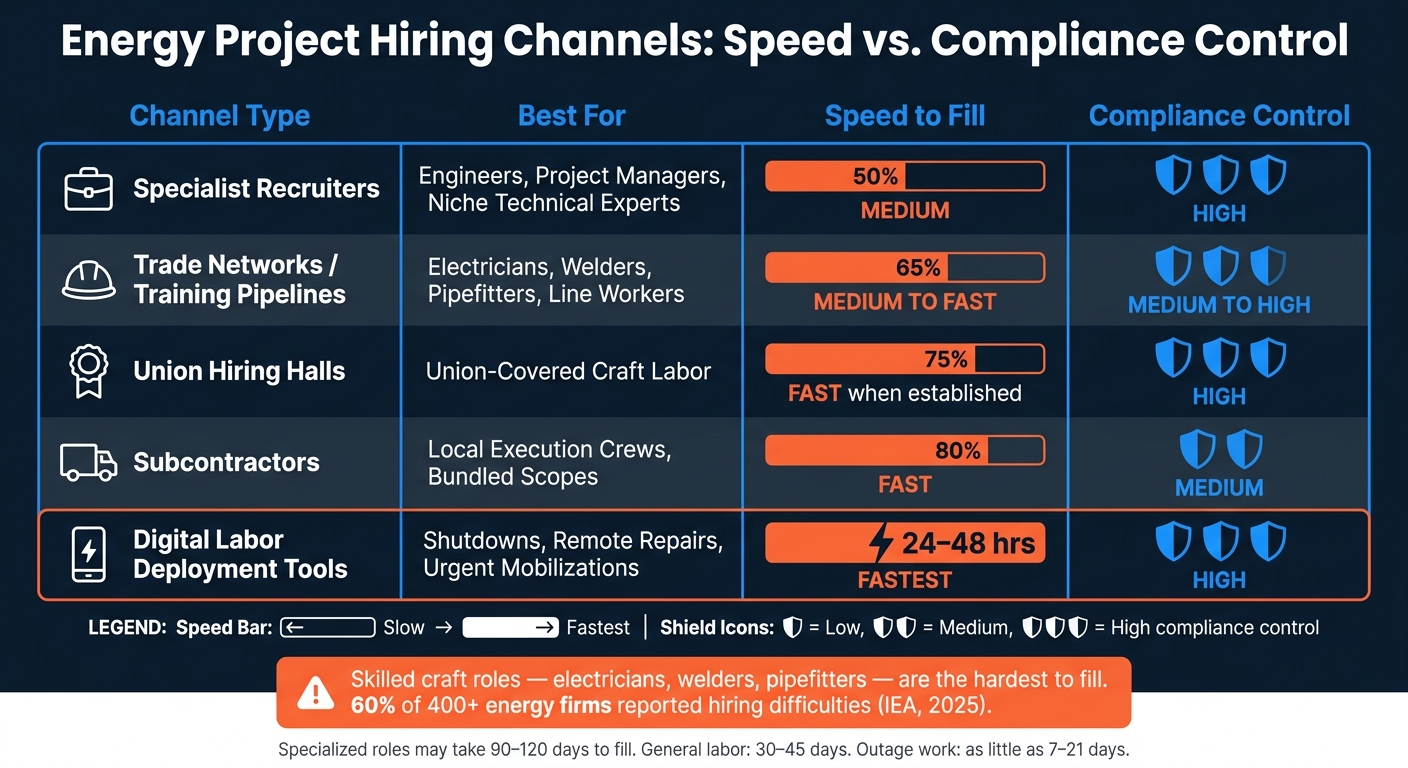
Energy Project Hiring Channels: Speed vs. Compliance Control
Once the workforce plan is set, the next move is picking the right hiring channel for each role, based on urgency, role type, and compliance risk, especially for jobs that can’t be filled locally. The goal is simple: use the fastest path that still keeps compliance in check.
That choice affects three things right away:
- How fast the role gets filled
- How much control you keep over credentials
- How much compliance risk follows the project
Best Channels by Role Type and Urgency
Not every role should go through the same path.
Engineers, project managers, and niche technical experts usually fit best with specialist workforce agencies. These firms can run targeted searches across energy sectors and go after hard-to-find talent. It’s not the fastest route, but for scarce roles with a lot of accountability, it often makes more sense.
Craft labor is a different story. Around 60% of more than 400 energy firms surveyed by the IEA in 2025 reported hiring difficulties, and the hardest roles to fill were skilled craft roles such as electricians, grid line workers, welders, pipefitters, and solar PV installers. For these jobs, trade networks, union hiring halls, and skills marketplaces often work better than general recruiters.
On PLA-covered projects, union hiring halls often control craft sourcing. In non-union settings, contractors have more room to use direct hiring, local staffing agencies, and subcontractors.
Subcontractors can help when speed matters. They bring a bundled crew, manage their own day-to-day hiring, and can move fast because they already know the local labor market. The tradeoff is pretty clear: you gain speed, but you give up some direct control. That means prime contractors still need to verify certifications and safety training before mobilization.
For outages and remote repairs, digital deployment tools can be the fastest option. Some can place qualified workers in 24–48 hours and flag compliance gaps before arrival.
| Channel Type | Best For | Speed to Fill | Compliance Control |
|---|---|---|---|
| Specialist recruiters | Engineers, PMs, niche technical experts | Medium | High |
| Trade networks / training pipelines | Electricians, welders, pipefitters, line workers | Medium to Fast | Medium to High |
| Union hiring halls | Union-covered craft labor | Fast when established | High |
| Subcontractors | Local execution crews, bundled scopes | Fast | Medium |
| Digital labor deployment tools | Shutdowns, remote repairs, urgent mobilizations | Fastest (24–48 hrs) | High |
Once you’ve picked the channel, the next screen is legal work status, credentials, and site readiness.
Using ABLEMKR for Fast U.S. Mobilization
For teams that need faster U.S. mobilization, software can bring sourcing and compliance into one workflow. For short-notice U.S. mobilization, ABLEMKR matches pre-vetted workers to jobs based on certification, availability, and location. The platform supports roles that are often hardest to fill on short notice, including ASME/API certified welders, structural ironworkers, pipefitters, millwrights, and heavy equipment operators.
Before dispatch, the platform checks TWIC, OSHA 10/30, H2S, confined space, DOT testing, and ISNetworld status. Employers also get real-time visibility into worker status, integrated payroll workflows, and built-in compliance tracking.
Even then, the hiring channel only works if work authorization, credentials, and site access are cleared before day one.
Verify Work Authorization, Credentials, and Site Access Readiness
Hiring the right person is only part of the job. If that worker can’t clear legal checks, credential checks, or site access steps, they won’t make it through the gate. This section focuses on the three checkpoints that matter most: work authorization, trade and safety credentials, and pre-arrival setup.
Visa Limits and Work Authorization Checks
Every worker hired in the U.S. after November 6, 1986 must complete Form I-9, and the employer must keep the supporting documents on file. Mistakes here can lead to audits, civil fines, and debarment from federal contracts.
For cross-border energy projects, the visa must match the actual job. A B-1 visitor can attend meetings and consult, but cannot perform productive site labor. Employer-sponsored visas such as H-1B, H-2B, and L-1 need approval and come with strict rules on pay, location, time period, and job duties. USCIS may also make unannounced site visits to confirm that H-1B workers are at the listed worksite and doing the duties in the petition.
The safest way to handle this is simple: treat visa-to-job matching like an audit trail. Review it with immigration counsel at four points:
- pre-offer
- pre-visa filing
- pre-travel
- gate access
Each step should be time-stamped in a tracking system. If there’s ever a regulatory audit or an incident review, that record shows the project did its homework.
Credential Verification and Safety Compliance
Work authorization alone isn’t enough. A worker should not be mobilized until both legal status and job credentials are cleared.
Trade credentials depend on the role and the state. Electricians, pipefitters, crane operators, and instrumentation technicians may need state or local licenses. In union settings, dispatch status can matter too. On pipeline and oil and gas sites, NCCER credentials are being checked more often, and completion records can be shared through systems such as ISNetworld to confirm site access status.
Safety checks need the same level of scrutiny. OSHA requires documented training for confined space entry, lockout/tagout (LOTO), fall protection, hazard communication, and emergency action plans. That training must be current, match the site, and be confirmed with the issuing body. A worker saying, "Yeah, I took that class", isn’t enough. OSHA 10 Construction and General Industry are not interchangeable on a transmission line project.
The table below shows common risk areas on U.S. energy sites and how they are checked:
| Risk Area | Requirement | Verification Method | Verifier | Verification Source |
|---|---|---|---|---|
| Secure facility access | TWIC Card | Physical card check / biometric scan | Site security / contractor | Government / TWIC database |
| Operator approval | ISNetworld status | Platform status verification | Project manager | ISNetworld |
| General site safety | OSHA 10/30 | Certification card / record review | Safety officer | OSHA / training provider |
| Hazardous atmosphere | H2S training | Training certificate validation | Safety lead | Internal compliance app |
| Technical competency | ASME/API welding certs | Practical test / paperwork review | Quality control | Contractor records |
| Confined space / energy control | Confined space entry, LOTO | Training records and permits | Site supervisor | Site safety log |
| Health and regulatory | DOT drug/alcohol testing | Lab results / DOT medical card | HR / third-party lab | Medical Review Officer (MRO) |
For DOT-regulated pipeline work, drug testing is mandatory. Under 49 CFR Part 199, no operator may hire or contract for a covered pipeline role unless the worker passes a DOT-compliant drug test or is already in a compliant program. Random drug testing must cover at least 50% of covered workers each year.
Medical and screening records should stay in access-controlled systems. Operations teams should only see status flags such as fit/unfit or cleared/not cleared. That keeps private health details out of day-to-day field decisions.
Once those checks are done, attention moves to pre-arrival setup so the worker can get on site without getting stuck at the last hurdle.
Pre-Arrival Readiness for Site Access
All clearance steps should be finished before travel is booked. Many operators now build worker profiles in the site access system before arrival, assign access zones such as process units or switchyards, and issue conditional digital badges that activate only after each requirement is complete. That includes I-9 checks, safety training, site orientation, and medical or drug screens.
After legal and credential review, the next pieces are badges, travel, and induction. Permit-to-work orientation belongs in the first-day induction flow. Workers need to know how to request, receive, and close permits for hot work, confined space, or line breaking before any high-risk task is approved. Many operators also use a safety green light check right before work begins – and again after breaks – to confirm conditions haven’t changed since the permit was issued.
For rotational crews headed to remote pipelines, wind farms, or offshore platforms, fatigue management is a safety control, not just an HR item. NIOSH and CDC guidance calls for 7–9 hours of sleep per off-duty day, limits on work and driving hours, and documented journey management plans. In plain terms, don’t fly someone across the country, bus them three more hours, and send them straight into a shift. Build in rest time between long-haul travel and day one.
Digital tools can help here by sending travel plans, lodging details, emergency contacts, and induction schedules to workers’ phones. They can also track whether workers acknowledged required briefings, so no one starts work without knowing the muster points, evacuation routes, and emergency contacts for that site.
ABLEMKR supports this pre-arrival flow by checking TWIC, OSHA 10/30, H2S, confined space, DOT testing, and ISNetworld status before dispatch. If something is missing, mobilization should stop until it’s cleared. Those status checks should then feed straight into the worker-tracking system covered next.
Track Workers From First Contact to Job Site Arrival
The Digital Worker Lifecycle for Energy Projects
Once authorization and site access are cleared, the next step is simple: keep each worker’s status visible in one live record. Track every person through defined lifecycle stages. Each stage should include its own data fields and a clear status, and the next step should stay locked until the current one is done.
Here’s what that lifecycle looks like in practice:
| Lifecycle Stage | Primary Data Captured | Typical System | Key Compliance Output |
|---|---|---|---|
| Workforce Request | Project, role, start date, duration, budget | Workforce planning or ERP | Documented need and budget control |
| Candidate Sourcing | Skills, certifications, availability, location, source channel | Applicant tracking system | Traceable candidate pipeline |
| Screening & Credentials | License numbers, safety training, background checks, drug screen status, expiry dates | HR and compliance systems | Verified qualifications and risk flags |
| Offer & Onboarding | Pay rate, overtime rules, per diem, W-4, policy acknowledgments | HR and onboarding systems | Signed digital employment record |
| Work Authorization | Visa type, I-9, E-Verify status, work-location restrictions | Compliance and immigration tracking | Legally valid work authorization proof |
| Travel & Mobilization | Itinerary, lodging, ETA to site | Travel and deployment platform | Documented mobilization and travel duty of care |
| Site Induction & Arrival | Site-specific orientation, badge issuance, PPE allocation, supervisor sign-off | Site access and safety systems | Proof of safety readiness and site access |
| Timekeeping & Payroll | Hours worked, shift differentials, approvals, cost center | Time, attendance, and payroll systems | Accurate pay and job-costing evidence |
Form I-9 Section 2 must be completed within 3 business days of hire, so it needs to be treated as a hard workflow gate. That deadline isn’t a small admin detail. Miss it, and a routine hire can turn into a compliance issue fast.
When these stages are tied together in one system, a project manager can check a worker’s status at a glance. You can see whether that person is sourced, credentialed, authorized, and on the way to site – or spot what’s missing before it turns into a gate-day mess.
That’s where deployment software earns its keep. It puts sourcing, compliance, travel, and arrival on one timeline.
How ABLEMKR Supports Labor Deployment and Compliance
ABLEMKR is built on a simple idea: a worker record should not be scattered across five different systems. From the moment a project team posts a role, the platform captures trade requirements, required certifications, shift patterns, and geographic preferences. That means matching starts with the right criteria, not a generic job post.
ABLEMKR matches pre-vetted workers to projects based on role, location, availability, and required certifications. Once a worker is matched and moving toward deployment, the mobile app gives project teams real-time visibility into worker location and status. GPS-verified timecards confirm arrival at the job site and feed straight into payroll workflows.
Workers can also review requirements, travel, lodging, and pay setup before deployment. That matters on fast-moving energy projects, where confusion around pay or site access can cause friction before the first shift even begins.
When those stages stay connected, the move from first contact to first shift is much smoother, with fewer gaps and fewer last-minute surprises.
Conclusion: What Strong Global Sourcing Looks Like in Practice
Strong global sourcing comes down to one connected process: plan the work, verify the worker, and track each status change through arrival. When that process stays intact – from workforce planning to hiring channel to authorization to site induction – the job site gets the right people on time, with one verified record from first contact to site arrival.
FAQs
How early should I start sourcing labor?
For planned energy projects, start sourcing labor as early as Q1. That gives you time to build a steady talent pipeline and lower project risk before work ramps up.
If you’re dealing with urgent needs or shutdowns, pre-vetted crews can be mobilized within 24 to 48 hours. But here’s the plain truth: proactive sourcing is still the best way to cover long-term labor needs and avoid last-minute scrambling.
Which hiring channel fits each energy role?
Choose the hiring channel based on the role’s trade requirements, safety credentials, and project location. A centralized, mobile-first platform lets firms post openings for roles like pipefitters, welders, and heavy equipment operators, along with the certifications each job calls for.
From there, it can match pre-vetted workers to project needs, check credentials and compliance records, and use real-time geo-location to help crews get to the job site faster with less manual sourcing.
What must be cleared before workers arrive?
Before arriving on-site, workers need to pass a set of compliance and readiness checks tied to safety and regulatory rules.
That usually means confirming certifications and licenses, finishing required safety training, and completing medical exams, drug and alcohol testing, and background checks. It also includes getting site access credentials, travel documents, and site-specific safety briefings in place.


