
If I’m hiring or planning geothermal work in the U.S., I start with one question: what is required by law, and what is just a skill signal? That split tells me who can legally work, who fits the role, and where I may hit delays.
Here’s the short version:
- EPA Section 608 is required for anyone who handles regulated refrigerants.
- State well driller or geothermal loop installer licenses may be required for drilling or loop-field work.
- OSHA 10 or OSHA 30 is often needed for site access, even though federal OSHA cards do not expire.
- IGSHPA certifications like GRIT, GHXI, GRST, GRSD, and GCSD help match people to installation, loop-field, service, and design roles.
- NATE fits equipment-side HVAC work.
- BPI fits audit and whole-home performance work.
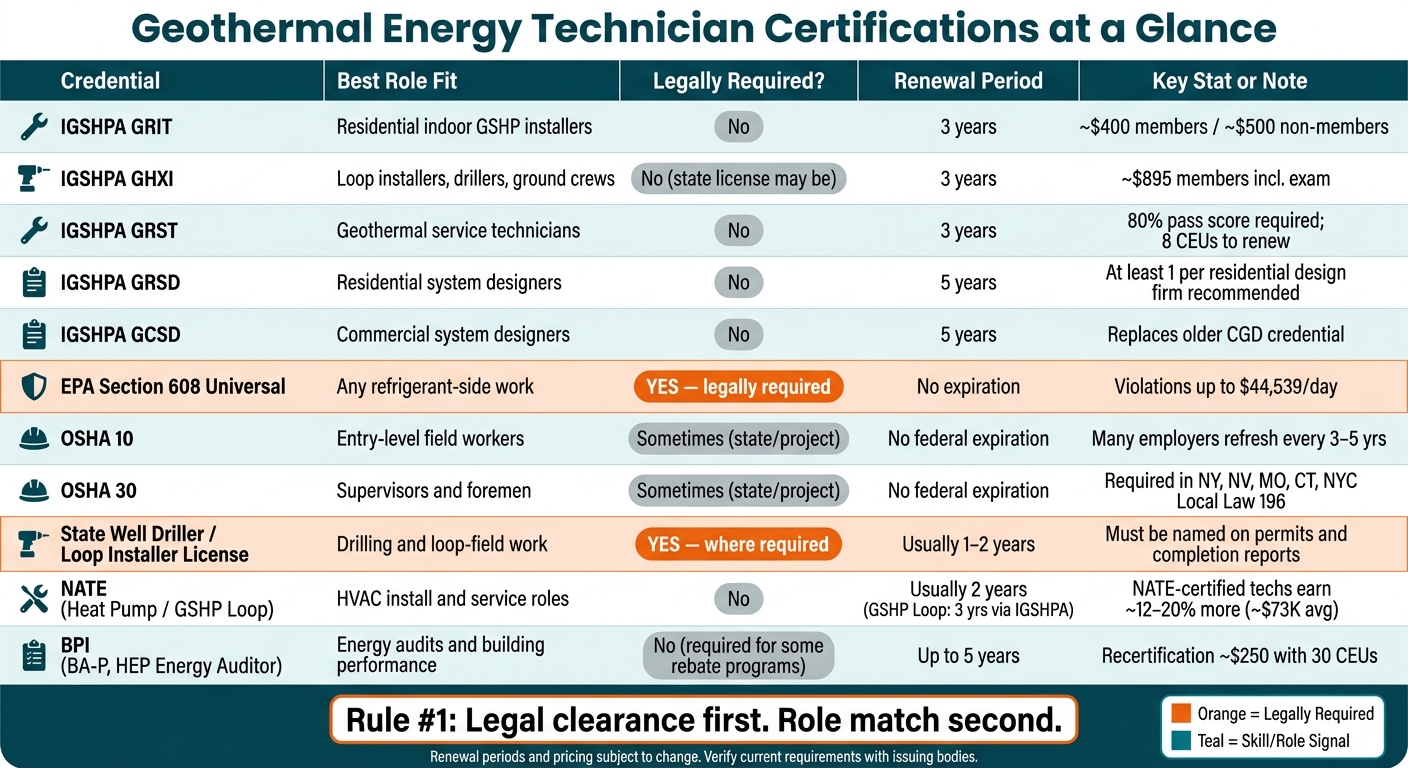
A few numbers stand out. Most IGSHPA credentials renew every 3 years, while GRSD and GCSD run 5 years. NATE often renews every 2 years. EPA 608 does not expire under current rules. And EPA violations tied to refrigerant rules can reach $44,539 per day.
Geothermal Energy Technician Certifications: Requirements & Renewal Guide
IGSHPA Geothermal Installer Certification Training – What is it? Who should take it?

sbb-itb-aa28329
Quick comparison
| Credential | Best for | Required by law? | Usual renewal |
|---|---|---|---|
| GRIT | Residential indoor GSHP installers | No | 3 years |
| GHXI | Loop installers, drillers, ground crews | No, but state license may be | 3 years |
| GRST | Geothermal service techs | No | 3 years |
| GRSD | Residential system designers | No | 5 years |
| GCSD | Commercial designers | No | 5 years |
| EPA Section 608 Universal | Refrigerant-side work | Yes | No expiration |
| OSHA 10 | Entry-level field workers | Sometimes, by project/state | No federal expiration |
| OSHA 30 | Supervisors and foremen | Sometimes, by project/state | No federal expiration |
| State driller / loop installer license | Drilling and loop-field work | Yes, where required | Usually 1 to 2 years |
| NATE | HVAC install/service roles | No | Usually 2 years |
| BPI | Energy audits and building performance | No | Up to 5 years for some tracks |
If I had to boil the whole article down to one rule, it would be this: legal clearance comes first, then role match. After that, I’d use IGSHPA, NATE, and BPI to sort who is best for installation, service, design, or audit work.
1. IGSHPA GSHP Residential Installation Technician (GRIT)
Role Fit
GRIT fits HVAC installers who handle the indoor side of residential GSHP jobs. That includes setting the unit, tying in loop stubs, running ductwork, wiring controls, and commissioning the system.
It does not cover loop-field or drilling work. That work falls under GHXI. So in practice, GRIT helps separate indoor installers from field crews.
IGSHPA expects candidates to come in with basic HVAC knowledge and trade experience. That means HVAC terminology, electrical concepts, and refrigeration fundamentals. Some programs go a step further and require IGSHPA training. Oregon, for example, requires proof of completed IGSHPA training or an IGSHPA-certified manufacturer’s installer program for the state’s tax-credit technician designation. For technicians who spend most of their time on startup, refrigerant piping, and performance checks, GRIT is the IGSHPA credential that lines up most closely with the job.
Legal Necessity
GRIT is a credential, not a license. The legal rules still come from the mechanical, electrical, or contractor requirements tied to the work itself.
Employer Signal
For geothermal contractors, GRIT works as a role-specific filter. It shows knowledge of CSA/ANSI/IGSHPA C448:25, not just general HVAC practice.
It can also help on utility or DOE-backed projects, where program rules and quality checks often favor IGSHPA-trained crews. The U.S. Department of Energy has recognized GRIT and GRST as best-practice content in the Energy Skilled™ HVAC Program. For employers, that signal means more when the credential is current, not expired and forgotten in a file.
Renewal & Compliance
GRIT stays active for three years. Renewal requires 8 CEU points earned through approved work, training, or membership. Typical pricing is about $400 for members and $500 for non-members. Combined GRIT/GRST enrollment is about $765 for members.
A simple way to avoid trouble: track expiration dates and CEUs in one place. That cuts the risk of lapses on audited jobs or work tied to rebates and incentive funding.
2. IGSHPA Ground Heat Exchanger Installer (GHXI)
Role Fit
If GRIT is about the indoor side, GHXI is about the loop field. This covers boreholes, trenches, pipe fusion, thermal grouting, pressure testing, flushing, purging, and backfilling. In plain terms, it fits techs who handle the ground heat exchanger, not the indoor unit.
IGSHPA aims GHXI at well drillers, excavators, and loop installers, not indoor HVAC techs. The path includes five online prerequisite modules and a two-day workshop. Member pricing is $895, and that includes the exam and course materials.
Legal Necessity
Because GHXI focuses on field work, legal authority still comes down to state licensing and local rules. The right to drill boreholes or install ground loops depends on state well-driller licensing, contractor registration, and local rules tied to water and site conditions.
Still, some project specs treat IGSHPA ground-loop credentials as mandatory. The U.S. Department of Veterans Affairs Ground-Source Heat Pumps specification requires the state-licensed well driller and installer of downhole piping to be IGSHPA-accredited (or equivalent), hold a state well-drilling license, and show at least four completed projects whose combined size matches the proposed job.
Employer Signal
For hiring managers, GHXI tells them a candidate knows where ground-loop jobs can go wrong: poor grouting, contamination pathways, failed pressure tests, and loop damage. It shows more than general excavation or HVAC knowledge. That can shorten training time and help avoid costly mistakes.
On projects that call for IGSHPA standards, check both GHXI and the needed state drilling license before bid submission. Miss either one, and the bid can be disqualified.
Renewal & Compliance
IGSHPA certificates, including GHXI, generally need renewal every three years, with continuing education units (CEUs) sent to IGSHPA. Current IGSHPA Accredited Installers can earn the GHXI certificate by taking the exam only, without repeating the full course.
3. IGSHPA GSHP Residential Service Technician (GRST)
Role Fit
GHXI is about the loop field. GRST is about what happens after startup: service, maintenance, and troubleshooting. It’s aimed at residential HVAC techs who work on ground-source heat pump systems in single-family and small multifamily homes.
The course runs 8 hours and expects you to already know basic refrigeration and HVAC service. You also need field experience and solid electrical troubleshooting skills. From there, GRST focuses on the stuff that often throws conventional HVAC techs off on geothermal calls, like:
- checking antifreeze concentration
- finding airlocks in the loop
- diagnosing flow problems
- working through variable-speed GSHP control behavior
That’s the big reason GRST tends to matter more in service hiring than in general HVAC screening. It deals with the exact weak spots that show up in geothermal repair work.
For pricing, IGSHPA members pay $400, while non-members pay about $500. If you’re taking GRIT too, the combined member bundle drops to $765. To earn the certificate, you must score 80% or higher on the online final exam and attend 100% of the course.
Legal Necessity
GRST is not a legal license. It does not replace a state HVAC contractor license, a mechanical license, or EPA Section 608 certification for refrigerant handling.
Instead, think of it as a specialized geothermal service credential. It sits on top of your license stack and shows that you’ve had training in GSHP-specific service work. That matters even more because GRST is recognized by the U.S. Department of Energy’s Energy Skilled™ HVAC Program, which gives it weight in quality assurance and program-based work.
Employer Signal
From an employer’s side, GRST helps answer a simple question: Can this tech walk into a geothermal service call without weeks of retraining?
That’s why firms shifting from standard HVAC into GSHP work often treat GRST as a bridge credential. It can also help on utility-backed or program-backed jobs where technician training gets reviewed and scored during RFP evaluations.
A tech who has EPA 608, a state HVAC license, and GRST usually stands out more for geothermal service work than someone with EPA 608 and NATE alone. The reason is pretty plain: GRST deals head-on with loop fields and GSHP fault diagnosis, which are the areas many standard HVAC credentials don’t cover in much depth. If the job is design-focused, that’s a different lane and calls for a different mix of credentials.
Renewal & Compliance
GRST certificates stay valid for three years. Renewal requires 8 CEU points.
For employers, it helps to track GRST expiration dates alongside EPA 608 and OSHA credentials. That makes it easier to spot gaps before they turn into a project eligibility problem.
4. IGSHPA GSHP Residential System Designer (GRSD)
Role Fit
After service and troubleshooting comes the next job: designing the system the right way from the start.
GRSD focuses on residential geothermal system design. That includes calculating building loads, sizing the loop, choosing components, and making sure the indoor unit and loop field work together for efficient operation. When the design is off, problems show up fast: poor efficiency, more callbacks, and higher operating costs.
GRSD aligns with CSA/ANSI/IGSHPA C448:25 and signals design competency under that standard. IGSHPA’s updated guidance also says that at least one person from a residential geothermal design or installation company should hold either GRSD certification or an IGSHPA Accredited Installer certificate to meet C448:25 compliance expectations.
That’s why GRSD matters most in roles where design quality has a direct effect on field performance, rebate approval, or plan review outcomes.
Legal Necessity
GRSD is a professional certification, not a legal license. State and local HVAC, engineering, contractor, or other licensing rules still control who can perform the work.
Employer Signal
For employers, the issue is pretty straightforward: who can design the system correctly before the crew ever gets to the job site?
GRSD is a strong hiring signal for people who will handle residential design work. It shows that a candidate can put together a workable residential design, not just move paperwork from one step to the next. It tends to mean more when it’s paired with installation or HVAC experience, because good design has to hold up in the field.
Renewal & Compliance
GRSD certificates are valid for five years. Renewal requires continuing education units (CEUs). Employers should track GRSD expiration dates alongside other active credentials, especially for teams that rely on certified staff for compliance or review needs.
5. IGSHPA Commercial System Designer (GCSD)
Role Fit
While GRSD is geared toward homes, GCSD is built for larger commercial systems. It lines up well with mechanical engineers, commercial HVAC designers, and contractors working on bigger buildings, institutions, and multifamily jobs. Compared with GRSD, it goes further into shared loop fields, multi-zone controls, and coordination with chillers, boilers, and building automation.
That broader scope shapes the training path. The program covers IGSHPA core modules, then adds a Commercial System Design Workshop and CSA exam, with the work tied to CSA/ANSI/IGSHPA C448:25 and the ASHRAE Geothermal Design Manual. GCSD also replaces the older Certified GeoExchange Designer (CGD) credential.
Legal Necessity
GCSD is a professional certification, not a state-issued license. If a commercial project calls for stamped mechanical drawings, you still need a state PE license. That said, utility rebates, local incentive programs, and institutional RFQs/RFPs often list GCSD or CGD as a project requirement. In some cases, local code officials may adopt C448:25, which can bring GCSD into the permit review process as well.
Employer Signal
From an employer’s point of view, GCSD shows that a candidate is ready for lead commercial design work. It works alongside PE licensure and commercial HVAC experience; it doesn’t replace either one. A GCSD-certified designer is in a stronger spot to avoid undersized loop fields, unbalanced hydraulic networks, and designs that fail to meet incentive criteria.
For firms chasing schools, hospitals, campuses, and other high-dollar commercial jobs, GCSD can help in two places at once: hiring and proposals.
Renewal & Compliance
GCSD certificates stay active for five years. After that, recertification is required through continuing education, documented professional practice, and/or re-examination. Since C448 is updated from time to time, that five-year cycle helps keep designers current with changes in the standard.
If an RFP or incentive filing depends on active status, it’s smart to track renewal dates early. A missed renewal can turn into a paperwork problem at the worst possible moment.
6. EPA Section 608 Universal Certification
Role Fit
This credential is different from the IGSHPA certifications above. It isn’t geothermal-specific. But the second a job involves refrigerant work, it becomes mandatory.
EPA Section 608 applies to geothermal roles that touch refrigerant circuits in any hands-on way, including charging, evacuation, recovery, connecting or disconnecting pre-charged line sets, compressor swaps, and coil replacement. If a technician only works on the loop field, this credential isn’t required.
For techs who do step into refrigerant work, Universal certification gives contractors the most room when assigning jobs. Type II may cover many residential systems. Still, Universal makes scheduling easier across different equipment types. In plain terms, Section 608 often acts as a hiring gate before a technician ever sets foot on a jobsite.
GRST covers geothermal service skills. Section 608 covers refrigerant legality.
Legal Necessity
EPA Section 608 is required under 40 CFR Part 82, Subpart F for anyone who services or disposes of stationary equipment that contains regulated refrigerants. Apprentices may work only under direct supervision of a certified technician.
Employer Signal
From a staffing standpoint, 608 is a simple filter: no card, no refrigerant work.
For employers, this isn’t a specialty badge. It’s a legal dispatch gate. Companies use it to check that a technician can legally buy refrigerant – containers larger than 2 lb are limited to Section 608-certified technicians – and can be sent alone to jobs that involve refrigerant circuits.
Renewal & Compliance
Section 608 credentials do not expire. Once a technician earns the certification, it stays valid indefinitely under current EPA rules.
That said, the rules around refrigerants can change, so techs still need to stay current even if the card itself doesn’t run out. Technicians must keep proof of certification on file for three years after they stop working. Employers also need to be able to produce proof of certification during inspections or audits.
Once refrigerant legality is covered, the next screen is jobsite safety training.
7. OSHA 10-Hour Construction
Role Fit
OSHA 10-Hour Construction is a baseline safety credential for entry-level geothermal field workers. It lines up well with loop installers, drill helpers, laborers, and junior field techs who work around trenches, rigs, and heavy equipment. In plain terms, OSHA 10 is often the first safety check for field crews, before technical certifications even come into play.
Legal Necessity
At the federal level, OSHA 10 is voluntary. That said, some states and public projects require it for covered work. Nevada is a clear case: construction workers on covered projects must get an OSHA 10 or OSHA 30 card within 15 days of hire, and employers must suspend or terminate workers who can’t show a valid card.
Employer Signal
For many entry-level geothermal field jobs, OSHA 10 works as a basic hiring filter. It does not prove drilling skill, HVAC ability, or geothermal system design knowledge. And it does not replace any state license or specialized geothermal certification a role may call for.
For foremen, site leads, and more experienced crews, OSHA 30 is usually the better fit.
Renewal & Compliance
Under federal rules, OSHA 10 cards do not expire. Even so, many employers and project owners want the training completed or refreshed within the past 3 to 5 years, especially on higher-risk or tightly regulated sites.
It helps to track OSHA 10 alongside the rest of the crew’s active credentials so workers stay job-ready. For supervisors and seasoned crews, OSHA 30 tends to carry more weight.
8. OSHA 30-Hour Construction
Role Fit
If OSHA 10 is the basic gatekeeper, OSHA 30 is the supervisor-level check for geothermal construction work.
It’s geared toward lead installers, foremen, site supervisors, and safety coordinators working on geothermal job sites. The course runs for 30 hours and is usually taught over four days, or taken self-paced over two to eight weeks. It covers 29 CFR 1926, hazard recognition, and safety program management. That includes the Focus Four hazards, plus electives like excavations, confined spaces, cranes, and scaffolds.
For geothermal crews, that matters. These jobs can involve trenching, pressure systems, electrical tie-ins, and heavy equipment, so supervisors need more than a basic safety overview.
Legal Necessity
OSHA 30 isn’t just classroom time. In many cases, it works like a job-access pass.
New York, Nevada, Missouri, Connecticut, and New York City Local Law 196 require OSHA 30 for certain construction roles. On top of that, many utilities, energy owners, and general contractors include OSHA 30 in prequalification standards and contract terms.
That means a worker can be skilled and still get blocked from a project if this training isn’t on file.
Employer Signal
For employers, OSHA 30 sends a clear message: this person is prepared to handle site-level safety duties.
A technician with OSHA 30 has shown they can:
- identify hazards
- understand OSHA rights and responsibilities
- use incident-prevention practices across geothermal sites with excavation, pressurized lines, electrical hookups, and heavy lifts
Even for technicians who don’t yet have formal supervisory duties, OSHA 30 can help them stand out. It often gives them an edge when they’re going after lead roles or higher-paying field assignments. Many employers use it as a screening filter for foremen, site leads, and crew coordinators.
Renewal & Compliance
Like OSHA 10, OSHA 30 cards do not expire under federal rules. Still, many employers and project owners treat them as current for 3 to 5 years.
For companies staffing geothermal projects in more than one state, it’s smart to track the training date, not just the card itself. That’s especially important for supervisors working in places like New York City, where site access can depend on current documentation.
9. State Well Driller / Geothermal Loop Installer License
Role Fit
For ground-side work, licensing comes first. This isn’t an optional badge. It’s the legal green light to do the job.
The exact license name changes from state to state, but crews working on ground-source heat pump projects usually need a state well driller or geothermal loop installer license. That license covers core field tasks such as operating drilling rigs, setting casing, grouting boreholes, pressure-testing loops, documenting borehole depth, and filing completion reports. Helpers can pitch in, but only under the supervision of the license holder.
Legal Necessity
State rules differ, and doing geothermal well work without a license can lead to fines, permit delays, or both. In plain English: this license is the legal gate for field work. IGSHPA and safety credentials matter too, but they sit on top of this requirement.
Employer Signal
Once a worker has the license in place, employers can use it as the first dispatch filter. A valid state license shows that the technician can be named as the responsible party on permits and reports.
That matters in day-to-day scheduling. If a company works across state lines, holding licenses in more than one state can help crews move between jurisdictions with less friction. Public and institutional project specs also often ask for both state licensing and IGSHPA credentials.
Renewal & Compliance
Most states require renewal every year or every two years. They may also require continuing education, active insurance or bonding, and on-time reporting. If a license lapses, it can lead to suspension. Some states also publish disciplinary actions, and employers or clients may review those records when screening contractors.
For employers running crews in multiple states, it helps to keep license numbers, expiration dates, CE status, insurance, and bonding details in one central system. That kind of tracking keeps multi-state crews ready to dispatch without last-minute paperwork problems.
10. NATE HVAC Certifications
Role Fit
NATE is one of the most useful adjacent HVAC credentials for geothermal technicians. It matters most on the equipment side of the job: commissioning, troubleshooting, and refrigerant-side service.
For geothermal work, two NATE options stand out:
- Heat pump specialty
- Ground Source Heat Pump Loop Installer
The Ground Source Heat Pump Loop Installer exam is built for experienced GSHP installers. It includes 100 questions and lasts 2 hours, and it does not require you to pass another NATE exam first.
That said, NATE is less relevant for well drillers or crews focused only on loop field installation. It’s aimed at technicians working on the mechanical side of the system, not subsurface loop construction.
So in practice, NATE works best as a signal of skill rather than a permitting credential.
Legal Necessity
NATE is voluntary. It does not replace EPA Section 608, state HVAC licensing, or state well driller and geothermal loop installer licenses.
Where it tends to matter most is day-to-day business use: dispatch flexibility, dealer program rules, and quality control.
Employer Signal
For employers, NATE can carry real weight. Some manufacturer and dealer programs require about 50% of staff to hold NATE certification, which can affect access to preferred manufacturer programs and rebates.
Pay data points in the same direction. NATE-certified technicians earn about 12% to 20% more than peers without the credential, with average salaries around $73,000 versus an overall median of $55,000 to $60,000.
That can matter a lot when hiring for equipment-side geothermal roles, especially service techs and commissioning techs. In those roles, NATE can help employers:
- expand the hiring pool
- support manufacturer program rules
- cut callbacks and warranty costs
Renewal & Compliance
Most NATE certifications renew every two years through continuing education or a retest.
The Ground Source Heat Pump Loop Installer credential is a little different. It stays valid for three years and renews through IGSHPA’s process. IGSHPA also notes that NATE and IGSHPA certifications can be maintained indefinitely as long as renewal and CEU rules are met.
For employers, it helps to track NATE expiration dates alongside EPA 608 and state license records. That keeps crews ready for assignment and lowers the odds of compliance issues. A lapsed certification can also put manufacturer dealer status at risk.
For load, envelope, and whole-building efficiency work, BPI fills a different role.
11. BPI Energy / Building Performance Certifications

Role Fit
Once you move past equipment-only credentials, BPI shifts the focus to the building itself. That makes it a strong fit for people who handle whole-home performance work connected to geothermal systems, like energy auditors, retrofit leads, and building-side diagnosticians.
Here’s the plain truth: a geothermal system is only as good as the house around it. If the ducts leak, the insulation is weak, or outside air keeps sneaking in, performance can drop fast even when the system was installed the right way. The BPI credentials that line up best here are BA-T, BA-P, and HEP Energy Auditor. Of those, BA-P and HEP Energy Auditor tend to fit audit-led retrofit and rebate work best. The AC / Heat Pump credential can also help with broader heat-pump retrofit work.
Legal Necessity
BPI tends to matter most when geothermal jobs connect to rebate or weatherization programs. In most cases, BPI certifications are not required to do geothermal work, and they do not replace EPA Section 608, state HVAC licenses, or local permits.
Where BPI starts to carry more weight is in federally tied programs, including HOMES and the Section 25C tax credit.
Employer Signal
From a hiring angle, BPI tells employers that a technician can look at the whole house, not just the heat pump. That matters. A building-side issue can look like equipment failure if the tech doesn’t know what to check. BPI helps signal someone who can spot air leakage, duct problems, or insulation gaps instead of pinning every issue on the geothermal unit.
It has also been a common requirement in Home Performance with ENERGY STAR and utility programs. In practice, BPI carries the most weight when geothermal hiring overlaps with retrofit, audit, or program-driven work. IGSHPA shows system know-how. BPI shows building-side tuning.
Renewal & Compliance
For employers, renewal tracking matters just as much as the first certification. Energy Auditor and QCI renewals now run up to 5 years, and CEUs can be used to waive written exams, though field exams still apply.
One example puts Energy Auditor recertification at about $250 with 30 CEUs. That’s why it makes sense to track BPI expiration dates right alongside EPA 608 and state license records. If a BPI credential lapses, it can shut down utility or rebate participation in the middle of a project.
Which Credentials Employers Value Most
Employers usually sort credentials into two groups: legal requirements and skill signals. One gets you in the door. The other helps you stand out from the pack.
Minimum Screening Requirements
In the U.S. geothermal market, four credential groups work as hard screening filters for most employers.
EPA Section 608 Universal is the most direct one. If someone services, installs, or disposes of stationary appliances, they must hold Section 608 certification. The penalty for violations can reach $44,539 per day.
State well driller and geothermal loop installer licenses are another major gate. The rules change by state, but in plain terms, these licenses affect permit approval and whether a worker can even get on the jobsite.
OSHA 10 is the usual floor for entry-level field roles. OSHA 30 carries more weight for crew leads and supervisors.
After those boxes are checked, hiring teams start looking at which credentials add the most role-specific value.
Credentials That Set Candidates Apart
Once a candidate clears the legal minimums, IGSHPA credentials tend to be the strongest geothermal-specific signals. That includes GRIT, GHXI, GRST, GRSD, and GCSD. Utilities and state incentive programs already use these certificates as proof of technician knowledge and skills.
That can matter a lot. If a contractor is working on an incentive-backed project, they may need to show that their staff meet program standards. In that case, the right IGSHPA credential is more than a nice extra. It can help support project approval.
NATE works well as a signal of HVAC depth, especially for service and install roles. BPI matters more when the work includes audits, duct testing, or building-performance tasks.
Credential Priority by Job Type
The pecking order changes by role. Legal compliance comes first, then specialty match, then broader HVAC or building-performance value.
| Role | Highest Priority | Secondary Priority |
|---|---|---|
| Residential Installer | EPA Section 608; OSHA 10; applicable state installer license | IGSHPA GRIT or GHXI; NATE Heat Pump |
| Service Technician | EPA Section 608; OSHA 10; applicable state HVAC/service license | IGSHPA GRST; NATE service specialization |
| Drilling Crew Member | State well driller license; OSHA 10 | IGSHPA GHXI |
| Loop Installer | State loop installer/driller license; OSHA 10 | IGSHPA GHXI; IGSHPA GRIT |
| Foreman / Supervisor | OSHA 30; applicable state licenses; EPA 608 | IGSHPA GHXI or GRIT; NATE |
| Commercial System Designer | IGSHPA GCSD or GRSD; EPA 608; OSHA 30 | NATE; BPI |
These priorities also shape hiring tradeoffs. A credential that speeds up compliance can shorten time-to-hire. Another may take more training time or add admin work for license and certificate tracking.
Pros and Cons for Employers and Technicians
These credentials don’t all do the same job. Some help with legal compliance. Some show deeper geothermal skill. Some add more paperwork than they solve. Once you know what each credential covers, the next issue is simple: what do you gain, and what does it cost in speed, flexibility, and recordkeeping?
For Employers: Benefits and Drawbacks
EPA 608 is the legal gate for refrigerant work. GHXI helps cut loop-field mistakes. And certified staff can make bid packages and incentive paperwork easier to support.
The catch is tracking. That job gets heavier when you’re dealing with more crews, more sites, and more than one jurisdiction.
The table below separates hiring value from compliance burden.
| Credential | Employer Benefit | Employer Drawback |
|---|---|---|
| EPA Section 608 Universal | Fewer compliance misses for refrigerant-handling work | Must be verified before refrigerant work begins |
| IGSHPA GHXI | Strong fit for loop-field installation; lowers rework risk | Requires tracking technician credentials and project requirements |
| IGSHPA certifications | Supports documented geothermal competency on bids and incentive-linked work | Fewer qualified candidates |
| State Well Driller / Loop Installer License | Helps satisfy jurisdiction-specific permitting and licensing needs | Adds state-by-state tracking and documentation burden |
| OSHA training | Supports site safety and access requirements | Requires managing separate training records |
For Technicians: Benefits and Drawbacks
EPA Section 608 Universal supports refrigerant-handling work across a broad set of HVAC and geothermal roles. IGSHPA certifications are more specialized. They make the most sense for people focused on installation, loop-field work, design, or service. State licenses create the most friction for mobility. A license that works in one state may not meet the rules in another.
| Credential | Career Value | Mobility | Training / Maintenance |
|---|---|---|---|
| EPA Section 608 Universal | Required for refrigerant-side work | Broadly useful across the U.S. | Moderate training and testing |
| IGSHPA GHXI | Best fit for loop-field work | Recognized on geothermal jobs | Focused training and ongoing credential tracking |
| IGSHPA certifications | Useful in geothermal-specific roles | Recognized in geothermal and adjacent work | Varies by credential |
| State Well Driller / Loop Installer License | Required by some states | Jurisdiction-specific | Highest tracking burden |
| OSHA training | Needed for jobsite access | Widely used on job sites | Lower training burden |
Using Certification Data in Staffing and Compliance
At scale, these differences stop being just an HR detail. They turn into a deployment and compliance-tracking issue. One project might call for EPA 608 cards, OSHA training, a state loop installer license, and IGSHPA GHXI credentials. That means multiple issuing bodies, separate records, and more chances for something to slip through the cracks.
For employers, credential tracking becomes a staffing issue. ABLEMKR matches pre-vetted workers by certifications, safety training, availability, and location, with real-time credential visibility and embedded compliance tracking.
Conclusion
Across installation, service, drilling, and design, the pattern stays the same: legal clearance comes first, role-specific skill comes second.
The Right Credential Mix for Most U.S. Geothermal Roles
For most geothermal jobs in the U.S., the starting point is usually four core requirements: IGSHPA training, EPA Section 608 Universal, OSHA 10 or OSHA 30, and any state-required drilling or loop-installation license.
After those basics are in place, the next layer of credentials helps match the person to the actual job. That’s where hiring gets more precise.
Use NATE or BPI only when the role includes air-side work or whole-building performance tasks.
Match Credentials to Scope and Jurisdiction
The right credential stack depends on scope, jurisdiction, and project risk. A residential installer and a drilling foreman are not doing the same job, so they should not be held to the same credential mix. Treating those roles as the same can lead to compliance gaps, extra cost, and wasted effort.
A simple way to think about it:
- OSHA 10 fits field workers
- OSHA 30 fits leads and supervisors
- IGSHPA residential tracks like GRIT and GRST fit installation and service roles
- GCSD and GRSD fit design work
- State drilling licenses are non-negotiable where required
Employer rule: define role-specific minimums, map them to the right jurisdiction, and apply them the same way across job descriptions, bids, and onboarding.
FAQs
Which certifications are legally required?
Most certifications are industry-standard, not federal requirements. That said, many employers at U.S. energy sites treat OSHA 10-hour or OSHA 30-hour training as a basic safety filter before they let someone on site.
If the job involves work on or near energized equipment, NFPA 70E training is often needed to meet OSHA rules. And for entry into secure coastal or high-risk facilities, a TWIC card may be legally required.
Do I need both IGSHPA and EPA 608?
Yes, often. IGSHPA covers the design, installation, and maintenance of geothermal heat pump systems. EPA 608 is required to legally service equipment that contains refrigerants.
Because geothermal systems use refrigerant cycles, many employers expect geothermal technicians to have both certifications.
How do certifications differ by job role?
Certifications depend on the job itself. The reason is pretty simple: different roles come with different safety rules, technical demands, and compliance needs.
For entry-level positions, employers usually look for basic safety training, such as OSHA 10 or OSHA 30.
As roles become more advanced, the required credentials get more specific. Mechanical jobs may call for NCCER Industrial Maintenance. Electrical roles may need NCCER Electrical or NFPA 70E. And for leadership positions, employers often expect higher-level industry certifications.


