
Solar panel fires are rare, but the main risks are easy to spot: DC arc faults, bad connectors, damaged insulation, poor cable routing, and missed maintenance. In the U.S., the fire rate is about 0.0289 fires per MW per year, and most problems start on the DC side of the system.
If I had to boil this article down, I’d say this: use safer system design, add the right electrical protection, inspect for heat and wear, keep cables and sites clean, and train both workers and local fire crews. That stack does two jobs at once: it helps stop ignition, and it helps limit harm if something still goes wrong.
Here’s the full picture in plain terms:
- Design the system to lower fire risk from day one
- Keep DC runs short
- Use listed parts
- Avoid mixed connectors
- Pick rooftop layouts that slow flame spread
- Add protection that can catch faults fast
- DC arc-fault protection
- Ground-fault protection
- DC-rated overcurrent devices
- Rapid shutdown that meets NEC 690.12
- Inspect the system on a set schedule
- Look for loose parts, cracked insulation, corrosion, and water entry
- Use IR thermal scans to find hot spots before they turn into fire points
- Pay close attention to systems over combustible roofs
- Manage cables and site fuel
- Support conductors the right way
- Keep wiring off sharp edges and away from pooled water
- Clear dry grass, weeds, and debris around equipment
- Train people and plan for emergencies
- Use lockout/tagout
- Treat PV equipment as energized unless verified otherwise
- Post shutdown labels and layout maps
- Walk the site with the local fire department before an emergency happens
Rapid Shutdown: Essential Photovoltaic Safety for Firefighters
sbb-itb-aa28329
Quick Comparison
| Strategy | Main job | What it helps prevent | Where it helps most |
|---|---|---|---|
| 1. Fire-safe design and parts | Lower risk at the source | Connector failure, DC arcing, roof fire spread | New system design and equipment choice |
| 2. Electrical protection and rapid shutdown | Detect and isolate faults | Arc faults, ground faults, energized rooftop conductors | Fault response and firefighter safety |
| 3. Maintenance and thermal inspection | Find wear before failure | Hot spots, loose terminations, insulation breakdown | Long-term system upkeep |
| 4. Cable management and housekeeping | Keep faults away from fuel | Insulation damage, debris ignition, spread along paths | Rooftops, ground-mount sites, penetrations |
| 5. Training and fire service coordination | Cut human error and improve response | Unsafe work, bad shutdown steps, delayed emergency action | Daily work and emergency response |
Bottom line: if you want to cut solar fire risk, don’t rely on one fix. Layer the controls. That means code-based design, fault protection, thermal checks, clean cable routing, and clear response steps all working together.
1. Fire-Safe System Design and Component Selection
Ignition Prevention
The DC side of the system – string wiring, combiner boxes, and connectors – is the part most often tied to fire risk. That means the design work here matters a lot. Keep DC runs short, route cables in conduit, and use inverters with NEC 690.11-compliant arc-fault protection. Under NEC 690.11, DC arc-fault protection is required for PV systems operating at 80 V DC or greater on or in a building.
Connector choice is another spot where small mistakes can turn into big problems. Do not cross-mate connectors from different manufacturers. Mismatched joints can overheat and fail. Torque all terminations to the manufacturer’s specified values.
For rooftop systems, microinverters are also worth a look. They convert DC to AC at each module, which cuts down on high-voltage DC across the roof.
Fire Spread Reduction
Use Class A-rated modules and noncombustible back sheets over combustible roofing. On large arrays, physical separation or noncombustible walkways can act as firebreaks and slow horizontal fire spread.
The gap between the module and the roof matters too. A tight, unventilated space can create a chimney effect that speeds up flame spread. Adjusting tilt angles or adding noncombustible barriers helps reduce that risk.
Design choices like these cut down on fuel sources and slow fire movement. Standards and shutdown rules deal with what happens after that.
Code and Standards Alignment
Align the system with NEC Article 690, UL 3741, and IEC 61215/61730 to cover wiring, shutdown, firefighter access, and module fire performance.
These design decisions help reduce ignition risk and limit fire spread, while electrical protection adds the next layer of defense.
2. Electrical Protection, Rapid Shutdown, and Arc-Fault Mitigation
Ignition Prevention
Good design cuts risk. Electrical protection deals with the faults that still get through. In U.S. solar PV systems, the main failure modes tied to fires are series arc faults, parallel arc faults, ground faults, and overcurrent and overvoltage events.
Use DC AFCIs to spot and clear arc signatures before nearby materials catch fire. These devices keep watching current and voltage waveforms for the telltale pattern of an electrical arc. If a fault shows up, the AFCI opens the circuit – often at the combiner box or inverter – before nearby materials hit ignition temperature. Ground-fault protection looks for leakage or fault current to ground and disconnects the affected circuit. That helps cut heating and lowers the chance of insulation damage that can lead to arcing.
Overcurrent protection also has to be DC-specific. Use DC-rated overcurrent protection because AC-only breakers can keep a DC arc going. For PV systems, use gPV-type fuses made for photovoltaic service, not motor fuses that only interrupt short circuits.
Fire Spread Reduction
If ignition prevention fails, rapid shutdown helps limit the danger from energized conductors during an emergency. Even with good design, a fault can still start a fire. Rapid shutdown gives firefighters a safer area to work by de-energizing rooftop conductors.
Under NEC 690.12, building-mounted PV systems must bring conductor voltages down to safe levels within 30 seconds of shutdown initiation. Conductors outside the 1 ft array boundary must drop to below 30 V, and conductors inside that boundary must reach 80 V or less. That gives crews a safer working zone for cutting roof decking, ventilating, and spraying water near the array without energized wiring creating new ignition points.
Code and Standards Alignment
Check the locally adopted NEC edition before locking in the rapid shutdown design.
Operational Practicality
False trips are a headache, and many come from basic issues like mismatched connectors, bad crimps, or weak commissioning. Here, that matters as a monitoring and reset issue. Remote monitoring helps technicians tell the difference between a real arc fault and a short-lived anomaly. Building operators should also have clear written steps for resetting rapid shutdown systems after a non-fire event and know when it’s time to call a technician. Rapid shutdown is a firefighter safety function, not a stand-in for normal lockout/tagout procedures during maintenance.
After fault-energy control, the next job is spotting heat buildup and insulation wear before they turn into ignition sources.
3. Scheduled Maintenance and Thermal Inspection
Even with arc-fault protection and rapid shutdown in place, small defects can still show up over time.
Ignition Prevention
Routine maintenance helps catch loose connections, worn insulation, and hot spots before they turn into ignition sources.
Inspect DC connector pairing, terminations, junction boxes, combiner boxes, inverters, cables, and module backsheets for heat damage, corrosion, cracks, abrasion, or water ingress. Also review fault logs for repeat arc-fault or ground-fault alerts.
Infrared (IR) thermography finds problems that a visual check can miss. Thermal cameras can spot unusual heating in connectors, junction boxes, cables, bypass diodes, and cell-level hot spots before they hit ignition temperatures. Plan IR surveys during peak sun hours – late morning to mid-afternoon on clear days – when the temperature gap between normal and faulty parts is easiest to see. If one part is running much hotter than similar nearby parts, it needs follow-up right away.
RSA’s photovoltaic risk-control guidance recommends infrared thermographic surveys at least twice per year for PV systems over combustible roof materials, and it says the inspections should be done when panels are under significant load.
Fire Spread Reduction
Inspection isn’t just about finding where a fire might start. It also helps limit how far damage can move.
Check that module backsheets, junction boxes, and cable insulation are still intact, because damaged insulation, backsheets, and cable jackets can let heat and flame spread farther. Thermal surveys can also reveal groups of overheating parts that, if ignored, may create multi-point ignition across an array. When issues show up, fix them fast: replace damaged modules and junction boxes, re-route or shield cables away from combustible debris, and restore fire-stopping around roof penetrations.
Code and Standards Alignment
Use ASTM E2908-12 for PV fire-prevention maintenance practices and IEC TS 62446-3 for thermographic inspection procedures.
Operational Practicality
It makes sense to use one inspection schedule for multiple tasks. That cuts down on site visits and keeps the work easier to manage.
For small rooftop systems, handheld thermal cameras usually do the job. On large sites, drones can scan faster and send anomaly maps into maintenance systems. You can also pair IR surveys with other scheduled work, such as module cleaning, vegetation management, and inverter servicing, to cut total trips and cost.
Document findings and repairs carefully. Record pass/fail thresholds, anomaly categories, photos, and repair deadlines; insurers and AHJs expect clear records.
4. Cable Management, Site Layout, and Housekeeping
Cable routing, site layout, and housekeeping do a lot of quiet work. They help keep ignition sources away from fuel and make it harder for a fire to spread. In plain terms, they turn a solid system design into a safer place to work.
Ignition Prevention
Route PV conductors along structural members with noncombustible supports so cable runs stay short, visible, and easy to inspect. Don’t drape cables over sharp roof flashing or tile edges. That kind of contact can wear through insulation over time.
NEC 690.31 requires conductors to be supported every 24 inches or less with outdoor-rated clips, straps, or hangers. For any DC circuit routed inside a building, use metal raceways or metal-clad cable from the building penetration to the first accessible disconnect.
It also helps to avoid tight cable bundles. Packed cables hold heat, and heat is the last thing you want around DC wiring. Keep AC and DC circuits separated in both routing and enclosures.
Once the cables are placed well, the next step is just as important: keep any fault away from fuel and away from the paths people need to use.
Fire Spread Reduction
On rooftops, keep conduit runs close to hips, valleys, and exterior walls so energized DC circuits stay out of firefighter access routes. Raise conduits off the roof surface instead of laying them flat. That cuts heat buildup and helps stop water from pooling under the conduit, which can wear down insulation over time.
When cables have to cross a fire compartment wall, use fire-resistant cable ducts or shafts to keep that compartment intact. At roof penetrations, noncombustible sleeves help stop fire from moving in either direction through the opening.
For ground-mount arrays, simple site layout choices matter too. Gravel strips under cable runs and vegetation-free buffers around inverters and combiner boxes can slow down how fast a ground-level arc finds something to burn.
Code and Standards Alignment
Follow NEC 690.31 and local roof-access rules so firefighters can move through the site without crossing energized conductors. Labels on DC cables and posted layout maps near the main service point help fire crews spot energized runs fast.
Operational Practicality
Housekeeping sounds basic, but it matters. A lot. In ground-mount systems, dry grass, weeds, and windblown debris under cable runs and around inverters can become ready fuel if a connector arcs.
A practical schedule for U.S. sites looks like this:
- Monthly visual checks during fire season
- Detailed housekeeping inspections at least twice per year
- Extra site walks after major storms
Keep a housekeeping log with the date, the area inspected, and the actions taken. Clear labels and open walkways also help reduce shortcuts during O&M.
Good routing and clean sites make emergency response smoother, and they make crew training easier too.
5. Worker Training, Emergency Planning, and Fire Service Coordination
Clean routing helps, but people and process are what keep a fault from turning into a fire. In practice, that means trained crews, clear shutdown steps, and tight coordination with responders.
Ignition Prevention
Never work on energized circuits. Before any task begins, isolate and verify every power source – PV strings, grid power, batteries, and generators – using lockout/tagout (LOTO). NFPA 70E says that only qualified persons with proven knowledge of PV construction and electrical hazards should perform work near equipment that may still be energized.
Workers also need hands-on training to spot arc-flash hazards. They should know where an arc flash can happen, how severe it may be, and which protective measures apply. Combiner boxes and inverters should be treated as energized. And one point needs to stay crystal clear: cutting PV conductors or conduit is never an acceptable field shortcut.
Rapid shutdown helps limit responder exposure, but it does not replace LOTO, and it does not prove that a system is fully de-energized.
Fire Spread Reduction
The same habits that prevent mistakes during maintenance also make emergency response safer.
Treat modules as energized at all times. Responders should not walk on, cut, or intentionally damage modules.
If crews need to apply water near energized PV equipment, they should follow the required standoff distance based on stream pattern and pressure. If cutting near PV components would add electrical risk, it’s better to use other ventilation tactics – such as existing openings – instead of making new ones.
Code and Standards Alignment
Training should line up with NFPA 70E for electrical safety and PPE selection, and with NEC Article 690.12 for rapid shutdown awareness. Supervisors and site managers should also know the NFPA firefighter standards that apply – NFPA 1001/1010 – so they can work smoothly with responding crews.
Post clear placards at array access points and at the main service location so responders can find shutdown points fast.
Operational Practicality
Planning has to match the site. A copy-and-paste ERP won’t cut it. Before work starts, brief every worker on the site-specific ERP, including fire prevention, hazardous materials awareness, and emergency communication channels.
It also helps to build safety checks into the day-to-day routine, not treat training like a box to check once and forget. That includes:
- LOTO checks
- PPE verification
- Job-site hazard assessments
Putting those steps into daily work keeps teams alert and keeps the plan alive.
Coordination with local fire departments should start during project planning, not after commissioning. Walk the site with fire service representatives, confirm roof and ground access corridors, review system diagrams, and share emergency shutdown procedures.
Risk-Reduction Comparison by Strategy
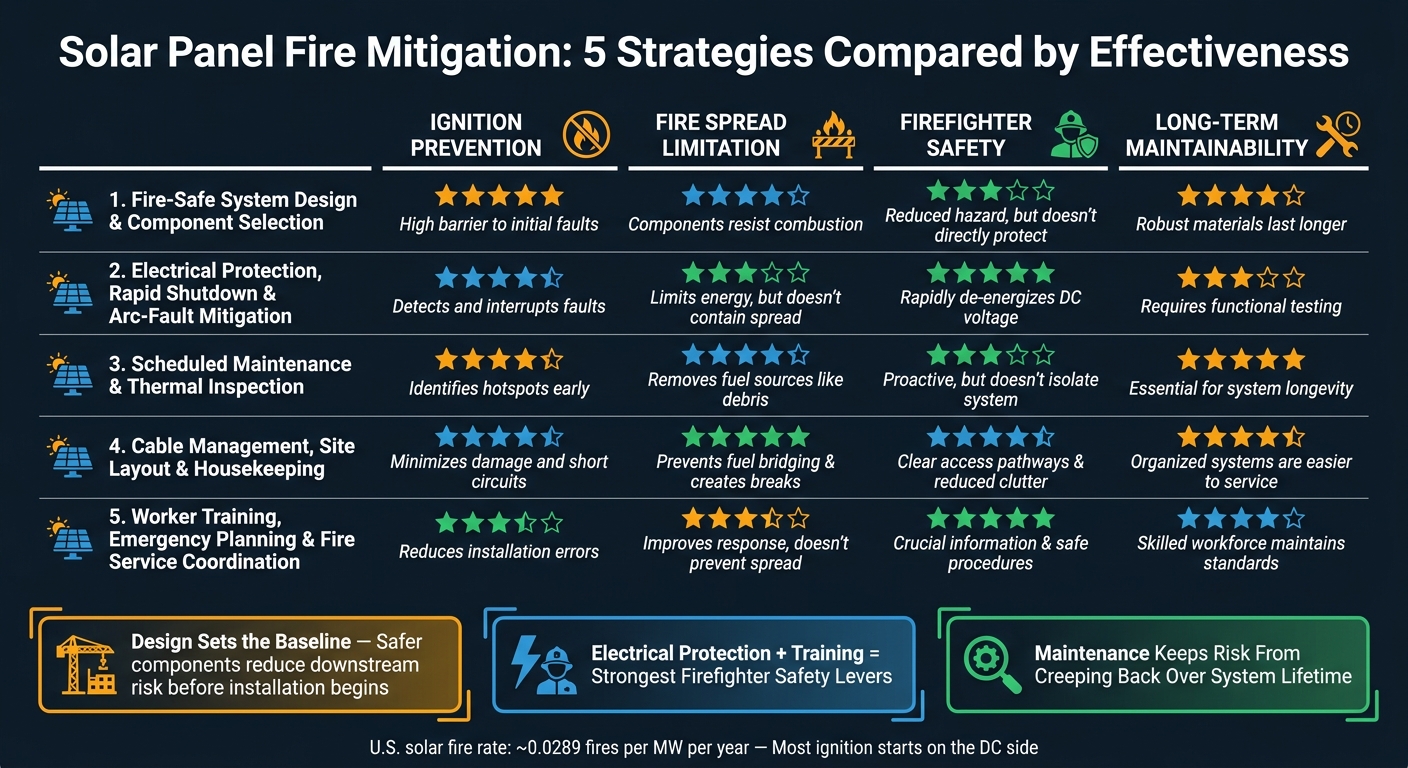
Solar Panel Fire Mitigation: 5 Strategies Compared by Effectiveness
The five controls work best as a system, not as one-off fixes. Put simply: one good move helps, but the stack is what keeps risk down over time.
Here’s how the five strategies compare across ignition prevention, fire spread limitation, firefighter safety, and long-term maintainability.
| Strategy | Ignition Prevention | Fire Spread Limitation | Firefighter Safety | Long-Term Maintainability |
|---|---|---|---|---|
| 1. Fire-Safe System Design & Component Selection | ★★★★★ – Highest impact; it reduces hazards at the source before installation begins | ★★★★☆ – Roof assembly choices and module spacing reduce spread potential | ★★★☆☆ – Safer layouts help, but design alone doesn’t address on-scene hazards | ★★★★☆ – Lower defect rates reduce future service burden |
| 2. Electrical Protection, Rapid Shutdown & Arc-Fault Mitigation | ★★★★☆ – Detects faults before they escalate into flame | ★★★☆☆ – Limits energized exposure, but it doesn’t control physical fuel | ★★★★★ – Rapid shutdown directly reduces live-circuit hazards for responders | ★★★☆☆ – Needs periodic testing and clear labeling to stay effective |
| 3. Scheduled Maintenance & Thermal Inspection | ★★★★☆ – Catches hot spots, loose connections, and insulation damage early | ★★★★☆ – Early detection keeps small defects from becoming array-wide events | ★★★☆☆ – Indirectly helps by reducing incident frequency | ★★★★★ – Built-in O&M schedules keep risk low over the system life |
| 4. Cable Management, Site Layout & Housekeeping | ★★★★☆ – Proper routing and debris removal cut fault initiation risk | ★★★★★ – Clear aisles, separation distances, and no combustible debris limit spread | ★★★★☆ – Access corridors and clear pathways improve on-scene navigation | ★★★★☆ – Consistent housekeeping is easy to sustain with routine O&M |
| 5. Worker Training, Emergency Planning & Fire Service Coordination | ★★★☆☆ – Hazard awareness and clear procedures reduce human error during installation and maintenance | ★★★☆☆ – Proper procedures help prevent accidental escalation during response | ★★★★★ – Pre-incident coordination and clear SOPs are the strongest firefighter safety lever | ★★★★☆ – Documented procedures and trained crews make inspections and incidents easier to manage |
Three patterns stand out.
Design sets the baseline. If the system starts with safer components, cleaner layouts, and better spacing, a lot of downstream trouble never gets a chance to start.
Electrical protection and worker training matter most for responder safety. That’s because they deal head-on with energized DC circuits that can stay live even after main disconnects are opened. For firefighters, that’s not a small detail. It changes how they move, where they cut, and what they can touch.
Maintenance keeps risk from creeping back in. Over the life of the system, hot spots, corrosion, and insulation damage can show up long after commissioning. That’s why scheduled inspection work does more than fix defects. It keeps small issues from turning into fire events.
Taken together, these controls reduce ignition risk, slow spread, and make emergency response safer.
Conclusion
These five controls work best as a layered defense. Solar PV fire risk can build over the life of a system, so the way to cut that risk is to stack protections together: safer design, electrical protection, routine inspection, clean cable routing and good housekeeping, and trained crews with clear emergency procedures.
That kind of layered setup also helps support compliance with key U.S. standards, including the National Electrical Code (NFPA 70) and Article 690 rapid shutdown rules, while cutting fire exposure.
Fire safety in solar is continuous work, not a one-time step.
FAQs
Which solar panel fire risks matter most?
Electrical faults and arc flashes are the biggest fire risks in solar panel installations. DC current makes this tougher because it doesn’t pass through a natural zero-crossing point. That means arcs are harder to stop once they start, and they can produce intense heat fast.
There are other big risk factors too. Installation mistakes like faulty wiring or loose connections can set the stage for trouble. Parts can also wear down from sun, rain, heat, and age. And because solar panels stay energized when exposed to light, maintenance work and emergency response become more complicated.
How often should a solar PV system be inspected?
There’s no single inspection interval listed here. Still, regular inspections matter because they help spot fire risks early, including faulty wiring, arc-flash risks, and wear caused by the surrounding environment.
A steady inspection schedule also makes the whole process easier to manage. When you document findings and track corrective actions, you support both safety and regulatory compliance.
Does rapid shutdown make solar panels fully safe?
No. Rapid shutdown helps protect emergency responders by bringing voltage down to safer levels within 30 seconds, but it does not make solar panels fully safe.
Solar modules still produce DC electricity any time light hits them. So even if the system seems to be off, shock and arc-flash hazards can still be there.
It also isn’t a substitute for verification, lockout/tagout, or other isolation steps during maintenance.


