
Fatigue on U.S. construction sites is a safety problem, not just a comfort issue. About 40% of construction workers deal with high fatigue, and severe fatigue is tied to 1.77x higher injury odds. If I had to sum up this topic in one line, it’s this: the best fatigue wearables use more than one signal, must fit the job and PPE, and only help when alerts lead to a clear supervisor response.
Here’s the short version:
- What they do: track body signals, movement, and sometimes heat strain
- What they measure: heart rate, HRV, EMG, skin temperature, gait, posture, and motion
- What works best: multi-sensor systems, not one metric alone
- Best device by job: wrist devices for broad use, vests/armbands for heavy labor, boots/insoles for gait, helmets for attention-sensitive roles
- Main limits: sweat, dust, vibration, poor fit, battery life, and weak jobsite connectivity
- What matters most: alerts need context, worker privacy rules, and a set action plan
A few key facts stand out:
- Fatigue-linked impairment has been tied to 9.6 incidents per 1,000 person-hours, vs. 0.8 for workers without impairment
- Overexertion makes up 33% of work-related musculoskeletal injuries in U.S. construction
- On many sites, 20% to 40% of craft workers go past accepted physiological limits during a shift
- Wrist heart-rate data can be less stable in the field, with one study showing 76.58% acquisition for heart-rate data vs. 86.55% for motion data
Improving construction worker safety with wearable sensors
sbb-itb-aa28329
Quick comparison
| Wearable type | Best use | Main signals | Main issue |
|---|---|---|---|
| Wrist wearables | General crews, supervisors | HR, HRV, motion | Heart-rate errors during heavy movement |
| Smart helmets | Equipment operators | EEG, temperature | Noise sensitivity, PPE fit checks |
| Biometric vests/suits | Lifting, hauling, repeat motion work | IMU, posture | Fit and sensor alignment |
| Forearm armbands | Tool-heavy work | EMG, IMU | Sweat and comfort over long shifts |
| Smart boots/insoles | Long walking routes, stance-heavy tasks | Gait, pressure, IMU | Uneven ground and boot fit |
| Patches/clothing | Heat strain, short-term checks | Skin temp, ECG, respiration | Single-use patches or wash needs |
If you’re choosing a system, I’d keep it simple: match the device to the task, check data quality on an active site, and decide in advance what happens when an alert fires. That’s the core of the article below.
What fatigue monitoring wearables are
Fatigue monitoring wearables are body-worn devices that track physiological, movement, and environmental signals in real time to spot rising fatigue risk. Unlike fitness trackers, these devices are built to flag safety risk, not just log activity. The next step is looking at which signals they measure and how those signals become alerts.
They can collect data such as heart rate, heart rate variability (HRV), skin temperature, electromyography (EMG) for muscle activity, and inertial measurement units (IMUs) for movement. When those data streams are combined, the device can form a better read on how a worker is holding up during a shift.
Fatigue vs. sleepiness vs. overexertion vs. heat stress
These risks often overlap on a construction site, but they are not the same. If you treat them as one problem, it’s easy to miss signals that matter.
Fatigue is a drop in performance and alertness after long periods of physical or mental work. Sleepiness comes from not getting enough sleep. Overexertion is physical strain from heavy or repetitive work, and it accounts for 33% of all work-related musculoskeletal injuries in U.S. construction. Heat stress comes from hot, humid conditions and may show up in skin temperature and heart rate readings.
On a long, hot shift, a worker may be dealing with more than one of these risks at the same time. That’s why watching a single metric often isn’t enough. In construction, those differences matter because site conditions can change how each risk appears.
Why construction needs its own monitoring approach
Construction sites are tough places for wearables to work well. Heat, vibration, noise, heavy labor, and limited connectivity can all interfere with sensor performance. Standard physiological sensors such as PPG can also be affected by light interference from the surroundings and by shifts in sensor placement during active movement.
PPE adds another layer of difficulty. Wearables need to fit into gear workers already use, and they need to work without touchscreens. Thresholds also need to match the task. The strain of hauling cement bags is not the same as bricklaying, so one-size-fits-all alerts can miss key changes.
On many job sites, 20% to 40% of craft workers exceed accepted physiological thresholds during a shift. That sets up the next section: how these wearables detect fatigue in the field.
How fatigue wearables work
The signals listed above only matter if software can turn them into a fatigue alert a worker or supervisor can use. That’s the job of fatigue wearables: they filter out noise, compare readings against a worker’s baseline, and flag changes that stick around long enough to suggest higher risk.
Physiological signals: heart rate, HRV, EMG, and skin temperature
Many wearables rely on photoplethysmography (PPG), which estimates heart rate by tracking changes in blood flow at the skin. From there, the system can monitor both heart rate and heart rate variability (HRV). Lower HRV is one of the signs used to flag fatigue risk.
Electromyography (EMG) tracks electrical activity in the muscles as fatigue builds. On active jobsites, that matters because EMG is less affected by heat and lighting than optical sensors. In plain terms, it gives the system another signal it can lean on when conditions get messy.
Skin temperature can also help, especially for spotting heat strain. But on its own, it doesn’t say much. It works best when the system reads it alongside other body signals.
Motion signals: accelerometers, IMUs, and actigraphy
On construction sites, movement is nonstop and rarely smooth. Because of that, motion data often shows fatigue earlier than heart-rate data.
Inertial Measurement Units (IMUs) pick up fatigue by detecting rougher, less controlled movement. A common way to measure this is through higher jerk values, or how sharply acceleration changes. Workers who are fresh tend to move in a smoother, more steady way. As fatigue builds, that control starts to slip.
Actigraphy looks at activity patterns over time and helps show when movement slows down or gets irregular during a shift. Research from VTT Technical Research Centre of Finland found that sensors placed on the pelvis and sternum capture the most meaningful fatigue-related motion data. For this use case, they performed better than sensors worn on the limbs.
"Fatigue adversely affects movement control and quality, therefore, demonstrating increases in the jerk values (with IMUs)." – Janne S. Keränen, VTT Technical Research Centre of Finland
Beyond jerk, some systems also use power spectral density analysis to spot shifts in movement frequency patterns.
Multi-sensor fusion and alert models
No single signal is dependable enough for a jobsite by itself, so most systems combine body data and motion data before sending an alert. One practical output is the Aerobic Fatigue Threshold (AFT). This calculation compares a worker’s real-time oxygen uptake with their maximum aerobic capacity. NIOSH recommends that average oxygen uptake during an 8-hour shift should not exceed 33% of a worker’s activity-specific maximum aerobic capacity.
From there, the system cleans the signal, compares it with a shift baseline, and issues alerts when risk goes up. Since the model checks live readings against that worker’s own baseline, the alert is tied to individual condition instead of a one-size-fits-all cutoff.
Those detection methods are built into wearables worn on the wrist, torso, feet, or clothing.
Wearable types used on construction sites
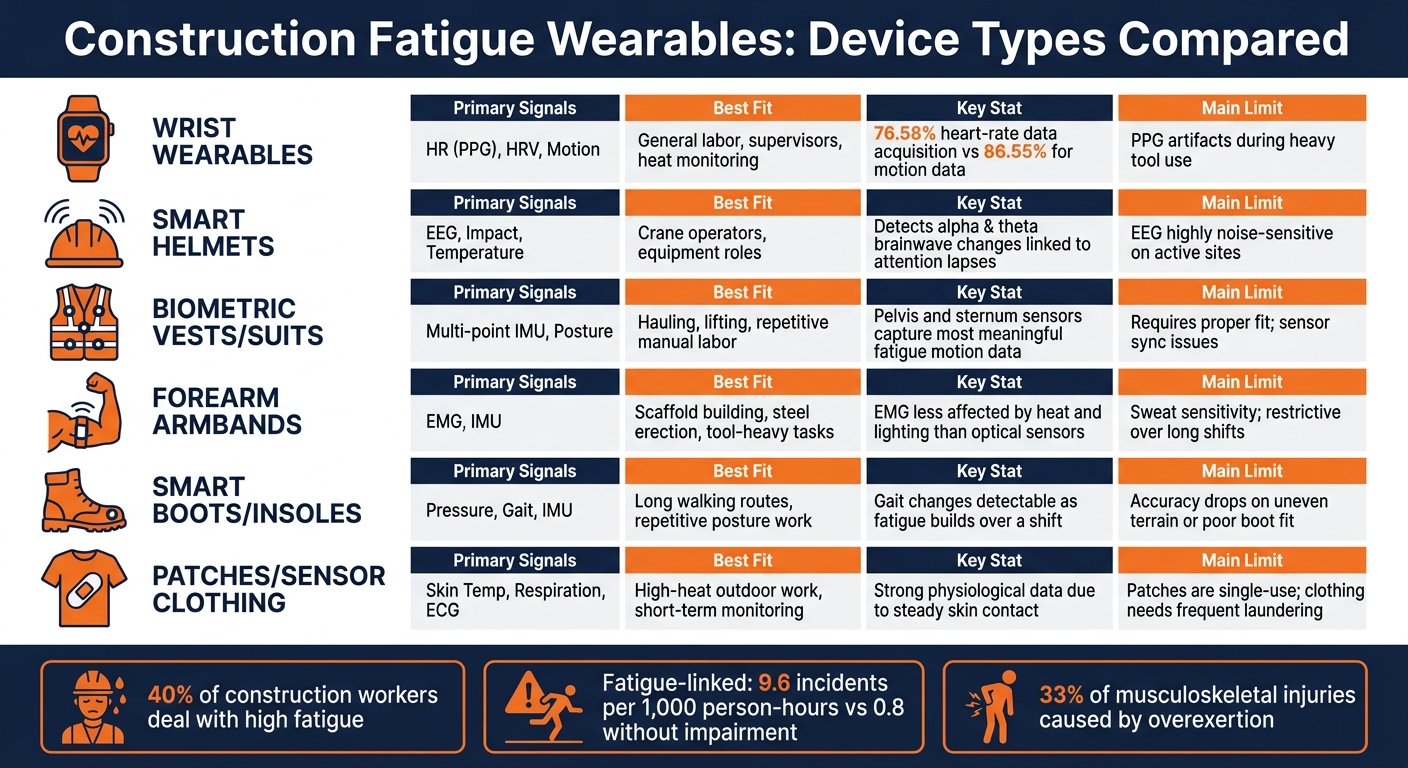
Construction Fatigue Wearables: Device Types Compared
The main job is simple: match each wearable to the task, the site conditions, and the PPE it has to live with. After that, you can line up the signals you want with the device types that still work on a busy jobsite.
Wrist wearables, helmets, and biometric vests
Wrist wearables are the easiest place to start. Most workers already know how to use them, and they’re usually fine with gloves if the device has buttons or a glove-friendly touchscreen. That makes them a practical pick for general labor and supervisors.
The catch is signal quality. In field studies, smartwatch heart-rate data acquisition averaged 76.58%, while accelerometer and gyroscope data averaged 86.55%. The main reason is motion artifacts and sensor displacement. Put bluntly, the wrist moves a lot, and that movement can throw off heart-rate readings.
Smart helmets make the most sense for equipment operators, especially crane operators, where even a brief drop in attention can matter. When EEG sensors are built into a hard hat, they can pick up changes in alpha and theta brainwave activity linked to lapses in attention.
There’s a catch here too. EEG is highly noise-sensitive, and active construction sites produce plenty of noise. Before using one, check hard hat rating compatibility.
The same logic carries over to torso, foot, and clothing-based devices: the best wearable is the one that fits the task and can hold up on site.
Biometric vests and suits place multiple IMUs directly into high-visibility PPE. They’re a good match for repetitive lifting, hauling, and other high-motion work. Once fitted the right way, they can work well. But fit matters a lot, especially when skin-contact sensors are involved. If the fit is off, the data can be off too.
Smart boots, insoles, sensor clothing, and patches
Lower-body wearables cover a blind spot that wrist and torso devices can miss. Smart boots and insoles track gait changes and ground-contact pressure. Those signals often shift as fatigue builds over a long shift. They fit workers who walk long routes across a site or stay in the same posture for hours.
Sensor clothing and patches can deliver strong physiological data because the sensors stay in steady contact with the body. Patches work well for short-term or specialized monitoring, like tracking heat strain during summer outdoor work.
The trade-off is upkeep. Patches are usually single-use, and sensor-embedded garments need frequent laundering. That adds time, cost, and hassle.
Device comparison table: best fit and limits
| Device Type | Primary Signals | Best Fit | Limits |
|---|---|---|---|
| Wrist Wearables | HR (PPG), HRV, Motion | General labor, supervisors, heat monitoring | PPG artifacts during heavy tool use; battery drain on long shifts |
| Smart Helmets | EEG, Impact, Temperature | Crane operators, equipment roles | EEG is highly noise-sensitive on active sites; PPE compatibility must be verified |
| Biometric Vests/Suits | Multi-point IMU, Posture | Hauling, lifting, repetitive manual labor | Requires proper fit; potential sensor synchronization issues |
| Forearm Armbands | EMG, IMU | Scaffold building, steel erection, tool-heavy tasks | Sweat sensitivity; can feel restrictive over long shifts |
| Smart Boots/Insoles | Pressure, Gait, IMU | Long walking routes, repetitive posture work | Accuracy drops on uneven terrain or with poor boot fit |
| Patches/Sensor Clothing | Skin Temp, Respiration, ECG | High-heat outdoor work, short-term monitoring | Patches are single-use; clothing needs frequent laundering |
One practical note on armbands: devices that combine EMG and IMU data can be a strong fit for roles like scaffold building and steel erection. In those jobs, arm load and movement patterns often give the clearest read on fatigue.
On site, the device itself matters less than one basic thing: whether the data stays accurate when the work gets messy.
Data accuracy, monitoring limits, and deployment in the field
Putting on a wearable is the easy part. Keeping its data usable through a full shift is where things get messy.
The main issue isn’t whether wearables can collect data. They can. The harder part is making sure that data stays reliable on a live jobsite, where dust, heat, motion, and long hours can throw things off.
What affects accuracy in the field
Construction sites are rough on sensors. A few common problems show up again and again:
- Sweat and dust can weaken sensor contact and reduce heart rate and EMG signal quality
- Vibration from heavy equipment can look like worker movement in accelerometer data
- Ambient light on outdoor sites can interfere with optical (PPG) sensors
- Fit shifts can cause IMU readings to drift
Jerk metrics are also sensitive to both sensor placement and the task being done. So if the device moves around or gets worn a bit differently from one shift to the next, the readings can change too.
Battery life adds another constraint. High-frequency logging can drain consumer-grade wearables before a 10- or 12-hour shift is over. In practice, that means teams should charge devices before the shift starts and limit tracking to active work hours.
Connectivity is another headache. Remote jobsites and underground areas often have Bluetooth dropouts. Devices with local storage help here because they can buffer data and sync later when the connection comes back.
Passive monitoring can show trends in real time, but it’s smart to pair that with brief check-ins at shift changes to confirm the signal still looks clean.
How construction teams roll out fatigue monitoring
Once teams understand the data limits, rollout should begin with the highest-risk roles and tasks. A practical first step is a risk assessment that shows which work needs the closest monitoring. That also helps with device selection and points to places where signal dropout is most likely.
After that, a small pilot crew makes sense. This gives teams room to test device fit, data acquisition rates, and worker comfort before scaling. During the pilot, supervisors should track which site conditions cause the most signal dropout, then adjust setup, placement, or workflow.
Before launch, teams also need to set thresholds and response steps. In plain terms, they need to decide:
- what fatigue score or physiological marker triggers a supervisor alert
- what action follows that alert
- how the intervention gets recorded
Without that part in place, alerts are just noise.
Connecting wearable data to workforce visibility and compliance
Once accuracy and rollout are handled, the next step is turning the data into action. Fatigue data only matters if someone uses it. When tied to a safety dashboard, a wearable alert can help with rest-break scheduling and support compliance records.
Privacy matters just as much as the data itself. Workers are generally more comfortable with motion-based IMU data than with continuous heart rate monitoring. Clear communication helps a lot here: what is being collected, who can see it, and how long it stays stored.
For multi-site contractors, ABLEMKR can connect fatigue status to certifications, safety training, availability, and location in one workflow – so a fatigued worker can be reassigned after checking training, availability, and location.
Conclusion: Choosing the right fatigue monitoring approach for construction
No single wearable works for every jobsite. After looking at signals, devices, and field limits, the choice comes down to fit. The device should match the risk: motion-based sensors for heavy manual work, EMG for high-effort tasks, and EEG for roles where attention lapses matter most.
The best alert systems use more than one signal, because no single metric is dependable by itself. Even then, a sensor can only flag a high-fatigue reading. It can’t tell you if the issue comes from hard physical work or from unsafe fatigue. The alert points to risk; the supervisor has to confirm the cause and decide what happens next. In practice, that makes the supervisor a key part of any rollout.
Deployment only works if the devices are comfortable, the data holds up through a full shift, and privacy rules are clear from day one. Heart rate, for example, may reflect task intensity more than fatigue state. That’s why alerts need context. The tech works best when it’s paired with fatigue-aware scheduling, hydration planning, and documented response steps that tell supervisors exactly what to do when an alert fires.
For multi-site contractors, fatigue data becomes much more useful when it connects to certifications, training, availability, and location. At that point, a safety alert can also shape a staffing decision. When fatigue data feeds staffing choices, safety and productivity can move together. ABLEMKR supports that visibility with mobile-first workforce matching and compliance tracking.
FAQs
How accurate are fatigue wearables on active jobsites?
Fatigue monitoring wearables can be highly accurate on active construction jobsites. Some studies report accuracy rates of up to 98.5%. Systems that use forearm muscle activity and motion data have reached 92.31% accuracy, which is better than old-school heart rate-based measures.
The reason is simple: fatigue isn’t just one thing. It shows up in different ways, and no single signal tells the whole story. That’s why the most dependable monitoring pairs objective sensor data with subjective assessments.
Which wearable type is best for my crew?
The best wearable comes down to what you’re trying to protect against.
Smartwatches are a solid fit for real-time tracking. They can monitor heart rate, movement, and self-reported input without much friction.
If the goal is a closer read on physical fatigue, forearm muscle activity sensors paired with motion tracking tend to be more precise. They give you a clearer picture of how hard the body is working.
IMUs are a common pick when cost and ease of use matter most. They’re often easier to add to work clothing, which makes them a practical choice on busy job sites.
There are also other tools in the mix, such as EEG sensors and devices that track visual cues or sleep patterns. In practice, the strongest systems don’t rely on just one signal. They combine physiological data with job site context so the feedback feels personal and useful – not just another stream of numbers.
What should happen after a fatigue alert?
After a fatigue alert, employers need to act right away to cut risk before something goes wrong. That can mean giving the worker a break so they can recover and reduce the odds of an accident tied to lower physical or mental function.
Over time, safety management systems should give personalized, task-specific feedback so each response better fits what the worker needs in that moment.


