
If you want to work in energy efficiency, the main tradeoff is simple: easier-to-enter jobs are more physical, while higher-paying jobs usually need more schooling, certifications, or time in the field. In 2023, this U.S. sector supported about 2.3 million jobs and added nearly 75,000 more, so there are paths for people coming from construction field staff roles, HVAC, engineering, data, and utility work.
Here’s the short version:
- Weatherization Technician / Home Performance Installer: fastest path in, often with a high school diploma, short training, and field work
- Building Energy Auditor / Home Energy Assessor: mix of site testing and report writing, often with BPI or RESNET credentials
- Building Automation System (BAS) Specialist: controls-focused work in commercial buildings, with HVAC, electrical, and IT skills
- Energy Efficiency / Building Engineer: degree-based path focused on design, modeling, and commissioning
- Energy Manager / Industrial Energy Efficiency Specialist: mid-career role focused on energy use, savings projects, budgets, and results
- Smart Grid / Demand Side Management Analyst: utility-side role centered on load data, programs, and grid planning
What stands out most is how each path fits a different kind of worker:
- If you like hands-on site work, start with weatherization or auditing
- If you like controls and troubleshooting, BAS work is a strong fit
- If you like design and modeling, engineering is the better lane
- If you like business, data, and project ownership, energy management makes more sense
- If you like utility data and grid programs, DSM analysis is the clearest match
Pay ranges also split pretty clearly:
- Field entry roles often start around $18 to $25 per hour
- Auditors and BAS specialists often move into the $45,000 to $90,000+ range
- Engineers, energy managers, and senior utility analysts can reach $100,000+
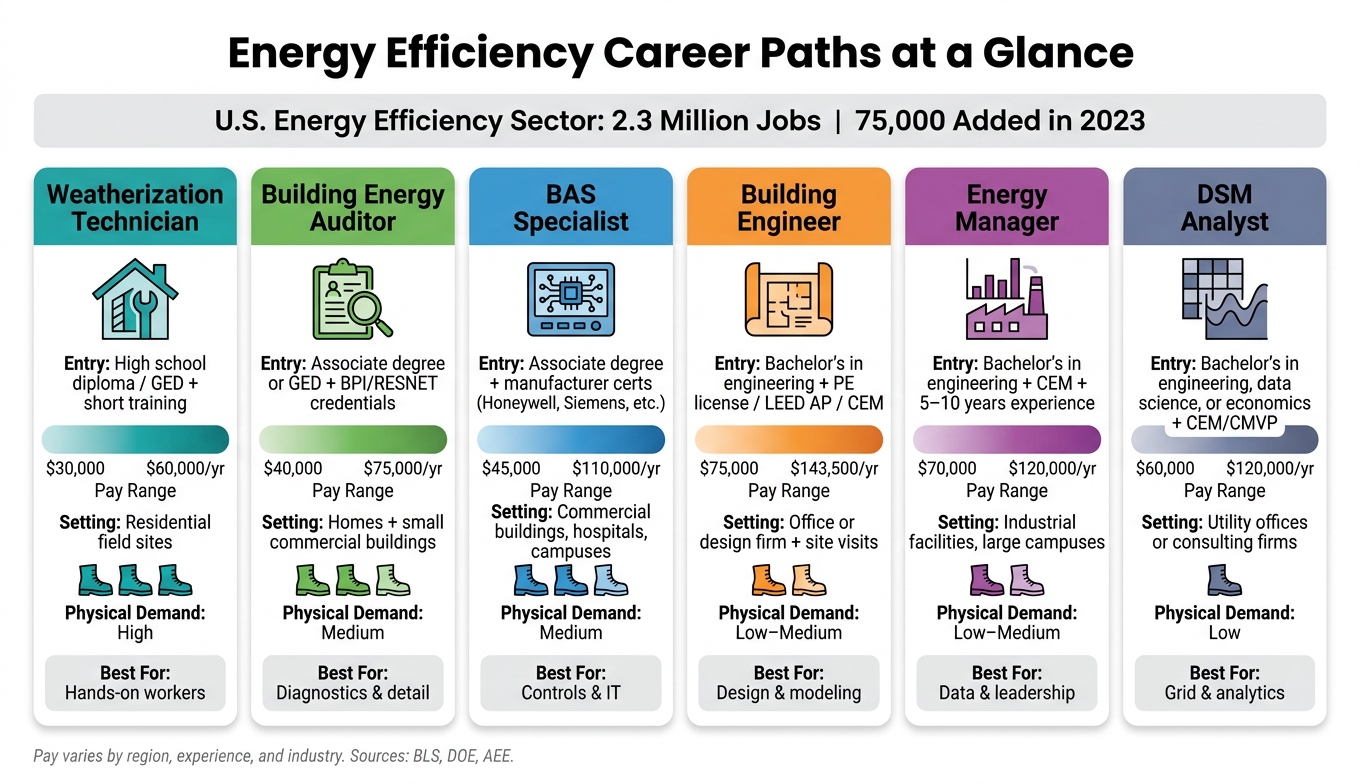
Energy Efficiency Career Paths: Pay, Entry Requirements & Growth
Kickstart Your Career in Energy Efficiency: A Practical Guide
sbb-itb-aa28329
Quick Comparison
| Role | Main Entry Point | Typical Work | Pay Direction |
|---|---|---|---|
| Weatherization Technician | High school diploma, short training | Physical field work in homes | Lower start, room to move up |
| Energy Auditor | Certificates plus field testing skills | Site visits + reports | Mid-range |
| BAS Specialist | HVAC/electrical training + controls skills | Building systems, programming, troubleshooting | Strong growth |
| Building Engineer | Bachelor’s degree | Design, modeling, commissioning | Higher ceiling |
| Energy Manager | Degree + years of experience | Data, projects, budgets, savings tracking | High mid-career pay |
| DSM Analyst | Degree + data skills | Utility programs, load analysis, reporting | High for analytics track |
Bottom line: I’d look at these roles less by title and more by the kind of day you want – field work, controls, design, data, or management. That usually tells you the best starting point faster than salary alone.
1. Weatherization Technician / Home Performance Installer
Weatherization is one of the fastest ways to get into hands-on energy work. You usually don’t need a college degree to start. Most people in this role have a high school diploma or GED, then learn through short, hands-on training.
Training Path
People often get started through WAP agencies, community groups, or community colleges that teach building science, insulation, and air sealing. A lot of these programs mix paid fieldwork with classroom learning, so you’re not stuck in a room all day. You learn by doing.
Some apprenticeship-style routes run for about 24 months and combine classroom instruction with supervised fieldwork. Common credentials include BPI Weatherization Installer/Technician, OSHA 10/30, and EPA RRP for older homes. That hands-on start can lead straight into auditing and quality-control work.
Salary Range
Entry-level pay usually falls between $17 and $22 per hour. More experienced crew leaders and specialists often make about $19.50 to $27.90 per hour. The BLS reports a $49,370 median annual wage for insulation workers, and the top 10% earn more than $78,000.
Pay tends to be higher in the Northeast and on the West Coast, where energy-efficiency incentives are stronger and construction wages are often higher.
Work Environment
This is field work, plain and simple. It’s physical, and some days can be rough around the edges. Expect attics, crawl spaces, basements, and other places that are hot, cold, cramped, or dusty. You’ll use diagnostic tools and insulation tools every day.
Standard gear includes respirators, coveralls, and eye protection. Most full-time jobs follow a Monday through Friday daytime schedule. You’ll usually work with a small crew and report to a crew leader or foreman. The same on-site diagnostic work you do here also builds the skills used later in audits and quality control.
Growth Potential
This role is a common first step in the Home Energy Professional path. From here, people often move into jobs like:
- Crew Leader
- Energy Auditor
- Quality Control Inspector
- Program Manager
- Contractor owner
The path usually moves from field work to certification, then into assessment and team oversight. Adding credentials like BPI Building Analyst or RESNET HERS Rater can help you move into diagnostic and assessment roles with more responsibility. Skills in HVAC, diagnostics, and digital job tracking can also help you move up over time.
That path leads straight into the next role: building energy auditing.
2. Building Energy Auditor / Home Energy Assessor
Building energy auditors figure out where a home or commercial building is wasting energy and which fixes are worth doing first. They sit in the middle of two worlds: part field work, part building-systems work. In practice, that means inspecting buildings, running tests, and recommending upgrades that can cut utility bills and make the space feel better to live or work in.
Training Path
For residential work, many auditors start with a high school diploma or GED and then add short training plus credentials like BPI Building Analyst, BPI Energy Auditor, or RESNET HERS Rater. If you want to move into commercial projects, an associate’s or bachelor’s degree in engineering or a related field can help, especially when paired with higher-level credentials such as ASHRAE BEAP.
There’s also a formal apprenticeship route. The Department of Labor offers a standard for this role that covers 2,000–3,350 hours of classroom and field training.
Salary Range
Pay usually falls between $45,000 and $80,000+, with higher pay in utility, consulting, and commercial roles.
Work Environment
This job mixes hands-on testing with desk work. On site, you might use a blower door, infrared camera, combustion analyzer, and duct leakage tester while working in attics, crawl spaces, and mechanical rooms. Off site, you’ll write reports, run energy models, and turn raw test results into clear next steps.
A big part of the role is communication. You’re not just finding problems – you’re helping clients understand what to fix first and why it matters.
Growth Potential
A common path starts with entry-level auditor and can move into senior auditor, QA reviewer, program manager, energy consultant, or commercial building performance specialist. People who spend time in commercial buildings or get good at energy modeling often move up sooner.
The BPI Energy Auditor credential shows how that next step works. Before you can sit for the exam, you need at least 1,000 hours of related field or technical work from the last five years, plus completion of 10 energy models or similar energy modeling training. That background can lead into commercial assessment, energy modeling, commissioning, or sustainability roles.
This mix of diagnostics and reporting also connects well to BAS work, where controls and building systems become the main focus.
3. Building Automation System (BAS) Specialist
A building energy auditor spots what’s going wrong. A BAS specialist gets inside the control system and fixes it.
These specialists program and maintain the controls that run HVAC, lighting, and ventilation in commercial and institutional buildings. Common platforms include Siemens Desigo, Tridium Niagara, and BACnet-based systems. When a BAS is tuned well, it can cut facility energy use by double digits. That’s why this job sits near the center of building performance work.
Training Path
Most employers look for an associate degree or certificate in HVAC technology, electrical technology, or building automation, along with 1–3 years of field experience. Some more advanced public-sector roles ask for 3–6 years.
A lot of people build skills through training from companies like Johnson Controls, Honeywell, Siemens, and Trane. Job postings also often mention certifications such as:
- Tridium Niagara N4
- BACnet fundamentals
- Certified Control Systems Technician (CCST)
If you want to move toward energy management, the Certified Energy Manager (CEM) is a common next step once you have at least three years of related experience.
Salary Range
Entry-level jobs usually start around $45,000–$54,000. Mid-career specialists often earn $70,000–$90,000, while senior specialists can reach $110,000–$140,000+. Building automation engineers, who take on design work and project leadership, average close to $99,000 per year.
Work Environment
This job mixes hands-on fieldwork with desk work. On site, you might be in mechanical rooms, on rooftops, or inside electrical closets commissioning controllers, calibrating sensors, and troubleshooting system issues. Off site, you’re programming control sequences, reviewing trend data, and building graphics from a computer. Controls contractors often travel across a region, while in-house specialists usually stay on one campus.
BAS work also has a strong IT side. You need solid knowledge of IP networking, communication protocols like BACnet, Modbus, and LonWorks, and Windows-based environments. That sets this role apart from weatherization or auditing. BAS work happens at the system level and ties directly into a building’s IT setup.
You’ll also spend a lot of time coordinating with other people. HVAC technicians, electricians, IT staff, and facility managers all have a piece of the puzzle, so clear communication matters just as much as technical skill.
Growth Potential
The path often moves from technician to senior BAS specialist to controls engineer, and then into roles like energy manager or building performance specialist. People who work with complex facilities – such as hospitals, data centers, and large campuses – and build strong programming and integration skills often move up faster.
Demand is growing as more buildings add smart systems, IoT controls, and grid-interactive efficient building setups, especially in major metro areas and places with heavy energy use. That controls background can also open the door to engineering work, where energy performance is built in from day one.
4. Energy Efficiency / Sustainable Building Engineer
A BAS specialist tunes systems that are already in place. An energy efficiency engineer takes a different angle: they help shape building performance from day one. That puts the role right where engineering, sustainability, and building performance meet, with work spanning HVAC, lighting, building envelopes, controls, and some renewable integration.
Day-to-day work often includes energy modeling, load calculations, designing energy-saving measures, and checking whether the projected savings show up in practice. These engineers usually work side by side with architects, facility managers, contractors, and utility program teams on high-performance buildings, retrofits, and campus decarbonization projects. That design-first approach is the main thing that separates this path from the controls roles covered above.
For people moving into this role from the field or from controls work, the biggest shift is education. In most cases, a bachelor’s degree in mechanical, electrical, or architectural engineering is the standard entry point. Many then go on to earn a Professional Engineer (PE) license, especially when stamped designs are part of the job in U.S. commercial and industrial markets.
The Certified Energy Manager (CEM) from the Association of Energy Engineers is widely seen as the top credential for this path. It covers audits, HVAC, building automation, verifying savings, and performance contracting. CEM eligibility usually calls for a 4-year engineering degree plus 3–5 years of energy-related experience. Other common add-ons are LEED AP, CMVP, and ASHRAE’s HBDP.
Pay reflects both the technical side of the job and the range of project types involved. Entry-level engineers often start around $65,000–$75,000 in many U.S. markets. Typical compensation falls near $80,000 to $100,000 per year, while senior energy engineers often make $104,000–$143,500. In high-cost, high-demand areas like California and major tech hubs such as San Jose, pay can go beyond $120,000 and climb to $200,000 in high-cost markets.
The work itself centers on design, modeling, commissioning, and site verification for commercial, campus, or industrial projects. In consulting firms or ESCOs, engineers often travel within a region to run audits, oversee commissioning, and verify savings at client sites. In industrial roles, the setting can shift to factories or refineries, working alongside operations teams where PPE and safety protocols are part of the daily routine.
Career growth usually moves from entry-level engineer to senior energy engineer, then into project manager or director of energy and sustainability roles at corporations, universities, healthcare systems, or public agencies. Engineers who pair strong technical depth with project management skills and a solid grasp of policy often move up faster. Demand is growing as building energy codes get tighter, companies push toward net-zero goals, and more buildings are expected to respond to utility signals. Engineers who add smart building analytics and advanced controls knowledge can find more openings in both new construction and large retrofit programs. From there, the next move often leads into operational leadership in energy management.
5. Energy Manager / Industrial Energy Efficiency Specialist
This role runs an organization’s energy program from end to end: tracking energy use, spotting savings, managing projects, and reporting results to leadership. You’ll find it in manufacturing plants, hospitals, universities, large commercial portfolios, and municipal governments. Unlike the engineering roles above, this one is less about designing a single project and more about owning results over time.
Training Path
Most people move into this role after working in analysis, engineering, commissioning, or BAS. A bachelor’s degree is common, usually in mechanical, electrical, industrial, or environmental engineering. Construction management and facilities management also show up often, especially in building operations and retrofit work.
The main credential here is the CEM. For plant-focused roles, some people also add CIEP, which centers on facility-level energy management systems and audits.
Salary Range
In the U.S., Energy Manager roles usually pay about $69,000 to $139,000. Managers with more experience, especially those handling large or multi-site portfolios, often land in the $80,000 to $100,000+ range.
Pay tends to run higher in industrial sectors like oil and gas, utilities, and high-tech data centers than in smaller commercial or municipal roles. That’s mostly because the energy spend is larger and the operations are more complex. Some employers also offer performance bonuses tied to verified savings or sustainability targets.
Work Environment
This is a mix of desk work and field work. On the desk side, Energy Managers review data from building automation systems and utility portals, track KPIs, and prepare reports and presentations for leadership. They also build financial models, manage budgets and contracts, and document project savings. In plain English: they turn raw data into action plans and measured results.
In the field, they handle site inspections and energy surveys, watch industrial processes, and coordinate contractors during retrofits. In industrial settings, PPE and safety procedures are standard, and working with safety managers is part of the job.
Growth Potential
The upside here is easy to see in the numbers. DOE analysis of ISO 50001-certified U.S. manufacturing facilities found average energy cost reductions of 12% within 15 months, with annual savings ranging from $36,000 to $938,000 per facility.
Results like that help make the case for the role inside an organization. They also create a path into jobs like Senior Energy Manager and then Director of Energy Management or Sustainability, where the work often expands into ESG reporting, carbon strategy, and renewable energy procurement.
People usually move up faster when they:
- earn certifications
- lead high-visibility projects
- build strong business communication skills
That portfolio-level focus leads next to grid-facing roles shaped by utility programs and demand response.
6. Smart Grid / Demand Side Management Analyst
The earlier roles leaned toward buildings and day-to-day operations. This path shifts to the utility side of energy use.
Smart Grid and demand-side management (DSM) analysts work with load data to shift when electricity gets used, not just how much gets used. Put simply, the job moves from lowering demand inside a building to managing load across the grid. The main work includes designing and reviewing demand response and efficiency programs, plus helping with smart grid projects like advanced metering infrastructure (AMI) rollouts and DER integration.
Training Path
A bachelor’s degree in engineering, economics, statistics, data science, or environmental science is the usual starting point. A master’s in energy systems, public policy, or data analytics can help, especially in roles with a lot of policy work.
On the skills side, employers usually expect strong Excel, SQL, and Python or R skills, along with Tableau or Power BI. Knowledge of program cost-effectiveness tests, M&V protocols, and state public utility commission (PUC) processes often comes from doing the work itself. Certifications like CEM and CMVP – Certified Measurement & Verification Professional – are well known in this field and can make your background look stronger.
Salary Range
Pay usually falls between $60,000 and $130,000+, with senior analysts often earning $90,000 or more.
Work Environment
Most of these jobs are office-based, and many come with hybrid or remote options. In a normal week, an analyst might:
- analyze interval meter data
- build load forecasts
- prepare regulatory reports
- coordinate with operations and customer teams
Field visits happen from time to time, but they’re not the main part of the role.
Growth Potential
Analysts with strong quantitative skills often move into senior analyst, program manager, or portfolio manager roles. In those jobs, they may oversee utility DSM portfolios, budgets, vendor contracts, and regulatory filings.
There’s also room to move into forecasting or risk modeling within utilities or energy tech. The DOE’s 2020 Smart Grid System Report points to data scientists, modeling and simulation experts, and communications engineers as key emerging skill sets for the modern grid, which gives this path solid long-term staying power. It’s also the most grid-facing role in this article, which makes it a useful point of comparison when looking at training, pay, and day-to-day work.
That contrast shows up more clearly in the side-by-side comparison below, where it’s easier to line up training, pay, and work setting.
Training, Pay, Work Setting, and Advancement: A Side-by-Side Look
This side-by-side view makes the tradeoffs easier to see: how tough each role is to break into, what it tends to pay, and where it can lead.
The contrast stands out fast once the jobs are lined up next to each other.
These are approximate salary bands. Actual pay varies by region, experience, and industry.
| Role | Entry Requirements | Entry-Level Pay | Mid-Career Pay | Typical Setting | Demand |
|---|---|---|---|---|---|
| Weatherization Technician / Home Performance Installer | High school diploma or GED; OSHA-10/30; state or utility weatherization credentials | $30,000–$40,000 | $40,000–$60,000 | Residential and small commercial job sites | Strong; driven by retrofit programs |
| Building Energy Auditor / Home Energy Assessor | Associate degree in construction technology, HVAC, or building science; BPI Building Analyst; RESNET HERS Rater | $40,000–$50,000 | $55,000–$75,000 | Homes and small commercial buildings | Good; tied to utility incentive programs |
| Building Automation System (BAS) Specialist | Associate degree in electrical technology or HVAC controls; manufacturer certifications (Honeywell, Siemens, Johnson Controls); NICET; low-voltage electrical licensing | $45,000–$60,000 | $80,000–$110,000 | Commercial buildings, campuses, hospitals, and industrial facilities | Strong; smart-building upgrades expanding |
| Energy Efficiency / Sustainable Building Engineer | Bachelor’s in mechanical, electrical, civil, or architectural engineering; PE license; LEED AP; CEM; ASHRAE-related qualifications | $75,000–$90,000 | $100,000–$143,500 | Office or design firm, with site visits | Very good; decarbonization driving demand |
| Energy Manager / Industrial Energy Efficiency Specialist | Bachelor’s in engineering, industrial technology, or energy management; CEM; Certified Energy Auditor; ISO 50001 lead auditor | $70,000–$80,000 | $90,000–$120,000 | Industrial facilities, factories, refineries, and large campuses | Very good; central to corporate energy strategy |
| Smart Grid / Demand Side Management Analyst | Bachelor’s in electrical engineering, data science, economics, or energy policy; CEM; CMVP; PMP or similar project management certification | $60,000–$75,000 | $85,000–$120,000 | Utility offices or consulting firms | Strong; grid modernization accelerating |
Pay and schooling matter, but day-to-day work matters just as much. That’s where a lot of people realize one path fits and another doesn’t.
Physical demands ease up as you move from field-heavy jobs into controls, engineering, and analysis. Weatherization is the most hands-on, with attics, crawl spaces, and ladder work baked into the day. Auditors split time between site inspections and desk work. BAS specialists and engineers move between mechanical rooms or job sites and computer screens. Energy managers may spend time on production floors, but most of their work is analytical. DSM analysts are mostly desk-based.
The clearest career path starts in the field and moves up from there. A weatherization technician who adds a BPI Building Analyst or RESNET HERS Rater credential can often step into auditing within 6 to 12 months. From there, coursework in HVAC controls or electrical systems, paired with a manufacturer certification, can open entry-level BAS roles.
That BAS step matters more than it may seem at first glance. It gives people hands-on exposure to systems, controls logic, and building operations. Then, if they go on to earn a CEM or finish an engineering degree, they’re in a strong spot to move into energy engineer or energy manager roles. Field time helps here. It gives design and strategy work some grounding, because the person has already seen what happens on actual job sites.
Energy manager roles usually come later. Most people land there after 5 to 10 years in maintenance, process engineering, or facilities work, so this is usually a mid-career move rather than a first job.
Those differences lead straight into the pros and cons of each path below.
Pros and Cons of Each Career Path
After training, pay, and work setting, fit becomes the main filter. Every path has tradeoffs, and those tradeoffs show up in everyday work.
This table compares the day-to-day upsides and downsides that matter most.
| Role | Pros | Cons | Best For | Typical Next Step |
|---|---|---|---|---|
| Weatherization Technician / Home Performance Installer | Fast entry into the field; no 4-year degree required; solid entry pay; direct, visible impact on household energy bills | Physically demanding – attics, crawlspaces, heat, cold, and PPE all day; work tied to program funding cycles; limited ceiling without additional credentials | People who prefer hands-on field work over desk jobs and want to help households directly | Crew leader, building energy auditor, HVAC technician, or residential energy program coordinator |
| Building Energy Auditor / Home Energy Assessor | Moves easily into modeling, consulting, or utility programs; flexible schedule; nationwide demand; strong impact on utility bills and home comfort | Frequent site travel; work in tight or dusty spaces; requires strong customer-service skills; ongoing code and program updates | Detail-oriented problem-solvers who enjoy a mix of fieldwork, diagnostics, and client interaction | Senior energy auditor, energy modeler, energy efficiency consultant, or utility/state program manager |
| Building Automation System (BAS) Specialist | Strong earning potential; steady demand since buildings always need controls; useful for workers who want both controls and systems work | Requires cross-disciplinary HVAC and IT skills; frequent site work; ongoing certification upkeep | Workers who like both controls and troubleshooting | BAS programmer, BAS engineer, BAS project manager, or energy/controls specialist |
| Energy Efficiency / Sustainable Building Engineer | Highest advancement potential; direct influence on large commercial or institutional projects; opportunities to lead design and retrofit strategies | Formal engineering credentials required; high responsibility for code-compliant design; tight deadlines and complex stakeholder coordination | Analytically minded individuals with engineering degrees who want a strategic design role | Senior engineer, sustainability director, or principal engineer leading integrated design teams |
| Energy Manager / Industrial Energy Efficiency Specialist | High accountability, high visibility; ability to drive substantial cost savings and emissions reductions across operations | Pressure to deliver measurable savings while production uptime stays the priority; travel to industrial sites; resistance from operations staff is common | Data-driven leaders who can work with operations teams | Corporate energy director, ESG/sustainability leader, plant manager with energy responsibilities, or industrial efficiency consultant |
| Smart Grid / Demand Side Management Analyst | Best suited to data-heavy, utility-facing work; strong long-term demand | High-pressure during grid events or program launches; complex regulatory landscape; constant upskilling required | Analytical workers who like utility programs and data | Senior DSM analyst, program manager, integrated resource planning analyst, or roles in regulatory affairs or product management |
There’s a pretty clear pattern here.
The roles with the lowest barriers to entry – weatherization and auditing – also tend to be the most physically demanding. You’re in attics, crawlspaces, basements, and on the road. If you like active, hands-on work, that may feel like a good trade.
At the other end, the roles with the highest pay and the most influence – energy manager, BAS engineer, and sustainable building engineer – usually call for more experience, more training, or formal credentials. The work is often less about doing the install and more about planning systems, managing people, reading data, and being accountable for results.
Conclusion
The pattern is pretty straightforward: jobs with easier entry tend to involve more physical work, while jobs with higher pay tend to ask for more training, licenses, or formal credentials. Energy efficiency is a large and growing U.S. job market, and it offers more than one way in – from field work to engineering to grid analytics.
Your background shapes the fastest path. Field roles are usually the simplest to enter. BAS, engineering, energy management, and DSM roles tend to pay more as your credentials and experience grow. If you come from electrical, HVAC, or controls work, you may be in a strong spot for BAS specialist or energy manager roles. If you have a degree in engineering, data, or business, you’re often a better fit for sustainable building engineering, energy management, or smart grid analysis.
These paths also map to different ways of working. Some roles focus on field crews. Others lean into diagnostics, controls, engineering, operations, or utility analytics. The better move is to match the job to the kind of work you want to do – hands-on field work, controls, design, data, or management.
Choose the route that fits where you’re starting, then add the next credential with a clear goal in mind.
FAQs
Which energy efficiency job is best for beginners?
For beginners, solar photovoltaic installer is often a solid place to start. The role usually doesn’t call for much formal schooling, gives you hands-on work from day one, and can open the door to crew lead or supervisor jobs later on.
Other entry-level paths include roustabouts, power plant laborers, and apprenticeships. These jobs usually train you on the job, and apprenticeships also mix in classroom instruction while paying about $35,000 to $40,000 per year.
Can I move from field work into higher-paying roles later?
Yes. Energy efficiency can lead from entry-level field roles to better-paid specialist or leadership jobs. A common path starts with an installation technician role, then moves into supervision, and later into project management or consulting.
In most cases, growth comes from a mix of hands-on experience, well-known industry certifications like NABCEP or PMP, and technical skills in areas such as SCADA, grid modernization, or energy efficiency auditing.
What certifications matter most for career growth?
In energy efficiency, certifications help prove your skills and can help you move up. For entry-level and field roles, OSHA 10 or 30 matter because they cover jobsite safety and compliance. In solar, many professionals put NABCEP near the top of the list.
If you’re aiming for leadership roles, CEM carries a lot of weight. Project managers often go after PMP, while LEED AP can be a smart pick for green building work and day-to-day efficiency efforts. In many cases, these credentials can support salary growth of 15% to 25%.


