
If I had to boil this down to one rule, it’s this: use containment first, cleanup second. Pads and granular absorbents help finish the job, but berms, socks, pans, and recovery tools are what keep a small spill from turning into a site problem.
Here’s the short answer:
- For small spills under 5 gallons, I’d look at portable spill kits, pads, socks, and disposal bags.
- For 5 to 50 gallons, I’d add berms, pans, and pumps.
- For damaged drums or leaking containers, I’d use overpack drums.
- For wet outdoor fuel areas, oil-only kits and socks make more sense than universal absorbents because they repel water.
- For acids, bases, solvents, or unknown liquids, I’d switch to hazmat kits with the right PPE and disposal supplies.
- For fixed drip points, I’d use low-profile pans.
- For large pooled liquid after containment, I’d use pumps first, then pads or granulars for what remains.
A few numbers make the choice easier:
- Small bag spill kits often handle 4 to 7 gallons
- Wheeled kits can reach 41 to 82 gallons
- Foldable berms can hold 179 to 4,488 gallons
- A single heavyweight pad can absorb about 30 oz.
- A 100-gallon spill may need 100 to 150 pads or about 20 to 25 bags of granular absorbent
- Battery transfer pumps can move up to 12 GPM
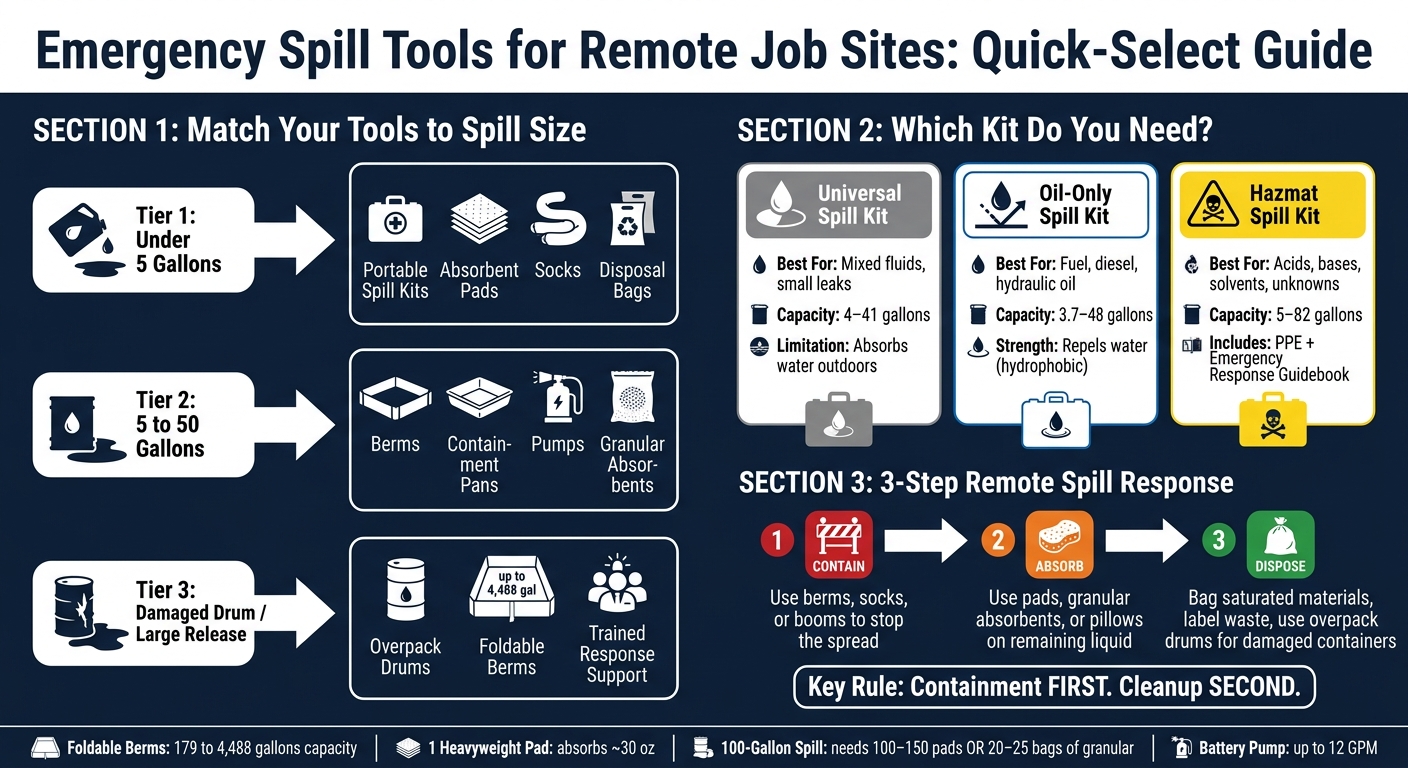
Emergency Spill Tools for Remote Job Sites: Quick-Select Guide
Spill Response Training | 7 Steps to Spill Cleanup
sbb-itb-aa28329
Quick Comparison
| Tool | Best use | Main strength | Main limit |
|---|---|---|---|
| Universal spill kits | Mixed fluids, small leaks | Easy to store in trucks | Soaks up water outdoors |
| Oil-only spill kits | Fuel, diesel, hydraulic oil | Works better in rain and puddles | Not for chemical spills |
| Hazmat spill kits | Acids, bases, solvents, unknowns | Built for chemical response | Higher cost, fluid-specific |
| Foldable berms | Large temporary containment | Holds from 179 to 4,488 gallons | Needs space and ground prep |
| Low-profile pans | Drips and short transfers | Good under fixed leak points | Not for large releases |
| Absorbent pads | Final surface cleanup | Fast to deploy | Big spills burn through stock fast |
| Absorbent socks | Perimeter control | Helps stop spread early | Doesn’t remove pooled liquid |
| Granular absorbents | Pooled liquid on rough ground | Works on gravel and soil | Heavy and labor-intensive |
| Hand pumps | Small liquid recovery | Works without power | Slow for larger volumes |
| Battery pumps | Faster liquid transfer | Up to 12 GPM | Must match pump to fluid |
| Overpack drums | Leaking containers | Seals damaged drums for transport | Used after isolation, not first response |
| Funnels and disposal gear | Waste handling | Helps seal, label, and load out | Only helps after recovery starts |
So if I’m planning a remote site, I’m not asking, “What spill kit should I buy?” I’m asking:
- What liquid is on site?
- How far is the crew from resupply?
- How big could the spill get?
- Can we contain it before we start cleanup?
That’s the frame I’d use for the rest of the article.
1. Universal Portable Spill Kits
Universal portable spill kits are the go-to first-response option when you need one kit for mixed fluids. They can handle oils, coolants, solvents, and water-based liquids, and they’re easy to move from place to place. They also cover basic compliance needs, which makes them a solid starting point for judging portability, cleanup speed, and response readiness.
Portability
For remote jobs, the easiest kits to carry usually come in soft-sided nylon or PVC bags with shoulder straps. That matters when one person has to move the kit hands-free across rough ground. Some models weigh just 4.6 lbs and still absorb more than 4 gallons.
For trucks and service vehicles, compact bag kits around 18" x 24" fit well behind a seat or inside a utility compartment. Yellow bags also stand out better in low light or messy cabs, which can save time when every minute counts.
Containment Capacity
Capacity changes a lot based on kit size. Small bag kits usually hold enough absorbents for 4–7 gallons, which is enough for most minor equipment leaks. Larger wheeled bins can handle up to 41 gallons for bigger spills.
A full kit should include socks, pillows, and pads so you can both contain the spill and clean it up. That mix gives you more control instead of forcing you to do everything with pads alone. A large sock can hold up to 4.15 gallons, while a standard pillow absorbs about 2 gallons.
Surface and Spill Fit
Universal kits are made to deal with different spill patterns and work surfaces. That’s a big deal because spills rarely spread in a neat circle.
High-performance absorbent pads often use 3-layer SMS polypropylene, which gives faster uptake and better tear resistance than economy pads. And when a spill runs around equipment feet, edges, or uneven ground, flexible socks in lengths from 48" to 144" can be shaped to follow the spill path.
Compliance Support
A spill kit isn’t complete if it only includes absorbents. PPE and disposal supplies matter too. Look for kits that include:
- Chemical-resistant nitrile gloves
- Polycarbonate safety goggles
- Heavy-duty 3-mil polyethylene hazmat disposal bags for used absorbents
These parts help support OSHA 1910.22(a) and EPA 40 CFR 112.7(c). Some lower-cost kits leave out PPE, and that can leave a gap in your response setup.
| Kit Format | Capacity | Portability | Approx. Price |
|---|---|---|---|
| Nylon/PVC Bag | 4–7 gallons | Shoulder strap, under 5 lbs | $60–$200 |
| 5-Gallon Bucket | 5 gallons | Handle, stackable | ~$63 |
| Wheeled Bin | 41 gallons | 4-wheel dolly | ~$750 |
Universal kits are the baseline option. From there, the next categories narrow the choice based on fluid type and hazard level.
2. Oil-Only Portable Spill Kits
If your remote site mainly handles diesel, hydraulic oil, or fuel, an oil-only kit is usually a better pick than a universal kit. The big difference comes down to water-repelling absorbents. These materials are made to pull in oil and fuel, not water.
That matters a lot outdoors. Rain, mud, and puddles can eat up a universal kit fast because it soaks up standing water before it even gets to the leak. An oil-only kit skips the water and goes straight after the contaminant. For wet, outdoor fuel-handling areas, that makes it the better match.
Portability
Most oil-only kits come in high-visibility yellow bags made for fast deployment. They’re compact enough to stash in a truck cab or an equipment compartment, which is a big deal when time is tight.
Even a typical economy bag kit can absorb about 3.7 gallons of fluid. If you need more capacity, wheeled container kits can scale up to roughly 48 gallons.
Keep oil-only kits within arm’s reach of fuel points, service trucks, and maintenance areas.
Containment Capacity
These kits usually include oil-only pads for surface absorption and oil-only socks for perimeter control. Pads handle the spill itself, while socks help stop it from spreading.
Small truck kits start at around $43, while larger cart-style units can cost more than $1,500.
Compliance Support
Store kits at fuel trailers, tank access points, and containment barriers to help meet EPA SPCC availability requirements.
| Feature | Oil-Only Kit | Universal Kit |
|---|---|---|
| Water Interaction | Repels water (hydrophobic) | Absorbs water (hydrophilic) |
| Best Environment | Outdoors, remote sites, wet weather | Indoor shops, dry environments |
| Primary Fluids | Fuel, diesel, hydraulic oil | Water, coolants, solvents, oils |
When the spill involves corrosive or toxic chemicals instead of oil, switch to hazmat-specific tools.
3. Hazmat and Chemical Spill Kits
Use hazmat kits for acids, bases, solvents, and unknown chemicals. Universal or oil-only absorbents aren’t made for these spills. Hazmat kits are usually color-coded yellow and built for corrosive or reactive chemicals. That matters most when chemical risk, movement across the ground, and disposal rules all hit at the same time.
For remote crews, speed is the whole game. The main question is simple: can the kit get to the spill fast enough to keep it from spreading?
Portability
Truck-style poly bags hold 5 to 7 gallons and fit in a cab or on a forklift. HDPE wheeled bins hold about 41 gallons and work well for outdoor storage because the construction resists UV exposure. Mobile carts go up to 82 gallons for larger releases.
Terrain matters more than people think. On gravel or uneven ground, 8-inch pneumatic wheels move better than 5-inch wheels, which are better for smooth indoor floors. Place kits near vehicle storage points and fuel areas so crews don’t have to cross rough ground on foot before they can act.
Containment Capacity
A bin kit usually combines pads, socks, and pillows to stop the spread and soak up pooled liquid. A standard kit includes 40 absorbent pads, multiple 3-inch socks up to 143-7/8 inches, and several absorbent pillows.
That mix gives crews some flexibility in the field. Socks can bend around uneven surfaces, which helps on remote terrain. And this is where hazmat-rated parts stand apart: yellow hazmat pads are made for corrosive chemicals, including aggressive substances that can overwhelm universal pads.
Compliance Support
Hazmat kits also need PPE and disposal supplies so crews can handle spills safely at remote sites. Look for kits that include:
- nitrile gloves
- safety goggles
- heavy-duty polyethylene hazmat bags
These items help support compliance with OSHA 29 CFR 1910.120(j), EPA 40 CFR 112.7(c), and DOT 49 CFR 173.3(c). Some larger cart kits also include an Emergency Response Guidebook.
| Kit Type | Capacity | Best Terrain | Price Range |
|---|---|---|---|
| Soft-Sided Poly Bag | 5–7 gallons | Vehicle-based, small spills | $54.97–$63.97 |
| Wheeled HDPE Bin | 41 gallons | Outdoor, UV-exposed storage | ~$749.95 |
| Mobile Cart (8" Wheels) | 82 gallons | Gravel, uneven remote terrain | ~$1,689.62 |
When absorbents can’t stop the spread on their own, the next move is portable containment.
4. Foldable Spill Berms
When absorbents can’t keep a leak contained, a foldable berm gives you a fast temporary barrier. These berms set up fast, fold flat for transport, and let remote crews create short-term containment without tools or assembly.
Portability
The no-assembly design keeps things simple. There are no loose parts to lose in the field, and crews can clean, fold, and store the berm for reuse.
Even the size range tells you a lot about where these work best. Small models, like a 4′ x 6′ unit, weigh as little as 38 lbs, so a small crew can carry and deploy them without much trouble. At the other end, a 15′ x 66′ model weighs about 490 lbs, which means it takes a crew to move it.
Containment Capacity
Capacity comes down to size. A 12′ x 12′ berm holds about 1,077 gallons. Step up to a 12′ x 50′ unit, and capacity jumps to 4,488 gallons. Most models use 30-mil Copolymer-2000, which resists gasoline and oil.
| Berm Dimensions | Capacity | Weight | Best Fit |
|---|---|---|---|
| 4′ x 6′ x 12" | 179 gallons | 38 lbs | Drums, small machinery |
| 12′ x 12′ x 12" | 1,077 gallons | 77 lbs | Decontamination stations, small machinery |
| 12′ x 25′ x 12" | 2,244 gallons | 130 lbs | IBC pump kits, medium vehicles |
| 12′ x 50′ x 12" | 4,488 gallons | 232 lbs | Tanker trucks, frac tanks, oil field equipment |
Surface/Spill Fit
Copolymer-2000 berms can sit on gravel, soil, sand, and asphalt, and they work in temperatures from -25°F to 160°F.
That said, surface prep still matters. On rough ground, clear sharp rocks and debris before you unfold the berm. A ground tarp can help protect the membrane from punctures. And if vehicles move across the area often, track belts can help cut down on tire wear across the containment floor.
Compliance Support
Foldable berms can help with secondary containment under 40 CFR 264.175 and SPCC rules under 40 CFR 112.7(c). For unattended outdoor use, add a drain plug or self-bailer so rainwater doesn’t eat into your containment capacity.
Pricing starts at about $997.97 for a small 4′ x 6′ unit and goes up to $9,898.97 for a high-capacity 15′ x 66′ frac tank berm. In practice, picking the right berm comes down to three things: site layout, leak volume, and weather exposure.
5. Low-Profile Containment Pans
Unlike foldable berms, low-profile containment pans work best at fixed drip points like fueling, drum handling, and routine maintenance. Their job is simple: provide immediate secondary containment before liquid hits the ground. That means they can catch small leaks early, often before you need absorbents or larger spill-control tools.
Portability
Most low-profile pans come in a one-piece, collapsible design that folds flat for storage or transport. In plain terms, they’re easy to stash, load, and move from one work zone to another.
That’s especially helpful on remote sites where gear shifts often. A truck or forklift can move these pans without much hassle, which saves time when crews need to reset fast.
Containment Capacity
These pans are made for small leaks and short transfers. They are not meant for bulk storage.
Surface/Spill Fit
Use low-profile pans when liquid needs to be caught right at the source, not pushed or routed into a larger containment area. Think of them as the first line under a drip point, not the main spill zone.
Material choice matters here. Steel pans are a fit for flammable liquids, while PVC pans work for other compatible liquids.
Compliance Support
Low-profile pans can help support secondary containment requirements under 40 CFR 112.7(c), 40 CFR 122.26, and 40 CFR 264.175. That said, they should be used only as secondary containment, not as the main spill-control measure.
After the liquid is captured, use absorbents and put the pan back into service. If any liquid gets past the pan, absorbents handle the rest of the cleanup in the next section.
6. Absorbent Pads
Absorbent pads are one of the main cleanup tools in a spill kit. Their job is simple: soak up liquid before it spreads farther or turns the area into a slip risk. On remote job sites, they do their best work after booms, socks, or other tools have already slowed the spill.
Portability
Pads are easy to place around a remote site. You can get them in compact poly bags or high-visibility PVC carrying cases that fit in a vehicle cab or on a forklift. Small pad kits start at about $49.97, and 100-count heavyweight packs cost about $35.
That price point makes it realistic to keep pads in more than one spot across a large site instead of relying on a single kit.
Size and packaging help with storage, but the thing that matters most in the field is absorbency. If a pad can’t hold enough liquid, it won’t finish the cleanup.
Containment Capacity
A single heavyweight pad, about 15 in. x 19 in., can absorb up to 30 oz. of liquid. High-density polypropylene pads can absorb common industrial liquids up to 50 times faster than standard economy versions. That speed matters when liquid is still moving across concrete, gravel, or shop floors.
For larger spills, the math adds up fast. A 100-gallon release may take 100 to 150 universal pads.
Surface/Spill Fit
Choosing the right pad depends on the liquid and the surface.
- Oil-only pads (white) repel water while absorbing hydrocarbons.
- Universal pads (gray) handle mixed fluids like oils, coolants, and water, but they can saturate fast in wet outdoor conditions.
- Hazmat pads (yellow) are made for aggressive chemicals like acids and bases, and they belong in battery storage areas.
Some specialty pads also have color-change indicators that show when neutralization is complete.
For drum storage areas, pre-cut drum top pads can catch leaks at the source before anything reaches the ground.
Compliance Support
Using the right pads helps support compliance with OSHA 29 CFR 1910.22(a) by keeping walking-working surfaces clean, dry, and free of slip hazards. It also lines up with 40 CFR 112.7 for spill prevention and control.
After use, saturated pads should be placed in heavy-duty, chemical-resistant polyethylene hazmat bags to help prevent secondary contamination and leaks during transport.
Pads take care of the last stage of cleanup once the spill is under control.
7. Absorbent Socks
Absorbent socks help you box in a spill before it runs. Use them to ring a spill, block a drain, or wrap a leak point so liquid stays put instead of spreading. They work as the first line of control when you need a perimeter fast, then buy you time for the rest of the cleanup.
Portability
Socks are easy to stash in a truck bed or UTV, which makes them handy for field crews and mobile response kits. A standard case of 3" x 12′ socks includes 10 socks and covers 120 linear feet of perimeter containment. A case of 3" x 4′ socks includes 20 socks and covers 80 linear feet.
Containment Capacity
Natural fiber socks can absorb up to 6 times their weight in hydrocarbons. In practice, that means you can use them to dike the spill first, then remove the pooled liquid inside the perimeter with pads.
Surface/Spill Fit
Socks bend and settle into place on uneven ground, around machine bases, and along awkward edges. You can also wrap them tightly around equipment for a snug fit with no seepage.
Oil-only socks are naturally hydrophobic, which means they repel water while taking in hydrocarbons. That’s a big help outdoors when the ground is wet or when the spill reaches water. They can float and pick up waterborne hydrocarbons at the same time.
Compliance Support
Oil-only socks are typically white. Replace one when it turns visibly dark. That simple color cue helps crews confirm they’re using the right sorbent for the right hazard, which supports spill response safety and regulatory compliance.
When the socks have the perimeter under control but liquid is still sitting inside, granular absorbents handle the next step of the cleanup.
8. Granular Absorbents
Use granular absorbents for pooled liquid inside the contained area. If the liquid is unknown, start with inert vermiculite to cut reaction risk. Once the spill is boxed in, granulars are the go-to option for the liquid left sitting there.
Portability
This is where granulars get heavy, fast. A standard bag weighs 30 to 40 lbs, and a 100-gallon spill can take 20 to 25 bags. That’s a lot of material for a field crew to haul, stage, and spread.
Lighter organic options, such as kenaf-based granulars, ease that load and are simpler for crews to move and deploy in the field. Bags usually come in 2-cubic-foot sizes, so storage has to fit truck and UTV capacity. On windy sites, apply from the upwind side and keep the drop height under 6 inches. In plain terms, granulars are more of a backup tool than the first thing you grab.
Containment Capacity
The performance gap can be huge. High-performance organic granulars can absorb over 6 times their own weight in oil, while clay absorbs about 0.063 times its weight.
Looking at volume, one 30–40 lb bag handles about 5 gallons of liquid. That works, but on a big spill the bag count climbs in a hurry. That’s why granulars make more sense as a bulk-volume cleanup tool than a first-reach choice.
Surface/Spill Fit
Granulars shine on surfaces that aren’t smooth or flat. They work best on:
- Cracked concrete
- Gravel
- Loose soil
- Uneven terrain where pads can’t stay in contact
Hydrophobic granulars are also used for hydrocarbons on water and in drainage channels.
Compliance Support
Used granulars may need hazardous-waste disposal. Collect saturated material with nitrile gloves and goggles, then place it in thick polyethylene hazmat bags for disposal under site hazardous-waste and SPCC procedures.
Some natural granular absorbents are biodegradable, which can ease disposal logistics at remote sites.
9. Portable Hand Pumps
After you’ve contained a spill, portable hand pumps help move the recovered liquid into a container when power isn’t available. That makes them a solid choice for remote job sites, especially when electricity isn’t ready yet.
Portability
Light hand pumps are easy to stash in field kits. By contrast, pumps built into recovery containers make more sense for fixed or semi-permanent stations.
Containment Capacity
Hand pumps are best for small amounts of recovered liquid, not bulk transfer. If you need more built-in storage, integrated pump-and-container setups can hold up to 10 gallons of recovered liquid.
Surface/Spill Fit
Hand pumps work best when liquid has collected in a sloped-bottom spill container or a secondary containment pallet and needs to be drained into a recovery drum.
Seal material matters here. Use:
- Nitrile for petroleum products
- Viton for aggressive chemicals
Compliance Support
Moving liquid in a controlled way into a labeled recovery container helps cut down on secondary spills. It also supports 29 CFR 1910.120(j) and 40 CFR 112.7(c).
If hand pumping starts to slow the cleanup, powered transfer tools can move liquid faster.
10. Battery-Powered Transfer Pumps
When hand pumps start to drag, battery-powered transfer pumps can move recovery along much faster. They work best after containment, once liquid needs to go into a recovery drum or holding tank.
Portability
Most cordless transfer pumps run on standard tool batteries or dedicated rechargeable packs. That makes them easy to bring into the field without much setup. Some lightweight units weigh about 8 lb without the battery, so crews can tuck them into a field kit and carry them where they’re needed.
Containment Capacity
The big draw here is flow rate. High-flow models can move up to 12 gallons per minute, while cordless submersible units can handle up to 635 gallons per hour for water. Battery life is solid too: a 21V, 4,000mAh battery can run for up to 40 minutes and transfer about 480 gallons per charge.
| Pump Type | Flow Rate | Approx. Price |
|---|---|---|
| High-Flow Diesel Pump | 12 GPM | $109–$159 |
| Standard Liquid Pump | 3.2–5 GPM | $48–$72 |
| Submersible Water Pump | 635 GPH | ~$28 (bare tool) |
| Heavy-Duty Transfer | 500 GPH | ~$310 |
Surface/Spill Fit
These pumps can handle more than simple bucket-to-drum transfers. Long suction hoses of up to 16.4 ft and lift heights up to 32.8 ft let crews pull liquid from sumps, berms, and containment pans. The key is to match the pump to the liquid – gasoline, diesel, water, or oil-only – so you don’t end up with equipment failure or, worse, a fire risk.
Compliance Support
Auto-stop pumps are worth putting near the top of the list because they help prevent overfills. For deep excavations, use a pump rated for at least 16 ft of suction lift so it can reach the liquid while the operator stays on stable ground.
If recovery containers need secure storage after transfer, overpack drums provide the next layer of control.
11. Overpack Drums
When a drum or package is already leaking, an overpack drum gives cleanup crews a liquid-tight, fully enclosed way to isolate the damaged container and move it off-site with less risk. Use an overpack when the original container is damaged and needs sealed containment for transport. After crews remove any liquid they can recover, the overpack holds the damaged container itself.
Portability
Some collapsible 55-gallon polypropylene models weigh as little as 7.5 lbs when empty, fit up to 80 units per pallet, and more than 4,000 units per truckload. That makes a difference for crews working in tight spaces or loading gear into limited cargo areas. Less bulk, less dead weight, and more units per shipment can make field work a lot easier.
Containment Capacity
A standard 55-gallon overpack is the practical choice for a leaking drum, as long as the drum can be sealed and fully enclosed inside it.
Compliance Support
In the U.S., 55-gallon containers used for hazardous materials may fall under bulk-packaging rules. That can mean added labeling, paperwork, and handling steps. For that reason, it helps to look for drums with UN/DOT "X" certification, which covers Packing Groups I, II, and III.
Before choosing a drum, verify the packing group rating for the leaked chemicals and any residue. Also check that every container is labeled correctly before it leaves the site. Overpacks should only be used after the damaged container has been isolated, while leftover residue should be handled with smaller cleanup tools.
12. Funnels, Scoops, and Disposal Accessories
After liquid recovery, the final job is pretty simple in theory: seal it, label it, and get it off-site. In practice, that takes the right accessories. Once containment and recovery are done, these tools help crews move liquid into drums with less mess and lock down contaminated waste for transport.
Portability
On remote sites, gear has to stay easy to move and easy to keep together. Wheeled response carts with 8-inch pneumatic tires can carry about 15 cubic feet and roll over rough ground without much trouble. Many are also UV-resistant and lockable, which helps when equipment has to sit outside between jobs.
Compliance Support
Disposal accessories also help crews prep waste before transport. A standard mobile kit usually comes with 4 yellow disposal bags, 4 nylon zip ties, and 1 waste label. That setup helps crews meet federal rules tied to waste handling, worker safety, and transport, including OSHA 29 CFR 1910.120(j), EPA 40 CFR 263.30(a), DOT 49 CFR 173.3(c), and EPA 40 CFR 112.7(c).
| Accessory | Qty per Mobile Kit | Purpose |
|---|---|---|
| Yellow Disposal Bags | 4 | Contain contaminated materials and support waste identification |
| Nylon Zip Ties | 4 | Seal bags securely for transport |
| Waste Label | 1 | Identify the waste stream and response kit |
| Drum Funnel | 1 | Cut splash during drum filling |
Smaller crews can keep things simple with 5-gallon drum kits or drawstring bag kits as a basic backup.
Next, weigh these tools by speed, storage demand, and compliance value.
Pros and Cons of Each Spill Tool Category
The comparison below shows where each tool does its best work and where it can come up short. Each category handles a different part of the response chain: kits handle small releases, berms and pans hold leaks in place, absorbents finish the cleanup, and pumps and overpacks help with recovery and disposal.
The main job is simple: match the tool to the fluid type, spill size, and terrain. Do that well, and the next move gets a lot easier – pick tools based on spill type, cleanup stage, and site access.
Conclusion
Remote spill response comes down to four choices: fluid type, spill size, distance to resupply, and disposal rules. Those four factors lead to one clear rule: stage the right tools before a spill happens.
The response flow is straightforward. First, contain the spill with booms, socks, or a berm. Then absorb what’s left with pads, granular absorbents, or pillows. After that, bag or overpack the waste so it can be handled and removed the right way.
Remote sites usually need higher-capacity, mobile kits. Small crews, on the other hand, can often get by with compact bucket or bag kits for minor leaks. Capacity matters, but spill size still decides the level of response.
The goal is simple: match containment tools to how far the spill spreads, then match cleanup tools to what remains.
- Spills under 5 gallons usually need pads, socks, and disposal bags.
- Spills from 5 to 50 gallons usually need booms, berms, and granular absorbents.
- Larger releases need containment barriers, overpack drums, and trained response support.
That tool match should happen before the job starts, not in the middle of a spill.
Once the spill is under control and the liquid is recovered, compliance and documentation finish the job. Remote sites still need to meet 40 CFR 112.7(c) for oil pollution prevention and 29 CFR 1910.120(j) for hazardous waste operations. In plain terms, that means documenting every spill, every response action, and every disposal step. Monthly kit inspections help crews spot depleted absorbents and expired PPE before a response falls apart. Readiness means stocked kits, documented use, and routine checks.
FAQs
How do I choose between universal, oil-only, and hazmat kits?
Choose the kit based on the liquids your site is most likely to handle:
- Oil-only: for hydrocarbons like diesel, gasoline, and hydraulic oil; not for water-based fluids
- Universal: for mixed or unknown liquids, including water, coolants, and oils
- Hazmat: for hazardous chemicals like acids, bases, or oxidizers
The goal is simple: match the kit to the spills you’re most likely to face so your response is effective and compliant.
When should I use a berm instead of pads or socks?
Use a berm when you need larger, temporary containment for equipment, vehicles, or uneven setups, especially outdoors or across job sites with a big footprint.
Berms work best when you need to move fast and pads or socks just won’t cover the space or hold the volume. They’re portable, flexible, and handy for temporary spill response, secondary containment, or blocking doorways during washdown operations.
What spill tools should every remote job site keep on hand?
Every remote job site should keep a spill response kit on hand. A solid kit usually includes absorbent pads, socks, and booms, along with plastic sheeting and disposable gloves.
It should also have fire extinguishers, shovels, cleanup rags, DOT-approved containers for contaminated soil, and portable containment such as bunded storage and spill kits.
These tools help limit contamination and support safety compliance.


