
Oil and gas shutdowns, or turnarounds, are high-pressure maintenance projects that require a surge of skilled workers in a short time. These planned or emergency halts in production are essential for safety, compliance, and equipment upgrades but come with tight deadlines and staffing challenges. Contract staffing platforms solve these problems by providing pre-vetted, certified workers within 24–48 hours, reducing delays and costs.
Key takeaways:
- Turnarounds need specialized workers like welders, pipefitters, and millwrights with certifications (e.g., TWIC cards, H2S training).
- Traditional hiring methods are too slow for the urgent demands of shutdowns.
- Contract staffing platforms ensure quick deployment, compliance management, and reduced administrative burden.
- Tools like ABLEMKR streamline hiring, payroll, and worker tracking, improving efficiency and safety.
Whether for planned or emergency shutdowns, contract staffing helps industries meet deadlines, control costs, and maintain safety standards.
What Are Oil and Gas Shutdowns?
In the oil and gas world, a shutdown happens when operations at facilities like refineries, pipelines, or processing plants are temporarily halted. The goal? To carry out critical maintenance, inspections, and upgrades. These pauses are essential for maintaining safety, meeting compliance requirements, and ensuring equipment runs efficiently. As Andre Andrade puts it, "Shutdowns and turnarounds are moments of strategic pause that allow for essential maintenance, inspections, upgrades, and planning for the future."
The stakes during these shutdowns are incredibly high. Nearly 50% of workplace accidents in industrial plants occur during maintenance outages, and over half of all turnarounds face major delays. This makes it crucial to have the right workforce in place as quickly as possible. To understand why staffing strategies matter so much, it helps to look at the two main types of shutdowns.
Types of Shutdowns and Their Purpose
Shutdowns fall into two categories, each requiring a unique approach to workforce planning.
Planned shutdowns, also known as turnarounds, are scheduled well in advance – typically 18 to 24 months ahead – and last anywhere from 3 to 12 weeks. These events, which occur every 4 to 10 years, focus on routine maintenance, regulatory inspections, and equipment upgrades. During this downtime, companies tackle tasks like replacing pumps, aligning rotating equipment, conducting Non-Destructive Testing (NDT), and installing systems that improve long-term operational efficiency.
Emergency shutdowns, on the other hand, are unplanned and happen in response to unexpected issues like equipment failures, safety threats, or natural disasters. These situations are chaotic and expensive, requiring companies to mobilize skilled workers in a matter of hours rather than weeks.
| Feature | Planned | Emergency |
|---|---|---|
| Nature | Scheduled and proactive | Unplanned and reactive |
| Primary Cause | Maintenance, upgrades, or inspections | Failures, hazards, or disasters |
| Duration | Longer (weeks to months) | Shorter, but more intense |
| Cost Impact | Budgeted and accounted for | High, with unexpected expenses |
| Safety Risk | Controlled and well-organized | Higher due to urgency and limited preparation |
Common Workforce Challenges During Shutdowns
Shutdowns don’t just bring operational risks – they also create huge staffing challenges. Imagine trying to cram an entire year’s worth of maintenance work into just a few weeks. That’s exactly what happens during a shutdown. Facilities often need hundreds – or even thousands – of specialized workers, including ASME/API-certified welders, millwrights, pipefitters, and HSE officers. These workers must also have specific qualifications, such as TWIC cards for secure access, H2S training for hazardous gas environments, and ISNetworld pre-qualification.
Finding this talent quickly is tough. Traditional hiring methods often fall short when it comes to verifying certifications and keeping up with the sheer volume of workers needed. This can lead to tight deadlines, compliance headaches, and the risk of hiring people who lack the experience required for shutdown-specific tasks. Mistakes in staffing can result in major costs and safety concerns.
sbb-itb-aa28329
How Contract Staffing Solves Shutdown Labor Problems
Contract staffing platforms offer a practical way to tackle the challenges of shutdown labor needs. These platforms connect businesses with pre-vetted, certified workers who are ready to step in immediately. Using technology-driven systems, they match projects with workers based on required skills and certifications, cutting out the lengthy hiring process. Most job postings on these platforms attract qualified applicants within 24–48 hours, making them a crucial resource when time is tight. The result? Less downtime and faster recovery of operations.
Fast Worker Deployment
When every hour counts during a shutdown, speed is everything. Automated systems on these platforms instantly connect your job with local workers who already meet the necessary credentials. This eliminates the need for time-consuming background checks or certifications. And if a worker doesn’t show up? Replacement guarantees ensure a substitute is provided within 24 hours, keeping your project on schedule. Additionally, these platforms handle GPS timecards, payroll, and project tracking, significantly reducing the administrative load during critical shutdown periods. Many users praise the time savings and efficiency these systems bring to payroll and timecard management during complex projects.
Access to Certified and Experienced Workers
Shutdown work often requires highly skilled tradespeople, and contract staffing platforms make it easy to find them. Whether you need structural ironworkers, ASME/API-certified welders, pipefitters, millwrights, or heavy equipment operators, these platforms ensure you have access to workers with the right certifications and training. By clearly outlining job requirements upfront, you can filter for qualified candidates and avoid deployment delays. Transparent pay rates in job postings also speed up the process, eliminating hidden fees or drawn-out negotiations. Along with providing skilled workers, these platforms adjust to the changing demands of your project with ease.
Flexible Workforce Scaling
Shutdown staffing needs can fluctuate wildly – you might need a small team one week and a much larger crew the next. Contract staffing platforms make it simple to scale your workforce up or down as needed. You can post specific requirements for each phase of the shutdown, ensuring the right workers are available at the right time. Digital tools streamline the process, managing time tracking and payroll automatically. This flexibility ensures you’re not overpaying for idle workers or left scrambling when workloads spike. With this scalable approach, you can maintain smooth operations throughout every stage of the shutdown.
Using ABLEMKR Technology for Shutdown Staffing
When it comes to shutdowns, contract staffing plays a crucial role in mobilizing a workforce quickly. ABLEMKR takes this concept further by offering a tech-driven solution tailored for high-demand, high-stakes industries like oil and gas.
This platform connects operators across the country with pre-vetted workers, simplifying the processes of hiring, onboarding, compliance, and payroll. Designed for precision and speed, ABLEMKR ensures rapid workforce deployment during these critical periods.
Automated Worker Matching by Location and Skills
ABLEMKR’s automated system makes finding the right workers for your shutdown project effortless. By posting job requirements and specifying the trades you need – such as ASME/API-certified welders, pipefitters, millwrights, or heavy equipment operators – the platform filters candidates based on location, skills, and availability. It even ensures workers hold essential certifications like TWIC cards, ISNetworld, OSHA 10/30, and H2S training.
This streamlined process allows you to build crews quickly. And if someone doesn’t show up, ABLEMKR steps in, launching replacement efforts within 24 hours to avoid costly delays. Employers also have full control over pay rates, which they set directly in the job posting, ensuring transparency and budget management.
Worker Tracking and Compliance Management
ABLEMKR goes beyond just matching workers. Its platform provides real-time workforce visibility through GPS-enabled timecards and a centralized dashboard. This tool gives you access to verified profiles, certifications, work history, and worker ratings, ensuring only qualified individuals are on-site.
For added safety and compliance, the system allows employers to filter candidates based on specific training, such as drug and alcohol testing or DOT compliance. This focus on security ensures your job site remains safe and adheres to regulatory standards.
Streamlined Payroll and Onboarding
Traditional manual processes are replaced with ABLEMKR’s mobile app, which handles GPS timecards, automated payroll, and invoicing in one convenient platform. Workers get paid promptly, while employers benefit from faster billing cycles that cut down on administrative delays.
Since workers are pre-vetted and already meet certification requirements, onboarding becomes faster and more efficient. This is critical during time-sensitive shutdowns, reducing delays and keeping projects on track. In fact, organizations using advanced shutdown methods like this report a 20–30% improvement in schedule reliability and a 15% reduction in overall shutdown costs.
Traditional Hiring vs. Contract Staffing for Shutdowns
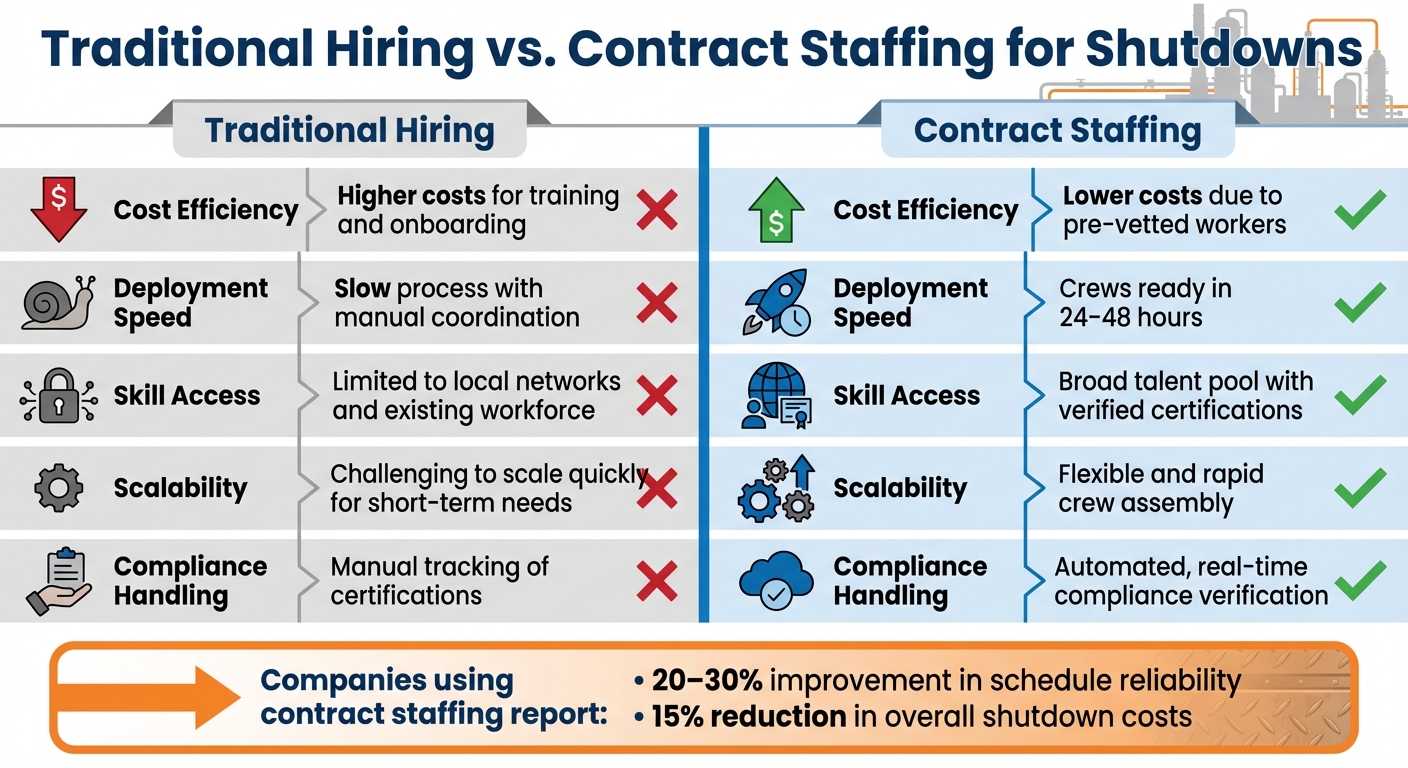
Traditional Hiring vs Contract Staffing for Oil and Gas Shutdowns
When a shutdown is on the horizon, the way you staff your project can heavily impact your timeline and budget. Traditional hiring through temp agencies often involves lengthy back-and-forth coordination and repeated phone calls. On top of that, many general staffing firms lack expertise in technical requirements like TWIC cards or ISNetworld pre-qualification. This mismatch can lead to hiring workers who don’t have the proper certifications needed for a shutdown, wasting both time and money.
Contract staffing platforms take a different approach by automating the vetting process. These platforms connect your project with workers who are already pre-vetted and hold the necessary certifications, such as H2S training, Confined Space entry permits, or OSHA 30. This streamlined method offers clear advantages in cost and schedule management. For example, most platforms can provide qualified candidates within 24–48 hours, which is a dramatic improvement compared to the weeks traditional hiring often takes.
Consider this: in a Delaware refinery turnaround, NES Fircroft successfully deployed 18 experienced shutdown coordinators using contract staffing, keeping the project on track without the delays typically seen with traditional recruitment. In another case, a planned shutdown wrapped up 19 days ahead of schedule, saving $2.5 million, thanks to flexible contract staffing. These examples highlight how the scalability of contract staffing can directly impact the bottom line.
Cost and Speed Comparison
| Factor | Traditional Hiring | Contract Staffing |
|---|---|---|
| Cost Efficiency | Higher costs for training and onboarding | Lower costs due to pre-vetted workers |
| Deployment Speed | Slow process with manual coordination | Crews ready in 24–48 hours |
| Skill Access | Limited to local networks and existing workforce | Broad talent pool with verified certifications |
| Scalability | Challenging to scale quickly for short-term needs | Flexible and rapid crew assembly |
| Compliance Handling | Manual tracking of certifications | Automated, real-time compliance verification |
These benefits go beyond just saving time and money. Contract staffing also shifts HR and legal responsibilities – like insurance and benefits – to the staffing supplier, reducing your liability. Companies that adopt contract staffing for shutdown planning report a 20–30% improvement in schedule reliability and a 15% reduction in overall costs. This approach ensures shutdowns stay on track, avoiding the delays and inflated expenses often tied to traditional hiring methods.
Main Benefits of Contract Staffing for Shutdowns
Contract staffing provides a way to quickly assemble skilled crews, often within just 24–48 hours. This quick turnaround is crucial during shutdowns, where delays can significantly affect both productivity and costs. Beyond speed, contract staffing also prioritizes high safety standards.
By deploying workers with necessary certifications like OSHA 30 and H2S training, this approach helps reduce risks in environments where nearly 50% of work-related accidents occur during shutdowns. Having experienced, certified professionals on-site is a key factor in maintaining safety.
Additionally, digital platforms simplify operations by handling GPS timecards, payroll, and compliance all in one place. This allows supervisors to focus on running the site rather than being bogged down by administrative tasks.
Another advantage is targeted hiring, which ensures you only pay for the specific skills needed. This eliminates overstaffing and avoids unnecessary costs.
Even in the face of unexpected challenges, features like a 24-hour replacement guarantee and worker rating systems help maintain schedules and keep projects on track. Altogether, these benefits make contract staffing a smart solution for managing shutdowns efficiently, safely, and with better cost control.
Conclusion
Managing oil and gas shutdowns demands speed, accuracy, and dependability – things that traditional hiring methods often struggle to deliver. Contract staffing steps in to solve these issues by linking operators with certified, experienced professionals in as little as 24–48 hours. This approach helps keep projects on track and within budget.
Platforms like ABLEMKR take things a step further by automating key processes like worker matching, compliance checks, and payroll. With features such as a built-in rating system and a 24-hour replacement guarantee, it ensures reliability during critical turnarounds.
Whether you’re preparing for a scheduled shutdown or handling an unexpected situation, having access to a pool of pre-vetted workers tailored to your technical needs removes uncertainty and minimizes risk. You control pay rates, specify required certifications, and avoid unnecessary costs for credentials that your project doesn’t need.
FAQs
What trades should I line up first for a shutdown crew?
When assembling a shutdown crew, focus on trades with specialized expertise and the ability to mobilize quickly. Roles like electricians, millwrights, welders, and pipefitters are essential for tasks such as disassembly, repairs, and inspections – especially given the tight deadlines typical of shutdown projects.
Additionally, HVAC specialists and instrumentation technicians play a crucial role in maintaining critical systems and ensuring safety standards are met throughout the process. Platforms like ABLEMKR can help streamline the search for pre-vetted professionals, making it easier to deploy skilled workers when time is of the essence.
How do I verify TWIC, H2S, OSHA, and ISNetworld compliance fast?
To swiftly confirm compliance with certifications like TWIC, H2S, OSHA, and ISNetworld, platforms such as ABLEMKR offer a streamlined solution. These tools connect you with pre-vetted workers who already have the necessary certifications and training, ensuring they align with project requirements. With features like real-time tracking and integrated workflows, ABLEMKR simplifies credential verification while minimizing the risks associated with non-compliance.
How can ABLEMKR help if headcount changes mid-shutdown?
ABLEMKR offers real-time workforce deployment and flexible staffing options to handle unexpected changes in headcount during mid-shutdowns. By swiftly connecting pre-screened workers to job sites, considering factors like certifications, availability, and location, ABLEMKR ensures crews are mobilized quickly. This approach helps reduce delays and keeps operations running smoothly.


