
Language gaps can get people hurt on a job site. When workers miss training, warning labels, hand signals, or emergency orders, the odds of mistakes go up fast.
If I had to sum up the issue in plain English, it would be this:
- Training fails when workers don’t fully understand it
- Hazards go unreported when forms, apps, or hotlines are English-only
- Crew coordination breaks down during crane work, equipment moves, and confined space jobs
- Emergency response slows when people don’t understand where to go or what to do
- Employers face more risk from injuries, delays, rework, OSHA issues, and weak records
The numbers make the problem hard to ignore:
- More than 40% of U.S. construction laborers do not speak English well
- 48.7% of migrant and immigrant construction workers said they misunderstood work or safety instructions
- 66.7% linked work mistakes to miscommunication
- 95.4% of people in one safety culture survey said a language barrier exists on their sites
- Hispanic and Latino workers face about 4.6 fatalities per 100,000 full-time workers
What do I take from that? This is not just a communication issue. It’s a safety issue.
The fix is pretty simple, even if putting it into place takes work:
- Give training in the worker’s main language
- Check understanding with repeat-back, short quizzes, or demos
- Use pictograms, photos, and color-coded signs
- Make reporting easy in the worker’s language
- Train supervisors to speak plainly and confirm understanding
- Track training, language needs, and certifications before crews get sent out
| Risk area | What goes wrong | What helps |
|---|---|---|
| Training | Workers miss steps or use equipment the wrong way | Translated training + repeat-back |
| Hazard communication | Labels and SDSs don’t make sense to all workers | Visuals + translated materials |
| Reporting | Hazards and near-misses never get logged | Simple reporting in the worker’s language |
| Coordination | Signals and task handoffs get mixed up | Plain speech + bilingual crew support |
| Emergencies | Workers react in different ways | Multilingual drills + mobile alerts |
Bottom line: if workers can’t understand the message, the message didn’t do its job. This article shows where those failures happen most and what employers can do to cut the risk.
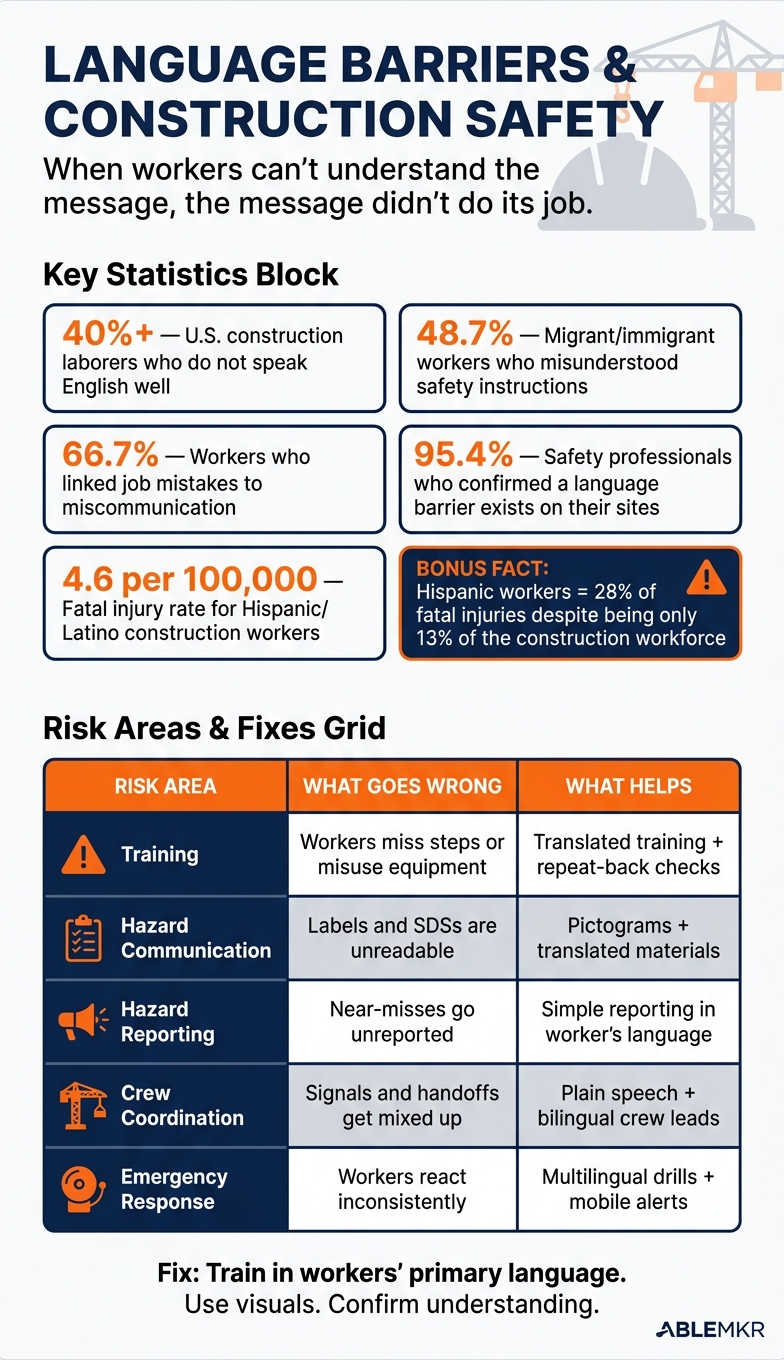
Language Barriers & Construction Safety: Key Statistics and Risk Areas
Where Language Barriers Cause the Biggest Safety Problems
Misunderstood Training, Procedures, and Hazard Communication
OSHA requires training that workers can understand. That covers fall protection, lockout/tagout, PPE, HazCom, and confined space entry.
When training materials, toolbox talks, and procedures are only in English, people often fill in the gaps on their own. They may guess. They may copy what a coworker does. And in safety work, that’s where things go sideways fast. A worker might pick the wrong PPE, anchor a harness the wrong way, or start up a machine in an unsafe sequence.
Hazard communication runs into the same wall. Labels, Safety Data Sheets, and chemical briefings have to make sense to every worker who handles those materials. If SDSs and HazCom training are only in English, they fail the moment part of the crew can’t read them.
Underreported Hazards and Weaker Incident Prevention
Language problems also shut people out of hazard reporting. Say a worker spots a loose scaffold plank, an unguarded edge, or a tool that isn’t working right. If the only reporting option is an English-only form, app, or hotline, that worker may say nothing at all. The process leaves them out.
That matters more than it may seem at first glance. Sites with limited bilingual support often get fewer hazard reports and near-miss records from non-English-speaking crews. So management ends up looking at only part of the picture. Conditions may seem fine on paper while day-to-day risks never get documented.
Once reporting is incomplete, the rest of the safety system starts to weaken too. Incident investigations miss details. Trend analysis becomes less useful. Corrective actions are based on partial information. That makes it much harder to run a strong safety program.
Breakdowns During Crew Coordination and Emergencies
High-risk work leaves almost no room for confusion. During live operations, even a small language gap can turn into a serious injury.
In crane work, one misunderstood signal or exclusion zone can create a strike hazard. During equipment handoffs, a missed warning about unstable ground or a blind spot can hurt someone in seconds.
Confined space work is even less forgiving. Workers need to clearly understand entry permits, atmospheric testing results, ventilation rules, communication protocols, and what to do if an alarm goes off. If even one part of that message gets lost, the result can be suffocation, toxic exposure, or a rescue that’s hard to carry out.
Emergencies compress everything. There’s no time to pause and sort out unclear instructions. During a fire evacuation or a stop-work order tied to a gas leak, workers who don’t fully understand the message may head to the wrong muster point, stay where they are, or keep running equipment. Mixed responses during evacuations or stop-work orders slow rescue and increase injury risk.
Heat alerts bring the same problem. If workers don’t understand work-rest rules or the signs of heat stroke, they may keep pushing until conditions become dangerous.
| Problem Area | How Language Barriers Create Risk | Relevant OSHA / Research Insight |
|---|---|---|
| Training & procedures | Workers misunderstand PPE, fall protection, lockout/tagout, or equipment operation when training is English-only or too technical. | OSHA requires training in a way workers can understand. |
| Hazard communication | English-only labels, SDS documents, and chemical briefings leave workers unaware of chemical hazards and safe handling steps. | HazCom training must be understandable to the workers using the materials. |
| Hazard reporting | Workers notice risks but can’t use English-only forms, hotlines, or apps effectively. | Sites with limited bilingual support collect fewer hazard and near-miss reports. |
| Crew coordination | Misunderstood crane signals, handoffs, or confined space instructions raise the risk of struck-by and entrapment incidents. | Language gaps weaken real-time coordination on high-risk tasks. |
| Emergency response | Workers may react inconsistently to evacuations, stop-work orders, or heat alerts. | Mixed responses during emergencies slow rescue and increase injury risk. |
These gaps point straight to multilingual training, visual signage, and mobile tools that make communication faster and easier to act on.
sbb-itb-aa28329
Breaking the Language Barrier in Safety
Practical Steps to Improve Safety on Multilingual Job Sites
The fix is operational: standardize training, visuals, and supervisor communication.
Deliver Training in Workers’ Primary Languages and Confirm Understanding
OSHA requires training workers can understand. On multilingual job sites, that means figuring out the main languages on site before work starts and then giving orientations, toolbox talks, and task training in those languages through bilingual trainers, interpreters, or translated materials.
One thing to avoid: leaning on an untrained bilingual coworker to fill the gap. If that person doesn’t know the material well, they may not be able to answer questions the right way.
And delivery alone isn’t enough. You need to check that workers actually got it. A few solid ways to do that:
- Ask workers to explain the task back in their own words
- Give a short quiz in the worker’s primary language
- Use a supervised demonstration before high-risk work starts
Those checks help catch confusion before someone is on a roof edge, near a crane, or entering a confined space.
Use Visual Systems, Translated Materials, and Clear Site Signage
Visual tools help when words alone fall short, especially on crews with mixed literacy levels. Pictograms, color-coded signs, and photo-based work instructions show hazards and required controls fast. That matters most in hazard communication and emergency response, where workers need to recognize what to do right away.
For written materials, start with the documents workers use most and the ones tied to the highest-risk tasks. That includes JSAs/JHAs for fall work, crane operations, and confined space entry, along with emergency response plans and incident forms.
Translations work better when they’re paired with images and diagrams. That makes the documents easier to use for workers with limited literacy. Keep those materials in site binders and mobile tools, and show workers where to find them during orientation.
Train Supervisors to Manage Multilingual Crews and Support Hazard Reporting
Foremen and supervisors need plain-language communication skills, not just technical know-how. In practice, that means slowing down, setting up briefings with interpreters, and checking understanding without relying only on yes-or-no questions. That directly helps with the underreporting and coordination gaps that increase risk on multilingual sites.
It also helps to pair limited-English workers with bilingual crew leads so they have someone to turn to in the moment, especially during complex tasks. On top of that, supervisors should make hazard reporting simple in the worker’s preferred language, whether through verbal check-ins, basic paper forms, or mobile tools with multilingual prompts.
Just as important, supervisors need to close the loop. Workers should see that concerns are acknowledged, checked, and fixed without retaliation.
Track language readiness, certifications, and training status in one place so these steps stay current.
How Workforce Systems and Mobile Tools Support Safer Communication
Tracking Training, Certifications, and Language Readiness Across Crews
Once training and supervision are in place, the next step is making sure each crew is ready before dispatch. Translated training, visual aids, and bilingual supervision help, but they only work if supervisors can confirm who has what. On busy sites, paper rosters and disconnected spreadsheets make that harder than it should be. Certifications can expire without anyone noticing. Training records can get lost between projects. And language needs may not show up until a worker is already onsite.
A workforce system that keeps training completion, certification expiration dates, and language preference in one place makes that check much easier. Before dispatch, supervisors can confirm current training and make sure language support is in place for confined-space work and other high-risk tasks. That check needs to happen before mobilization, not after a crew arrives and a gap becomes obvious.
This matters even more for high-risk or remote assignments. When crews are far from immediate support, it’s harder to fix a misunderstood permit rule or emergency step in the moment. If supervisors know in advance which workers need translation support, they can reduce compliance gaps and safety exposure. Mobile tools help here too. They can send translated alerts, share digital safety checklists, and display site rules or updated procedures in a worker’s preferred language.
How ABLEMKR Can Support Multilingual Safety and Compliance
ABLEMKR matches pre-vetted workers to job sites based on certifications, safety training, availability, and location. It gives supervisors one view of readiness, training status, and language needs before crews are mobilized.
That visibility matters most when crews need language support in the field. Employers can see which workers need onboarding in the worker’s language or bilingual crew leads, then build that support into the assignment from day one. This creates a clear record of training, communication, and language support before work starts. That record helps with audits, contractor oversight, and internal safety reviews.
Conclusion: Closing Language Gaps Lowers Risk
Language barriers on construction sites create a direct safety risk. When workers miss instructions, can’t read warnings, or don’t get clear emergency directions, the chance of injury goes up. That risk hits Hispanic workers hard. They account for 28% of fatal injuries while making up about 13% of the construction workforce. Research ties that gap to language barriers, uneven access to training, and underreporting.
The fix is disciplined communication, not guesswork. Safety communication needs to be checked, not assumed. That means training workers in their primary languages, using visual systems that work across different literacy levels, asking supervisors to confirm understanding, and giving every worker a reporting channel they can use.
Workforce systems add the day-to-day structure that helps these fixes stick across crews. Crew readiness can be checked before mobilization instead of after a problem shows up on site. ABLEMKR’s model can match pre-vetted workers by certification, safety training, availability, and location while tracking compliance. That same visibility helps teams handle daily communication and emergency readiness with less room for confusion.
Comparison Table: Problems, Risks, and Communication Methods
The summary below shows how each communication failure maps to a specific risk and fix.
| Problem | Primary Safety Risk | Best Communication Fix |
|---|---|---|
| Misunderstood training | Incorrect tool use, skipped protective steps | Translated training + repeat-back verification |
| Missed hazard warnings | Unreported near-misses, unsafe conditions | Pictogram signage + accessible reporting channels |
| Slow emergency response | Injury escalation, delayed intervention | Multilingual drills + mobile notifications |
| Underreported incidents | Hidden risk patterns, no early correction | Trusted reporting channels in workers’ language |
FAQs
What does OSHA require for multilingual safety training?
OSHA requires employers to provide safety training in a language and vocabulary workers can clearly understand.
That matters for a simple reason: workers need to understand workplace hazards, equipment instructions, emergency procedures, and the steps they need to take to protect themselves.
If training doesn’t make sense to the worker, key safety information can slip through the cracks. And when that happens, the risk of violations, accidents, and serious injuries goes up.
How can crews verify understanding beyond translation alone?
Supervisors should do more than ask whether workers understand. That kind of question often gets an automatic “yes,” even when the message didn’t fully land.
A better approach is closed-loop communication. Ask workers to repeat the instructions in their own words, show how they would do the task, or walk through the procedure step by step. You can also use open-ended questions about what might go wrong. That helps confirm understanding and makes it easier for workers to speak up about hazards.
What site documents should be translated first?
To support site safety and compliance, start with the documents that shape day-to-day work and keep people safe:
- Safety data sheets
- Operation manuals
- Employee handbooks
- Onboarding materials
- HR policies
- Safety protocols
Each of these should be ready in every worker’s native language from day one. That way, expectations are clear, project requirements make sense, and workers can get started without confusion.


