
Understanding blueprints is critical for energy jobs like pipeline work, power plant operations, and renewable energy projects. Certifications validate these skills, ensuring professionals can interpret technical drawings, comply with industry standards, and improve job prospects. Here are five certifications that stand out:
- Certified Engineering Technician (CET): Focuses on blueprint reading for energy infrastructure, including electrical and civil engineering tracks. Requires exams, experience, and recertification every three years.
- ASME Y14.5 GD&T Certification: Covers geometric dimensioning and tolerancing for interpreting engineering drawings. Two levels: Technologist and Senior, with exams starting at $520.
- Blueprint Reading for Energy Professionals (VDCI): A 110-hour course with hands-on training in Bluebeam Revu software. Costs $999 and includes a certification exam.
- Autodesk Certified Professional (AutoCAD): Validates advanced AutoCAD skills, essential for modern energy projects. Exam costs $200 and is valid for three years.
- ABLEMKR Certification: Targets P&IDs, ISO piping drawings, and compliance with industry standards like ASME B31Q and API 1161.
These certifications help energy professionals meet industry requirements, secure better roles, and stay competitive in an evolving field.
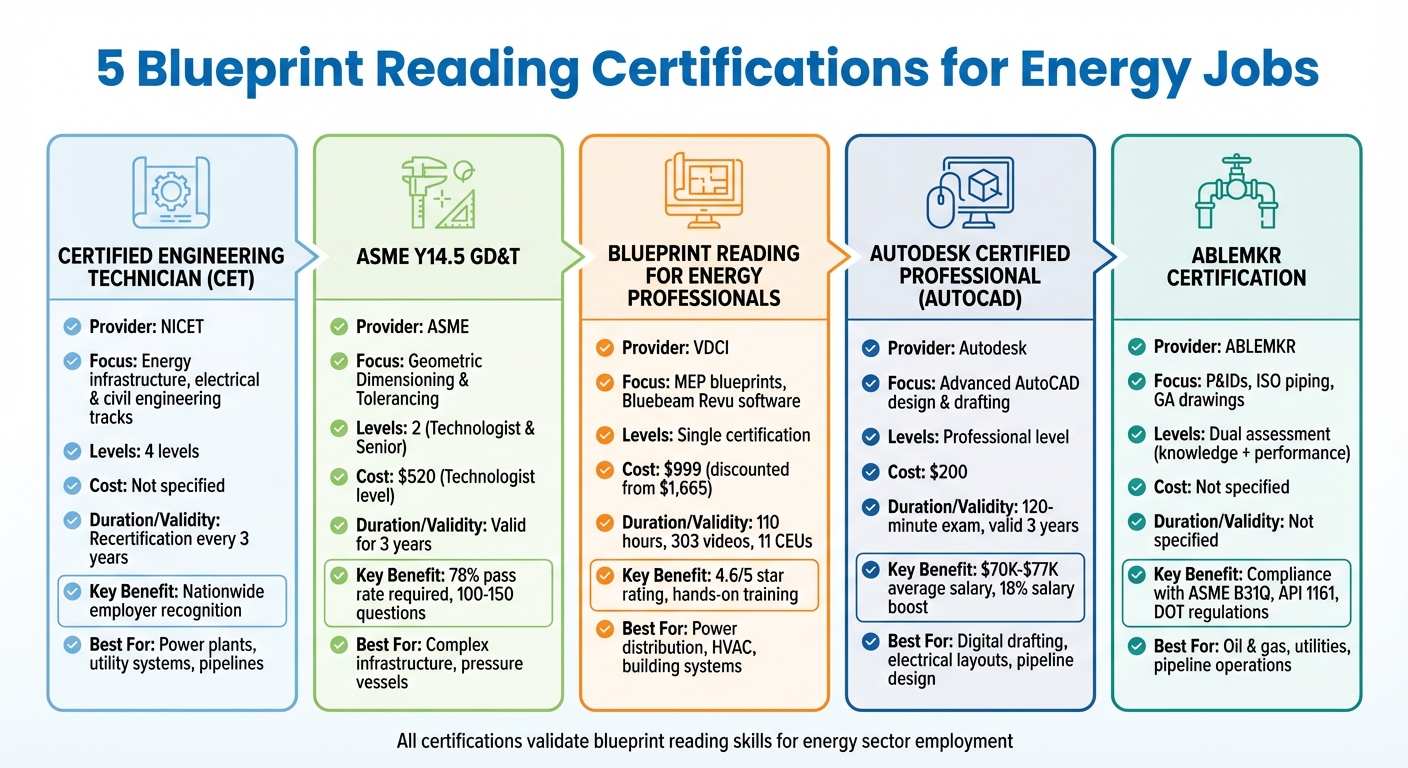
5 Blueprint Reading Certifications for Energy Jobs: Comparison Chart
How to Read Electrical Diagrams | A REAL WORLD PROJECT
sbb-itb-aa28329
1. Certified Engineering Technician (CET)
The CET credential, offered by NICET, is a respected certification that thoroughly assesses blueprint reading skills for professionals in the energy sector. Earning this certification involves passing third-party examinations designed to confirm expertise in technical standards.
Importance in the Energy Sector
The CET program includes specialized tracks tailored to meet the demands of energy infrastructure. For example, the Electrical Power Testing and Civil Engineering Technology tracks focus on developing the skills needed to interpret schematics, wiring diagrams, and system layouts – essential for work in power plants, utility systems, and pipelines. This targeted approach ensures technicians are prepared for real-world challenges, not just theoretical knowledge.
Advanced Blueprint Reading Validation
The CET certification is divided into four levels. Advancing through these levels requires documented industry experience, significant professional accomplishments, personal recommendations, and ongoing recertification every three years through CPD. This rigorous process ensures technicians are equipped to handle the complex projects often encountered in energy infrastructure.
Employer Recognition in the Energy Industry
"Each of NICET’s nationally recognized certification programs are designed by industry experts and practitioners to ensure a qualified workforce", states NICET.
Thanks to its expert-driven structure, the CET certification is recognized nationwide. This nationwide recognition assures energy employers that certified technicians possess consistent, high-level blueprint interpretation skills. The program’s structured career path and mandatory recertification also demonstrate that certified professionals stay up-to-date with evolving industry standards, making them a valuable asset to employers.
2. ASME Y14.5 Geometric Dimensioning and Tolerancing Certification
The ASME Y14.5 certification demonstrates a professional’s ability to interpret Geometric Dimensioning and Tolerancing (GD&T), a standardized system used in engineering drawings. Offered at two levels – Technologist and Senior – this certification caters to varying expertise. The Technologist level focuses on understanding and interpreting GD&T, while the Senior level assesses the ability to apply geometric controls in design. For professionals in the energy sector, especially those involved in complex infrastructure like power plants, pipelines, and pressure vessels, the Technologist certification is particularly relevant. It requires no prior experience and costs $520. Mastering GD&T is a critical skill for meeting the rigorous demands of energy infrastructure projects.
Industry Relevance to Energy Sector
The ASME Y14.5 standard plays a key role in ensuring consistent interpretation of GD&T, aligning engineering drawings with critical energy codes such as ASME B31.1 (Power Piping), B31.3 (Process Piping), and B31.8 (Gas Transmission and Distribution Piping Systems). These standards are essential for the seamless execution of multi-national energy projects.
Validation of Advanced Blueprint Reading Skills
Beyond its relevance to the industry, this certification verifies advanced blueprint reading capabilities. The Technologist Level exam includes 100 to 150 questions, takes up to 4 hours, and requires a minimum score of 78% to pass. Certified professionals gain expertise in calculating tolerances, selecting datum features, and applying condition modifiers to ensure accurate assembly. These skills help reduce costly rework, prevent production delays, and enhance safety in high-pressure energy environments.
Recognition by Energy Employers
ASME certification is widely respected, with over 1,300 GDTP-certified professionals globally and nearly 3,000 individuals in North America holding ASME personnel certifications. ASME President Charla K. Wise highlights the value of this credential:
"Our certification program is in direct response to employers seeking accuracy, quality, precision, and clear communication up and down the supply chain, allowing these manufacturers to reduce costs and gain customer confidence."
Many manufacturers and government agencies now require GDTP certification from their suppliers to ensure high standards of quality and precision. The certification is valid for three years, after which renewal is required. This recognition emphasizes the importance of accuracy and precision in energy sector engineering drawings.
3. Blueprint Reading for Energy Professionals by VDCI
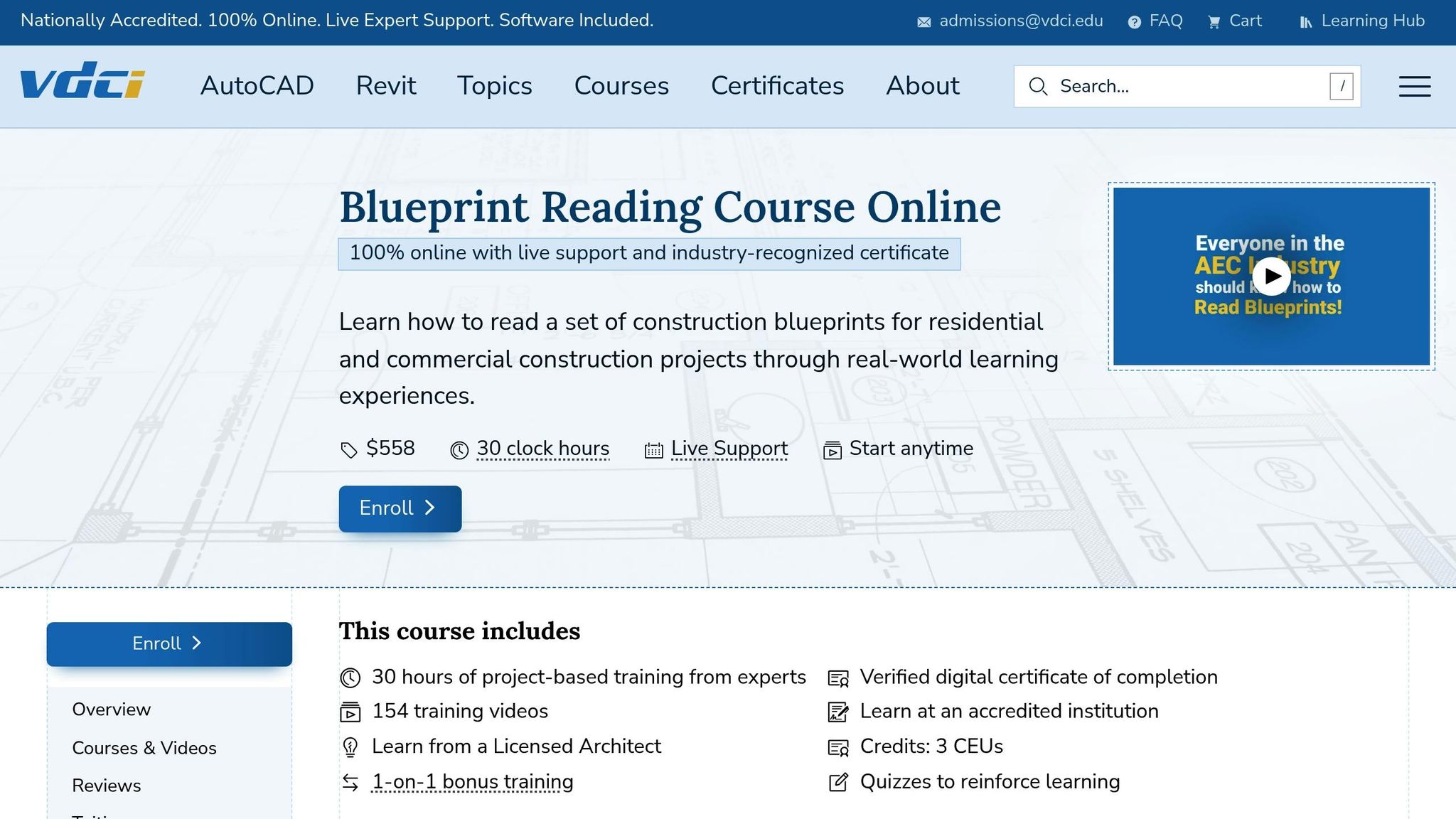
The Blueprint Reading for Energy Professionals course from VDCI offers 110 clock hours of specialized training, delivered through 303 videos and 11 CEUs. Covering everything from residential plans to intricate commercial MEP systems, this program is designed to equip professionals with a comprehensive understanding of blueprint reading. With 36 years of experience and over 45,000 students trained, VDCI has earned a reputation for reliable technical education. The course is priced at $999 (discounted from $1,665) and offers flexible payment options, starting with a $279 deposit.
Industry Relevance to Energy Sector
This course focuses on Mechanical, Electrical, and Plumbing (MEP) blueprints – key components for energy infrastructure projects like power distribution systems, HVAC installations, and building service systems. Students gain hands-on experience with Bluebeam Revu, a widely-used tool for tasks like takeoffs, markups, and project collaboration. By working with real construction documents and 3D models, participants develop the spatial reasoning skills necessary to interpret complex energy systems from 2D drawings. This practical approach ensures that theoretical concepts are directly tied to real-world energy infrastructure applications.
Validation of Advanced Blueprint Reading Skills
The program emphasizes project-based learning and culminates in the Bluebeam Certified Professional (BCP) Exam, which serves as a recognized credential for expertise in digital PDF workflows. Throughout the course, students build proficiency in reading structural drawings, foundation layouts, and section views, while also learning how to connect various construction document sets. To enhance their skills further, students receive 30 days of Bluebeam software access and a live one-on-one training session with an industry expert.
Recognition by Energy Employers
The course boasts a 4.6/5-star rating from 1,913 students, with many alumni experiencing career growth after completion. One such success story comes from Carlos Escobar Guillen, who shared:
"After earning my Blueprint Reading Certification with VDCI, I received a promotion and a sizable raise."
VDCI’s national accreditation ensures that its digital certificates of completion are widely recognized by employers in the energy and construction sectors. The curriculum’s focus on standard symbols, annotations, and building code requirements ensures compliance and precision in energy facility construction and maintenance projects.
4. Autodesk Certified Professional: AutoCAD for Design and Drafting
The Autodesk Certified Professional (ACP) credential showcases advanced skills in AutoCAD, the leading CAD software with a 39.64% market share. This certification is tailored for professionals who need to demonstrate expertise in AutoCAD, particularly in industries like energy. Priced at $200.00 USD, the 120-minute exam (comprising 45–60 questions) evaluates practical design abilities, typically requiring 400–1,200 hours of hands-on experience. Beyond software knowledge, it aligns with the real-world needs of energy infrastructure design projects.
Industry Relevance to Energy Sector
In an era where energy projects are increasingly digitized, AutoCAD proficiency is indispensable for interpreting modern blueprints. The software plays a pivotal role in energy infrastructure, including electrical distribution systems, mechanical setups, and pipeline designs. This certification tests essential skills like graphic interpretation, ensuring candidates can accurately analyze technical drawings. For energy professionals, this translates to understanding intricate electrical layouts, mechanical diagrams, and system schematics crucial to power generation and transmission networks. The exam also covers advanced workflows, such as linking external files, managing outputs, and leveraging collaboration tools – key for large-scale energy projects.
Validation of Advanced Blueprint Reading Skills
The ACP credential confirms expertise in drafting concepts, CAD standards, and annotation techniques. It assesses skills like drawing management, object accuracy, and the use of reusable content, which are critical for maintaining consistency in complex engineering documents. The exam includes multiple-choice, drag-and-drop, and active-screen questions designed to reflect real-world challenges, emphasizing problem-solving over memorization. Architect Brian Kish highlights the value of this certification:
"An Autodesk certification is a good validation in your career. It clearly says that you know what you’re doing. It’s not just me telling you that I know what you’re doing, it’s verified."
Recognition by Energy Employers
This certification provides verified proof of technical skills, with certified professionals earning average annual salaries between $70,000 and $77,000. Additionally, certifications like this can result in salary boosts of around 18%. Successful candidates are awarded digital badges and personalized certificates, which employers can instantly verify on platforms like Credly. With nearly 49% of drafters employed in architectural, engineering, and related services – sectors integral to energy projects – the ACP credential is a trusted benchmark for hiring managers. The certification remains valid for three years, requiring retesting to ensure professionals stay current with software advancements. This renewal process helps maintain expertise in digital drafting and blueprint interpretation, keeping professionals aligned with the evolving demands of the energy sector.
5. ABLEMKR Certification Integration for Energy Jobs

The ABLEMKR certification plays a key role in validating blueprint reading skills for energy sector jobs. It addresses the demand for standardized skill verification in industries like oil & gas, utilities, and heavy infrastructure. By providing a clear benchmark, it helps employers quickly identify workers with proven expertise in blueprint reading, ensuring they meet the technical needs of complex energy projects.
Industry Relevance to Energy Sector
This certification focuses on interpreting essential documents such as Piping and Instrumentation Diagrams (P&IDs), ISO piping drawings, and General Arrangement (GA) drawings. Certified workers gain skills in material takeoffs, understanding drawing hierarchies, and navigating multi-sheet blueprints. These competencies are tailored to the specific demands of energy projects, ensuring workers can handle the technical challenges of the field.
Validation of Advanced Blueprint Reading Skills
ABLEMKR uses a dual-assessment approach that combines a knowledge-based exam with a hands-on performance evaluation. This ensures that certified individuals are not only familiar with theoretical concepts but also possess practical, job-ready skills essential for on-site tasks.
Focus on Technical Standards and Compliance
The certification also emphasizes adherence to critical industry standards. It aligns with key pipeline standards like ASME B31Q and API 1161, while ensuring compliance with Department of Transportation (DOT) regulations for pipeline facilities. It particularly supports Operator Qualification (OQ) programs, verifying that workers are capable of performing Covered Tasks (CT) that are vital for minimizing incidents in energy operations.
How Certifications Meet Energy Sector Requirements
Certifications play a crucial role in ensuring safety and compliance in the energy sector, where strict standards are the norm. Blueprint reading certifications, in particular, are indispensable for construction, manufacturing, and engineering projects, as blueprints form the backbone of these operations. In energy-related roles – whether in oil & gas, utilities, or pipeline operations – workers must interpret intricate drawings like P&IDs, alignment sheets, and Classified Area diagrams that detail explosion-proof equipment requirements.
These certifications confirm that professionals can spot potential issues early, avoiding costly delays and ensuring workers understand how to navigate drawings for Classified Areas (Class I, II, III, and IV). This knowledge is essential for identifying where specialized safety equipment is needed to prevent ignition hazards. Beyond technical skills, certifications also simplify workforce deployment, enabling teams to hit the ground running.
"Having NCCER credentials is so important, especially to hiring contractors. It really separates them applying for a career against a person who doesn’t have NCCER credentials … when they get on the job site, they are ready to show, improve and perform." – Desmond Marshall, Chief Operation Officer, Project H.O.O.D.
Platforms like ABLEMKR make it easier for certified professionals to connect with energy projects. By matching pre-vetted workers to job sites based on verified certifications, safety training, availability, and location, the platform meets the industry’s urgent need for swift and compliant crew mobilization. Employers benefit from real-time digital verification of worker credentials, eliminating administrative delays and ensuring on-site compliance. This streamlined process is vital for tasks like emergency shutdowns, remote pipeline repairs, or scheduled infrastructure projects, all while maintaining the high technical standards required to keep operations safe and on track.
Through certification integration, ABLEMKR ensures that workers with proven blueprint reading expertise can quickly access lucrative opportunities across oil & gas, utilities, mining, and heavy infrastructure projects in key U.S. energy corridors.
Conclusion
Earning a blueprint reading certification can give you a clear advantage in the energy sector. These credentials prove your ability to understand complex technical drawings – like P&IDs and alignment sheets – making you a stronger candidate in the eyes of hiring contractors. Certified professionals often land higher-paying roles in areas like drafting, CAD design, and project management while helping to reduce costly on-site errors and project delays.
The certifications mentioned in this article, such as Certified Engineering Technician (CET) and ASME Y14.5 GD&T, open up opportunities across industries like oil and gas, utilities, mining, and heavy infrastructure. Digital verification tools make these credentials even more valuable by enabling instant qualification checks, cutting out administrative hurdles, and speeding up the hiring process.
To get the most out of these certifications, align them with your career goals. For instance, pipeline workers should focus on NCCER Pipeline programs, while design professionals will benefit from AutoCAD certifications. Pairing blueprint reading credentials with skills in digital tools like Revit or SolidWorks can also help you stay ahead as the industry adopts more integrated technologies.
Equally important is connecting your certifications to real job opportunities. Platforms like ABLEMKR make this transition easier by matching certified workers with energy projects that fit their qualifications, safety training, and location. With real-time verification, your certifications can directly lead to roles in major U.S. energy hubs – whether you’re tackling emergency shutdowns or working on planned infrastructure projects. Workers gain access to well-paying jobs with reliable payments, while employers can quickly assemble compliant crews to keep projects on track.
FAQs
What certification is best for pipeline and P&ID work?
The API 1169 – Pipeline Construction Inspector certification is a well-regarded credential for professionals involved in pipeline construction and P&ID (Piping and Instrumentation Diagram) work. It serves as proof of expertise in areas like pipeline construction, inspection processes, and associated documentation, making it an excellent option for those pursuing roles in these fields.
Do I need job experience before taking these exams?
Practical job experience is often encouraged, particularly when pursuing advanced certifications in blueprint reading. Being familiar with technical drawings and industry standards can make understanding and passing the exams much more manageable. Although it may not be a strict requirement, hands-on experience provides essential skills that are crucial for success.
How do I choose between GD&T, AutoCAD, and blueprint reading courses?
Choosing the right course – GD&T, AutoCAD, or blueprint reading – depends on where you see your career heading.
- GD&T (Geometric Dimensioning and Tolerancing) is perfect for roles in manufacturing and quality control, where precision and adherence to detailed specifications are critical.
- AutoCAD is a go-to for those pursuing design and drafting careers, especially in fields like architecture, engineering, or construction.
- Blueprint reading is a must-have skill for interpreting technical drawings, making it especially useful in industries like construction, energy, and infrastructure.
Your decision should align with the industry and job responsibilities you want to focus on.


