
Electricians in 2026 are seeing increased demand for specialized skills driven by advancements in renewable energy, automation, and stricter safety requirements. Certifications are no longer optional – they’re critical for career growth, higher pay, and access to more complex projects. Here’s a quick rundown of the most sought-after certifications:
- OSHA Safety Certificate: Focused on workplace safety and compliance with NFPA 70E. Affordable and renews every three years.
- Electrical Technician Certifications (CEST, NICET EPT): Validates expertise in safety and power testing; ideal for renewable energy and large-scale projects.
- EPA Section 608 Technician Certification: Required for handling refrigeration systems. Lifetime validity, no renewal needed.
- Master Electrician Certification: A pathway to leadership roles, requiring years of experience and passing state exams.
- Certified Electrical Inspector (CEI): Ensures compliance with NEC standards, with specialized tracks for residential and system-wide inspections.
- Photovoltaic Installation Certification (PVIP): Key for renewable energy roles, boosting pay and job opportunities.
- NCCER Electrical and Instrumentation Pipeline Technician (EIPT): Tailored for pipeline projects, covering SCADA systems and advanced electrical tasks.
- Certified Professional Electrician (CPE): Highlights advanced skills in troubleshooting and motor controls, setting electricians apart.
- HVAC Master Specialist: Combines HVAC expertise with electrical skills, preparing professionals for high-efficiency systems.
- Industrial Electrician Certification: Focused on complex power systems, ideal for industrial and energy sectors.
These certifications not only improve career prospects but also ensure compliance with evolving industry standards. Platforms like ABLEMKR connect certified electricians with high-demand projects, streamlining opportunities for professionals with these credentials.
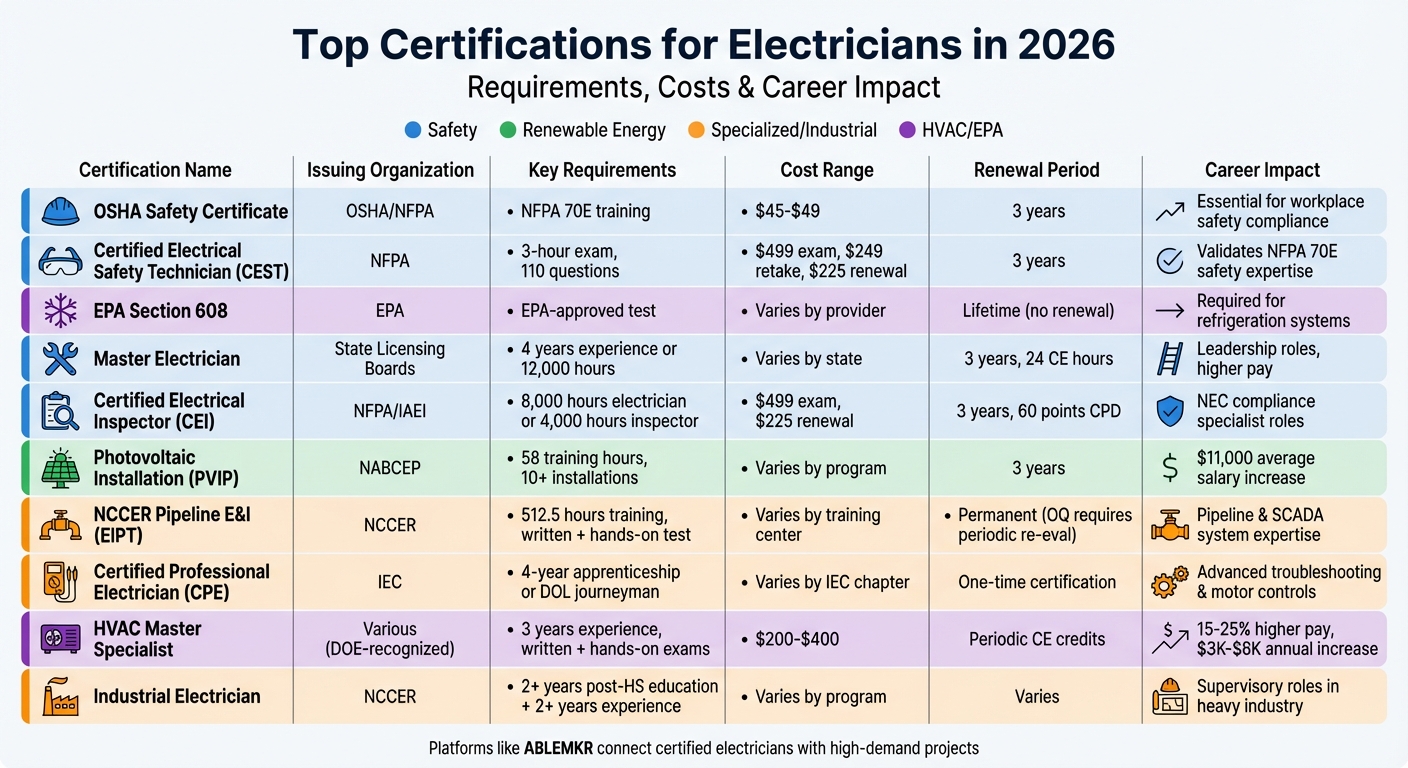
Top 10 Electrician Certifications 2026: Requirements, Costs & Salary Impact Comparison
1. OSHA Safety Certificate
Relevance to Construction and Energy Sectors
The NFPA 70E (Standard for Electrical Safety in the Workplace) serves as OSHA’s go-to framework for electrical safety in general industry (29 CFR 1910 Subpart S) and construction (29 CFR 1926 Subpart K). This certification identifies a "Qualified Person" – someone skilled in operating electrical equipment and mitigating hazards. For Department of Energy (DOE) contractors, NFPA 70E certification isn’t just recommended; it’s legally required under 10 CFR 851.23(a). The training dives into critical areas like arc flash analysis, selecting the right PPE, handling shock hazards, and emergency response protocols. These skills are essential for anyone working on energized equipment, whether at construction sites, industrial substations, or energy facilities.
Benefits for Career Advancement and Salary
Earning an OSHA certification can open doors to better career opportunities and higher pay. R.T. Leicht, Chief of Fire Protection at Delaware’s State Fire Marshal’s Office, shared his experience:
"Initially, certification served to provide me an added level of confidence for what I was doing. Later in my career, it proved to be acknowledged by promotional boards as symbolic of quality and merit in the fire prevention industry."
Employers often offer higher salaries to certified professionals, helping to bridge skill gaps in the workforce. Certifications like these can also be a strong negotiating tool for better pay. Beyond financial perks, proper safety training saves lives – preventing hundreds of deaths and thousands of injuries each year. And with the certification process being straightforward and cost-effective, it’s a win-win for professionals looking to boost their credentials.
Ease of Obtaining and Renewal Process
Getting certified doesn’t have to break the bank. Online NFPA 70E courses are available for as little as $45, with options like the Arc Flash Electrical Safety Course priced around $49. These courses are accessible 24/7 and often provide instant certification upon completion, earning positive feedback (4.3/5 on Indeed.com). The certification is valid for three years, aligning with the NFPA 70E standard’s revision cycle. To stay compliant with evolving safety standards and technology, electricians should verify that their training provider meets employer or licensing board requirements and renew their certification every three years.
sbb-itb-aa28329
2. Electrical Technician Certification
Relevance to Construction and Energy Sectors
Electrical Technician Certifications validate your ability to handle electrical risks and maintain critical systems. Two prominent certifications are the Certified Electrical Safety Technician (CEST) and the NICET Electrical Power Testing (EPT) program. The CEST emphasizes using NFPA 70E safety guidelines, making it highly relevant for electricians in construction, HVAC, and renewable energy projects. On the other hand, the EPT program is geared towards technicians who inspect, test, and maintain equipment involved in power generation, transmission, and distribution. These credentials not only prove your technical skills but also open doors for career growth.
Benefits for Career Advancement and Salary
Certifications like these can significantly improve job prospects and earning potential. The NICET EPT program, for instance, offers a clear four-level career path, with each level requiring more advanced skills and documented experience. Achieving these certifications demonstrates expertise that employers, utilities, and regulators value. They’re especially beneficial for those looking to work in the growing renewable energy sector [14,15]. Combined with credentials like OSHA training or a Master Electrician license, these certifications equip you with the skills needed for modern construction and energy roles.
Ease of Obtaining and Renewal Process
To earn the CEST, candidates must pass a 3-hour open-book exam with 110 multiple-choice questions at a Prometric testing center. The exam costs $499, with a $249 fee for retakes if necessary. Recertification, which costs $225, can be done through the NFPA certification portal. During the exam, candidates can reference the NFPA 70E standard.
For the NICET EPT certification, costs range from $230 for Level I to $425 for Level IV. Exam difficulty increases with each level, featuring between 67 and 136 questions. Achieving Level IV requires ten years of documented experience, including two years managing multi-crew projects. Certification renewal is required every three years and involves earning Continuing Professional Development (CPD) points. This structured process ensures technicians are well-prepared for specialized roles in the evolving energy sector.
Applicability to Emerging Technologies or Specialized Roles
The CEST certification is particularly relevant for professionals working in renewable energy, such as those installing and maintaining solar panels or wind turbines. As the shift to cleaner energy accelerates, these certifications position you for specialized roles in energy storage systems and renewable installations. The NICET EPT program, with its focus on medium- and high-voltage systems (600 V and above), is ideal for technicians involved in large-scale utility projects.
3. EPA Section 608 Technician Certification

Why It Matters in Construction and Energy
The EPA Section 608 Technician Certification is a must-have for electricians working with refrigeration and air conditioning systems in places like construction sites, commercial buildings, and energy facilities. Legally mandated by the Clean Air Act, this certification is required for anyone maintaining, servicing, or repairing equipment that could release refrigerants into the atmosphere. It ensures technicians know how to handle, charge, and measure refrigerant systems safely. Beyond legal compliance, this qualification makes professionals more appealing for HVAC-related roles.
Career Boost and Earning Potential
Holding the EPA Section 608 certification signals dedication to safety and adherence to industry standards. Many employers specifically look for this credential when hiring for positions involving HVAC systems and refrigeration. It’s especially valuable on construction sites that rely heavily on climate control systems and in energy facilities where cooling systems are critical for operations. This certification can set you apart in a competitive job market and potentially lead to better job opportunities and higher pay.
Straightforward Certification Process
To earn this certification, candidates need to pass an EPA-approved test tailored to specific equipment categories. The test is conducted by an EPA-approved certifying organization, and there are four types of certifications available, each focusing on different types of equipment. The best part? Once you’ve earned it, the certification doesn’t expire, so there’s no need for renewals.
4. Master Electrician Certification
Relevance to Construction and Energy Sectors
As safety standards grow stricter and projects become more intricate, the Master Electrician Certification plays a key role in advancing careers. This certification allows professionals to handle advanced installations and ensure compliance with state laws and the National Electrical Code (NFPA 70). It’s also a common pathway for those aspiring to become Certified Electrical Inspectors, offering additional opportunities in safety-focused roles. In today’s regulatory-heavy construction and energy industries, this credential is highly valued.
Benefits for Career Advancement and Salary
Holding a Master Electrician Certification can open doors to leadership roles and higher pay, as it demonstrates expertise in NFPA 70 practices on a national level. Many employers prioritize candidates with master-level credentials, especially for supervisory positions. This certification also boosts your competitiveness when bidding on large-scale projects in construction or energy infrastructure.
Ease of Obtaining and Renewal Process
While the process to earn and renew this certification is rigorous, it’s designed to be clear and achievable. Requirements typically include documented experience and passing a state-approved exam – such as four years as a journey-level electrician or 12,000 hours of on-the-job training in states like Washington and Texas. In some cases, passing a state-administered exam (e.g., by PSI) can substitute for journey-level qualifications. Renewals occur every three years and require 24 hours of continuing education. However, missing the 90-day renewal window means starting over with a new application and exam.
5. Certified Electrical Inspector (CEI)
Relevance to Construction and Energy Sectors
Earning a CEI certification ensures that electrical installations align with NEC standards. It validates your ability to identify safety requirements and effectively communicate with professionals in the industry. The certification offers two specialized tracks: CEI-M for system-wide inspections and CEI-R for residential inspections. This credential pairs well with other technical and safety certifications, making it a powerful addition for those looking to advance in the construction and energy sectors.
Benefits for Career Advancement and Salary
With a CEI certification, you’ll be qualified for roles like electrical inspector, compliance officer, or consultant. It highlights your expertise in NEC standards, enhancing both your employability and earning potential. If you work as an independent contractor, this certification can help you command higher rates by showcasing your specialized skills in code-compliant inspections. Additionally, the International Association of Electrical Inspectors (IAEI) and the International Code Council (ICC) offer a dual certification program, which is widely recognized by municipal governments across the U.S..
Ease of Obtaining and Renewal Process
To qualify, you’ll need documented experience – either 8,000 hours as an electrician or 4,000 hours as an inspector. The certification exam is a 3-hour, open-book test with 80 multiple-choice questions, based on the NFPA 70 (NEC) 2023 Edition. The application and exam fee is $499, with a $249 fee for retests. The IAEI program also includes a practicum phase, requiring you to complete and document 30 inspections within 270 days.
Recertification is required every three years and involves earning 60 points of professional development. Fees for renewal are $225 through NFPA or $60 annually for IAEI members. You can take the exam anytime via remote proctoring or at testing centers, making the process flexible and accessible.
6. Photovoltaic Installation Certification
Relevance to Construction and Energy Sectors
The Photovoltaic Installation Professional (PVIP) Board Certification from NABCEP is a key credential for anyone looking to excel in renewable energy projects. In the construction industry, this certification is highly regarded – 60% of Engineering, Procurement, and Construction (EPC) firms rate NABCEP Board Certifications as "essential" or "very important" when hiring craft workers. States like Illinois even recognize it as an official qualification for legally installing photovoltaic (PV) systems on buildings. For electricians, this certification opens doors to the rapidly expanding renewable energy market.
Benefits for Career Advancement and Salary
NABCEP Board Certification doesn’t just validate skills – it can also boost earning potential. Certified professionals often enjoy an average salary increase of $11,000, and 26% of them go on to start their own businesses. The "Board Eligible" status is another perk, allowing candidates to take the certification exam after completing training requirements, even if they haven’t yet fulfilled all the field hour prerequisites. This feature is especially helpful for those looking to advance their careers early on.
Ease of Obtaining and Renewal Process
NABCEP provides two main certification levels: the Associate credential for beginners and Board Certifications for seasoned professionals. To maintain active certification, PV professionals must complete 58 training hours (including 18 non-accredited hours) and earn between 12 and 20 Continuing Education Units (CEUs). Detailed prerequisites can be found in the NABCEP Certification Handbook.
Applicability to Emerging Technologies or Specialized Roles
As solar technology increasingly integrates with energy storage, NABCEP has introduced the Energy Storage Installation Professional (ESIP) certification. There are also specialized options, such as the Veterans Pathway for the PV Associate Exam, which helps U.S. Armed Forces veterans transition their skills into renewable energy roles. To further support career growth, NABCEP offers a Career Center where certified professionals can post resumes and receive job alerts tailored to renewable energy opportunities.
7. NCCER Electrical and Instrumentation Pipeline Technician (EIPT)

Relevance to Construction and Energy Sectors
The NCCER Pipeline Electrical & Instrumentation (E&I) program offers a two-level curriculum tailored to prepare technicians for work on Department of Transportation (DOT)-regulated pipeline facilities. This certification ensures electricians meet the specific tasks required for Operator Qualification (OQ) while adhering to industry standards like ASME B31Q and API 1161. Since its launch in 2002, the program has gained credibility among contractors and energy operators.
Level 1 focuses on the fundamentals, such as electrical theory, National Electrical Code (NEC) applications, and safe installations in classified environments. Level 2 dives into advanced topics, including SCADA systems, programmable logic controllers (PLCs), and OQ tasks. Andrea Chamblin, Operator Qualification Manager at Colonial Pipeline, emphasizes the program’s industry alignment:
NCCER effectively engages operators, contractors, and emerging professionals, ensuring comprehensive industry alignment.
This strong foundation makes the program a valuable asset for career growth.
Benefits for Career Advancement and Salary
Earning NCCER certification can significantly enhance earning potential and job prospects. Desmond Marshall, Chief Operating Officer at Project H.O.O.D., highlights its importance:
Having NCCER credentials is so important, especially to hiring contractors. It really separates them applying for a career against a person who doesn’t have NCCER credentials … when they get on the job site, they are ready to show, improve and perform.
The certification’s portability is another major advantage, allowing electricians to maintain their credentials when moving between companies or locations. Starting in February 2026, NCCER will integrate the BuilderFax Digital Wallet app, enabling technicians to instantly share credentials through QR codes or secure links. This feature reduces administrative delays during hiring. Additionally, platforms like ABLEMKR connect certified workers with pipeline projects, streamlining workforce deployment for both routine and urgent infrastructure needs.
Ease of Obtaining and Renewal Process
To earn the NCCER Pipeline E&I certification, candidates must pass a standardized written test and a supervised hands-on evaluation. Level 1 training requires about 512.5 hours, split between Volume 1 (272.5 hours) and Volume 2 (240 hours). If a candidate does not pass the written assessment, NCCER provides a "training prescription" to help them focus on areas needing improvement before retesting.
Training and testing are accessible nationwide through NCCER Accredited Organizations, which can be located using the "Find a Center" tool. While the core certification is permanent and portable, pipeline operator qualifications require periodic re-evaluation to comply with DOT regulations.
Applicability to Emerging Technologies or Specialized Roles
This certification also prepares technicians for roles in integrated and automated systems within the energy sector. It includes training on Supervisory Control Systems, Human Machine Interfaces (HMIs), and Remote Terminal Units (RTUs). Level 2 further enhances skills with specialized tasks such as "Maintain Fixed Gas Detection Equipment" and "Prove Flow Meters", equipping electricians for advanced roles in the field. The program also serves as a stepping stone for further specialization in areas like Industrial Maintenance E&I, Pipeline Corrosion Control, and Pipeline Maintenance.
8. Certified Professional Electrician (CPE)
Relevance to Construction and Energy Sectors
The Certified Professional Electrician (CPE) credential, provided by the Independent Electrical Contractors (IEC), showcases an electrician’s advanced skills and technical knowledge for demanding worksites. It’s specifically tailored for graduates of the IEC’s four-year Apprentice Training Program or Department of Labor journeymen employed by IEC contractors.
Blake Behr, owner of Ridgeline Electrical Industries, highlights the certification’s purpose:
"This exam was created to get away from the participation trophy mindset and show that there is a difference between journeymen. This exam is to highlight a journeyman’s logical problem solving, rapid problem solving, and spatial visualization."
For professionals in construction and energy, the CPE credential signifies the ability to tackle complex challenges like motor control troubleshooting and transformer issues. These skills are particularly valuable in industrial, power, and large-scale projects, setting certified electricians apart in these fields.
Benefits for Career Advancement and Salary
The CPE designation is a clear indicator of expertise, making it a critical factor in hiring decisions and promotions. Dave Gilson, Chair of the IEC Apprenticeship and Training Committee, emphasizes its importance:
"Obtaining a CPE designation demonstrates a deep understanding and appreciation for the electrical industry."
Employers often use this certification to identify top talent, justifying promotions or higher pay. Additionally, platforms like ABLEMKR help certified electricians connect with high-demand projects in construction and energy, speeding up placement on key jobsites. With this credential, professionals can also advance more quickly into specialized or leadership roles.
Ease of Obtaining and Renewal Process
The CPE exam is a rigorous two-day process, requiring 8–9 hours to complete. The written portion spans four hours and includes 80–100 questions covering topics such as electrical theory, transformers, motor controls, grounding and bonding, and a thorough review of the National Electrical Code. The Code Review section alone includes 35 questions.
The practical portion involves nine hands-on tasks, such as conduit bending, motor control troubleshooting, and switch installations. Candidates can schedule the exam through their local IEC chapter. This one-time certification process ensures that electricians demonstrate the advanced skills needed for today’s evolving technologies.
Applicability to Emerging Technologies or Specialized Roles
The CPE certification equips electricians with the expertise to excel in areas like industrial automation and smart energy systems. Its focus on motor controls, grounding systems, and transformer applications prepares professionals for roles in cutting-edge technologies. The exam’s emphasis on logical reasoning, quick troubleshooting, and spatial visualization ensures certified electricians are ready to address the challenges of modern control systems and complex installations. As industries adopt more automated and smart technologies, these skills become increasingly critical.
9. HVAC Master Specialist
Relevance to Construction and Energy Sectors
The HVAC Master Specialist certification highlights advanced skills in heating, ventilation, and air conditioning systems. It validates the ability to integrate complex electrical components with HVACR systems, focusing on areas like control circuit troubleshooting, motor testing, and schematic interpretation.
In the energy sector, this certification aligns with the industry’s shift toward high-efficiency systems such as geothermal heat pumps and solar heating, which require advanced electrical integration. Jim Hughes, Director of Service Experts Academy, emphasizes:
"The skills taught are transferable to every area we work in so we have one curriculum and one standard to work towards."
This certification’s recognition by the U.S. Department of Energy as part of "Energy Skilled" curricula for heat pump installation further underscores its importance for electricians working on decarbonization projects. It complements other electrical certifications, preparing professionals for the evolving challenges in construction and energy sectors.
Benefits for Career Advancement and Salary
HVAC-certified technicians typically earn 15–25% more than their non-certified counterparts, with advanced certifications adding an extra $3,000 to $8,000 annually. Beyond higher pay, this certification opens doors to supervisory roles, specialized positions, and projects requiring specific credentials. Many manufacturers and insurance companies mandate certifications for warranty-related work, reducing liability risks. Platforms like ABLEMKR help certified electricians with HVAC expertise find lucrative opportunities in construction and energy industries.
Ease of Obtaining and Renewal Process
To qualify for the Master Specialist certification, candidates need at least three years of verified field experience. The certification process includes rigorous written exams covering advanced installation, service, and diagnostic skills, along with hands-on competency tests. Preparation typically takes three to six months, with costs ranging from $200 to $400. Most advanced HVAC certifications require periodic renewal through continuing education credits, ensuring professionals stay updated on new technologies and regulations.
Applicability to Emerging Technologies or Specialized Roles
This certification equips professionals to stay ahead of emerging trends in HVAC technology. The rapid growth of heat pump systems, along with the integration of HVAC systems into building management systems, mobile apps, and IoT networks, has increased the demand for specialists skilled in both electrical systems and digital connectivity. Additionally, the push for green energy solutions, including geothermal and solar thermal systems, creates opportunities for those adept at managing complex electrical and mechanical installations. These specialized skills build on traditional electrical training, positioning professionals to thrive in the evolving HVAC landscape.
10. Industrial Electrician Certification
Relevance to Construction and Energy Sectors
The Industrial Electrician certification, offered by the National Center for Construction Education and Research (NCCER), is tailored for professionals handling complex power distribution and control systems in large industrial environments. While general electricians focus on residential and commercial wiring, this certification highlights advanced skills such as interpreting industrial schematics, performing medium-voltage splicing, and handling transformer installations. These capabilities are vital for construction projects involving heavy infrastructure or energy facilities, where high-voltage systems demand advanced expertise.
Additionally, certified industrial electricians are equipped to manage raceway and cable distribution systems, which form the backbone of industrial electrical setups. This skill set is especially relevant for sectors like oil and gas, mining, utilities, and heavy manufacturing. Organizations like ABLEMKR help connect these certified professionals to high-demand projects in these industries, where specialized qualifications are crucial for meeting safety and compliance standards. This certification not only ensures adherence to industry requirements but also opens doors to greater career opportunities.
Benefits for Career Advancement and Salary
As an advanced credential – often compared to earning an Associate of Arts or Associate of Sciences degree – the Industrial Electrician certification can significantly boost career prospects. It qualifies electricians for supervisory roles and specialized positions, often tied to higher pay and more stable job opportunities in energy and heavy industries.
Ease of Obtaining and Renewal Process
To earn this certification, candidates must complete at least two years of post-high school education or training, along with over two years of professional experience. Passing a written or oral exam is required to obtain the credential. Alternatively, candidates can pursue NCCER’s "core" level certification if they also meet the work experience criteria. The certification process aligns with structured pathways like those offered by the Job Corps training program, making it accessible for those looking to advance their careers.
Master Electrician Exam Prep 2026 NEC Updates
Certification Comparison Table
Choosing the right certification depends on your career goals, budget, and the specific sector you work in. Below is a quick-reference table summarizing key certifications, their requirements, costs, and potential career benefits. Use this information to determine which certification aligns best with your professional path.
| Certification | Issuing Organization | Key Requirements | Cost Range | Renewal Period | Typical Salary Impact |
|---|---|---|---|---|---|
| Certified Electrical Safety Worker (CESW) | NFPA | 3 years of experience; 40 hours of safety training; OSHA 30 certification | $499 initial exam; $225 recertification fee | 3 years | Improves job prospects for industrial and high-risk projects |
| Certified Electrical Safety Compliance Professional (CESCP) | NFPA | 5 years’ experience (or 3 years with a degree); 40 hours of continuing education | $499 initial exam; $225 recertification fee | 3 years | Opens doors to roles like Safety Manager and Inspector |
| Master Electrician Certification | State Licensing Boards | 4–7 years of experience; Journeyman license; passing a state exam | Varies by state | Varies by state | Often required for contracting and business ownership |
| Photovoltaic Installation Certification (PVIP) | NABCEP | 58 hours of advanced training; 10+ installations; OSHA 10 certification | Varies by program | 3 years | Boosts earning potential in renewable energy fields |
These certifications not only validate your expertise but can also significantly improve your earning potential and job opportunities, especially in construction and energy-related industries.
For example, CESW credentials, issued by the NFPA, require an initial fee of $499 and a $225 recertification fee every three years. Industry professionals view this certification as a reliable indicator of quality and skill in electrical work. Similarly, NABCEP certifications, which have been a global standard for over a decade, carry ISO/IEC 17024:2012 accreditation. The ANAB/ANSI symbol on NABCEP credentials assures employers of a professional’s verified skills and competencies, as they undergo rigorous and fair assessments.
When considering certifications, it’s essential to confirm their accreditation. Look for the ANAB/ANSI symbol, which guarantees that the program meets international standards. Additionally, review eligibility requirements carefully – many advanced certifications require a combination of documented training hours and hands-on field experience to qualify for the exam.
Platforms like ABLEMKR can also be valuable resources. They connect certified professionals with high-demand projects in industries like construction, energy, oil and gas, and utilities. These platforms help match specialized qualifications with the right opportunities, ensuring that certifications have a direct impact on hiring decisions and project assignments.
Conclusion
Earning certifications in 2026 offers electricians higher pay and more opportunities in construction, energy, and industrial sectors. Credentials like the Certified Electrical Safety Worker (CESW), Master Electrician, and Photovoltaic Installation Certification demonstrate expertise to employers and unlock access to specialized, well-paying roles. Professionals in the field often view these credentials as trusted indicators of skill and quality, helping to build confidence and advance careers. As the demand for skilled electricians continues to grow, these certifications become even more valuable.
The need for electricians with specific technical skills is outpacing supply, particularly in areas like renewable energy, oil and gas, utilities, and large-scale infrastructure. Staying competitive means keeping certifications up to date as industry standards evolve.
Platforms like ABLEMKR help certified electricians find projects across the U.S., connecting them to job sites based on their certifications, training, and location. Whether you have an OSHA 30, NABCEP solar certification, or NCCER pipeline credentials, ABLEMKR offers access to in-demand opportunities with guaranteed on-time payments.
Certifications are a powerful way to enhance career prospects, increase earnings, and ensure job stability in industries undergoing rapid change.
FAQs
What certification should I get first as an electrician in 2026?
In 2026, beginning with the OSHA Safety Certificate is a smart move. This certification highlights your understanding of core safety practices, ensures you’re meeting workplace safety standards, and often serves as a prerequisite for more advanced certifications or apprenticeship programs.
Once you’ve completed OSHA training, think about pursuing certifications such as the Electrical Technician Certification or the Certified Electrical Safety Worker (CESW). These can help sharpen your expertise and broaden your opportunities. Additionally, focusing on specialized fields like renewable energy or fire safety can open doors to even more career advancements.
How do I choose between solar (NABCEP), industrial (NCCER), and pipeline (EIPT) credentials?
Choosing between NABCEP, NCCER, and EIPT comes down to your career ambitions and the field you want to specialize in.
- NABCEP focuses on renewable energy, making it a great option if you’re interested in solar installations or energy storage systems.
- NCCER provides certifications across a variety of construction and industrial trades, giving you flexibility if you’re exploring broader opportunities in these industries.
- EIPT is specifically designed for those pursuing careers in pipeline construction and maintenance.
The right choice depends on which sector you want to thrive in, so pick the certification that matches your professional goals.
Will these certifications help me get higher-paying jobs through ABLEMKR?
Certifications can play a big role in boosting your chances of securing higher-paying jobs through ABLEMKR. They highlight your expertise, demonstrate your commitment to safety standards, and showcase specialized skills – qualities that employers in energy and construction value highly.


