
If I had to sum it up in one line: biomass technicians keep plants running by watching systems, fixing equipment, staying safe, knowing the fuel, solving problems, tracking data, and working well with the crew.
Biomass supports about 5% of U.S. energy demand, and biomass made up about 1.97% of U.S. renewable electricity generation in 2025. That means these jobs are tied to plants that need steady output, clean records, and safe day-to-day work.
If I were looking at this role, I’d focus on these 7 skills first:
- Process monitoring and control
- Maintenance and repair
- Safety, risk control, and OSHA rules
- Feedstock and system knowledge
- Troubleshooting and root-cause work
- Data tracking and documentation
- Communication, teamwork, and learning
A few facts stand out:
- U.S. bioenergy electric generation and biofuel fields support 112,642 workers
- A single hour of utility downtime can cost more than $300,000
- Biomass handling systems often run at only 40% to 50% of design capacity
- Better maintenance work has cut conveyor downtime incidents by 48%
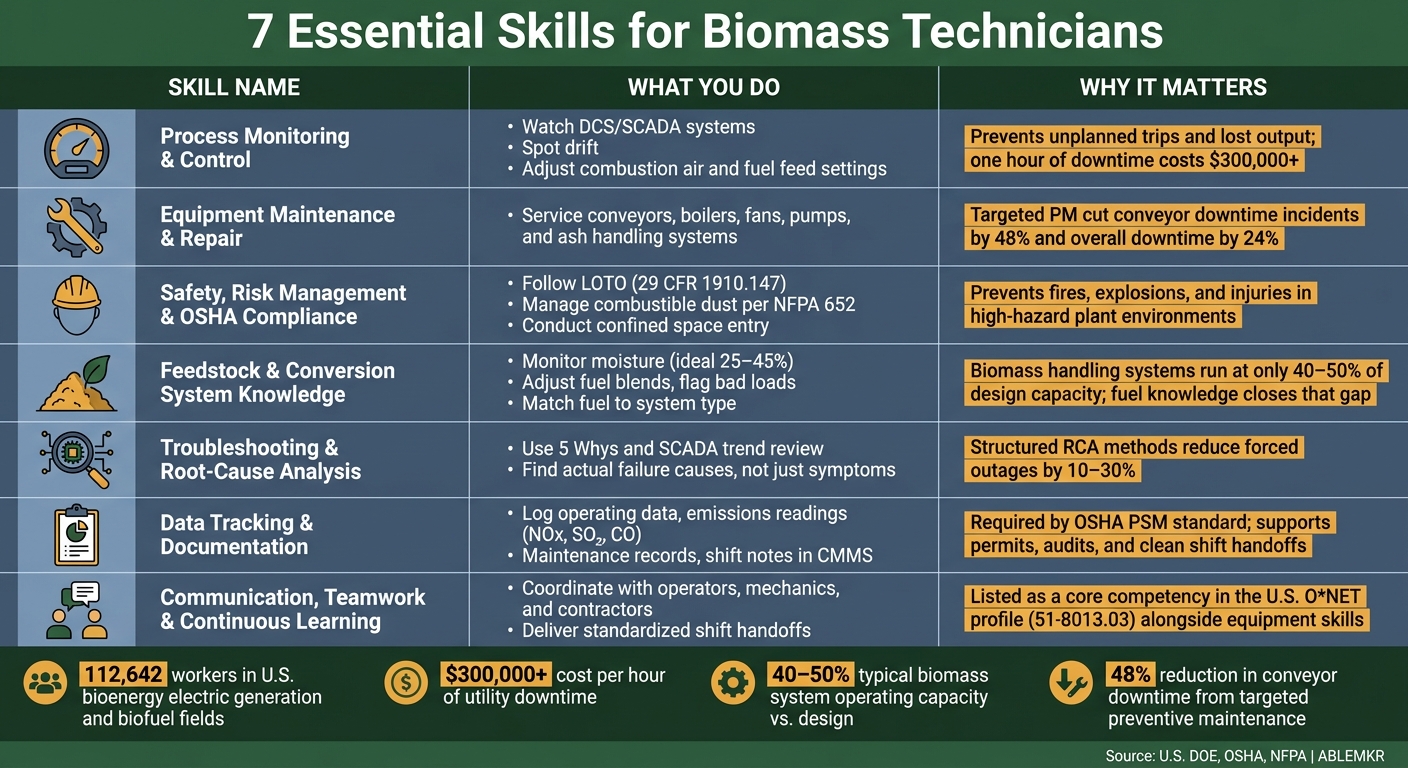
7 Essential Skills for Biomass Technicians: What They Do & Why They Matter
Alternative Energy Plant and System Technicians Career Video
sbb-itb-aa28329
Quick Comparison
| Skill | What I’d use it for | Why it matters |
|---|---|---|
| Process monitoring | Watch DCS/SCADA, spot drift, adjust settings | Helps avoid trips and lost output |
| Maintenance and repair | Work on conveyors, boilers, pumps, fans, ash systems | Cuts breakdowns and lost time |
| Safety and OSHA | Follow LOTO, dust controls, safe work steps | Helps prevent fires, explosions, and injuries |
| Feedstock knowledge | Read fuel quality and match it to the system | Helps keep combustion or digestion steady |
| Troubleshooting | Find the cause, not just the symptom | Cuts repeat failures |
| Data and documentation | Log readings, tests, repairs, and shift notes | Supports permits, handoffs, and audits |
| Communication and learning | Coordinate with operators, mechanics, and contractors | Keeps work clear across shifts |
In short, this article says the job is not just about “running equipment.” It’s about keeping the whole plant steady, safe, and within limits – while building the records and skills that help you move into lead or supervisor roles.
Why Biomass Technicians Matter in the U.S. Energy Transition
The U.S. uses about 342 million tons of biomass each year – including corn grain for ethanol, plus wood and wood waste for heat and power. That adds up to about 5% of U.S. energy demand. In plain English: biomass already plays a big role in the country’s renewable energy mix. For technicians, that scale points to steady work centered on safe, steady plant operation.
One reason biomass matters so much is simple: it’s dispatchable. Unlike wind and solar, it can support around-the-clock output when operators need it. That puts a lot of weight on uptime, fuel handling, and control-room accuracy. It also helps back up other renewable sources while supplying continuous process heat for industries that can’t fully switch to electricity.
Some of the heaviest users are industrial facilities. Sectors such as pulp and paper, food processing, chemicals, and cement rely on biomass for high-temperature steam and on-site power. The EPA has documented more than 750 combined heat and power (CHP) installations using low-carbon fuels – including solid biomass, landfill gas, and digester gas – at sites such as paper mills, landfills, and wastewater treatment plants. In places like these, technicians help keep systems steady while also keeping emissions under control. That matters because industrial low-temperature heat produced 171 million metric tons of CO₂ in 2021, and bioenergy can help cut those emissions in processes that are hard to electrify.
Waste-to-energy is another part of the picture. These plants turn post-recycled, non-hazardous municipal solid waste into electricity. That keeps material out of landfills and helps reduce methane emissions at the same time. In these settings, biomass technicians run incinerators, boilers, and flue-gas cleaning systems. Their work shapes energy recovery, emissions results, and OSHA compliance. Day to day, that means careful monitoring, routine maintenance, and a strong safety mindset.
Across all of these settings – biomass power plants, biorefineries, fuel processing sites, utilities, industrial CHP facilities, and waste-to-energy plants – the technician is the common thread. DOE data shows 112,642 workers in bioenergy electric generation and biofuel sub-technologies across the country. Each workplace calls for a different mix of operations know-how, mechanical skill, and safety discipline. The next seven sections break those skills down.
1. Operations Monitoring and Process Control
This skill comes down to watching plant conditions closely and fixing small drift before it turns into downtime. Biomass technicians spend a big part of every shift on distributed control systems (DCS) and SCADA platforms, following readings like boiler pressure, steam temperature, flue gas oxygen, and fuel feed rates. The job isn’t just to react when an alarm goes off. It’s also to catch patterns early. A slow climb in stack temperature at the same load, for example, can point to fouling long before any alarm fires. That kind of real-time view helps keep combustion steady and the plant on target.
Good monitoring has a direct link to uptime. Plants that combine solid operator training with active process control keep equipment within the right operating range and cut unplanned outages. That’s a big deal in industrial CHP settings, where one boiler trip can shut off needed process heat.
The work goes past screen-watching. Technicians adjust combustion air fans, fuel feed rates, and grate speeds to keep combustion stable. They also manage emissions control equipment like baghouses and scrubbers when readings move off target. During startups and shutdowns, they follow detailed operating procedures to bring systems online or offline safely and avoid problems like thermal stress or water hammer. When numbers drift, the technician has to figure out what’s wrong: is it a controls issue, or is the equipment itself the problem?
Dust control is part of day-to-day monitoring too. Biomass plants deal with fine organic particles that can create explosion hazards, and NFPA 652 requires facilities to complete a Dust Hazard Analysis (DHA). Technicians who know the process and the risk are in a much better position to monitor safely and keep the plant running the same way shift after shift. In practice, dust control often starts with the small things technicians notice, hear, and write down during routine rounds.
2. Equipment Maintenance and Mechanical Repair
Biomass maintenance keeps conveyors, boilers, fans, pumps, and ash handling equipment up and running. Once monitoring shows something drifting out of range, the job shifts from watching to fixing.
Biomass systems are tough on equipment because the fuel is never perfectly uniform. Wood chips, agricultural residues, and pellets all vary in moisture, particle size, and contaminants such as rocks or metal fragments. That swing in fuel quality increases wear and makes clogging more likely, especially in grinders and conveyors. Then you add high heat, abrasive particulates, and corrosive flue gas, and parts wear out faster than they do in many other industrial settings.
That means technicians need more than basic wrench-turning skills. They need strong general mechanical knowledge in areas like rotating equipment, hydraulics, and pneumatics. But they also need biomass-specific know-how: how different feedstocks change hopper flow, affect combustion grates, and impact ash systems. A conveyor that handles clean pellets well might struggle badly with wetter, dirtier material. That kind of difference matters on the plant floor.
The cost of downtime is steep. One analysis of U.S. electric utilities estimates that a single hour of downtime can cost over $300,000, and a typical 5.8-hour outage can reach around $1.7 million in direct losses. That’s why solid maintenance programs matter so much.
A good program usually includes:
- Scheduled preventive maintenance managed in a CMMS, where technicians log work orders and track wear trends
- Predictive tools such as vibration analysis and thermography to spot imbalance or bearing wear in fans, pumps, and turbines before failure happens
- Strict lockout/tagout discipline during repair work
The payoff can be major. Targeted preventive maintenance cut conveyor downtime incidents by 48% and overall downtime by 24%.
Mechanical repair also depends on strict lockout/tagout discipline. Repair work on energized or pressurized equipment must follow lockout/tagout (LOTO) procedures under OSHA 29 CFR 1910. High-performing technicians treat LOTO as non-negotiable, no matter how routine the repair may look. That mindset isn’t just about compliance. It’s about making sure everyone goes home with the same number of fingers they came in with.
Maintenance credentials can help with career growth, too. The NCCER Industrial Maintenance Mechanic (Levels I–III) and NCCER Power Generation Maintenance Mechanic certifications cover lubrication, bearing and coupling installation, precision alignment, and troubleshooting. Those skills map directly to biomass plant work. The SMRP Certified Maintenance & Reliability Technician (CMRT) shows skill across preventive, predictive, and corrective maintenance.
3. Safety Procedures, Risk Management, and OSHA Compliance
Once technicians shift from monitoring equipment to working on it, the risk level climbs fast. Biomass plants can be dangerous places. Combustible dust, pressurized systems, high temperatures, and stored fuel mean a small error can spiral into a major event. A 2025 fatal explosion at a Nebraska wood-based biomass facility showed just how deadly dust hazards can become.
The biggest hazard is combustible dust. Biomass dust can build up inside conveyors, silos, and baghouses. And when the conditions line up, it can ignite with violent force. OSHA addresses combustible dust through the General Duty Clause and other standards, while NFPA 652 and NFPA 660 give biomass facilities the technical guidance they use for dust safety.
This is where day-to-day plant work matters. Technicians should support the DHA by tracking dust buildup, ignition sources, and control measures like venting, spark detection, and housekeeping. Put simply, dust control isn’t just something you deal with during an audit. It’s a daily operating job.
Maintenance work also brings people closer to stored energy hazards. The same repair tasks that help plant uptime can increase exposure if isolation steps aren’t followed. Technicians need to know isolation boundaries and never bypass safeguards.
4. Technical Knowledge of Biomass Feedstocks and Conversion Systems
After operations, maintenance, and safety, technical knowledge is what helps technicians explain the root cause behind plant behavior. Monitoring and safety are part of the job, sure. But technicians also need to know why a plant responds the way it does, and that starts with the fuel.
That’s often the line between an average technician and a strong one. Strong technicians don’t just react to alarms or chase symptoms. They understand what the fuel is doing and can catch feedstock problems before they turn into downtime.
Feedstocks do not behave the same way in a plant. Moisture content, ash content, particle size, and bulk density all shape how biomass burns, gasifies, or digests. Most industrial biomass boilers perform best with moisture levels between 25% and 45%. When moisture gets above about 50%, net heating value drops so much that stable combustion becomes hard to maintain. If a technician knows that, they can spot the issue early instead of burning hours on side effects.
In day-to-day work, technicians use feedstock data to:
- adjust blends
- flag bad loads
- keep combustion or digestion within range
That means fuel knowledge has to match the plant’s conversion process, not just the hardware sitting on site.
Conversion system type also shapes the skills a technician needs. Combustion boilers are sensitive to high ash and low heating value. Gasification systems may handle a broader moisture range in some designs – some units accept feedstock moisture from 6% to 60% – but they are much more sensitive to particle size consistency and ash fusion behavior. When those drift out of range, slagging and bed agglomeration can follow.
Anaerobic digesters are a different story. In those systems, technicians need to track feedstock biodegradability, loading rates, retention times, pH, and digester biology rather than combustion chemistry. Each conversion pathway has its own operating envelope, and technicians need to know that envelope cold.
There’s another point that matters here. Biomass handling systems often run at only 40% to 50% of design capacity, which is far below liquid and gas systems. A lot of that gap comes from feedstock variability and handling problems. Technicians with solid technical knowledge can help close that gap by adjusting feedstock blends, catching quality issues early, and working with fuel suppliers before a bad load reaches the boiler.
The American Biogas Council‘s Digester Operator Certification covers operations experience, safety training, and a formal exam. Vendor training from boiler, gasifier, or digester manufacturers is often the most direct path to broader conversion system knowledge. Employers tend to value technicians who bring both hands-on experience and documented training. That base also makes later certifications easier to earn and simpler for employers to verify.
5. Troubleshooting and Root-Cause Analysis
When monitoring shows drift, troubleshooting is what tells you why it happened. Technical know-how helps you spot normal operation. Troubleshooting explains why the system moved off target.
In biomass plants, that gap matters. The line between a short-term patch and a fix that lasts often comes down to one thing: can the technician find the actual cause of the problem, not just the symptom flashing on the alarm panel?
Root-cause analysis helps cut repeat outages. Structured root-cause methods often report 10–30% reductions in forced outages, which can trim lost revenue and contract penalties.
An alarm, trip, or temperature swing is a clue, not the answer. Take a recurring conveyor motor trip. At first glance, it may seem like a basic electrical fault. But a 5 Whys review might point to misalignment and foundation problems that are driving early bearing failure. That kind of finding leads to a fix that holds, instead of one that buys only a few more weeks.
A good troubleshooting sequence on shift follows a clear path:
- Review alarms and SCADA trends first
- Confirm any lockout/tagout needs
- Stabilize the process if possible
- Move to field inspection
- Check readings with handheld instruments
- Start with the simplest likely cause
- Log each step in the CMMS as you go
That last step matters more than people sometimes think. Logging each action in the CMMS helps confirm the fix and makes repeat failures easier to spot.
CMRT and CMRP back up skills in systematic diagnosis, condition monitoring, and reliability work.
6. Quality Control, Data Monitoring, and Documentation
After troubleshooting, technicians still have work to do: keep the plant inside its normal operating range. Quality control and data monitoring help stop small drifts from turning into full outages. And none of that works well without clean records and steady trend checks.
Biomass technicians are expected to record operating data and test feedstock, fluids, and emissions as part of their core daily work. On the fuel side, that includes feedstock moisture, contamination, ash, and energy content. On the process side, technicians watch boiler inlet and outlet temperatures, steam pressure and flow, flue gas composition (O₂, CO, CO₂), and turbine output. They also track NOx, SO₂, particulate matter, and CO against permit limits, and retain monitoring and calibration records as required.
This is where DCS, SCADA, and lab software come into play. Readings by themselves don’t help much if no one acts on them. The job is to turn those readings into corrective action. A technician who spots a slow rise in bearing temperature or a steady drop in combustion efficiency before an alarm goes off can prevent downtime instead of just reacting to it. Just as important, those records make shift handoffs faster and cleaner.
Documentation matters as much as the data itself. OSHA’s PSM standard requires that every inspection and test on process equipment be fully documented – date, technician name, equipment ID, test description, and results. Daily shift logs, maintenance checklists, and CMMS work orders should record key operating conditions, anomalies, parts replaced, and follow-up actions in a standard format. That gives auditors a cleaner record and gives the next shift a clear picture of plant status. Clear records improve shift handoffs, compliance reviews, and reliability decisions. They also help cross-shift communication and continuous improvement.
7. Communication, Teamwork, and Continuous Learning
Biomass plants run better when technicians communicate clearly, coordinate fast, and keep learning. You can be strong on the equipment side and still struggle on the job if information doesn’t move cleanly from one person to the next. The U.S. O*NET profile for Biomass Plant Technicians (51‑8013.03) lists communicating with supervisors, coworkers, and contractors, active listening, coordination, and continuous learning as core competencies right alongside equipment monitoring and maintenance. Those aren’t side skills. They’re part of the job.
Standardized shift handoffs help keep crews on the same page. A short verbal update, paired with clear written notes on permits, safety issues, and equipment status, gives the next shift the context they need before they touch anything. In a biomass plant, a communication gap can turn into a safety gap in no time.
The same goes for hazard reporting. Clear updates on lockout status and entry conditions help stop avoidable errors before they happen. Hazard communication is both a compliance duty and a day-to-day safety practice. Technicians also need to know exactly who to contact for each type of problem, during routine operations and in an emergency.
Learning can’t be a one-and-done thing. Plants change all the time: feedstocks shift, controls get updated, and regulations change. Technicians who keep learning are better prepared to work with new equipment, avoid old habits that no longer fit, and improve first-time fix rates. It also makes later certification work and career moves easier to track and show on paper.
Operations Control vs. Monitoring at a Biomass Plant
Skill 1 only works when technicians know exactly where monitoring stops and control starts.
These two jobs are connected, but they are not the same. Monitoring means watching SCADA/DCS data and spotting drift early. Control means changing setpoints and equipment settings to keep the plant inside safe operating targets. One feeds the other. Monitoring gives control the signal, and control confirms whether that signal was right.
In plants where these roles are split, the control-room operator is the one who makes the setpoint changes. That line matters. If a monitoring technician sees a slow bed temperature drop at the same time CO is climbing, they can warn the control operator before combustion starts to lose stability. That handoff is what helps keep combustion steady when fuel conditions shift.
Role-based DCS access also cuts the risk of unauthorized setpoint changes and supports safer plant operation. When monitoring and control stay in sync, the plant tends to run with more stable combustion, steadier steam production, and better overall efficiency.
Preventive Maintenance vs. Corrective Repair
In biomass operations, technicians have to figure out if a task is about stopping a problem before it starts or fixing one after it happens.
Preventive maintenance is planned work done on a set schedule or based on equipment condition to lower the risk of failure. Corrective repair is unplanned work that happens after an alarm, breakdown, or drop in performance. And in the field, the line between the two isn’t always neat. A routine inspection can turn into a repair during the same outage window.
Here’s the difference in plain terms:
- Preventive maintenance keeps equipment ahead of failure. For example, servicing a screw conveyor before wear turns into a jam.
- Corrective repair gets equipment back up and running after a fault. For example, replacing a broken conveyor chain after an unplanned stop.
Biomass equipment tends to wear out faster because of moisture, ash, vibration, and corrosion. That’s why preventive maintenance matters so much. It helps protect uptime, efficiency, and compliance.
If the same repairs keep showing up, it’s usually a sign that the team needs to look past the symptom and find the root cause.
Key Safety and Technical Certifications for Biomass Technicians
Credentials do more than make a résumé look stronger. In a biomass plant, they often decide whether a technician can work on their own at all.
That’s because these credentials show that a technician has the skills needed for operations, maintenance, safety, and troubleshooting. And the best ones line up with the hazards and day-to-day jobs technicians deal with on every shift.
A good starting point is OSHA 10-Hour General Industry for entry-level technicians. For team leads and supervisors, OSHA 30-Hour General Industry is the better fit. Both set the safety baseline most plants want to see before someone starts working without close oversight.
General safety training is only part of the picture. Biomass plants have plenty of equipment and spaces that can turn risky fast, so task-based training matters just as much. LOTO and confined-space training are essential for service work on conveyors, boilers, silos, hoppers, and tanks. One thing to know: OSHA does not issue LOTO cards. Employers have to document the training and the worker’s evaluation.
Industrial maintenance certificates help turn hands-on ability into something an employer can check fast. They cover core skills like mechanical systems, electrical work, PLCs, rigging, and safety. For hiring managers, that documented proof can save time. For technicians, it can make the path into the job a lot smoother.
If you’re thinking about moving up, an associate degree in Renewable Energy Technology or Power Plant Technology can help open the door to control room, lead, and supervision roles. In some states, technicians who operate boilers directly also need a boiler operator license.
Here’s how each credential lines up with the job it supports:
| Credential | Typical Use | Who Needs It |
|---|---|---|
| OSHA 10-Hour General Industry | Entry-level safety baseline | Entry-level workers and contractors |
| OSHA 30-Hour General Industry | Advanced hazard recognition, program oversight | Lead techs and shift supervisors |
| LOTO Training (29 CFR 1910.147) | Safe energy isolation during maintenance | Anyone servicing equipment |
| Confined Space Training (29 CFR 1910.146) | Safe entry into silos, boilers, tanks, and hoppers | Technicians working in enclosed process areas |
| Boiler Operation Coursework / License | Steam generation, combustion control, safety devices | Technicians assigned to boiler rooms or high-pressure systems |
| Industrial Maintenance Certificate | Mechanical, electrical, PLC, and safety skills | Entry-to-mid-level technicians |
| Renewable Energy / Power Plant Technology A.S. | Broad power generation and systems knowledge | Technicians targeting control room or lead roles |
Career Growth and Credential Visibility for Biomass Technicians
Once technicians learn the core plant skills, the next step is simple: prove those skills on paper and on the job.
Most biomass technicians come up through hands-on training, not a four-year degree. More than 60% hold only a high school diploma, about 25% have a post-secondary certificate, and fewer than 10% have some college. So when employers decide who to hire, promote, or send to a site, academic background often matters less than certifications and documented training.
That matters even more now because demand is growing, and employers are screening more closely for verified safety and technical credentials. In plain terms, if two people look similar on the surface, the one with clear, current records usually has the edge. That’s where digital credential tracking starts to matter.
Digital credential records can speed up hiring and deployment. When certifications, training completions, and licenses are stored in a digital format, technicians can share proof of training with more than one employer without the usual back-and-forth. ABLEMKR can support that process by connecting verified workers to jobs based on certifications, safety training, availability, and location. That helps technicians get to shutdowns, outages, and plant startups faster.
With those records in place, entry-level workers have a clearer path into roles with more responsibility. Documented training can help support moves into lead maintenance, control room operator, or shift supervisor positions. Plant managers also pay close attention to the day-to-day stuff: reliable attendance, a clean safety record, and active participation in safety programs. Those are often the signals that someone is ready for more responsibility.
Technicians tend to move up faster when their credentials are current, organized, and easy to verify.
Conclusion
Biomass technicians wear a lot of hats. They blend operations, maintenance, and safety into one job, and no single skill carries the whole load. What sets apart an entry-level technician from someone who moves into a lead operator, maintenance lead, or shift supervisor role is a balanced mix of skills: operations, maintenance, safety, troubleshooting, quality control, communication, and continuous learning.
That mix is what turns a first job into a career that lasts. Most biomass roles begin with a high school diploma or GED, then grow through hands-on work and verified credentials.
Use those seven skills as a roadmap. Start with one gap and work on it over the next few months or over the next year. That could mean enrolling in a power plant operations course, taking part in a planned outage, or earning a safety certification. Small, steady steps add up over a 12–24 month period.
Once the skills are there, visibility starts to matter. Employers want verified technicians who can work safely from day one. Keeping credentials current, documented, and easy to verify helps put you in front of those openings. On ABLEMKR, current credentials, availability, and location data help match technicians to shutdowns, outages, and new projects faster. Technicians who keep learning and keep credentials current tend to move ahead faster.
The strongest technicians bring together skill, safety discipline, and current credentials.
FAQs
What does a biomass technician do each day?
A biomass technician helps operations teams by moving materials, handling routine upkeep, and supporting work at power generation sites. Their day-to-day work helps keep equipment running well so the facility can produce renewable energy.
They also use mechanical and maintenance skills to keep biomass equipment and site infrastructure in working order while following safety protocols and regulatory compliance rules.
Which certifications help most in this role?
The most helpful certifications blend safety with hands-on technical know-how.
For many jobs in the U.S., OSHA 10-hour or OSHA 30-hour Construction Safety is a core credential. It helps with site access and shows you understand hazard recognition on active job sites.
On the technical side, Certified Renewable Energy Professional (REP) can strengthen your credibility. So can NCCER Industrial Maintenance Mechanic or NCCER Electrical certifications. These signal relevant biomass, mechanical, and electrical skills that employers often want to see.
How can I become a biomass technician?
Start with a solid base in renewable energy. For many people, that means a trade school or community college certificate program that includes hands-on training, not just classroom work.
Then build on that base with OSHA 10 or 30 and other job-ready credentials. If you already have a background in mechanics, electrical work, or industrial maintenance, that can help a lot. Employers also look for certifications like NCCER and the AEE’s Renewable Energy Professional (REP).


