
The renewable energy sector is growing fast, with global jobs reaching 16.2 million in 2023 – an 18% rise from 2022. But this growth comes with a challenge: a major talent gap. By 2030, the industry will need 1.1 million construction workers, 1.7 million maintenance professionals, and 1.3 million leadership hires. Companies must act now to attract and retain skilled workers while competing with oil and gas firms offering higher pay.
Here are 7 recruitment strategies to tackle these challenges:
- Partner with Specialized Recruiters: Use experts to fill niche roles and scale hiring efficiently.
- Collaborate with Training Providers: Build long-term pipelines through universities and vocational programs.
- Leverage Digital Platforms: Focus on industry-specific job boards for targeted hiring.
- Strengthen Employer Branding: Showcase your mission and career growth opportunities to attract value-driven candidates.
- Offer Competitive Pay and Flexibility: Highlight total compensation packages and work-life balance options.
- Expand Referral Networks: Use employee referrals to find high-quality, trusted candidates.
- Adopt Mobile-First Workforce Tools: Streamline hiring and compliance for remote and field-based roles.
These strategies combine immediate fixes, like digital platforms and referrals, with long-term solutions, such as training partnerships and employer branding. The goal? Build a workforce ready to meet the growing demand for clean energy jobs.
Building a Clean Energy Workforce: Strategies for Recruitment and Growth
1. Partner with Specialized Renewable Energy Recruiters
When it comes to niche roles like grid integration engineers or solar project managers, generalist recruiters often fall short. These positions demand a level of expertise and screening that goes well beyond simply matching keywords on a résumé.
"Generalist hiring approaches rarely work in niche technical industries. Recruitment partners with sector expertise enhance reach, save time, and lower risk." – Mackinnon Bruce
Specialized recruiters bring deep technical knowledge and access to passive candidates who may not be actively job hunting. They understand the full project lifecycle – from development to operations and maintenance (O&M) – and can evaluate candidates based on the specific skills required. Plus, they maintain robust pipelines for hard-to-fill roles, so when a project needs to scale quickly, they’re already prepared.
It’s also important to understand the difference between traditional headhunters and Recruitment as a Service (RaaS) models. Traditional search firms typically charge 20% to 30% of a candidate’s first-year salary per hire. While this might work for one-off placements, costs can add up fast when filling multiple roles. In contrast, RaaS providers use a monthly or project-based subscription model, offering an embedded recruiting capability that adjusts to your hiring needs. This flexibility makes RaaS a better fit for the fluctuating demands of renewable energy projects.
| Feature | Traditional Headhunters | Recruitment as a Service (RaaS) |
|---|---|---|
| Cost Structure | Per-hire fee (20–30% of salary) | Monthly or project-based subscription |
| Scalability | Challenging to scale quickly | Built for project cycles |
| Focus | Filling individual roles | Developing long-term hiring strategies |
| Integration | External/transactional | Embedded within your HR team |
Here’s the key takeaway: involve your recruiting partner early in the process – ideally during the project planning phase. Hiring cycles in renewable energy can take six months or more, and waiting until the last minute puts you at a disadvantage. This is especially true when competing with oil and gas companies that often have deeper pockets for compensation.
Next, we’ll look at how partnerships with training providers can expand your talent pool even further.
2. Build Partnerships with Training Providers and Universities
Specialized recruiting helps tap into today’s talent pool, but partnerships with training providers and universities ensure a steady flow of skilled workers for the future. Collaborating with community colleges, vocational programs, and universities allows renewable energy companies to influence curricula, ensuring graduates are well-prepared for industry needs.
"Developing long-term alliances with educators will help meet recruitment needs and align training programs and curricula with the demands of the marketplace." – Janell Hills-Thomas, Senior Director for Equitable Workforce Strategies, Interstate Renewable Energy Council
Interestingly, over half of solar jobs don’t require a four-year degree. This makes community colleges and trade schools essential for training workers like installers, field technicians, and electricians. In fact, about 70 million U.S. workers acquire their skills through military service, on-the-job training, or community college programs. These partnerships create a strong talent foundation, complementing other recruitment methods discussed later.
Take ReVision Energy, for example. They developed a Registered Apprenticeship program aimed at building future managers, showing how apprenticeships can go beyond technical roles. Another example is Trane Technologies, which hired Cale Simmons – a Navy electronics veteran – who transitioned into a Regional Service Leader position without a formal degree.
"Companies benefit immensely when they focus on what people can do rather than where they went to school." – Cale Simmons, Technician Productivity Leader, Trane Technologies
To go a step further, consider hosting career taster days that give students hands-on exposure to installations. Pair these with webinars and social media outreach to engage students early on. By the time they graduate, your company could already stand out as a top choice. Building these partnerships not only strengthens your workforce pipeline but also ensures you’re ready to meet the evolving demands of renewable energy projects.
3. Use Digital Platforms and Industry Job Boards
Digital platforms make hiring faster by connecting you with active candidates, complementing the longer-term strategies mentioned earlier.
When it comes to job boards, prioritize niche platforms. General sites like Indeed or LinkedIn often blend unrelated roles, making it harder for your job postings to stand out. Instead, specialized platforms such as Energy Jobline, Green Workforce Connect, and Renewables Forward Jobs are designed to attract professionals with expertise in solar, wind, and building performance.
As Luisa Espinosa, an HR and People Strategy leader at Amplēo, explains:
"Posting jobs and hoping for the best isn’t a recruitment strategy. It’s a gamble."
These targeted platforms allow you to focus your efforts on candidates with the specific skills needed for renewable energy projects.
You can also leverage industry association portals to refine your search. Groups like the Solar Energy Industries Association (SEIA) and the Energy Storage Association (ESA) offer job boards that often include built-in candidate assessment tools. These resources help ensure your job postings reach well-qualified applicants. If you’re aiming to diversify your workforce, tools like the HBCU database and the Women & Minority-Owned Business Database can expand your candidate pool.
While niche platforms are essential, LinkedIn remains a valuable tool – not just for posting jobs, but for engaging passive talent. Sharing updates about your projects or highlighting employee stories can showcase your company’s mission and appeal to professionals who may not be actively job hunting. As Kurt Vosburgh from MSH advises:
"If you want to win top talent in renewable energy you need to treat recruitment like a sales process. Know your why."
Finally, make sure your job postings are mobile-friendly. Many renewable energy workers – such as installers, field technicians, and electricians – spend most of their time in the field, not at a desk. Overly complicated desktop applications could discourage them from applying. By focusing on mobile optimization, you’ll improve accessibility and set the stage for even broader recruitment efforts in the next strategy.
4. Build Employer Branding Around Mission and Growth
When candidates come across your job posting, one of their first thoughts is, "Why should I work here?" In the renewable energy sector, this question carries extra weight. 80% of Gen-Z employees prioritize working for companies whose values align with their own. And this isn’t just a Gen-Z trend – it’s becoming important across all levels of experience. To stand out, you need to communicate your mission clearly and effectively, laying the groundwork for a strong employer brand.
Matt Nicholson of NES Fircroft emphasizes this idea:
"Employer brand is the face of an organisation in terms of recruitment… it’s the most crucial factor when attracting candidates who align with that company’s mission."
Instead of relying on broad terms like "decarbonization pathways", focus on tangible results. Highlight achievements such as megawatts of clean energy delivered, tons of carbon emissions reduced, or communities positively impacted. A regularly updated sustainability statement on your website can go a long way in proving your commitments are genuine. Platforms like LinkedIn or X (formerly Twitter) are great for sharing employee stories, offering potential hires a glimpse into your company culture.
But mission alone isn’t enough. To truly build a compelling employer brand, you need to showcase clear career progression opportunities. If candidates can’t see a future with your company, they’ll move on to one that can provide that vision. Michael Isle of CSG Talent puts it plainly:
"If candidates can visualise their future at a company, they are more likely to be attracted to and work for them."
Providing visible career tracks can make a huge difference. It’s not just about managerial roles – technical specialists also want to see opportunities to grow their expertise. One particularly effective strategy is to highlight field-to-office pathways. For instance, demonstrate how a solar installer or wind technician can transition into project management roles within three to five years. This reinforces your company as a place where employees can build long-term, rewarding careers.
sbb-itb-aa28329
5. Offer Competitive Pay, Benefits, and Flexibility
Attracting top talent in the renewable energy sector goes beyond branding and digital outreach – it demands competitive compensation. With the renewable energy workforce growing about three times faster than the rest of the U.S. job market, the competition for skilled professionals is intense.
One major hurdle is competing with the salaries offered by traditional energy companies. Oil and gas firms often pay 20% higher base salaries than renewable energy employers. Ignoring this gap can result in losing strong candidates. However, rather than focusing solely on matching base pay, it’s smarter to highlight the entire compensation package. As Luisa Espinosa, HR and People Strategy leader at Amplēo, explains:
"The companies losing candidates aren’t necessarily paying too little. They’re often failing to articulate why their opportunity is worth more than the sum of its salary."
This is where framing total rewards becomes essential. Instead of just emphasizing base salary, showcase the full offering: equity or profit-sharing options, bonuses, comprehensive health and retirement plans, and professional development budgets. For growth-stage companies, equity with clear vesting schedules can be a game-changer. Considering 93% of clean energy workers expect career advancement within the next year, pairing competitive pay with clear growth opportunities makes your offer much more compelling.
Flexibility is another critical factor. Many renewable energy projects are in remote locations, which can lead to challenges like relocation and burnout. Offering hybrid work models, flexible schedules, or compressed workweeks can show employees that their work–life balance matters. For office-based and technical roles, explicitly mentioning remote or hybrid options in job listings can significantly broaden your candidate pool. This is especially important when competing with tech companies that have made flexibility a standard benefit.
Finally, consider adding purpose-driven perks. Benefits like paid volunteer time or opportunities to engage in social impact initiatives don’t cost much but strongly appeal to mission-driven candidates who want their work to align with their personal values.
6. Expand Referral and Network-Based Hiring
The renewable energy job market is highly competitive, with specialists often receiving multiple recruitment pitches every week. In this environment, relying solely on cold job postings simply doesn’t work. Referral and network-based hiring offer a more direct way to connect with candidates who come with built-in trust – thanks to recommendations from your existing team.
Employee referral programs are particularly effective in this field. For technical roles like engineers and grid specialists, referrals often bring candidates who are already assessed for both their technical skills and how well they align with your team.
Successful hiring teams don’t wait for candidates to come to them – they make networking a constant effort. This includes attending niche industry events, sharing project successes on LinkedIn, and highlighting employee achievements. These activities help build a network that can support your hiring needs long-term.
"Recruitment is a long-term function, not a reactive task. Investing in the right infrastructure now will support growth as the market continues to evolve." – Mackinnon Bruce
Network-based hiring also plays a key role in succession planning. With only 216,000 workers projected to fill 400,000 renewable energy roles by 2030, having a strong referral pipeline can help avoid last-minute hiring challenges. It also opens doors to candidates with transferable skills from related industries.
To make the most of referrals, combine these programs with targeted outreach efforts aimed at increasing diversity. This approach ensures you’re not limiting your talent pool.
7. Invest in Mobile-First Workforce Deployment and Compliance
Renewable energy projects like solar farms, wind installations, and large-scale battery storage systems are often set up far from urban areas – in deserts, rural plains, or other remote locations. In these environments, workers don’t have the luxury of desk access, making mobile-first workforce platforms essential for smooth operations.
These platforms, especially those with pre-vetted talent pools, can quickly supply qualified candidates for hard-to-fill positions, often within 48 hours. This speed is critical for ensuring utility-scale solar projects hit their tight commissioning deadlines. But it’s not just about staffing quickly – these platforms also simplify compliance with complex regulations.
Renewable energy employers juggle a mix of challenges: multi-state labor laws, OSHA safety requirements, prevailing wage mandates, and contractor classification rules. Managing these manually during rapid crew mobilizations can lead to costly legal risks. By embedding compliance tracking directly into deployment workflows, employers can automate these requirements, reducing errors and ensuring smoother operations.
"Infrastructure isn’t glamorous, but it’s the foundation that makes everything else possible… You can’t scale if every HR task requires manual intervention." – Amplēo
This approach lays the groundwork for scaling efficiently, especially when managing remote and distributed project sites.
One example is ABLEMKR, a mobile-first platform that matches pre-vetted workers to job sites based on certifications, safety training, availability, and location. It also integrates payroll and compliance tracking into a single system. For renewable energy operators managing crews across multiple states, this end-to-end visibility eliminates much of the friction associated with traditional workforce deployment.
Another key feature to prioritize is offline functionality. Workers in remote areas often face limited or no internet connectivity. A platform that depends on a stable connection to log safety documentation or confirm shifts can create critical gaps – precisely where seamless operations are most needed.
Comparison Table
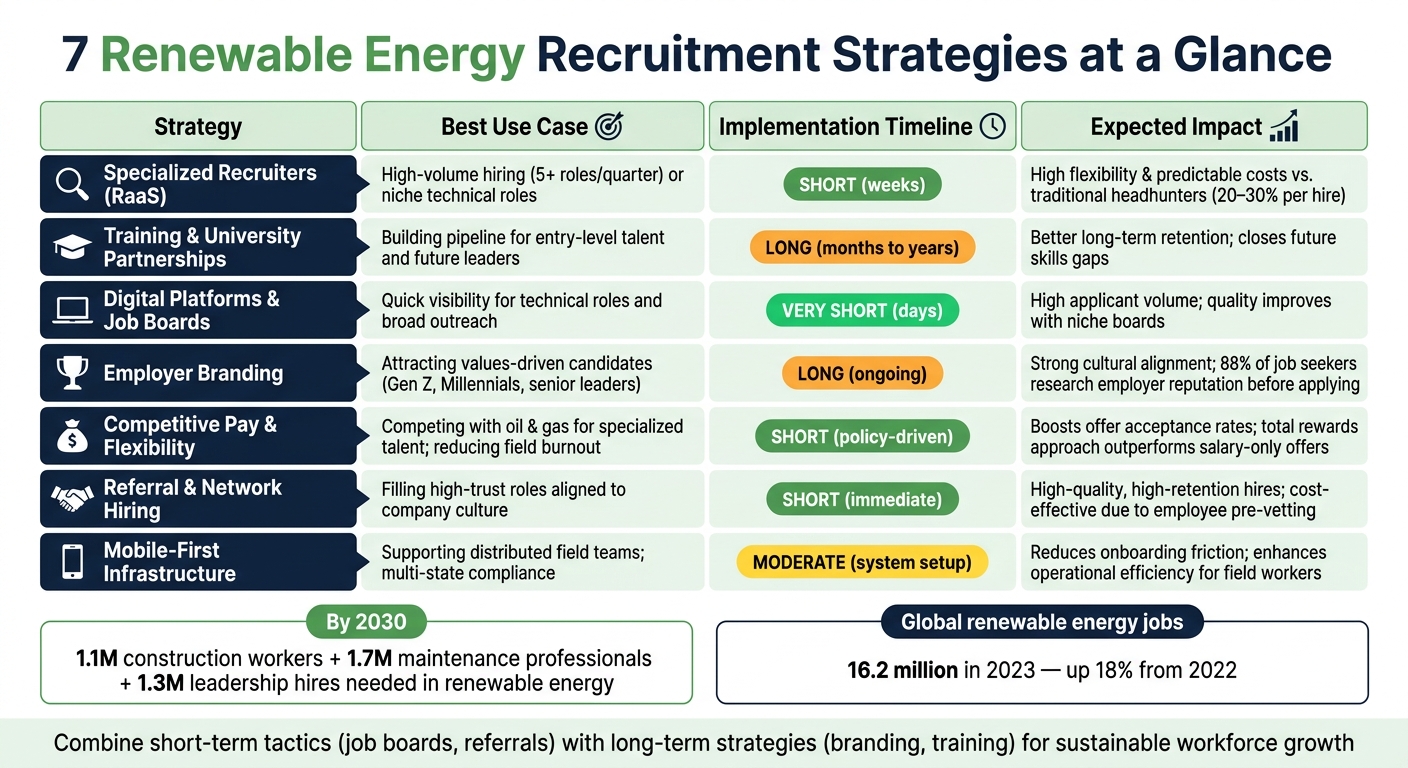
7 Renewable Energy Recruitment Strategies: Speed vs. Long-Term Impact
The table below highlights the best use cases, timelines, and impacts for various recruitment strategies.
| Strategy | Best Use Case | Implementation Timeline | Expected Impact |
|---|---|---|---|
| 1. Specialized Recruiters (RaaS) | Ideal for high-volume hiring (5+ roles per quarter) or filling niche technical positions | Short (weeks) | Offers high flexibility and predictable costs, outperforming traditional headhunters (20–30% per hire) |
| 2. Training & University Partnerships | Building a pipeline for entry-level talent and future leaders | Long (months to years) | Leads to better long-term retention and helps close future skills gaps |
| 3. Digital Platforms & Job Boards | Providing quick visibility for technical roles and broad outreach | Very short (days) | Generates a high volume of applicants; quality improves with niche, industry-specific boards |
| 4. Employer Branding | Attracting values-driven candidates, including Gen Z, Millennials, and senior leaders | Long (ongoing) | Drives strong cultural alignment and retention; 88% of job seekers research employer reputation before applying |
| 5. Competitive Pay & Flexibility | Competing with sectors like oil and gas for specialized talent; addressing burnout in field roles | Short (policy-driven) | Boosts offer acceptance rates immediately; "total rewards" approach appeals where salary alone may not |
| 6. Referral & Network Hiring | Filling high-trust roles with candidates aligned to company culture | Short (immediate) | Results in high-quality hires with strong retention; cost-effective due to pre-vetting by current employees |
| 7. Mobile-First Infrastructure | Supporting distributed field teams and ensuring compliance across multiple states | Moderate (system setup) | Enhances operational efficiency, reduces onboarding friction, and mitigates burnout for field workers |
The main takeaway? Balancing speed with long-term impact often requires multiple approaches. Quick solutions like job boards and referral programs can address immediate hiring needs, but they aren’t enough to sustain growth as the sector expands toward an estimated 38.2 million jobs by 2030. On the other hand, strategies like university partnerships and employer branding take time but deliver lasting benefits in employee quality and retention.
For renewable energy operators, the best approach is to combine short-term and long-term strategies. Use fast-acting methods like job boards and referrals to fill immediate gaps, while investing in initiatives like branding and training partnerships to prepare for future talent demands. This layered approach ensures a more sustainable and resilient recruitment process tailored to the industry’s growth trajectory.
Conclusion
There’s no magic formula for securing top talent in renewable energy. The most resilient companies focus on a holistic approach, weaving together sourcing, branding, training, and deployment into a cohesive strategy rather than treating them as isolated efforts. This combination helps address immediate staffing needs while laying the groundwork for long-term workforce stability.
The numbers are striking: by 2030, the sector will need 1.1 million construction workers and 1.7 million maintenance workers. Meeting this demand requires proactive workforce planning that aligns seamlessly with your project pipeline.
Each strategy discussed earlier plays a critical role in this effort. Mission-driven branding attracts candidates who are eager to contribute to a greater purpose. Collaborations with universities and robust upskilling programs help close the skills gap before it becomes unmanageable. Offering competitive total rewards ensures your company stands out in a crowded market, while mobile-first deployment systems ensure that new hires are quickly and efficiently prepared for the job site. Tools like ABLEMKR demonstrate how technology can simplify workforce deployment by combining real-time oversight with streamlined compliance processes, creating a seamless bridge between recruitment and job readiness.
"In a market this competitive, gambling with your workforce means gambling with your project timelines, your growth targets, and your ability to deliver on the energy transition." – Amplēo
Take a moment to assess whether your hiring approach is strategic or reactive. Refine job descriptions to highlight transferable skills, and ensure your onboarding process works smoothly across state lines. By building a recruitment system that integrates sourcing, branding, training, and deployment, you’ll position your company for sustainable success in the rapidly growing renewable energy sector.
FAQs
Which roles should we prioritize hiring for first?
When building your team, think beyond immediate openings. Instead, align hiring decisions with your project’s upcoming demands and your long-term goals. Some of the most sought-after roles right now include solar technicians, wind engineers, battery storage specialists, and energy analysts.
Here’s where you might want to focus:
- Technical experts: Engineers skilled in resource assessment and grid interconnection are essential for ensuring projects run smoothly.
- Operational leaders: Project managers and asset managers play a key role in keeping everything on track.
- Specialized tech professionals: Data scientists and software engineers are increasingly valuable for developing AI-driven energy solutions.
To make the process easier, tools like ABLEMKR can help you efficiently recruit for critical roles.
When should we use specialized recruiters vs. RaaS?
The decision comes down to your specific hiring needs, budget, and project requirements. If you’re looking to fill senior-level or highly specialized positions, specialized recruiters are your best bet, thanks to their industry knowledge and expertise. On the other hand, Recruiting-as-a-Service (RaaS) models work well for quickly scaling teams while keeping costs manageable, especially when you need to fill multiple roles. For urgent staffing needs, platforms like ABLEMKR offer a streamlined solution by matching pre-vetted workers to job sites based on their certifications and availability, helping to cut down on overhead expenses.
How does ABLEMKR speed up field hiring and compliance?
ABLEMKR speeds up field hiring and compliance through a tech-powered platform designed to simplify recruitment. It pre-checks worker credentials and automates compliance verification, ensuring teams are ready to hit the ground running. By cutting out inefficiencies in these processes, companies can deploy skilled workers faster, keeping projects on track and avoiding delays tied to outdated onboarding methods.


