
Managing PPE certifications is easier and safer with the right tools. Manual methods like spreadsheets often lead to errors, missed certification expirations, and costly delays. Digital platforms automate tracking, send alerts, and centralize records, ensuring compliance with safety standards like OSHA 1910.132 and ISO 45001. Companies using these tools report fewer safety violations and improved efficiency.
Key Benefits of Digital PPE Management Tools:
- Automated expiration alerts and reminders.
- Real-time certification visibility for on-site verification.
- Centralized dashboards for compliance tracking.
- Reduced safety violations and project delays.
Top Tools to Consider:
- ABLEMKR: Combines certification tracking with workforce deployment, payroll, and compliance management.
- Fluix: Offers offline forms, GPS tracking, and project management integration.
- SafetyCulture: Provides digital checklists and analytics for identifying safety risks.
- CORE EHS (PPEVault): Tracks stock levels, expiration dates, and safety response times.
- Sortly: Focuses on QR/barcode-based inventory tracking for small teams.
Choosing the right tool depends on your industry, team size, and specific needs. For high-risk sectors like construction and energy, features like mobile access, automated alerts, and integration with existing systems are essential. Tools like ABLEMKR stand out for their workforce-focused approach, while others specialize in equipment management or analytics.
Why Use Software for PPE Certification Management
Better Compliance and Lower Risk
Software platforms provide digital audit trails that track every detail about safety equipment, inspection schedules, and training certifications. When OSHA or ISO 45001 auditors show up, managers can generate audit-ready reports in seconds, avoiding the hassle of manual searches. Some systems even connect with site access badges, automatically disabling entry for workers whose certifications have expired. This ensures that uncertified personnel are kept out of hazardous areas, reducing a major source of liability.
More Efficiency Through Automation
Automated alerts can cut down the time spent on managing certifications by as much as 80%. Instead of manually tracking expiration dates, managers receive reminders 60, 30, and 7 days beforehand, giving them plenty of time to schedule retraining. Tools like QR codes and NFC tags allow supervisors to verify credentials instantly on-site – even in remote areas with limited internet access – by simply scanning a badge or equipment tag. These automation features are especially impactful in industries where safety risks are high.
Benefits for High-Risk Industries
Industries like construction and energy operate under strict regulations, such as LOLER and PUWER, which require specific inspection intervals for heavy machinery and fall protection equipment. Digital platforms make it easier for these companies to quickly deploy compliant teams. Features like labor maps let managers see, in real time, which certified workers are available, ensuring that only qualified personnel are assigned to high-risk tasks. These tools not only improve safety compliance but also help control costs. For contractors juggling multiple sites and subcontractors, a centralized system ensures consistent safety standards across all projects.
sbb-itb-aa28329
How to effectively manage PPE using the PPE Monitoring Tool
ABLEMKR: PPE Certification and Workforce Compliance Platform
ABLEMKR is a mobile-first platform for workforce deployment, tailored for high-risk industries such as construction, oil & gas, mining, and utilities. By automating updates and connecting certified workers to projects, it tackles the challenges of manual certification management head-on. The platform consolidates PPE certification tracking and streamlines the process of assigning pre-vetted workers to projects. Assignments are based on safety credentials, technical qualifications, and location, cutting down on the weeks of manual coordination often required. This streamlined system not only speeds up crew deployment but also ensures a clear and organized view of workforce compliance.
ABLEMKR Features
The platform relies on verified worker profiles that showcase real-time certifications, safety training, and work history. Workers can instantly upload new PPE training completions or certifications through the mobile app. This ensures they’re immediately eligible for jobs requiring those credentials, eliminating delays caused by outdated paperwork.
Employers gain real-time insights into worker compliance and location, allowing them to quickly assemble compliant crews for urgent needs like pipeline shutdowns or scheduled projects. The automated job-matching system assigns workers to tasks based on their certifications, availability, and proximity, ensuring only qualified personnel handle hazardous work. Additionally, ABLEMKR incorporates W-2 processing, workers’ compensation management, and real-time invoicing, simplifying the administrative workload involved in managing compliance across multiple sites.
Another standout feature is the mentorship pairing system, which matches seasoned journeymen with newer workers. Pairing is based on trade specialties, career goals, and communication preferences. This approach helps transfer knowledge effectively, reducing accidents tied to inexperience while addressing the skilled labor shortages many industries face.
What Employers and Workers Get
ABLEMKR offers clear advantages for both employers and workers.
For employers dealing with multiple job sites and subcontractors, the platform centralizes safety and compliance tracking. It maintains consistent safety standards across projects and provides tools to monitor hours, productivity, and the learning progress of newer staff. This gives managers better control over labor costs and minimizes compliance risks.
Workers, on the other hand, benefit from flexible access to job opportunities and seamless payroll processing. Through the mobile app, they can book appointments, communicate directly with employers, and view detailed job postings, including transparent cost breakdowns. The platform also tracks their career progress, opening doors to growth opportunities. By helping workers transition from entry-level roles to advanced positions like journeymen or foremen, ABLEMKR supports long-term career development in industries where advancement can often feel out of reach.
PPE Certification Management Tools
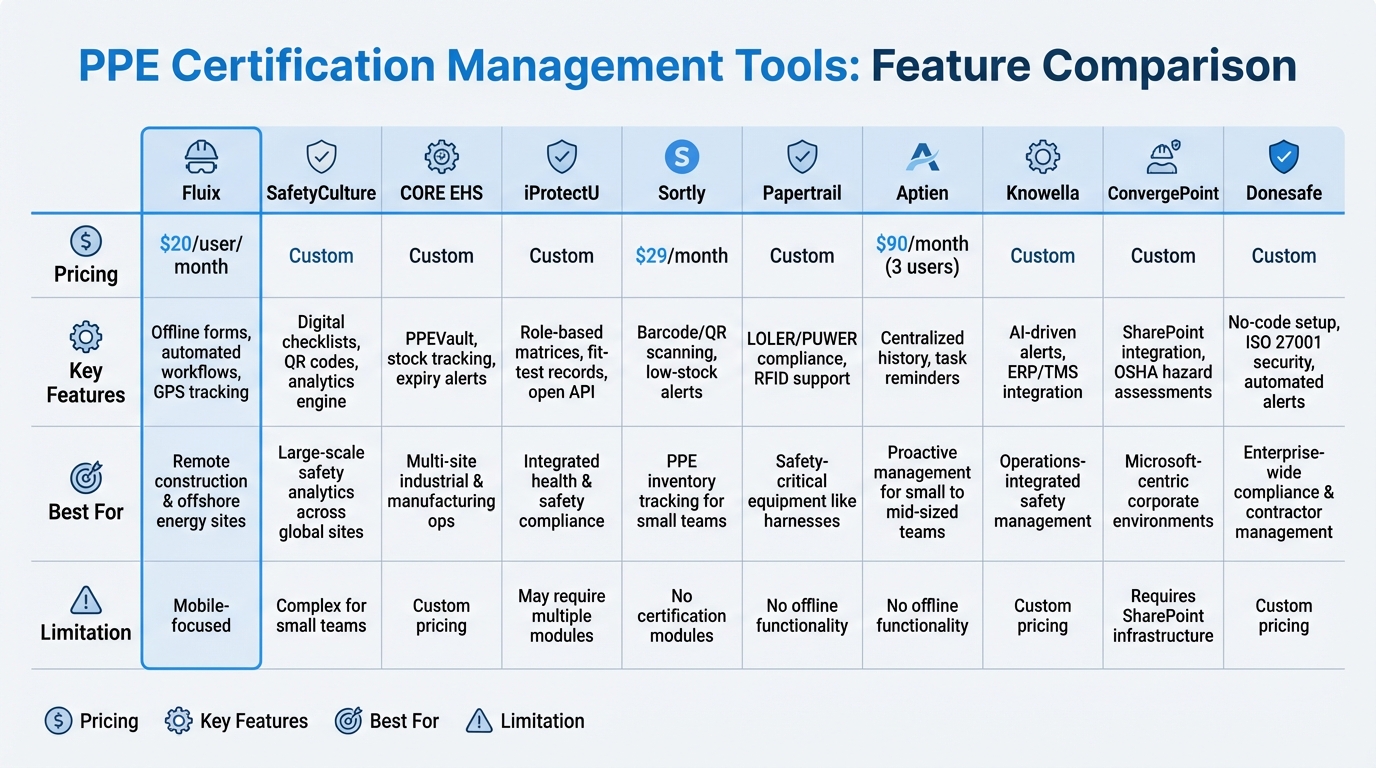
PPE Certification Management Tools Comparison Chart
While ABLEMKR focuses on worker certifications, there are tools specifically designed to manage PPE (Personal Protective Equipment). These platforms handle tasks like tracking equipment, maintaining inspection histories, and organizing compliance records. They cater to different operational needs – ranging from fieldwork and inventory management to regulatory documentation – and work alongside workforce deployment systems to streamline safety processes.
Tool Options
Fluix is priced at $20 per user per month and offers features like offline forms, automated workflows, and GPS tracking. It also integrates with project management tools like Procore, making it a great option for remote construction sites or offshore energy operations.
SafetyCulture provides digital checklists, QR code scanning for instant equipment verification, and an analytics engine to spot recurring safety risks. With 34% of workplace accidents tied to PPE issues, its analytics can help identify and address patterns before they become major problems.
CORE EHS includes a module called PPEVault, designed for industries managing large inventories. It tracks stock levels, sends alerts for expired equipment, and monitors response times for safety issues – claiming a 90% improvement in response efficiency. This makes it ideal for manufacturing and chemical plants.
iProtectU offers role-based PPE matrices that align specific gear with job tasks. It also keeps fit-test records and features an open API for integration with other systems. Users appreciate its ease of use and the positive feedback from employees.
Sortly focuses on inventory tracking using barcode and QR scanning. It sends alerts for low stock and is optimized for mobile access, making it a good fit for smaller teams managing PPE across multiple locations. However, it lacks features for certification and training management.
Papertrail specializes in compliance for safety-critical equipment, supporting LOLER and PUWER regulations. It uses RFID and barcode scanning to track items like harnesses and rigging gear and imports manufacturer data directly. However, it does not work offline.
Aptien centralizes equipment history and includes automated task reminders. Starting at $90 per month for three users, it’s aimed at small to mid-sized teams but does not offer offline functionality.
Knowella uses AI to flag risks and generate usage reports. It integrates with ERP and transportation management systems, making it a strong choice for operations-focused safety management.
ConvergePoint integrates with SharePoint and emphasizes OSHA compliance. It links incident reports directly to PPE records, making it particularly suitable for organizations already using Microsoft tools.
Donesafe features a no-code, modular design that allows businesses to customize compliance workflows. It adheres to ISO 27001 security standards and automates safety issue escalations. Pricing is tailored to the needs of each business.
Feature Comparison
| Tool | Pricing | Key PPE Features | Best Use Case | Limitations |
|---|---|---|---|---|
| Fluix | $20/user/month | Offline forms, automated workflows, GPS tracking | Remote construction and offshore energy sites | Mobile-focused |
| SafetyCulture | Custom | Digital checklists, QR codes, analytics engine | Large-scale safety analytics across global sites | Complex for small teams |
| CORE EHS | Custom | PPEVault, stock tracking, expiry alerts | Multi-site industrial and manufacturing ops | Custom pricing |
| iProtectU | Custom | Role-based matrices, fit-test records, open API | Integrated health & safety compliance | May require multiple modules |
| Sortly | $29/month | Barcode/QR scanning, low-stock alerts | PPE inventory tracking for small teams | No certification modules |
| Papertrail | Custom | LOLER/PUWER compliance, RFID support | Safety-critical equipment like harnesses | No offline functionality |
| Aptien | $90/month (3 users) | Centralized history, task reminders | Proactive management for small to mid-sized teams | No offline functionality |
| Knowella | Custom | AI-driven alerts, ERP/TMS integration | Operations-integrated safety management | Custom pricing |
| ConvergePoint | Custom | SharePoint integration, OSHA hazard assessments | Microsoft-centric corporate environments | Requires SharePoint infrastructure |
| Donesafe | Custom | No-code setup, ISO 27001 security, automated alerts | Enterprise-wide compliance and contractor management | Custom pricing |
These tools complement ABLEMKR by focusing on the physical aspects of PPE management – like tracking equipment and scheduling inspections. Meanwhile, ABLEMKR handles the human side, such as worker certifications and job assignments. Thanks to open API integration, data flows seamlessly between systems, ensuring safety records stay current and accurate across the board.
How to Choose the Right Tool
Focus on Compliance and Growth
When selecting a tool, it’s crucial to ensure it supports real-time compliance and can grow alongside your operations. For instance, digital platforms have been shown to cut certificate administration time by up to 80%. Look for systems with features like automated expiry alerts and escalation workflows, which notify both workers and supervisors well before certifications expire. This helps prevent compliance lapses. A modular framework is also a smart choice – start with core features, such as a PPE Manager, and expand to include additional tools like incident reporting or contractor management. These capabilities are especially helpful in tackling the unique challenges of high-risk industries.
What High-Risk Industries Need
High-risk industries, such as construction, energy, and extractives, require tools tailored to their demanding environments. Mobile-first verification is a must, enabling seamless field operations. Features like QR code or NFC-enabled ID badges allow safety officers to instantly verify certifications on-site. Auto-lockout functionality deactivates expired badges, preventing unauthorized access. Offline capabilities are also essential for remote locations, ensuring uninterrupted data entry.
A centralized dashboard can be a game-changer, offering multi-site visibility so managers can track compliance by project or team. This kind of system can result in up to 90% faster acknowledgment of issues and 60% faster resolution of safety concerns. Platforms like ABLEMKR take it a step further by integrating certification tracking with workforce deployment, payroll, and onboarding, streamlining operations and boosting efficiency.
Conclusion
Managing PPE certifications doesn’t need to rely on manual tracking anymore. With 34% of workplace accidents linked to PPE issues, having the right platform isn’t just about convenience – it’s a key safety measure. Plus, streamlining these processes improves how quickly and effectively teams can be deployed.
For industries like construction, energy, and mining, the risks are even higher. Workers in these fields often operate in remote areas, face tight deadlines, and require immediate verification of their credentials. That’s where ABLEMKR comes in. Designed specifically for high-risk sectors, it simplifies operations by connecting every part of the workforce deployment process. From matching pre-qualified workers based on their certifications and location to integrating payroll with compliance tracking, ABLEMKR eliminates the delays caused by manual coordination.
Imagine managing a pipeline repair team or mobilizing workers for a mine development project – having real-time visibility into worker certifications means faster, more confident crew deployment. Features like automated expiration alerts, mobile-friendly documentation, and centralized dashboards keep everyone on the same page. This reduces compliance gaps and prevents costly delays. ABLEMKR’s integrated approach strengthens both safety and efficiency.
FAQs
What should I track: worker certifications or PPE equipment expirations?
Tracking worker certifications and PPE (Personal Protective Equipment) expirations is crucial for maintaining safety and compliance on the job. Certifications verify that employees are qualified and meet regulatory standards, which reduces risks and ensures tasks are performed correctly.
At the same time, keeping an eye on PPE expiration dates ensures that protective gear remains effective. Outdated equipment can compromise safety, increasing the likelihood of accidents or injuries.
By staying on top of both, you’re not just meeting compliance requirements – you’re actively creating a safer, more efficient workplace for everyone.
How do I verify PPE credentials on-site without internet access?
Verifying PPE credentials in areas without internet access is entirely doable with tools designed for offline use. For instance, platforms like ABLEMKR let supervisors retrieve stored certification details directly on their mobile devices. This means checks can happen smoothly, even in remote locations. Once the device reconnects to the internet, updates are synced automatically. These tools prioritize safety by keeping essential data locally accessible, ensuring credential checks remain hassle-free no matter the connectivity situation.
What integrations matter most for a PPE certification tool?
The most impactful integrations for a PPE certification tool focus on real-time tracking, simplifying compliance processes, and enabling effortless data sharing. These tools often include features like automated alerts for upcoming certification expirations, QR code or mobile app scanning for quick verification, and integration with workforce or inventory management systems. Such capabilities help safety managers stay on top of compliance, minimize manual mistakes, and keep records current – especially critical in industries like construction and energy where safety is non-negotiable.


