
The U.S. battery industry is expanding fast, driven by rising electric vehicle (EV) demand and the push for domestic energy storage solutions. By 2030, over 310,000 jobs are expected in lithium-ion battery manufacturing, but a lack of skilled workers remains a challenge. Key initiatives address this gap through training, apprenticeships, and workforce platforms. Here’s a quick overview of the most impactful efforts:
- National Programs: The Department of Energy’s Battery Workforce Initiative (BWI) sets national apprenticeship standards and safety-focused training. The Battery Workforce Challenge prepares students for advanced EV battery roles.
- Regional Efforts: Programs like Arkansas Lithium Technology Accelerator (ALTA) and New Energy New York (NENY) connect local industries, startups, and universities to train workers and drive innovation.
- Workforce Platforms: Tools like ABLEMKR streamline hiring by matching certified workers with battery manufacturing projects, reducing delays in workforce deployment.
While these programs build skills, retaining and attracting talent remains critical. Digital platforms are bridging the gap between training and job placement, ensuring the workforce can meet the industry’s rapid growth.
Webinar: The Future-Charged Workforce: Adapting to Change in the Battery Industry
National Workforce Development Programs
The federal government has introduced major initiatives to tackle the shortage of skilled workers in the battery sector. These efforts aim to standardize training, define clear career pathways, and coordinate efforts across multiple agencies. These national programs lay the groundwork for the regional initiatives that follow.
Battery Workforce Initiative (BWI) by U.S. Department of Energy
With an initial $5 million investment, the Battery Workforce Initiative is a collaborative effort led by the Department of Energy (DOE), in partnership with the Department of Labor (DOL) and the Department of Education. The goal? To create a skilled workforce tailored to the battery manufacturing industry’s needs. By bringing together key players, including manufacturers and organizations like the UAW, the initiative ensures that training programs align with industry demands.
The DOE and DOL have introduced National Guideline Standards for battery machine operator apprenticeships. These standards establish national credentials and prioritize consistent, high-quality training with a strong focus on safety. This move directly addresses the industry’s concerns about skill mismatches. As U.S. Secretary of Energy Jennifer M. Granholm put it:
The Battery Workforce Initiative is part of our whole-of-government approach to revitalize industry and rebuild our economy from the bottom up and the middle out, providing American workers with good paying forward looking careers.
BWI is also expanding its scope to include skill requirements for battery materials processing and recycling. To streamline the process, pre-approved materials are being developed for new training programs. In April 2024, the National Energy Technology Laboratory launched a BWI Pilot Training program, which incorporates employer-based testing to refine training materials for critical roles.
Energy Storage Tech Training at University at Albany
The University at Albany’s Energy Storage Tech Training program offers hands-on education in lithium-ion battery technology and energy storage systems. This program is part of the broader New Energy New York (NENY) initiative, a coalition of over 70 industry partners spanning 27 counties in upstate New York. By tailoring its curriculum to meet national standards, the program ensures participants – whether students or working professionals – gain the skills needed for roles such as battery machine operators.
Battery Workforce Challenge by American Battery Technology Company
The Battery Workforce Challenge, a three-year initiative sponsored by the DOE and Stellantis and managed by Argonne National Laboratory, takes a multi-pronged approach to workforce development. The program focuses on bridging workforce gaps by providing hands-on experience in battery design, simulation, controls, testing, and vehicle integration – skills that go beyond traditional engineering programs.
The challenge is built on four key components:
- Collegiate competition: Students design and build advanced EV batteries for future vehicles.
- Regional Workforce Training Hubs: These hubs collaborate with manufacturers and educational institutions to help transitional workers gain new skills.
- Cloud-based career learning system: This platform connects participants with job opportunities in the automotive and battery sectors.
- STEM education outreach: Programs aimed at middle and high school students introduce them to the field early on.
This comprehensive approach creates opportunities for individuals at every career stage, from high schoolers exploring the field to seasoned professionals transitioning into battery technology. Together, these efforts establish a strong foundation for regional programs to build upon.
Regional Workforce Programs
While national programs lay the groundwork, state and regional initiatives are stepping up with targeted strategies to address workforce challenges specific to local industries. These programs create connections between startups and established manufacturers, provide practical training opportunities, and gather data to guide hiring practices. Two notable efforts showcase how regions are building their battery-focused workforce from scratch, complementing federal programs by addressing unique local needs.
Arkansas Lithium Technology Accelerator (ALTA)
Arkansas is positioning itself as a key player in lithium production by capitalizing on the Smackover Formation, one of North America’s largest lithium reserves. The Arkansas Lithium Technology Accelerator (ALTA), spearheaded by The Venture Center and Standard Lithium with support from the Walton Family Foundation, links early-stage tech companies with lithium producers, academic researchers, and policymakers.
ALTA is the first U.S.-based accelerator program dedicated to lithium innovation and the battery supply chain. In 2025, the program completed two successful cohorts. The first cohort (April 2025) included Nano One, RAM Geothermal, and Telescope Innovations, while the second (December 2025) featured Lithios, Menen Group, and Tyfast Energy. These companies engaged in research visits and workshops across El Dorado, Little Rock, and Bentonville, integrating themselves into Arkansas’s growing lithium ecosystem.
The University of Arkansas plays a pivotal role in workforce development. In October 2025, the university hosted ALTA’s first cohort, facilitating meetings between startup founders and researchers from the Stable Isotope Lab and the Institute for Integrative and Innovative Research. These sessions focused on translating academic expertise in geothermal and battery technologies into real-world industrial applications. Margaret Sova McCabe, Vice Chancellor for Research and Innovation at the University of Arkansas, highlighted the university’s contributions:
The U of A is uniquely equipped to support Arkansas’ lithium initiatives… providing the workforce that will drive success.
Looking ahead, ALTA transitioned to a rolling application model for its 2026 cohorts, with Cohort Three planned for April 2026 and Cohort Four for September 2026. This shift reflects its expanding regional workforce pipeline. The program’s structure includes four key modules – LiTHIUM LEARNS, Research & Innovation, Commercial Partners, and Government & Economic Development – offering clear paths for technical training and policy collaboration.
While ALTA focuses on driving innovation in lithium, the Battery Talent Census offers critical data to align workforce development efforts with industry needs.
Battery Talent Census by Volta Foundation
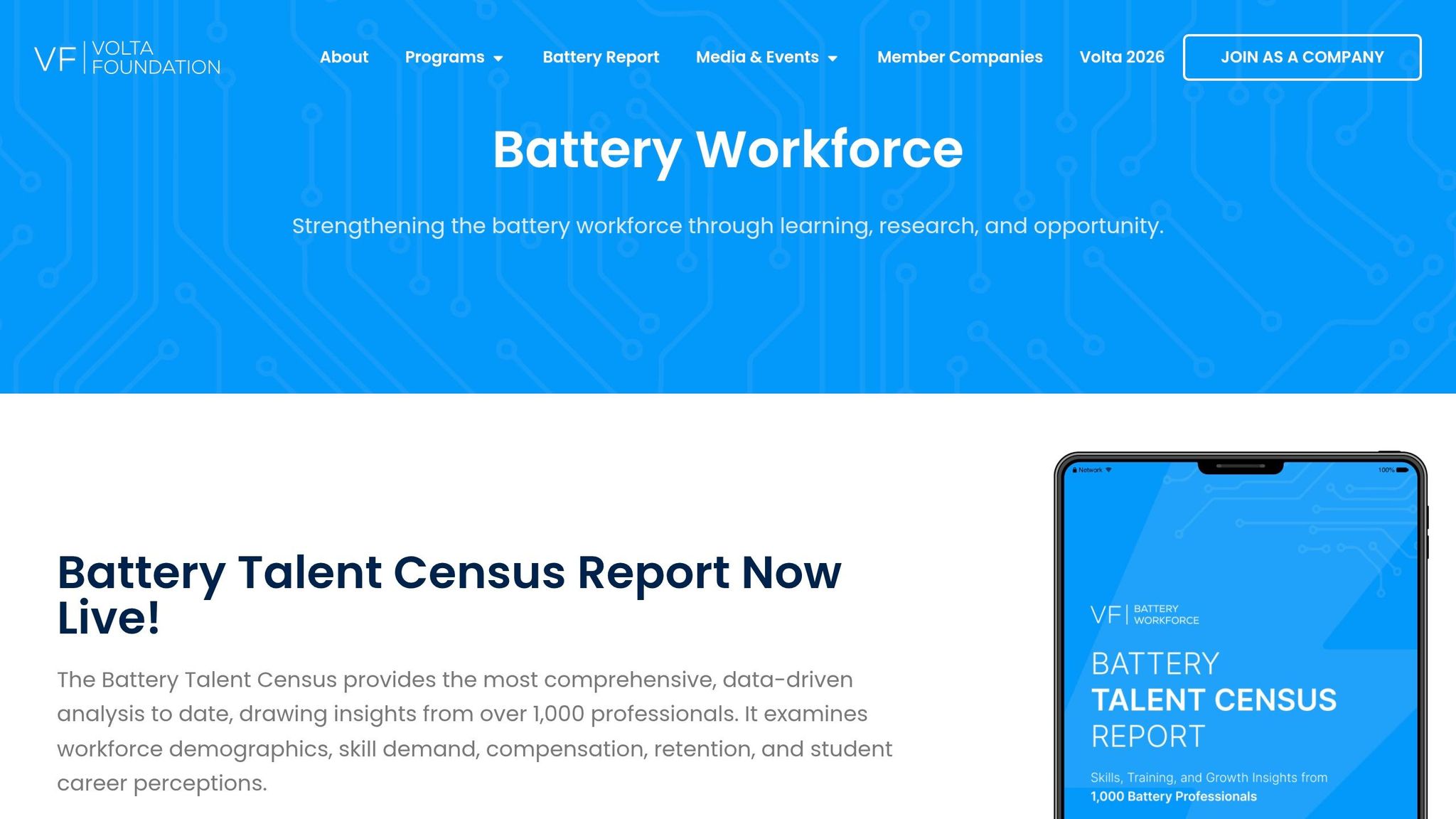
Complementing initiatives like ALTA, the Battery Talent Census provides the first broad, data-driven look at the battery workforce. Led by Volta Foundation Program Directors Wendy Papakostandini and Andrew Weng, the Census gathered insights from over 1,000 professionals, offering a detailed analysis of workforce demographics, skill demands, compensation trends, retention challenges, and student career perceptions. By consolidating previously scattered survey data, it paints a clearer picture of workforce challenges. For instance, over 80% of industry stakeholders report difficulty finding technicians and assemblers with expertise in electrochemistry and mechanical or electrical systems.
The Census also sheds light on diversity gaps: only 10% of the workforce identifies as female, and 80% identify as White or Asian. These findings give employers and educators specific benchmarks to address diversity and inclusion within the industry.
With the lithium-ion supply chain expected to exceed $400 billion by 2030 and create an estimated 310,000 jobs in the early 2030s, the Census equips regional training hubs with the data needed to align educational programs with industry demands. Additionally, the Volta Foundation maintains a "Battery Careers & Workforce" LinkedIn page, keeping the community informed about career fairs and job opportunities.
sbb-itb-aa28329
Workforce Deployment Platforms for Battery Technology
How ABLEMKR Supports Battery Workforce Deployment
With the rapid expansion of the battery industry, the demand for flexible and efficient workforce deployment has never been higher. Digital platforms are stepping up to address this challenge by reducing lengthy hiring processes and organizing worker qualifications in one place.
ABLEMKR offers a mobile-first platform that connects certified professionals with battery manufacturing and energy storage projects across the U.S. Its focus is on technicians and assemblers – roles that are currently in highest demand. The platform matches workers to job sites based on their credentials, safety records, availability, and location. This ensures manufacturers can quickly assemble teams for critical tasks like time-sensitive installations, facility expansions, or production scale-ups. By integrating certified apprenticeship standards for battery machine operators, ABLEMKR ensures workers meet strict safety and technical benchmarks. This approach not only accelerates workforce deployment but also improves operational oversight through the platform’s built-in features.
Platform Features for Employers and Workers
Beyond its advanced matching capabilities, the platform provides a suite of tools designed to benefit both employers and workers. Automated job matching aligns worker certifications with specific project needs, a crucial feature as the industry anticipates creating around 310,000 jobs by the next decade. Employers gain access to real-time updates on worker status through a cloud-based management system.
The platform also addresses compliance by tracking and validating credentials, ensuring workers meet industry standards. As Bob Galyen, Chief Technology Officer for NAATBatt, noted, "Training is the key to a successful battery industry". Additional features like integrated payroll processes and clear cost structures help streamline operations, reducing traditional bottlenecks. Workers, in turn, benefit from flexible scheduling options and guaranteed on-time payments. These features are particularly appealing to a wide range of talent, from recent high school graduates to vocational workers and those transitioning into battery manufacturing roles.
Program Comparison
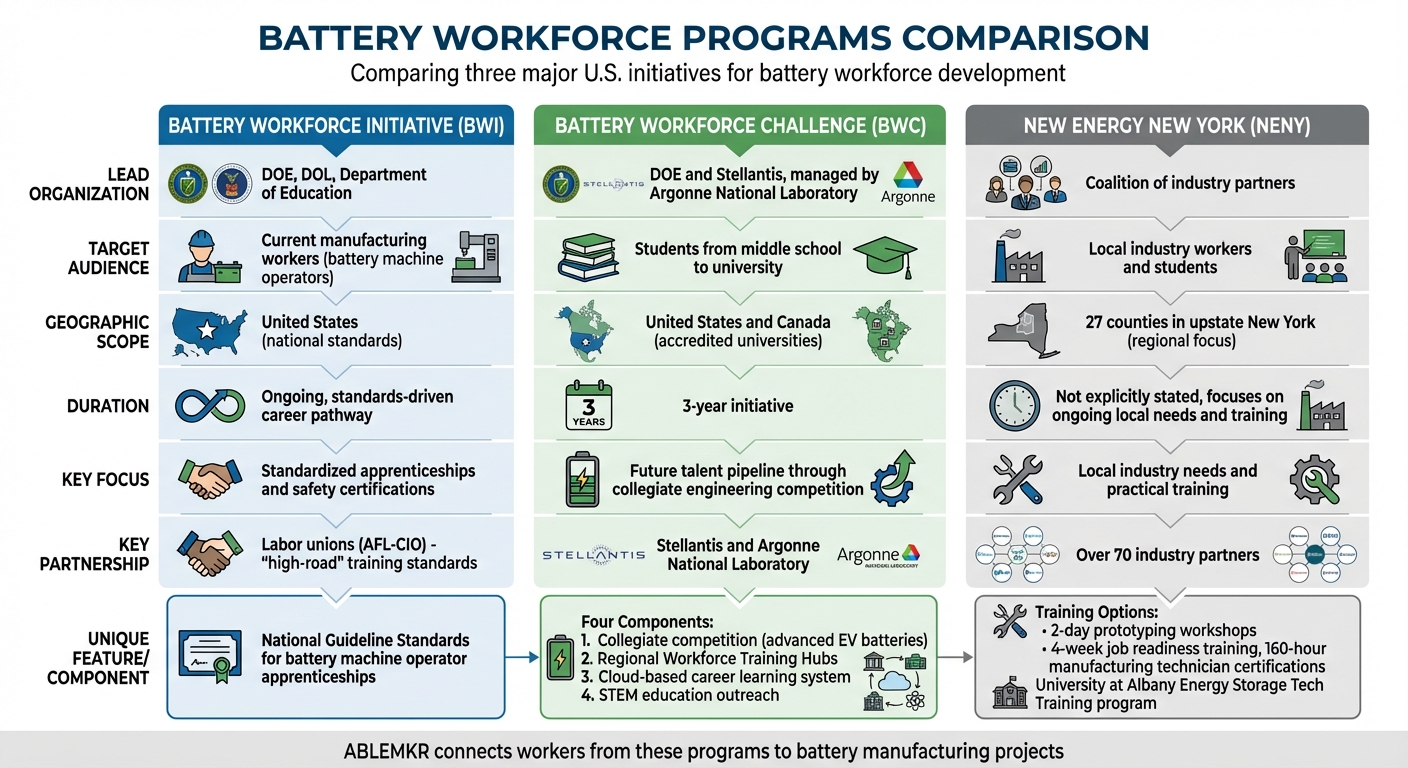
Comparison of Major U.S. Battery Workforce Development Programs
Battery workforce programs vary widely in their strategies, scope, and timeframes. National initiatives like the Battery Workforce Initiative (BWI) focus on current manufacturing workers, such as battery machine operators, by offering standardized apprenticeships and safety certifications. On the other hand, the Battery Workforce Challenge (BWC) looks to the future, cultivating a talent pipeline by engaging students from middle school to university through a three-year collegiate engineering competition.
Geographic scope is another key difference. BWI enforces consistent training standards across the United States. In contrast, the BWC has a broader reach, including accredited universities in Canada, creating a North American collaboration. Meanwhile, regional programs like New Energy New York (NENY) focus on addressing local industry needs, supporting over 70 industry partners across 27 counties in upstate New York.
The duration and audience of these programs also set them apart. BWI provides an ongoing, standards-driven career pathway. In comparison, the BWC centers on a three-year cycle tied to its engineering competition. Regional programs offer diverse options, from two-day prototyping workshops to four-week job readiness training and 160-hour manufacturing technician certifications.
Partnerships highlight additional contrasts in priorities. BWI collaborates with labor unions like the AFL-CIO to establish "high-road" training standards that promote worker safety and career growth. As Liz Shuler, President of AFL-CIO, emphasized:
We look forward to working with DOE and DOL to develop high-road training standards for the entire battery supply chain.
The BWC, by contrast, partners with industry heavyweights like Stellantis and Argonne National Laboratory. Student teams in this program are tasked with designing and integrating advanced EV batteries into functional vehicle platforms, bridging academic learning with practical, hands-on applications.
A critical element tying these efforts together is the use of deployment platforms like ABLEMKR. While educational programs focus on skill-building, ABLEMKR ensures certified workers are quickly connected to active projects. This platform matches worker credentials with employer needs in real time, speeding up the transition from training to workforce engagement. It serves as a vital link between the skills developed through these programs and the industry’s immediate demands for qualified talent.
Conclusion
The U.S. battery industry is growing at a fast pace, fueled by the rising demand for electric vehicles and the push to increase domestic energy storage. Keeping up with this momentum requires a well-coordinated strategy that combines standardized training, skill development tailored to regional needs, and effective workforce placement. National programs like the Battery Workforce Initiative are setting consistent apprenticeship standards, while regional hubs tackle local skill gaps. Meanwhile, efforts like the Battery Workforce Challenge are nurturing talent from middle school all the way to university.
However, even with these robust training programs, challenges like retaining and attracting skilled workers persist. As Justin Yeung, Project Director for Battery Workforce at the Volta Foundation, pointed out, “Building training hubs and a curriculum is not enough if the battery industry cannot retain workers or attract talent from other industries”. Training alone isn’t the solution – programs must also focus on keeping workers engaged and ensuring they transition smoothly into jobs. With projections of 310,000 jobs in the lithium-battery sector by 2030, workforce shortages remain a pressing issue despite these efforts. This highlights the importance of finding better ways to connect training with employment.
Digital platforms are stepping in to fill this gap. Tools like ABLEMKR make it easier to transition workers from training to jobs. By matching pre-qualified workers to battery manufacturing projects based on factors like certifications, safety training, location, and availability, ABLEMKR ensures that trained workers can quickly find positions. Its mobile-first design allows operators to deploy crews to job sites across the Battery Belt and beyond, cutting down on delays.
Bringing together education, regional support, and digital tools creates a strong workforce system. Workers get clear paths to rewarding careers, and employers can fill critical roles without the hassle of long hiring processes. As battery production ramps up to meet a sixfold increase in demand by 2030, this integrated approach will be key to supporting America’s energy transition.
FAQs
How do I qualify for a battery manufacturing apprenticeship?
To get started, you’ll need to meet some basic requirements: being of legal working age and holding a high school diploma or equivalent. Many programs also expect you to complete some initial technical or safety training. While not mandatory, having prior experience in related trades can give you an edge.
Explore opportunities like the Battery Workforce Challenge or regional training centers, which provide structured pathways into the field. You can also reach out to local colleges, trade unions, or industry organizations to learn more about specific application processes and next steps.
What battery jobs are most in demand right now?
The battery industry is seeing high demand for roles like machine operators, technicians, engineers, and skilled tradespeople who focus on battery manufacturing and electric vehicle technologies. Programs like the Battery Workforce Challenge and guidelines from the DOE (Department of Energy) and DOL (Department of Labor) are actively working to strengthen and expand the talent pool for these critical positions.
How can I go from training to a paid battery job faster?
To move efficiently from training to a paid position in the battery industry, prioritize gaining specific skills and certifications that match industry requirements. Programs such as regional workforce training hubs and apprenticeships provide practical, hands-on experience while allowing you to earn credentials. These programs are designed to bridge skill gaps, help workers transition into new roles, and connect you directly with employers seeking talent in battery manufacturing and energy storage.


