
Solar demand is outpacing the labor supply, and public training programs are helping fill part of that gap. In the U.S., solar installer jobs are set to grow 22% from 2022 to 2032, while average job growth is just 3%. But short training programs only get people into entry-level roles. They do not replace the 4 to 5 years needed to produce licensed electricians or the 2 to 4 years often needed for crew leads.
If you want the short answer, it’s this:
- Government-funded solar training helps more people enter the field
- It cuts upfront costs like tuition, exam fees, transportation, and childcare
- It supports installer, apprentice, and O&M pipelines
- It does not remove the need for screening
- Contractors still need to verify licensure, safety status, site fit, travel fit, and hands-on experience
The labor gap is showing up most in:
- Journeyman electricians
- Crew leads
- NABCEP-track installers
- O&M technicians
That matters because delays are already showing up in the field. Some projects are being scheduled 6 to 10 weeks out, and permit delays can leave crews waiting even when workers are available. On top of that, solar firms are pulling from the same labor pool as EV charging and heat pump work, while the U.S. is projected to have about 73,000 electrician openings per year through 2032.
Here’s the core point: public training grows the hiring pool, but it doesn’t make every graduate job-ready for every project. Most programs teach DC/AC basics, mounting, wiring, OSHA safety, and NEC basics, and many help students prepare for the NABCEP PV Associate exam. That’s a good start. But contractors still need to check who can handle a commercial rooftop, who can sign off on interconnection work, and who can travel where the job is.
A simple way to look at it:
| Step | What it solves | What it doesn’t solve |
|---|---|---|
| Public training | Entry into solar work, lower training cost, basic safety and field skills | Lead-role judgment, licensing, project-specific fit |
| Contractor screening | Site match, compliance, travel fit, payroll/onboarding checks | Long training timelines for electricians and lead staff |
So if you’re reading this to understand whether government solar training programs fix the labor shortage, my answer is: they help at the front end, but they don’t finish the job. Training creates more candidates. Verification turns them into deployable crews.
Where the Solar Labor Gap Shows Up Most
The labor shortage is hitting a small set of jobs that can slow a project fast. For project managers and workforce planners, the first job is simple: know exactly where the pinch points are. Right now, the strain is most visible in three roles that often decide whether a project keeps moving or gets stuck.
Installation Crews, Electricians, and O&M Technicians
The toughest roles to hire for right now are journeyman electricians, crew leads, and NABCEP-certified installers. Each is hard to find for its own reason. Electricians need a 4- to 5-year apprenticeship before they can sign off on interconnection and code compliance work. Crew leads usually come up through years in the field. And NABCEP certification requires documented installation hours plus a rigorous exam cycle.
The staffing math gets tight fast. A company aiming for 10 MW of residential solar work needs about 150 field workers, and losing one trained crew lead can cost roughly $90,000.
And the problem doesn’t stop once the system is commissioned. After that, O&M technicians are the people who keep systems running. But many contractors still have a hard time keeping those crews in place. One practical fix is to use off-season service work to reduce layoffs and lower the odds that workers get poached by other contractors.
Why Standard Hiring Channels Are Not Keeping Up
Even when workers are out there, the usual hiring routes often don’t get them to the places where projects are breaking ground. Solar demand is growing fastest in Sun Belt metros and states with strong incentives, but training capacity is still tied to older patterns. Put plainly, workers are not moving as fast as project demand shifts.
Solar contractors are also fighting over the same journeyman electricians needed for EV charging infrastructure and data center buildouts. There are roughly 73,000 electrician openings projected per year through 2032, and most of those jobs are replacing retirees before new solar demand is even added to the picture.
Federal tax credits add another layer. Prevailing wage and registered apprenticeship rules mean contractors without established apprenticeship ties can be shut out of tax-credit-backed work.
In some jurisdictions, the bottleneck isn’t the crew at all. It’s plan reviewers and inspectors. Shortages there can add weeks to permit queues, leaving crews on standby even when they’re ready to go. When permits and inspections drag, available labor still sits idle.
sbb-itb-aa28329
How Government Solar Training Programs Lower Entry Barriers
The hiring problem described above has one partial fix: public solar training programs. These workforce programs help close the gap for installers, electricians, and O&M technicians by cutting upfront costs and shortening the road to a first job. Federal agencies, state energy offices, and community colleges have built training pipelines meant to move people into solar work faster and with less out-of-pocket cost than the usual route. That gives contractors a larger pool to hire from before they even start screening for site readiness.
Common Barriers These Programs Are Built to Address
The biggest barrier is cost. Tuition, exam fees, prep materials, transportation, and childcare can pile up fast before someone earns their first paycheck. Government-backed programs often help with exam fees, provide stipends, or reduce community college tuition. That lowers the financial gamble for people who are ready to get started.
Access is the second barrier. Solar demand is clustered in fast-growth Sun Belt metros, but training capacity is still uneven from place to place. Public programs help close that gap with hands-on basics and apprenticeship pathways.
When training is expensive and hard to reach, the labor pool stays too small for the pace of solar buildouts. That’s why many programs focus on veterans, women, and justice-involved workers. Support like childcare, transportation, and job placement can make the difference between dropping out and finishing training.
Program Models Used Across the United States
Public solar training comes in a few main forms, and each one fits a different starting point and timeline.
| Program Type | Typical Duration | Credential Earned | Target Population | Funding Support |
|---|---|---|---|---|
| IBEW/NECA Registered Apprenticeship | 4–5 years (paid) | Journeyman electrician credential | Workers pursuing long-term specialization | Aligned with prevailing wage requirements |
| Community College Certificate Programs | 6 months–2 years | Certificate/AAS; NABCEP exam prep | Career changers needing electrical fundamentals | Federal and state grants; subsidized tuition |
| Nonprofit / Bootcamp Programs | 2–12 weeks | Entry-level certificates; placement support | Veterans, justice-impacted individuals | DOE grants, workforce development boards |
| Contractor In-House Academies | Weeks to months (paid) | Company-specific; OSHA 10/30 | High-volume installer pipelines | Employer-funded; paid training from day one |
Each model solves a different hiring need. Apprenticeships build licensed electricians over time. Certificate programs help career changers get into the field faster. Bootcamps prepare entry-level hires. In-house academies help contractors staff large crews without waiting on outside pipelines.
Training gets people through the door. The next step is figuring out what graduates can actually do on site.
What Training Graduates Can Do and What Contractors Still Need to Check
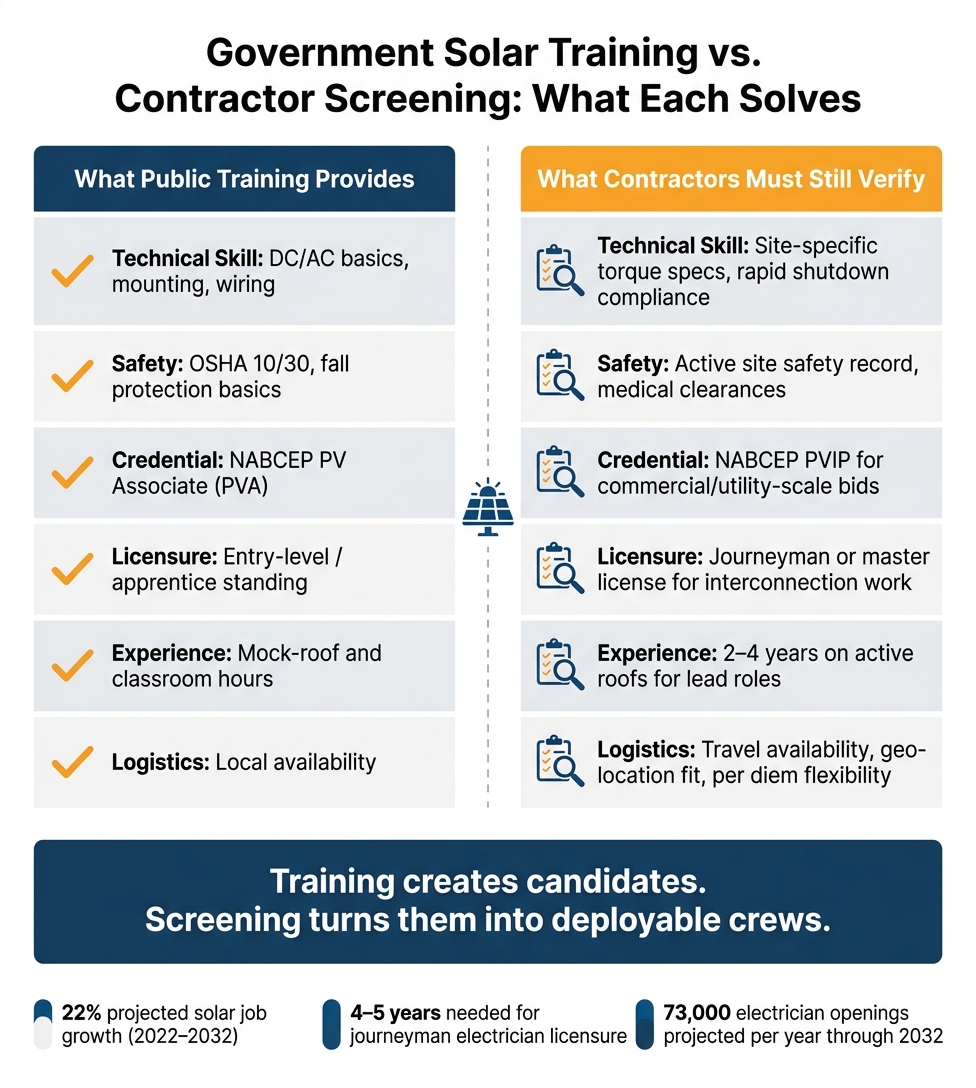
Government Solar Training vs. Contractor Screening: What Each Solves
Skills and Readiness Workers Gain From Public Training
Graduates usually leave public programs with entry-level solar skills for field work. That often includes working knowledge of DC/AC fundamentals, mounting and racking systems, basic wiring, and system sizing.
Safety is usually part of the package too. Most programs include OSHA 10 or OSHA 30, fall protection, lockout/tagout, and first aid. On the code side, trainees are introduced to National Electrical Code (NEC) basics like grounding, bonding, and ampacity. Many programs also give students hands-on practice with torque specs and mid-clamp installation on mock roofs.
Most structured programs also get graduates ready to sit for the NABCEP PV Associate (PVA) exam, which is a common entry-level credential in solar.
That said, finishing training is not the same as being ready to run a crew. Crew judgment tends to come from time on the roof, usually 2 to 4 years of field experience. Licensing is another gap. If the job involves service upgrades or code sign-off, contractors still need a journeyman or master electrician. Earning that license usually takes 4 to 5 years of apprenticeship.
So while training gives workers a solid start, it doesn’t make them ready for every site or every scope of work.
Why Screening, Compliance Checks, and Site Matching Still Matter
Contractors still need to confirm fit at the project level. A training certificate can show baseline knowledge, but it doesn’t prove someone is ready for a tough commercial rooftop or a utility-scale ground mount.
Before sending a worker into the field, contractors still need to check the details. That can mean site-specific torque specs, rapid shutdown rules, active safety status, medical clearances, license level, and whether the person can travel or work in the right area. Just because someone knows solar in general doesn’t mean they’re the right fit for this job.
The table below shows where public training stops and contractor-side checks begin:
| Area | What Training Provides | What Contractors Must Still Verify |
|---|---|---|
| Technical Skill | DC/AC basics, mounting, wiring | Site-specific torque specs, rapid shutdown compliance |
| Safety | OSHA 10/30, fall protection basics | Active site safety record, medical clearances |
| Credential | NABCEP PV Associate (PVA) | NABCEP PVIP for commercial/utility-scale bids |
| Licensure | Entry-level / apprentice standing | Journeyman or master license for interconnection work |
| Experience | Mock-roof and classroom hours | 2–4 years on active roofs for lead roles |
| Logistics | Local availability | Travel availability, geo-location fit, per diem flexibility |
Contractors also need to look at whether a worker’s background lines up with the racking system used on the project, whether that’s a ballasted rooftop array or a driven-pile ground mount. And then there are the practical issues: Can they get to the site? Can they travel? Will the per diem work for them? Those details still shape who can actually take the job.
Where ABLEMKR Fits In After Training Ends
Once training is done, the next snag is matching workers to the right project. ABLEMKR steps in at that point by matching pre-vetted workers to solar jobs based on certification, safety training, availability, and location, while also tracking onboarding, payroll, and compliance.
Conclusion: Public Training Helps Close the Gap, But Deployment Still Requires Verification
U.S. solar demand is still moving faster than the labor pipeline. Public programs help open that pipeline up. Community colleges, nonprofits, bootcamps, and apprenticeships give new hires core safety knowledge and field basics, which means graduates can often step into entry-level installer roles as soon as they’re hired.
That kind of speed matters. But it doesn’t mean someone is fully ready for every job on day one.
Training is a good start, but licensed electricians and seasoned crew leads still need years in the field, plus licensure. Short programs can’t replace that kind of on-site experience.
So after training, contractors still have work to do. They need to check licensure, field judgment, and site fit before sending people out. Training creates candidates. Screening and matching turn those candidates into working crews.
Public training helps grow the pipeline. Verification is what turns that training into deployable labor.
FAQs
Can short solar training programs lead to long-term careers?
Yes. Short solar training programs can be a strong starting point for long-term careers, especially when they’re part of a broader professional development plan.
These programs help workers move into field roles fast, where they can gain hands-on experience and work toward advanced credentials. Long-term growth also depends on clear career paths, tuition assistance, and employer-run training.
What should contractors verify after training ends?
Contractors should check that each worker has the right certifications, trade licenses, and safety credentials before they step onto the job site.
That also means keeping records of registered apprenticeship status, tracking hours tied to Apprentice Labor Hour and participation rules, and making sure OSHA 10-hour or 30-hour training is still current.
ABLEMKR can help automate these checks and give teams real-time visibility into worker status and documentation.
Which solar roles are hardest to fill?
The hardest solar roles to fill tend to be the ones with long training paths and heavy compliance demands.
That usually includes:
- licensed electricians (journeyman and above) for service upgrades, interconnection, and code sign-offs
- experienced crew leads who can manage fast installations safely
- NABCEP-certified professionals for stricter utility-scale and commercial bids
- AHJ inspectors and plan reviewers when permit queues turn into bottlenecks


