
Labor churn can wreck an energy project fast. When people leave early, costs climb, schedules slip, safety risk goes up, and quality starts to drift.
If I had to boil the full article down, it’s this: retention starts before day one and runs through the next job offer. The article shows that teams keep more workers when they do five things well:
- Hire for fit, not just headcount
- Set up a clear first 90 days
- Keep pay, housing, transport, and site support steady
- Track licenses, training, and access cards before they expire
- Line up the next assignment before the current project ends
A few numbers make the point fast:
- 83% of firms reported turnover among new field workers in the first 90 days
- Construction turnover averages 68.2% per year
- Skilled trades can hit 73.1%
- Each exit can cost about $25,000 to $40,000
The article also makes one thing clear: retention problems change by project type. Solar jobs often lose people during fast ramp-ups and heat-heavy work. Wind jobs face fatigue, climbs, and travel between sites. Grid and substation crews deal with high-voltage stress. BESS work needs job-specific safety training. Outages burn people out with long weeks and tight shutdown windows.
Here’s the short version of what you need to watch:
| Area | What keeps workers on the job | What pushes workers out |
|---|---|---|
| Hiring | Clear pay, hours, travel, and site terms | Vague job posts and bad job match |
| Onboarding | Start info, paperwork, day-one safety, 30/60/90-day check-ins | Confusing first day and weak follow-up |
| Site support | On-time pay, per diem clarity, housing, transport, break areas, good supervision | Payroll issues, poor site conditions, disrespect |
| Compliance | Current OSHA, NFPA 70E, fall protection, confined space, and site access records | Expired credentials and missed renewals |
| Redeployment | Next job lined up 30 to 60 days before closeout | No visibility into what comes next |
Bottom line: if you want people to stay through commissioning, you can’t treat retention like an HR side task. I’d treat it as a full project system tied to cost, safety, schedule, and crew stability.
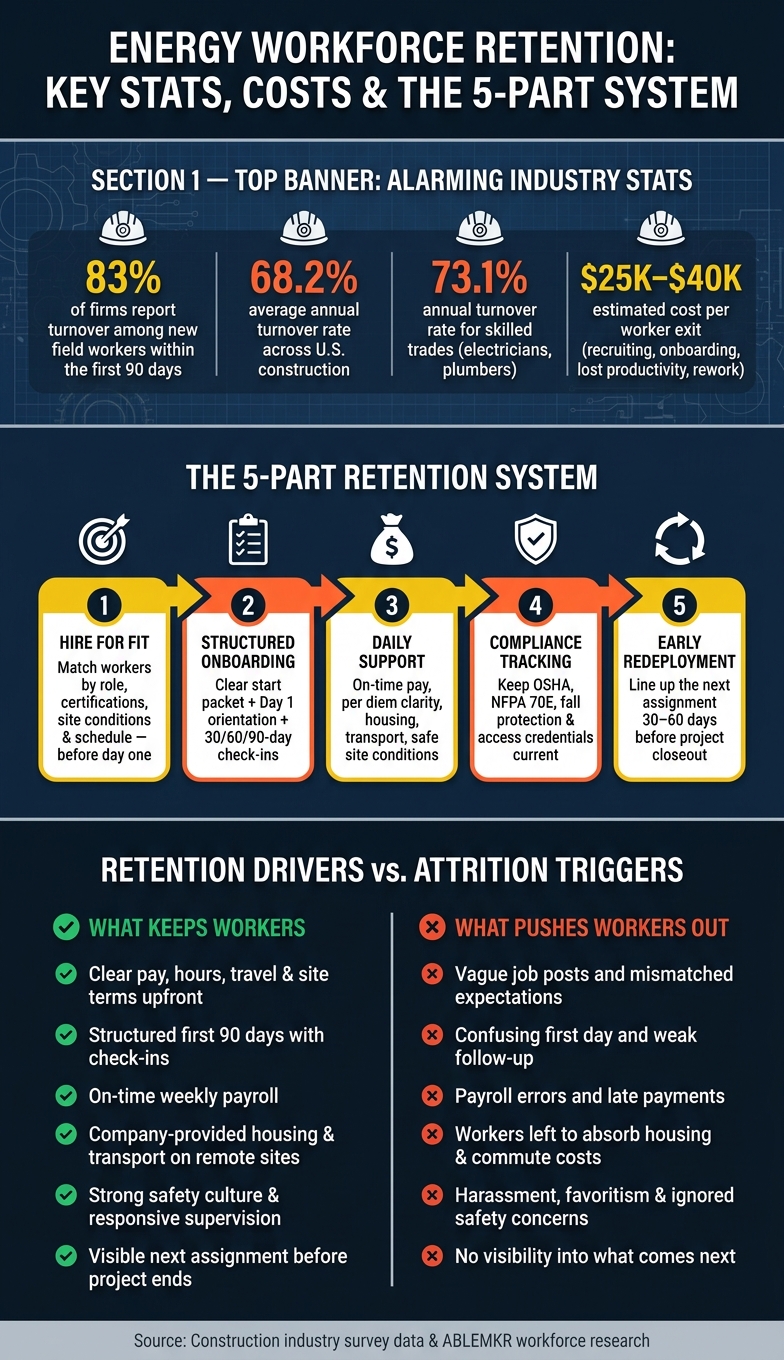
Energy Workforce Retention: Key Stats, Costs & the 5-Part Retention System
The Great Resignation: Re-shaping talent retention for the energy industry in a post-Covid world
sbb-itb-aa28329
Hire for Fit Before You Hire for Speed
Hiring fast can feel like progress. But when someone shows up and the job is not what they expected, things fall apart early. Maybe the pay setup is different. Maybe the shifts run longer. Maybe the site is farther out or rougher than the posting made it sound. People leave, often before the project finds its rhythm.
That’s why retention starts with the job match. And the job description is the first tool that helps make that match.
Set Role Requirements by Project Type
Every energy project has a few hard lines. If a job post is vague, it pulls in people who were never right for the work in the first place.
Solar installers need experience with racking, mounting, DC wiring, and familiarity with NEC Article 690. Wind technicians need GWO Basic Safety Training, OSHA 10/30, climbing fitness, and experience working in remote, high-wind conditions. High-voltage electricians on grid and substation jobs need any state journeyman or master electrician license the role calls for, familiarity with NEC Articles 110 and 300, substation and grounding experience, and knowledge of high-voltage PPE and arc-flash protocols. Battery storage technicians need DC systems troubleshooting experience, BMS familiarity, and knowledge of thermal runaway and fire-risk controls. Plant upgrade trades – pipefitters, millwrights, and electricians – need process piping experience, precision alignment skills, equipment setting and rigging experience, shutdown and turnaround work, and comfort with compressed schedules and extended shifts.
Technical needs are only part of the story. Every posting should also spell out the day-to-day terms in plain English, including:
- Shift patterns
- Typical weekly hours
- Overtime expectations
- Per diem rules
- Travel radius
- Site conditions
If lodging is not provided, say so. If the site deals with extreme heat or cold, put that in the post too. A plain job ad may not look flashy, but it saves a lot of grief later.
Screen for Skills, Safety Mindset, and Reliability
A certification tells you someone finished training. It does not tell you how they think on the job.
That’s why technical and behavioral screening need to happen together. The goal is simple: filter out workers who may leave early or miss safety expectations.
On the technical side, don’t just ask whether someone has taken a LOTO class. Ask them to walk through an isolation sequence. That shows whether they know the steps or just know the acronym. For fall protection, look at both training records and prior tower, roof, or elevated platform experience. For wind and grid roles, ask which SCADA systems they’ve used and which fault conditions they’ve handled. For solar and electrical roles, scenario-based questions tied to NEC code sections do a much better job of showing real familiarity than surface-level answers.
Safety mindset is easier to spot when you ask about real situations. A good question is to ask about a time the worker stopped work because of a safety concern. Strong candidates can explain the hazard, what action they took, and what happened after that. If someone can’t name a real example, that should make you pause.
Reliability checks should be just as direct. Talk to prior supervisors and ask about attendance consistency, willingness to stay through project completion, and how the worker handled last-minute schedule changes. Prior attendance records add another layer of proof beyond references.
The next move is to use verified worker data so this screening gets faster and more exact.
Use Verified Matching to Cut Hiring Mismatches
Verified matching helps cut early attrition by putting the right worker in the right role before day one.
ABLEMKR uses pre-vetted worker profiles to match workers by certification, safety training, availability, and location before outreach begins. Workers update their current availability, preferred travel radius, and shift preferences from their phones, which gives hiring teams current data instead of stale records.
That matters because clearer offers cut mismatches. If pay rates, site conditions, schedule, and per diem are spelled out before acceptance, workers know what they’re saying yes to. When that gap stays open, early exits follow.
Once the right worker is matched to the role, the first 90 days determine whether they stay.
Build a Structured Onboarding Flow That Keeps Workers on Site
Once the right worker is matched, onboarding often decides if that person sticks around. In a recent construction industry survey, 83% of firms reported turnover among new field employees within their first 90 days. That’s why the first 90 days matter so much. A structured onboarding flow gives workers clear direction from the moment they accept the job.
Before Day 1: Clear Start Instructions and Paperwork
Send one start packet as soon as the worker is confirmed. Keep it simple and complete. It should include the start date in U.S. format, such as 09/08/2026, reporting time, site address, gate or parking instructions, supervisor name and phone number, required PPE, any tools the worker must bring, and lodging or travel details if the site is remote.
If a worker shows up unsure where to park, which gate to use, or who to call, the first day can go sideways fast. And when that happens, some people don’t last long.
The packet should also cover payroll and employment documents, including payroll, contact, benefits, and work authorization forms. For energy projects, include proof of required safety training, trade credentials, and any project-specific qualifications so nothing holds up the first shift. The goal is simple: finish paperwork before arrival so day 1 starts with orientation, not admin.
Day 1: Site Orientation, Safety Briefing, and Crew Introduction
Day 1 should feel planned, not thrown together. Start with a site tour that shows workers the basics:
- Entrances
- Parking areas
- Break rooms
- First-aid stations
- Eyewash stations
- Emergency exits
After that, move into a project-specific safety briefing.
For grid jobs, cover arc-flash boundaries, lockout/tagout sequences, energized-area restrictions, and arc-rated PPE requirements. On wind sites, focus on work-at-heights procedures, fall protection systems, and rescue planning. On battery storage projects, workers need to understand thermal runaway risks, fire-response procedures, and battery-room restrictions before entering the area. On plant upgrades, the focus should be confined-space entry, hot work controls, and how multiple trades coordinate safely in shared spaces.
This part needs to go beyond site rules. Workers need to know the hazards, the controls, and what to do if something goes wrong.
Close out the day with introductions to the superintendent, safety lead, and crew. That matters more than it may seem. People stay more engaged when they know exactly who to ask for help. Good day-one clarity also makes the first 30-day check-in much smoother.
First 90 Days: Check-Ins, Training, and Early Issue Resolution
Use 30-, 60-, and 90-day check-ins to catch issues before they turn into exits.
In the first 30 days, supervisors should confirm attendance, role understanding, safety compliance, and whether the worker has the tools and support needed to do the job. By 60 days, the focus shifts to training milestones, crew fit, and any gaps in communication or supervision. By 90 days, the conversation should cover performance, schedule fit, and readiness for the next assignment or a cross-training opportunity.
The point isn’t just to get a worker through startup. It’s to end up with a crew you can redeploy to the next phase without starting from scratch.
Ask direct questions about whether expectations, pay, scheduling, and support needs match reality. If someone says there’s a problem, don’t leave it hanging. Each check-in should end with a clear action owner and a deadline.
ABLEMKR tracks document completion, worker status, and certification currency in one place, which helps field leaders spot dropouts before the next phase.
After that, retention depends on pay, supervision, and day-to-day site conditions.
Give Workers Enough Support to Stay Through the Project
Once onboarding is done, retention comes down to the job people live with each day. The offer letter gets someone in the door. Day-to-day working conditions are what keep them there. If pay, site conditions, and next steps stay steady, workers are far more likely to stay through the project.
Pay, Pay Timing, and Remote Site Support
Pay gets attention. Support helps people stick around.
Market-rate hourly pay matters, especially for specialty work and remote jobs. But workers don’t look at base pay alone. They look at the whole package: overtime, per diem, travel help, and whether pay shows up on time. Predictable pay timing is one of the most overlooked tools for keeping crews in energy construction. Weekly payroll with a fixed payday gives workers room to handle rent, car payments, and family bills. When payroll mistakes happen, fixing them fast builds trust instead of resentment.
Remote work adds another layer. Workers compare pay against housing, transportation, and meals. A wind project that covers shared housing, daily shuttle service, and a meal stipend will often keep its core crew longer than a higher-paying job that leaves workers to sort all of that out themselves.
| Package Type | Pros | Cons | Likely Retention Effect |
|---|---|---|---|
| Remote Site Amenities Package (company-provided housing, transport, meal stipend, Wi-Fi, laundry) | Lower out-of-pocket costs; less daily friction; steadier crew morale | Higher employer cost; more logistics to manage | Stronger retention on long-duration remote projects; workers more likely to stay through commissioning |
| Higher Base Pay Only (no structured housing/transport support) | Simpler to administer; attractive headline hourly rate | Workers absorb housing, commute, and meal costs; more fatigue over time | Higher mid-project attrition |
Milestone bonuses can also help steady long projects, especially in battery storage and plant upgrade work, where mid-project drop-off happens often.
Safety, Supervision, and Daily Work Conditions
A well-run jobsite sends a clear message: management is paying attention. Clean laydown areas, stocked PPE, and usable break facilities aren’t perks. They’re baseline retention factors. The data lines up with that. 64% of firms with strong safety cultures reported an increased ability to retain staff.
Supervision matters just as much. A foreman who shrugs off safety issues or plays favorites can push workers to start planning their exit. That doesn’t take long. In a 2021 survey of more than 2,600 tradeswomen, 26.5% always or frequently faced harassment for being a woman. The EEOC has described harassment as a "significant barrier to the recruitment and retention of women and workers of color" in construction.
Crews watch what happens after a complaint is made. Visible action on safety and harassment issues keeps people from checking out. Defined timelines – initial response within 24 hours, investigation plan within 72 hours – and anonymized lessons shared in toolbox talks show workers that the process works. When people see problems handled fast, they’re more likely to stay and finish the job.
Training, Multi-Skilling, and Career Visibility
Workers are more likely to finish a project when they can see what comes after it. That’s where cross-training helps. An electrician who can move between solar array wiring, battery energy storage system (BESS) installation, and substation work has more job security than someone boxed into one lane. That sense of job security has a direct effect on retention.
Training needs to be part of the schedule, not something squeezed in when nobody has time. Short, focused training blocks during slower phases – like early civil works or commissioning lulls – tend to work better than ad hoc sessions that pull workers away from critical path work.
| Strategy | Worker Stability | Training Time Required | Deployment Flexibility |
|---|---|---|---|
| Single-Trade Specialization | Lower – tied to demand for one trade | Minimal upfront | Limited to one project type |
| Multi-Skilling Across Project Types | Higher – more options between projects | Moderate (planned blocks) | Strong – can move between solar, BESS, grid, and plant work |
ABLEMKR supports this with worker profiles that track certifications, safety training, availability, and geo-location, along with integrated payroll workflows and real-time visibility into worker status. That same worker profile also helps with compliance tracking and redeployment.
Track Compliance and Plan Redeployment Before the Project Ends
Retention doesn’t stop once people are on site. It often gets shaky during closeout.
That’s when workers start looking ahead to their next assignment, sometimes before commissioning is done. And if a certification expires at the wrong time, someone can be removed from the job even if their work has been solid.
Keep Certifications, Safety Records, and Site Requirements Current
Every required credential needs to stay current: OSHA 10 or 30, NFPA 70E, fall protection, confined space, HazCom, plus any site-specific cards or orientations, including site orientations, utility programs, and access cards. If any of these lapse, a worker can be pulled off the job – not because of performance, but because of a missed renewal date.
That kind of issue is frustrating because it’s preventable. A missed date on a spreadsheet shouldn’t decide whether someone stays billable.
Keep training records organized so audits and project transfers don’t slow down redeployment. Manual tracking leaves too much room for gaps. A centralized system cuts down on those gaps and makes records easier to find when the pressure is on.
| Aspect | Manual Compliance Tracking | Tech-Enabled Compliance Tracking |
|---|---|---|
| Accuracy | High risk of errors and outdated records due to manual data entry and multiple spreadsheet versions | Standardized data entry, single source of truth, automated updates from training providers |
| Administrative Effort | Significant time spent chasing documents, updating sheets, and checking expiries before mobilizations | Automated reminders, worker self-service uploads, and streamlined reporting reduce admin load |
| Audit Readiness | Reactive, with last-minute document pulls and potential gaps during audits | On-demand, structured reports and centralized documentation improve audit outcomes |
| Retention Impact | More frequent work stoppages or removals due to missed expirations; higher worker frustration and turnover | Workers remain deployable and billable; fewer compliance-related disruptions help retention |
Set automated reminders at 30 and 60 days before expiration. Then review compliance every week during closeout, not just at mobilization. A late-stage credential gap can block a worker from moving straight into the next project.
When records are current, you can move people fast as soon as the next opening appears.
Use Retention Metrics to Spot Problems Early
A single annual turnover number doesn’t say much. You need to break it out by project, location, crew, and tenure. That’s how you find where the trouble is piling up.
Early-tenure turnover, meaning workers who leave within the first 30 days, usually points to onboarding gaps, mismatched expectations, or pay friction. A spike in no-shows at one site often traces back to poor pre-start communication or a bad reputation moving through the local labor market. Payroll disputes that bunch up on remote or overtime-heavy projects often come from pay rules that were never explained well during onboarding.
Review no-shows, early quits, payroll disputes, and incident rates on a weekly cadence during active projects. Monthly, look at turnover by project type and location. Quarterly, review tenure band trends and connect them to compliance data. That rhythm helps teams adjust mid-project instead of waiting until closeout to find out what went wrong.
Those patterns also help you decide which workers should move to the front of the line for the next assignment.
Move Good Workers Into the Next Project
Start redeployment talks 30 to 60 days before commissioning. People are more likely to stay when the next job is already visible.
The offer matters, but the logistics matter just as much. A clear per diem, lodging, and travel policy can cut down on the drop-off that happens between projects. If workers don’t know where they’ll stay, how travel gets handled, or what they’ll be paid, many will start looking elsewhere.
| Redeployment Model | Regional Labor Pools | National Mobility Models |
|---|---|---|
| Worker Reach | Limited to nearby labor market | Wider access to craft labor across states and energy corridors |
| Fill Speed | Good for local demand, weaker for sudden spikes | Better for urgent shutdowns, outages, and remote projects |
| Housing/Per Diem Complexity | Lower logistics burden | Higher logistics burden, but more flexible coverage |
| Retention Continuity | Can drop off sharply when local project ends | Better continuity if workers roll from one project to another |
| Best Use | Stable, localized buildouts | Multi-project developers and contractors with staggered schedules |
ABLEMKR can keep certifications, safety training, availability, and location in one record so closeout teams can match workers to the next project without rebuilding files.
Conclusion: The Retention System That Energy Projects Need
Retention isn’t one task. It runs through the full life of a project, from the first hire to the next assignment. In practice, that system comes down to five parts.
You need to hire for fit, not just speed. You need to onboard with structure so workers know what to expect before they ever step on site. You need to support workers through the project with reliable pay, safe conditions, and supervisors who know how to manage people. You need to keep compliance current so credential gaps don’t pull workers off the job. And you need to plan redeployment early so strong workers don’t drift away between projects.
Each part affects cost, safety, and schedule. The thread running through all of it is consistency. People stay when the job feels steady: expectations are clear from day one, pay shows up on time, the site is safe, supervision is steady, and the next opportunity is already in view before the current project ends.
That matters even more when you look at the numbers. The U.S. construction industry has an average annual turnover rate of 68.2%. For skilled trades like electricians and plumbers, that figure reaches 73.1%. And churn like that isn’t cheap. Employers lose an estimated $25,000–$40,000 per exit once recruiting, onboarding, lost productivity, and rework are included.
Labor gaps make the issue hard to ignore. In solar, wind, grid, BESS, and outage work, teams can’t afford to keep starting over with new people.
Retention works best when employers treat it like an operating system, not a one-off fix. That means tracking metrics on a regular basis, acting on worker feedback, keeping records up to date, and linking workers to their next project before they start looking somewhere else. ABLEMKR helps support that continuity by keeping certifications, safety training, availability, and location in one place, so crews can move to the next project without rebuilding files.
FAQs
What causes early turnover on energy projects?
Early turnover often happens when there’s a gap between what candidates expect and what the job is actually like. Someone may sign on thinking the role will look one way, then step in and find a very different day-to-day experience. That disconnect can push people out fast.
Poor onboarding is another big reason. About 31% of new hires leave within their first 3 to 6 months because they weren’t brought into the team and role well. If those first few months feel confusing, isolated, or disorganized, people start looking elsewhere.
A few other factors show up again and again:
- The project-based or seasonal nature of the work
- Limited career growth
- High-pressure work settings
- Workers leaving for better offers
Put simply, people don’t just leave because of pay. They also leave when the job feels unstable, the pressure is nonstop, or they can’t see where they’re headed next.
How can we improve retention in the first 90 days?
Improve retention by closing the gap between hiring expectations and what the job looks like in the field.
Before day one, make sure equipment, system access, and safety documents are ready to go. Use ABLEMKR to automate paperwork and certification checks, and make sure the first paycheck is accurate. That sounds basic, but it sets the tone fast.
Once new hires are on-site, onboard them in cohorts instead of dropping people in one by one. Pair each person with an experienced mentor, spread key information across the first few weeks, and keep feedback loops short so issues come up early, not after someone’s already halfway out the door.
When should redeployment planning start?
Redeployment planning should start well before a project wraps up so craft labor can move to the next job without chaos.
The key is to line up workforce forecasting with project calendars early. That gives you time to map labor needs against upcoming work, shift skilled workers from one site to another, and avoid losing people you’ll just have to hire again later.
When that handoff is planned in advance, you also cut down on delays that come from stopping and restarting hiring.


