
If you need to hire a petroleum geologist, the short answer is this: define the basin and asset work first, test technical fit early, post a clear pay range, and move fast on the offer.
I’d treat this hire as a field fit problem, not a generic recruiting task. The role can change a lot between exploration, drilling, development, and production, so the right profile depends on the asset, the software stack, and the day-to-day work. In a tight market, delays cost candidates. Texas upstream jobs reached 197,700 in June 2026, with 400 jobs added month over month, which means many geologists have choices.
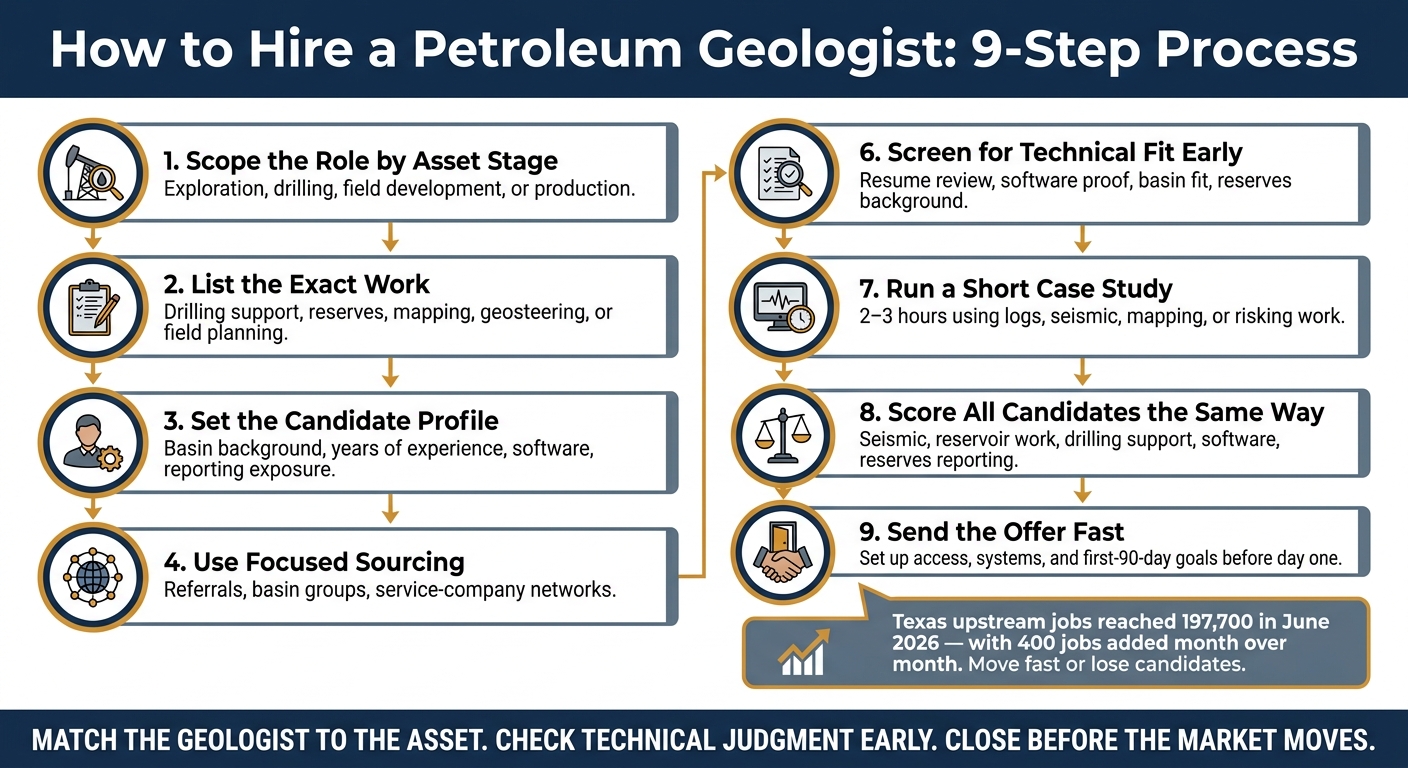
Here’s the whole process in plain terms:
- Scope the role by asset stage: exploration, drilling, field development, or production
- List the exact work: drilling support, reserves, mapping, geosteering, or field planning
- Set the candidate profile: basin background, years of experience, software, and reporting exposure
- Use focused sourcing: referrals, basin groups, and service-company networks
- Publish pay clearly in U.S. dollars, based on scope, basin, location, and schedule
- Screen for technical fit early: resume review, software proof, basin fit, and reserves background
- Use a short case study: about 2–3 hours with logs, seismic, mapping, or risking work
- Score all candidates the same way across seismic, reservoir work, drilling support, software use, and reserves reporting
- Send the offer fast and set up access, systems, and first-90-day goals before day one
A petroleum geologist hire usually goes wrong for two reasons: the role is too vague, or the team takes too long to decide. I’d avoid both by keeping the process simple, specific, and fast.
| Hiring step | What I’d focus on |
|---|---|
| Role scope | Basin, asset stage, decision authority, and daily work |
| Candidate profile | Basin fit, formation evaluation, reservoir work, team fit |
| Sourcing | Referrals, basin groups, service firms, contract help if needed |
| Screening | Software use, basin history, reserves standards, drilling/development work |
| Assessment | 2–3 hour subsurface case with clear scoring |
| Offer and start | $ pay range, rotation details, relocation, access, onboarding plan |
If you want a clean hiring process, this guide comes down to one idea: match the geologist to the asset, check technical judgment early, and close before the market moves on.
Petroleum Geologist Hiring Process: 9 Steps to the Right Hire
Position Description – Oil and Gas Petroleum Geology and Petroleum Geologists
sbb-itb-aa28329
Define the Role and Candidate Profile
Start by matching the role to the asset stage. In exploration, the work leans toward seismic interpretation and prospect generation. In development, the focus shifts to reservoir characterization and drilling-location support. In production, the role usually centers on infill drilling and depletion analysis.
Core Duties in Drilling, Reserves, and Field Development
An upstream petroleum geologist’s day-to-day work usually falls into four main areas: prospect generation, reserves estimation, and coordination with reservoir, drilling, and land teams. In active drilling programs, the role can also include well-site geology, formation evaluation, and geosteering support.
| Upstream Phase | Primary Responsibilities | Key Technical Focus |
|---|---|---|
| Exploration | Seismic survey interpretation, prospect generation, exploration drilling oversight | Subsurface risk assessment, petroleum systems |
| Drilling | Well site geology, formation evaluation, well log interpretation | Real-time data analysis, geosteering |
| Field Development | Reservoir characterization, geological modeling, volumetrics | Cross-functional project teams, reservoir connectivity |
| Production | Production monitoring, reservoir monitoring, infill drilling support | Formation evaluation, depletion analysis |
Required Skills, Software, and Credentials
Put the most weight on basin-specific experience, formation evaluation, reservoir characterization, and the ability to work across drilling and reservoir teams. That mix matters because the job rarely happens in a silo. A geologist may help shape subsurface maps one day and line up with drilling or reservoir staff the next.
Experience Levels and Role Scoping
Basin experience should come first when local stratigraphy, play risk, and operating practices drive the work. A candidate who knows the basin can often get up to speed faster and make sound calls with less ramp time.
Use that scope to define seniority, decision authority, and pay before writing the job post. It’s a simple step, but it saves a lot of back-and-forth later.
Build a Hiring Plan with Sourcing Channels and Pay Ranges
Once the role scope is clear, turn that clarity into a hiring plan you can actually use. That means locking down three things: what the job post says, where you’ll look for people, and what you’re prepared to pay.
Write a Job Description That Matches the Asset and Work Scope
A strong job description for a petroleum geologist should be specific, not vague. Call out the basin, the asset phase, the software required, and whether the role supports drilling, reserves, or field development. If the job depends on certain interpretation or reservoir tools, say so plainly.
That level of detail helps you narrow both sourcing and pay before the role goes live.
Use Targeted Sourcing Channels for Petroleum Geologists
Petroleum geologists usually aren’t found through broad job-board blasts alone. It makes more sense to source through basin associations, referrals, and service-company networks.
You can also look at geologists from service firms who support:
- formation evaluation
- reservoir characterization
- integrated project delivery
For urgent contract or project-based support, use ABLEMKR to mobilize pre-vetted talent, streamline onboarding, and track compliance.
Set Compensation Based on Market and Project Factors
Pay for petroleum geologists in the U.S. varies based on years of experience, basin specialization, role scope, software proficiency, operator or service-company background, and rotation, remote work, or hard-to-fill location requirements.
| Pay Factor | Effect on Compensation |
|---|---|
| Basin specialization | Proven experience in the target basin can increase market value |
| Role scope | Drilling, reserves, and field development responsibilities may pay differently |
| Operator or service-company background | Background influences fit for the assignment and overall package |
| Software proficiency | Advanced technical tool proficiency can support higher pay |
| Rotation, remote work, or hard-to-fill location | Rotational or location-specific work can affect total compensation |
Publish a clear U.S. dollar range tied to scope, basin, and rotation. That makes the role easier to assess at a glance and helps filter out mismatched candidates before interviews.
Screen and Select Candidates for Technical Fit
After sourcing, screen for subsurface fit to cut down on mistakes in drilling, reserves, and field development. A simple two-step filter works best: start with resume review, then move to a short technical case study.
Resume Review and Credential Verification
Start with documented software use. If a resume mentions Petrel or Kingdom, ask for proof of how the candidate used those tools in actual subsurface work, like well log correlation, seismic review, or a similar project.
Then look at basin fit. A geologist who has worked in your target basin can often get up to speed faster than someone coming from a very different play. It also helps to check whether the candidate has reported reserves under SEC or SPE-PRMS standards, and whether their background includes drilling support, development mapping, or exploration programs.
Technical Assessments for Subsurface Decision-Making
A resume tells you where someone has worked. A case study tells you how they think.
Use a 2–3 hour exercise based on actual subsurface data. Good options include well log correlation, seismic interpretation review, prospect risking, or development mapping.
Focus on the reasoning, not just the final answer. Ask candidates to walk through their assumptions, show how they dealt with uncertainty, and explain how they brought together logs, cores, seismic, and production data into one recommendation. Keep the exercise capped at 2–3 hours.
Use the case study results to shape the interview scorecard.
Structured Interviews and Candidate Comparison
Use the same scorecard for every candidate. That keeps comparisons fair and gives your team a cleaner way to judge technical fit. Cover core areas like formation evaluation, reservoir characterization, and drilling support so everyone is measured against the same standard.
Score each candidate on a shared scorecard. Here’s a solid starting point:
| Evaluation Area | What to Assess |
|---|---|
| Seismic Interpretation | Ability to integrate seismic data into prospect or development decisions |
| Reservoir Characterization | Experience evaluating reservoirs for development or production decisions |
| Software Proficiency | Demonstrated use of Petrel, Kingdom, ArcGIS, or reserves workflows on actual projects |
| Drilling/Development Support | Hands-on involvement in drilling, field development, or exploration programs |
| Reserves Reporting Experience | Familiarity with SEC reserves reporting or SPE-PRMS standards |
Once the scorecard is done, move straight to offer terms and onboarding requirements.
Make the Offer, Onboard Quickly, and Prevent Hiring Delays
Offer Terms and Onboarding Requirements
Once you know the candidate can do the job, speed matters. If your scorecard points to a clear top pick, send the offer right away.
A strong offer should spell out the key terms in plain English:
- Base pay
- Bonus
- Relocation support
- Rotation or field schedule
If the role includes basin work or regular site visits, put those expectations in writing before the candidate says yes. That avoids confusion later and helps both sides start on the same page.
Onboarding should begin before day one, not after. Set up software licenses, data-room access, and seismic archives in advance. Then tie the first 90 days to specific goals around drilling, reserves, or field development.
Common Delays and How to Reduce Them
When the offer package and onboarding steps are already set, the last handoff moves much faster. Most slowdowns come from two places: vague role scope and slow approvals.
One way to cut time is to use a 2–3 hour technical case study instead of dragging candidates through a long interview loop. That gives you a faster read on subsurface decision-making.
ABLEMKR can also help reduce onboarding friction by matching pre-vetted workers based on certification, safety training, availability, and location, while giving you real-time status and compliance tracking.
Conclusion: What a Faster, Better Petroleum Geologist Hire Looks Like
A better petroleum geologist hire is pretty straightforward: define the role clearly, screen fast, move on the offer without delay, and have onboarding ready before day one.
FAQs
How do I know which asset-stage experience matters most for this role?
Start by defining the role with hiring managers using structured, data-driven job templates. Put the focus on measurable requirements, like years of experience in drilling, reserves, or field development, instead of subjective criteria.
A talent audit can then show which operational areas matter most to the project, such as automation or environmental compliance. From there, match those needs to the asset phase so you can target the best basin-fit talent.
What should a petroleum geologist case study include?
Use a 2–3 hour technical assessment to see how the candidate handles actual job work, not just interview talk.
The test should focus on real problem-solving and day-to-day technical skill. In practice, that means asking the candidate to review subsurface data from your specific basin and work through scenario-based exercises linked to drilling, reserves, or field development.
This kind of assessment gives you a much clearer view of how the person thinks under normal working conditions. Can they sort through imperfect data? Can they make sound calls with the basin context in mind? That’s usually where strong candidates stand out.
How can I speed up hiring without lowering technical standards?
Define the role with precision, hire for basin and skill fit, and use a short, hands-on technical case – about 2 to 3 hours – to check whether someone can actually do the work.
Pre-qualify candidates with verified credentials and safety checks first. Then use strict pass/fail screening to move qualified people fast into scheduling, background checks, and onboarding. Keep SOPs clear, and make sure hiring managers help set the criteria so the process matches the job in the field, not just on paper.


