
Labor cost can swing fast in energy work. In this breakdown, I’d boil it down to four things: base rate, overtime, travel, and job location.
If you need the short answer, here it is:
- Welders usually cost the most on an hourly basis, often $70–$95/hour for journeyman work and $100–$140/hour for code or pipeline work.
- Operators and riggers often sit in the middle, with onshore day rates near $500–$560/day and offshore rates around $776/day.
- General labor has the lowest base pay, but total spend can still climb when you add per diem, long shifts, and large crew counts.
- Offshore work often runs 20%–40% above onshore.
- Remote onshore jobs can add $206/day in GSA per diem, plus $0.70/mile for business travel in 2026.
- Long schedules like 6x10s and 14/14 rotations can push weekly or hitch cost far above the posted rate.
In plain terms: the cheapest crew on paper is not always the cheapest crew by the end of the job. A local crew with fewer travel costs can beat a lower base rate from non-local labor. And a higher-paid specialist can cost less than a bigger, slower crew if the work sits on the critical path.
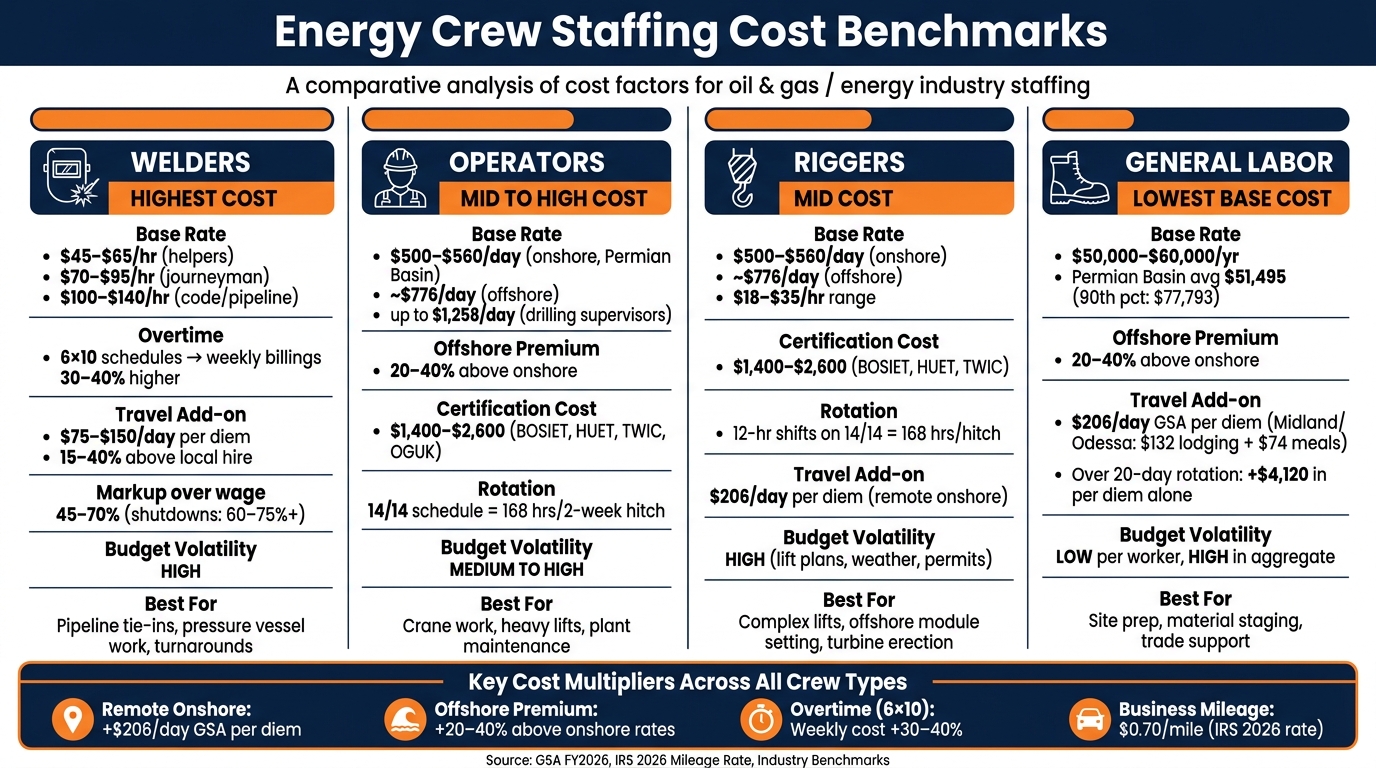
Energy Crew Staffing Cost Benchmarks: Welders vs Operators vs Riggers vs General Labor
Quick Comparison
| Crew Type | Base Cost Level | Main Cost Drivers | Where Spend Jumps |
|---|---|---|---|
| Welders | Highest | Certifications, overtime, travel, shutdown demand | Pipeline work, turnarounds, remote jobs |
| Operators | Mid to high | Equipment-linked downtime, offshore premiums, training | Offshore rotations, crane work, remote basins |
| Riggers | Mid | Lift tickets, hitch length, standby time | Offshore lifts, weather delays, permit holds |
| General Labor | Lowest base | Crew size, overtime, per diem, standby time | Remote sites, long shifts, milestone surges |
So if I were building a budget, I’d start with median pay, then layer in overtime rules, travel costs, certs, and local labor supply right away. That’s where most budget misses happen.
sbb-itb-aa28329
1. Welders
Welders are some of the most expensive crews in energy work. The reason is pretty simple: certifications cost money, qualified people are hard to find, and deadlines don’t wait. If you want one trade that shows how pay jumps when skill and scarcity collide, this is it.
Base bill rate
Welder bill rates in U.S. energy projects can swing a lot by skill level. Entry-level welder helpers usually bill at $45–$65/hour. Journeyman structural welders tend to land in the $70–$95/hour range, with union status, region, and project size all affecting the number. High-pressure, pipeline, and code-certified welders can reach $100–$140/hour, especially during outages, shutdowns, or remote pipeline jobs where timing is tight and qualified labor is limited.[^qa]
Here’s what that looks like in practice: a journeyman welder making $40/hour often loads to about $48–$54/hour after taxes, workers’ comp, insurance, and overhead. Once margin is added, that worker usually bills at roughly $70–$90/hour.[^qa] In skilled trades, markups often fall between 45–70% over wage. For shutdown and turnaround crews, that number can climb to 60–75%+.
Overtime premium
Turnarounds and shutdowns often run on 6×10 schedules, or 60 hours per week. That usually means 40 hours at the base rate, then 20 hours at 1.5×. The result: weekly billings can end up 30–40% higher than they would on a straight 40-hour week.[^qa] Double-time may also kick in on Sundays, holidays, or after thresholds set by state rules or union agreements.
Welders often sit on the critical path for piping and pressure vessel work, so owners usually pay the premium rather than risk delays. One common way to control that cost is to bring in a second crew or split work into day and night shifts. That keeps each welder closer to 40–50 hours a week and cuts some of the time-and-a-half spend.
Travel burden
Remote jobs – like pipelines, midstream sites, and shale plays – add another layer of cost. Per diem, lodging, and travel time all stack on top of the base rate. Per diem for traveling welders usually runs $75–$150/day, and the full cost of a traveling welder can be 15–40% higher than a similar local hire.[^qa]
That’s why local labor matters so much. A local welder skips many of those extra costs, which helps keep billing closer to base levels. ABLEMKR can help match pre-vetted welders by certification, location, and availability for shutdowns and remote repairs.
Location sensitivity
Location pushes rates up or down even more. The Gulf Coast – especially Texas and Louisiana – has a deep pool of industrial welders near refineries and petrochemical plants, so base rates are often more competitive there. The Northeast and West Coast tend to cost more because of higher living costs, stronger union presence, and tighter regulatory rules. In remote energy corridors, like shale plays and long-haul pipeline routes, employers often have to offer premium pay just to get certified welders on site. That stacks on top of the travel costs already built into those jobs.
2. Operators
Operators usually cost less than welders. But that gap can shrink in a hurry offshore.
Why? A few things push operator costs up: certifications, rotation schedules, and where the job is located. Onshore, staffing is more manageable. Offshore, the math changes fast.
Base bill rate
In the Permian Basin, onshore operators usually bill at $500–$560/day. Offshore, rates jump with a 20%–40% premium, with average day rates around $776. Drilling supervisors can reach $1,258/day.
A big reason is certification cost. Offshore operators often need $1,400–$2,600 in training and clearance items like BOSIET, HUET, TWIC, and OGUK medicals. Contractors usually fold that upfront cost into what they charge.
Overtime premium
Offshore rotations often follow a 14/14 schedule, or 168 hours over two weeks. On paper, the day rate may not look too bad. In practice, that packed schedule stacks up billable hours fast, and total project cost ends up much higher than the day rate alone would suggest.
Travel burden
Remote onshore jobs around Midland/Odessa add a $206/day per diem: $132 for lodging and $74 for meals. Over a 20-day rotation, that comes to $4,120.
Offshore work is different. Operators usually avoid most day-to-day living costs because employers cover room and board.
Location sensitivity
Remote basins and offshore platforms have smaller labor pools and longer mobilization times. That tends to push costs up. The same thing happens when operators need extra job-site requirements like OSHA 10/30, confined space entry permits, H2S training, and DOT drug/alcohol testing.
You can see the same cost pattern in rigging, although certification and travel pressure start to ease a bit there.
3. Riggers
Riggers follow much the same offshore cost pattern as operators. But their labor cost can swing more because of lifting tickets and long hitches.
Base bill rate
Onshore, riggers usually track close to operator pricing. In places like the Permian Basin, they tend to bill $500–$560/day.
Offshore, that rate climbs to about $776/day. Part of the jump comes from required certifications. Offshore riggers often need tickets like BOSIET, HUET, and TWIC, and those can add $1,400–$2,600 to the total cost profile.
Overtime premium
Offshore riggers work 12-hour shifts on 14/14 rotations. That adds up to 168 hours of labor in a single two-week hitch – more than double a standard 80-hour work period.
That schedule pushes up total cost even before overtime enters the picture. In plain terms, the hitch itself is already expensive.
Travel burden
On remote onshore jobs around Midland/Odessa, per diem can add $206/day.
Offshore crews usually get room and board instead. That helps offset travel-related costs, though it doesn’t change the stated day rate.
Location sensitivity
Offshore work costs more because crews need more training, longer hitches, and paid rotation time.
General labor sits lower on the cost scale, but travel and rotation still shape the final bill.
4. General Labor
General labor roles, including roustabouts and entry-level rig hands, sit at the low end of the energy crew cost ladder. But “lower pay” doesn’t always mean lower total cost. Travel, housing, and rotation schedules can still push the full crew spend up.
Base bill rate
Entry-level roustabouts earn between $50,000 and $60,000 per year in 2026. These roles stay near the bottom of the skill-cost ladder because they usually don’t carry the same certification premiums as welders, operators, or riggers.
Pay can still shift a lot between onshore and offshore work. Offshore compensation can run 20% to 40% higher, driven in large part by the cost of offshore operations. Deepwater drillships with lease rates of $400,000 to $600,000 per day can support higher labor costs, while onshore rigs tend to work with tighter margins that hold base pay down.
Travel burden
Even lower-skill crews can come with a noticeable travel bill. Remote onshore jobs still bring subsistence costs, and those add up fast.
In Midland/Odessa, the GSA federal per diem for FY2026 is $206 per day – $132 for lodging and $74 for meals. Over a 20-day rotation, that adds $4,120.
Offshore workers on a 14/14 rotation usually get room and board at no direct cost to the worker. That cuts the cash expense on the employee side, but it still carries real value as part of the full compensation picture.
Location sensitivity
For general labor, cost tends to move more with mobilization and subsistence than with certifications. That’s a key difference from welders and operators, where credentials often do more of the heavy lifting on pay.
The Permian Basin average for an onshore general laborer is $51,495, while the 90th percentile reaches $77,793.
The next cost swing comes from the same forces seen across every crew type: skill, certifications, rotation, and geography.
What Drives Cost Differences Between Crew Types
Across these four crew types, the same few factors explain most of the price gap. Crew costs usually come down to four things: skill and certifications, overtime structure, travel burden, and location. And these don’t act on their own. They tend to stack.
Skill level and certifications set the floor. When a job needs more specialized training or licenses, the labor pool gets smaller. That usually means less room to negotiate on rate.
Overtime can be minor or baked into the job from day one. In plain English, the project type often decides whether overtime is occasional or just part of the schedule.
Travel burden is one of the most missed cost items. It covers lodging, the IRS standard mileage rate of $0.70 per mile for business travel in 2026, travel time, and daily per diem. For non-local workers, those costs sit on top of the base bill rate and keep adding up until the work is done.
Geography changes the rate floor. Remote onshore areas like the Permian Basin add GSA per diem costs of $206 per day on top of wages. You can see that pattern show up across the scenarios below.
| Location / Scenario | Rate Effect | Overtime Load | Travel Cost |
|---|---|---|---|
| Metro / Regional Hub | Lower; larger local labor pool | Occasional / standard | Minimal; local commute only |
| Onshore (Permian Basin) | Moderate; constrained by tight rig lease margins | High; standard hourly/day rates apply | $206/day GSA per diem; $0.70/mile mileage |
| Offshore (Gulf of Mexico) | High; 20%–40% base premium over onshore | Extreme; 168 hours per 14-day hitch | Room and board covered; high mobilization cost to the employer |
| Planned Shutdown | High; advance booking required | Structural; 60–84 hour weeks common | High; requires non-local specialists and lodging |
| Unplanned / Emergency | Extreme; immediate mobilization drives the highest market rates | Maximum; 24/7 emergency shifts | Extreme; expedited travel and immediate deployment |
Local workers help keep lodging and mobilization costs down. Non-local workers can bring harder-to-find expertise, but they also add per diem and more moving parts on the logistics side. That tradeoff becomes a lot more obvious when you compare the cost upsides and downsides of each crew type.
Cost Advantages and Drawbacks by Crew Type
Each crew type comes with its own cost pattern. The main challenge isn’t just finding the lowest hourly rate. It’s making sure labor spend matches the work in front of you. The table below shows where each crew type can save money and where the budget can drift.
Welders often have the highest base rates in this group. But that higher rate can pay off when the job sits on the critical path. A smaller certified crew can complete pipeline tie-ins or other code-driven welds faster and with less rework, which can cut indirect costs even when hourly pay is high. The big risk is idle time. When welders are waiting on permits, inspections, or materials, the meter keeps running fast.
You see a similar tradeoff with operator roles, but the cost swing is bigger because equipment is part of the equation. Operators can turn into a major line item when the work is specialized. A skilled crane or excavator operator can shorten a heavy-lift schedule and make better use of the equipment, but operators are usually paired with expensive machines. So when work stops, both labor and equipment budgets take the hit at the same time. In Houston-area industrial shutdown work, crane operators can bill $55–$70/hour, and that rate still applies during weather holds and engineering delays.
Riggers follow much the same pattern. Their cost ties closely to lift complexity and schedule risk. They often fall in the $18–$35/hour range. Their main value is reducing risk and keeping lifts coordinated. But if permits, lift plans, and weather windows fall out of sync, riggers can end up on standby at a rate that’s still above general labor.
At first glance, general labor looks like the budget pick. And per worker, it usually is. But big remote crews can still pile on overtime, per diem, and standby costs. Once general laborers move to extended shifts at 1.5x or even 2x their base rate, the gap between them and skilled trades can shrink fast. General labor stays low-cost when the work is repetitive, local, and tightly scheduled. That makes it cheap on an individual basis, but easy to underestimate once crew sizes grow.
| Crew Type | Cost Advantages | Cost Drawbacks | Budget Volatility | Best-Fit Use Cases |
|---|---|---|---|---|
| Welders | High output on critical welds; reduced rework risk on qualified jobs | Higher base wage; certification and specialty premiums; travel-heavy jobs often add per diem | High – shutdowns, turnarounds, and remote sites | Pipeline tie-ins, pressure vessel work, refinery piping, maintenance outages |
| Operators | Efficient on lifting, earthmoving, and material handling; experienced operators can reduce equipment idle time | Higher wage than general labor; crane and industrial work can attract strong overtime premiums | Medium to high – tied to equipment mobilization, weather, and maintenance peaks | Crane work, civil support, heavy lifts, plant maintenance, loading/unloading |
| Riggers | Usually cheaper than specialty welders and crane operators; adds critical lift safety and coordination value | Overtime and premium pay can rise quickly; safety-sensitive work may require more supervision | High – lift plans, engineering approvals, and weather windows can push work | Complex lifts, offshore module setting, turbine erection, confined-space rigging |
| General Labor | Lowest base rate; flexible headcount; easily scaled for high-volume repetitive tasks | Overtime exposure on long shifts; standby time adds up on large crews; low productivity without tight task planning | Low per worker, high in aggregate – surges near milestones and commissioning | Site prep, material staging, racking assembly, trade support, housekeeping |
These crew-level cost gaps play a direct role in the staffing mix and the controls needed to keep the budget in line.
Conclusion
Start with median rates, then adjust for skill level, schedule, and location. In the Gulf of Mexico, offshore day rates usually run 20% to 40% higher than similar onshore roles in the Permian Basin. After base pay, travel is often the next big cost driver.
Offshore requirements like BOSIET, HUET, and TWIC add $1,400 to $2,600 per worker. Onshore work in the Permian Basin brings its own costs too, including a GSA per diem of $206 per day – $132 for lodging and $74 for M&IE – and that number adds up fast during multi-week rotations. Put simply, these extras can narrow the cost gap between crew types on remote and offshore jobs, which can change which crew setup makes the most sense.
A solid estimate starts with median rates and then layers in overtime, travel, certifications, and local labor market conditions. Welders tend to sit at the top end on cost, general labor at the low end, while operators and riggers can move around the most based on location and rotation length.
FAQs
How do I budget total crew cost, not just hourly rate?
Build a loaded labor model, not just an hourly or day rate.
Use this formula:
(Headcount × Day Rate × Days) + Overtime + Per Diems + Travel + Insurance
Then add a 10%–15% contingency on top.
That matters because the base rate rarely tells the whole story. Labor costs can drift fast once longer days, hotel stays, flights, and coverage get folded in.
Plan overtime at 1.5x after the usual thresholds. Budget per diems for meals and lodging at $100–$150 per day in high-cost areas. Add travel costs too, such as flights or reimbursed mileage at about $0.67 per mile. And make sure hours are tracked by role and project code, so you can see where the money is going without digging through a mess later.
When is a local crew cheaper than a lower-rate traveling crew?
A local crew usually costs less when travel expenses for out-of-town workers – lodging, meals, transportation, and reimbursements – end up costing more than any gap in hourly rate or skill level.
That’s the core trade-off. A traveling crew may still make sense for specialized work, especially when you need skills that just aren’t available nearby. But local hires can cut housing and mobilization costs fast.
The break-even point comes down to a simple comparison: the local rate versus the traveler’s total cost, including base pay plus the full travel burden.
Which labor costs are most often missed on energy jobs?
The costs people miss most often sit well beyond base pay.
Total labor burden alone can add 35% to 65% on top of wages once you factor in taxes, insurance, and benefits. Then there are the extras that quietly pile up: per diems, travel reimbursements, and agency markups can tack on another 20% to 50%.
Another line item that gets skipped? Replacing specialized remote workers. That cost can hit $50,000. And if a team leans on long stretches of overtime, the damage isn’t just financial. Productivity can drop by 15% to 25%, which means you’re paying more while getting less done.


