
If I had to sum it up in one line: construction robots make sense when they cut overtime, rework, and delay costs by more than they add in equipment, software, maintenance, and staffing.
Right now, that tradeoff matters more because the labor gap is large. The industry needs about 499,000 net new workers in 2026, and many firms are already dealing with delays tied to worker shortages. So I wouldn’t look at robots as a one-for-one labor swap. I’d look at them as a way to keep work moving when crews are short and schedules are tight.
Here’s the short version:
- Labor shortages push costs up through higher wages, overtime, and project delays.
- Robots can cut labor hours on repeat tasks like layout, rebar tying, and site scanning.
- The biggest savings often come from fewer delays and less rework, not just lower payroll.
- Robots also add costs: upfront equipment spend, software, repairs, maintenance, and downtime risk.
- You still need people to run, check, and support the machines.
- The best fit is repeat work on schedule-sensitive jobs where the robot stays busy enough to pay back its cost.
A few numbers make the tradeoff clear:
- A robotic layout case used 824 labor hours instead of an estimated 2,500 hours, a 68% cut.
- Rework in that case fell from 6.42% to 0.25% of layout hours.
- Rework on construction jobs can eat up 5% to 9% of total project cost.
- Research on ten robot deployments found an average 13% total cost reduction, but 4 out of 10 cases ended up costing more because use was too low or setup took too much effort.
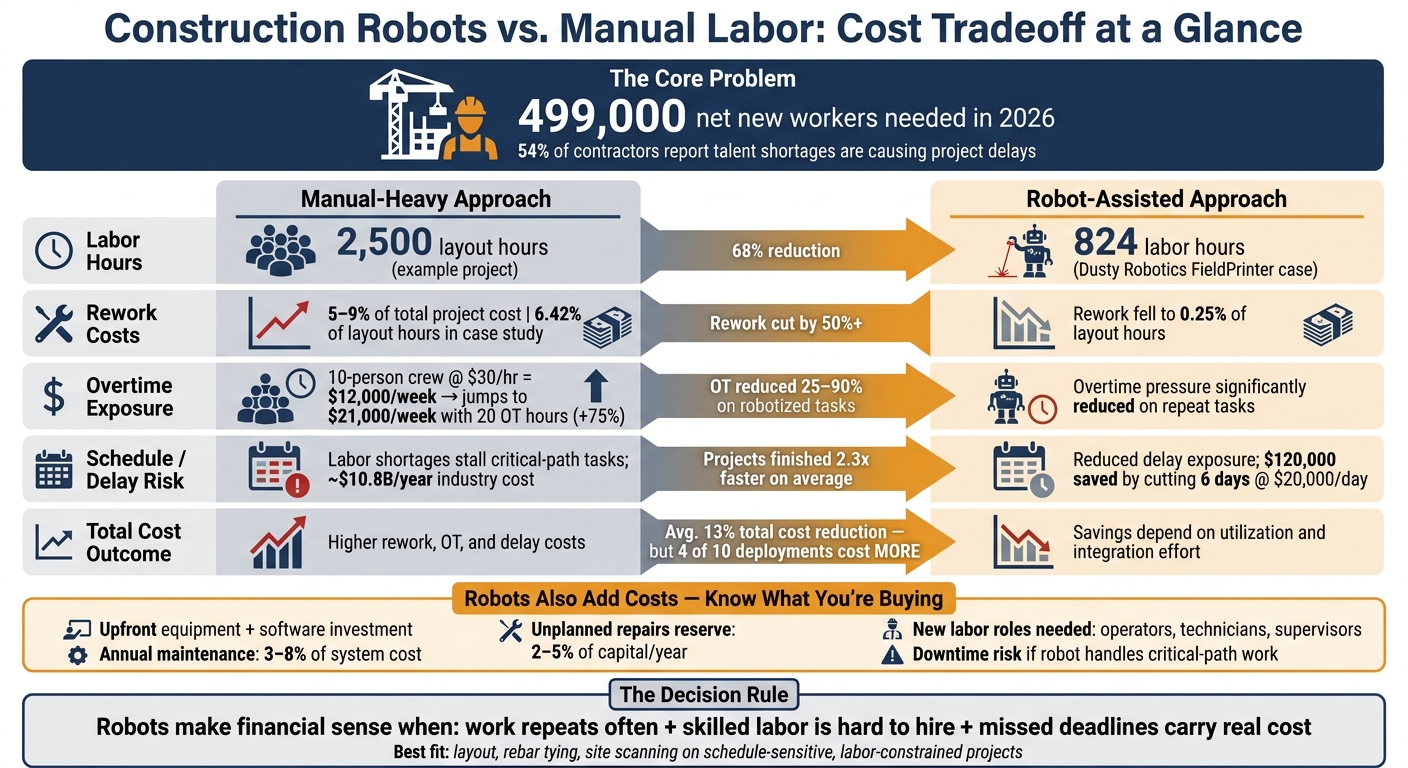
Construction Robots vs. Manual Labor: Cost Tradeoff at a Glance
Task-Based Robots for Contractors to Solve the Labor Crisis in Construction with Shamoon Siddiqui
sbb-itb-aa28329
Quick Comparison
| Area | Manual-heavy approach | Robot-assisted approach |
|---|---|---|
| Labor pressure | More exposed to shortages | Lower pressure on repeat tasks |
| Overtime | Often climbs fast | Can drop if the robot keeps pace |
| Rework | Higher when crews are stretched | Lower on precision-heavy work |
| Delay risk | Higher if key trades are short-staffed | Lower if the robot protects critical tasks |
| Upfront cost | Lower | Higher |
| Support needs | Standard field staffing | Operators, techs, and supervision needed |
| Best use case | Smaller or less repeatable scopes | Repeatable, labor-tight, deadline-driven scopes |
So if you’re weighing robots against labor shortages, I’d keep the question simple: Will this machine save more in labor strain and schedule risk than it costs to buy, run, and support? That’s the math that matters.
The problem: labor gaps are pushing up wages, overtime, and delay risk
Labor gaps push costs up in a few direct ways: higher wages, more overtime, and schedules that start to slide. When there aren’t enough qualified workers to staff a crew, contractors usually end up in a simple bind. They can pay more to bring people in, or they can accept delay risk. That’s the pressure robotics can ease.
Higher wages and overtime can drive up total crew costs fast
Construction wages hit $39.33 per hour in early 2025, which is 24% higher than the private-sector average. Entry-level laborer pay is also up, rising by about 21% since 2021. In tight labor markets, big builds like fabs and data centers are often fighting over the same pool of electricians and equipment operators.
And when regular pay still isn’t enough to fill out a crew, overtime steps in. That’s where costs can jump fast.
Overtime is paid at 1.5× the regular rate after 40 hours a week. So the math changes in a hurry. A 10-person crew earning $30 an hour goes from $12,000 a week to $21,000 a week with 20 overtime hours. That’s a 75% increase. Once labor spend starts climbing, schedule pressure usually climbs too.
Worker shortages also increase the cost of delays and rework
Short crews don’t just cost more on payroll. They can slow critical-path work and block the trades coming next, which means downstream teams lose access to their work areas. In contractor surveys, 54% say talent shortages are causing delays.
The meter keeps running either way. Cranes and lifts still rack up rental charges, and subcontractors may need to demobilize and come back later at change-order premiums. If the contract includes liquidated damages, each late day brings a set penalty. One estimate puts the yearly cost of skilled labor shortages at about $10.8 billion, driven by longer build times, carrying costs, and lost output.
Rework makes the hit even worse. Workers who are stretched by long overtime hours are more likely to make mistakes in layout, installation, and finishing. That can turn into punch-list items, failed inspections, and tear-outs. And because the fixes happen at today’s higher wage rates, each mistake costs more than it used to. That’s where task-specific robots start to change the math.
The solution: where construction robots can reduce labor pressure
When crews are stretched thin and deadlines are tight, task-focused automation starts to make a lot of sense. The point isn’t to swap out skilled trades for machines. It’s to take repetitive, physically hard, and mistake-prone work off their plate so smaller teams can keep moving.
Task-specific robots can improve output without replacing every worker
The robots making the biggest dent in labor pressure today are purpose-built tools that do one job very well.
Robotic layout is one of the clearest cases. Dusty Robotics‘ FieldPrinter enables multi-trade layout up to 10x faster than manual methods, with a single operator running the robot while the rest of the crew focuses on installation. That can cut labor hours and reduce rework on high-precision tasks. And when crews are short, that kind of accuracy matters even more.
Rebar tying is another area with a big payoff. Rebar-tying robots can outpace manual crews and reduce man-hours on bridge work. On bridge projects, that kind of output helps keep critical-path work from getting stuck.
Site-scanning robots and drones fill in the rest of the picture. They can scan jobsites with LiDAR or cameras to track progress and spot deviations early, which frees up crews from slow measurement and inspection walks. Finding issues sooner lowers the odds of expensive fixes later. That helps with schedule control, but it also brings new operating and support needs.
Human-robot teams can help keep schedules on track
The model here is simple: robots and workers, side by side. When robots take on the most physically demanding parts of the job, like overhead drilling or repetitive layout and tying, workers get less fatigued and are less likely to make mistakes that lead to rework.
Robots don’t need a full crew around them to be useful. They need trained operators and supervisors who can set them up, check their output, and keep the work sequence on track. The upside is real, but the crew still has to run, verify, and support the machines.
That shift in staffing is real too. Robots need operators, technicians, and supervisors. Those roles add labor costs even as they ease pressure on the field crew.
The tradeoff: lower labor pressure vs. higher equipment and support costs
The savings story isn’t just about paying fewer wages. It’s about cutting overtime, trimming rework, and lowering the odds of schedule slip. So the real comparison is total project cost versus manual-only delivery – not just the sticker price of the robot.
Potential savings: less overtime, less rework, and lower delay exposure
The clearest savings usually come from overtime. When crews are thin and the deadline won’t move, contractors often lean on night shifts, weekend work, and double-time pay. If a robot takes over a high-volume repetitive task like rebar tying or layout, the crew doesn’t need as many extra hours just to keep pace. Across deployments, repetitive-task labor dropped by 25–90%.
Rework can be just as expensive. It often consumes 5–9% of total project cost. On a $5 million job, that’s $250,000–$450,000 spent on tearout, redo, and the delays that come with them. Robots can help here because they bring steadier accuracy and consistency. Studies found rework fell by more than 50% when robots handled high-precision tasks.
Delay avoidance may be where the money gets real. Labor shortages were tied directly to project delays at nearly half of U.S. firms surveyed. Robots can shorten task durations and reduce dependence on hard-to-find craft labor. Across ten robot deployments, projects finished 2.3 times faster on average, with a 1.4x median improvement. On a job carrying $20,000 per day in general conditions and liquidated damages, shaving even six days off a critical-path task is worth $120,000.
Added costs: equipment, software, maintenance, and downtime risk
The other side of the ledger matters just as much. The cost of deployment goes well past the machine itself. A full rollout can include software, design-system integration, calibration, replacement parts, and support. Annual maintenance is usually budgeted at 3–8% of initial system cost, and that figure can climb on sites with heavy dust, vibration, or weather exposure. Unplanned repairs add another 2–5% of capital per year as a reserve.
Downtime is easy to underrate. If a robot is doing critical-path work – say deck layout or rebar tying on a bridge span – and it goes down, the project picks up a new type of schedule risk. No backup plan? Then the machine becomes a bottleneck. Contractors need to price that risk the same way they price any other delay exposure.
| Cost Category | Manual-Only | Robot-Assisted |
|---|---|---|
| Overtime exposure | High on labor-constrained tasks | Reduced by 25–90% on robotized tasks |
| Rework costs | 5–9% of total project cost | Rework reduced by more than 50% |
| Schedule delay risk | Labor shortages can stall critical tasks | Projects finished 2.3x faster on average; 1.4x median |
New labor needs: operators, technicians, and supervisors
The labor bill doesn’t vanish. It shifts.
Robots move labor demand toward operators, technicians, and supervisors. Every unit on site needs someone to set it up, watch output, and step in when things go sideways. Those are higher-skill roles, and they usually come with higher pay.
This is where some budgets go off track. A contractor may plan for the hardware and forget the people needed to keep it running day to day. On paper, the numbers can look great. In the field, that gap shows up fast.
The crew mix changes too: fewer workers doing repetitive manual tasks, more workers managing the systems doing that work. For firms already short on skilled labor, finding qualified robot operators adds one more staffing problem to solve before the equipment even shows up on site.
That cost balance is what decides where robotics pencil out.
How to decide when robotics make financial sense
Best-fit projects are repetitive, labor-constrained, and schedule-sensitive
Robotics make financial sense when three things line up at the same time: the work repeats often, skilled workers are tough to hire, and missed deadlines come with a real cost.
That’s why the best candidates tend to be repeatable scopes like layout, tying, finishing, and scanning. Schedule-sensitive work also stands out. Slabs, steel, and MEP rough-in are strong fits because when those scopes slip, the rest of the project can get knocked off pace too.
Utilization matters just as much as project fit. A robot that can move from one long-duration work front to another has more chances to earn back its cost. More productive hours usually mean a shorter payback period.
The numbers back that up. Research on ten deployed construction robots found an average total cost reduction of 13% across all cases studied. But the story wasn’t all upside: 4 out of 10 cases saw costs increase, mostly because utilization was low or integration took more time and effort than expected. In plain terms, the economics depend on where the robot is used and how often it stays busy.
Workforce planning still matters on a more automated job site
Even a good-fit project can fall apart if the site isn’t ready to support the machine. Automation shifts the labor issue; it doesn’t make it disappear.
Robots still need people around them, including trained operators, technicians, and supervisors. So ROI isn’t just about the machine itself. It also depends on whether the company can staff the work around it. For firms already short on skilled labor, that can be a problem all by itself, and it needs to be addressed before the equipment shows up on site.
Conclusion: robots can ease shortages, but they do not remove the need for workforce strategy
This makes the decision less about buying a machine and more about matching that machine to the job and the crew. Robotics tend to work best when workforce planning is part of the same plan.
A practical way to look at it is simple:
- Screen tasks first to find repeatable, schedule-sensitive work.
- Build the utilization case across your backlog, not just one project.
- Treat workforce deployment as part of the tech investment, not something to figure out later.
FAQs
When do construction robots actually pay off?
Construction robots tend to pay off fastest when they take on specific, repeatable, or hard-to-do jobs. Think layout, site surveys, or earthmoving. In those cases, they can improve accuracy and help move projects along faster.
ROI is often strongest when companies start with a pilot project and then scale once the process works. The upfront price can also be easier to handle with leasing, grants, or tax incentives. ABLEMKR can help companies find pre-trained robotics talent, which cuts training costs and makes day-to-day rollout smoother.
What hidden costs should I budget for?
Look past the sticker price of the equipment. You also need room in the budget for updates, calibration, and ongoing technical support, especially for remote sites where help can be harder to get.
Labor costs need a fuller look too. Include loaded labor costs such as taxes, benefits, workers’ comp, premium pay for skilled operators, and retention incentives.
Then factor in the costs that tend to sneak up on teams:
- Delay risks
- Wage escalation
- Overtime
- Expedited shipping
- Extended rentals
- Rework caused by fatigue-related mistakes
That’s where budgets often get squeezed – not by one big line item, but by a pileup of smaller costs that add up fast.
Which projects are the best fit for robots?
Robots work best on jobs that are repetitive, dangerous, or demand tight precision. That includes layout, drilling, bricklaying, material handling, and heavy demolition. They also hold up well during long, uninterrupted shifts, which makes them a strong fit for work that needs steady output hour after hour.
They’re especially useful in off-site prefabrication and modular construction, where controlled conditions make standardized assembly easier to manage. In that setting, teams can improve safety, tighten quality control, and keep schedules more dependable when on-site labor is in short supply.


