
Solar installer jobs are set to grow 22% from 2022 to 2032, while all jobs average just 3%. If I wanted to get into solar without paying full tuition, I’d start with grant-backed paths that lead to free or low-cost training, paid apprenticeships, or entry-level certificates.
Here’s the short version:
- I found 10 public funding paths for U.S. workers
- Most routes go through community colleges, nonprofits, unions, or workforce boards
- The main options are:
- bootcamps
- certificate programs
- registered apprenticeships
- Many programs focus on:
- veterans
- women
- justice-impacted workers
- career changers
- roofers and construction workers
- Common outcomes include:
- NABCEP PV Associate prep
- OSHA 10 or OSHA 30
- job placement help
- apprenticeship entry
The 10 paths covered here are:
- Solar Ready Vets Network
- DOE Advancing Workforce Partnerships Solar Grants
- DOE Solar Training Network
- EPA Solar for All Workforce Training Programs
- California Solar for All Workforce Pathways
- MassCEC Clean Energy and Solar Training Grants
- NYSERDA Clean Energy Workforce and Solar Training Programs
- DOL Building Pathways to Infrastructure Jobs Grants
- Community College Solar Installer Grant Cohorts
- Local Workforce Board Solar and Green Jobs Training Grants
Bottom line: if I were choosing, I’d match the path to my location, schedule, and end goal. If I wanted to earn while I train, I’d look at apprenticeship routes. If I wanted a classroom path first, I’d check local college or workforce-funded cohorts.
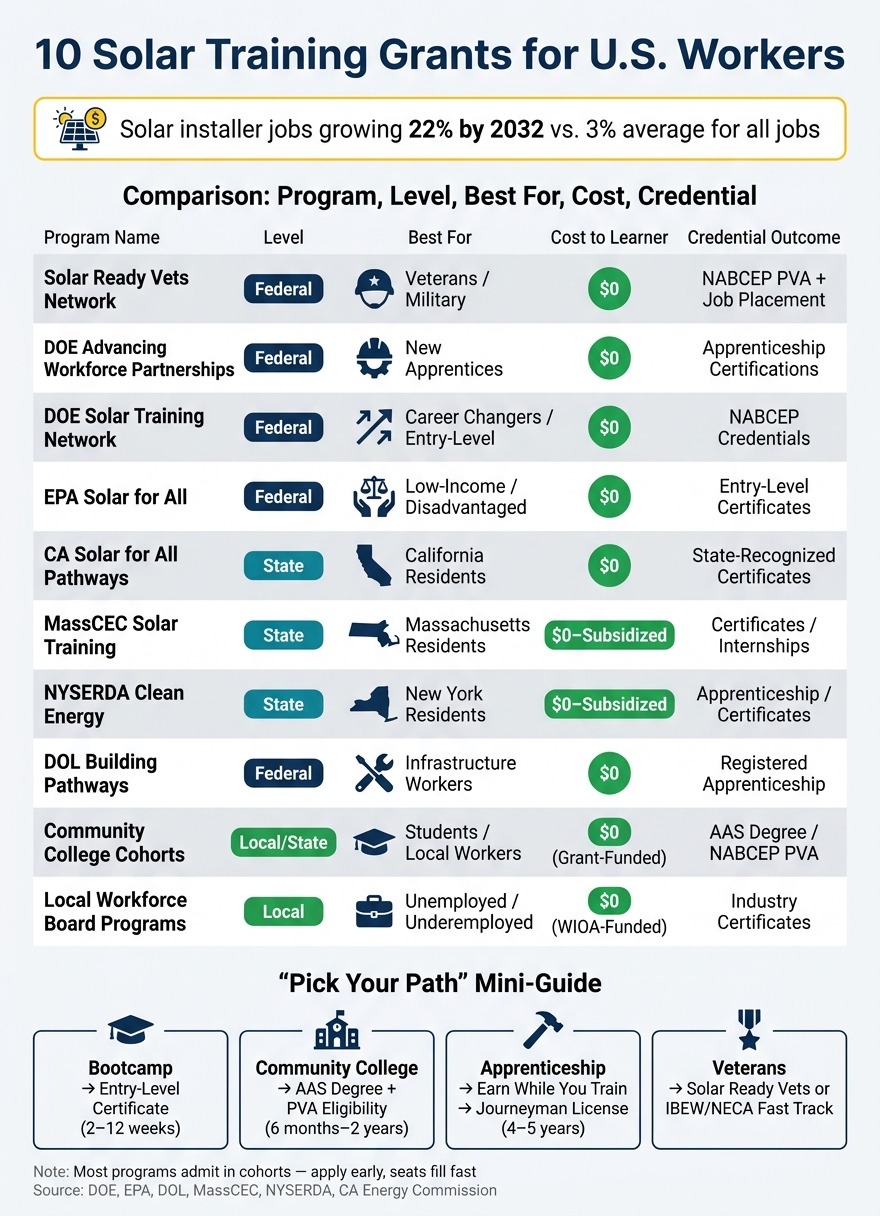
10 Solar Training Grants for U.S. Workers: Side-by-Side Comparison
Quick Comparison
| Program | Main path | Best fit for | Usual result | Where I’d look |
|---|---|---|---|---|
| Solar Ready Vets Network | Bootcamp | Veterans, transitioning service members | PVA prep, placement help | Transition offices, SkillBridge |
| DOE Advancing Workforce Partnerships | Apprenticeship-linked | New solar apprentices | Paid training path | IBEW/NECA, colleges |
| DOE Solar Training Network | Provider hub | Entry-level workers, career changers | Varies by provider | Colleges, workforce boards |
| EPA Solar for All | Local grant-funded seats | Underserved communities | Entry-level training | State and local partners |
| California Solar for All | State mix of providers | California workers | Certificates or apprenticeship link | Colleges, boards, nonprofits |
| MassCEC Solar Training | State-funded seats | Massachusetts workers | Certificates, training seats | Local providers |
| NYSERDA Clean Energy | State-funded mix | New York workers | Certificates or apprenticeship link | Union halls, colleges, boards |
| DOL Building Pathways | Infrastructure apprenticeship track | People aiming for commercial work | Apprenticeship-linked training | Workforce boards, unions |
| Community College Cohorts | Certificate or AAS | Workers wanting classroom training | PVA prep, OSHA, degree options | College trades pages |
| Local Workforce Board Programs | Local cohorts | Unemployed or underemployed workers | Short certificates or paid training | American Job Centers |
The key point is simple: most workers won’t get a check in hand. Instead, the grant usually pays the school, nonprofit, union, or training partner so you can join at $0 or at a much lower cost.
That makes the next step simple: find the programs in your area, check the entry rules, and apply early because many seats open in cohorts and fill fast.
sbb-itb-aa28329
What Counts as a Solar Training Grant Path
Solar training grant paths are publicly funded ways to enter the field. They can cover training seats, trainee stipends, or instruction tied to an apprenticeship. In practice, workers will usually run into three common formats.
Direct Grants vs. Grant-Funded Training Seats
Most worker-facing programs don’t hand cash straight to trainees. Instead, the money usually goes to a community college, nonprofit, or workforce board that runs a solar training track. From there, eligible participants can enroll at no cost or at a heavily reduced price.
Some paths also pay people while they train. That shows up most often in contractor-led academies and registered apprenticeships. For workers, the upside is pretty simple: lower-cost access to solar training and a more direct path into the job market. And those funding models shape the kinds of training workers tend to see next.
Pre-Apprenticeship, Certificate, and Apprenticeship-Linked Tracks
Bootcamps and pre-apprenticeships are usually the shortest route. They often run for 2 to 12 weeks and wrap up with entry-level certificates plus job placement help.
Community college certificate programs take longer, usually 6 months to 2 years. Many line up with the NABCEP PV Associate (PVA) credential, which employers recognize.
Apprenticeship-linked tracks are the most structured option. They connect workers to union or employer hiring pipelines, especially IBEW/NECA programs. These paths can lead to a journeyman electrician license after 4 to 5 years of paid on-the-job training.
Federal clean-energy incentives now come with apprenticeship rules attached, which gives these tracks extra weight in commercial solar hiring.
What This List Covers and Leaves Out
This list focuses on publicly funded solar or clean-energy training programs that have a direct pipeline for workers. It leaves out private paid courses and broad green-jobs programs that don’t include a solar credential or a hiring link. Those rules also affect who can qualify.
Who These Programs Usually Serve
Grant-backed solar training programs don’t serve every worker group the same way. So it’s worth figuring out where you fit before you spend time applying.
Common Target Groups
Many programs focus on veterans and transitioning service members, justice-impacted workers, women, experienced roofers, and people coming from construction or warehouse jobs. Veterans often line up well with solar field work, so a lot of programs put this group near the top of the list. Women are still underrepresented in the field, but more programs are trying to bring them in and keep them there by improving protective gear fit and jobsite culture. Experienced roofers also tend to have a head start, since they already bring many of the hands-on installation skills the work calls for.
Common Entry Requirements
Most programs stick to a short set of basic rules. In general, applicants need to be 18 or older and able to handle fieldwork, including lifting panels and working at height. Some providers also check for basic math and reading skills. That makes sense when you look at the job itself: installers need to deal with electrical code basics and torque requirements on site.
Requirements That Vary by Provider
Licensing rules, background checks, and drug testing can change based on the state and the employer tied to the program. Programs built for justice-impacted workers often use looser screening rules.
The programs below vary for a simple reason: they serve different groups, and they don’t screen applicants the same way.
1. Solar Ready Vets Network
First up is one of the clearest veteran-to-solar pipelines.
Program Type
Solar Ready Vets Network is a nonprofit bootcamp path that offers short-term training, entry-level certificates, and job placement support. Most training runs from 2 to 12 weeks.
Target Worker Groups
This network is built for veterans and transitioning service members.
Common Entry Rules
Applicants are often active-duty service members in their final months of service or veterans who recently left the military. These programs often lead to the NABCEP PV Associate (PVA) credential.
Where Openings Appear
A good place to start is your military transition office. Programs like DoD SkillBridge can connect active-duty members with solar training during their final months of service.
You can also check:
- Military transition offices
- DOE partner pages
- Local workforce boards
- Community colleges
That’s usually where new openings tend to show up.
2. DOE Advancing Workforce Partnerships Solar Grants
This federal grant path pays for solar training through registered apprenticeships. It’s a step up from short bootcamps and works well for people who want a longer, paid way into the trade. Instead of paying out of pocket for a stand-alone course, workers can move into structured solar training while earning as they learn.
Program Type
The DOE Advancing Workforce Partnerships grants support solar training through registered apprenticeship programs.
Target Worker Groups
These grants focus on workers entering solar installation apprenticeships.
Common Entry Rules
Entry usually happens through IBEW/NECA programs, state-registered apprenticeships, and community-college partners.
Where Openings Appear
Openings usually show up through IBEW/NECA programs, state-registered apprenticeships, and community-college partners. Employers with established apprenticeship relationships may also post seats tied to federally funded work.
That makes this option a strong fit for workers who want training linked straight to a job pipeline.
3. DOE Solar Training Network
For workers who want a broader search than a single apprenticeship track, the DOE Solar Training Network points to several training providers. It works as a multi-provider hub for community college, nonprofit, and contractor-led solar training. That gives workers more than one way in, which can help if one path doesn’t fit.
Program Type
The DOE Solar Training Network is a multi-provider training hub.
Target Worker Groups
This option fits career changers, entry-level workers, veterans, and justice-impacted workers.
Common Entry Rules
Entry rules depend on the provider. Community colleges often ask for a high school diploma or GED. Bootcamps and contractor academies usually take entry-level applicants.
Where Openings Appear
Openings often appear where providers and hiring partners already work together. Look for them on:
- Community college energy pages
- Local workforce board listings
- Contractor career pages
4. EPA Solar for All Workforce Training Programs
Unlike national application programs, EPA Solar for All sends funding through local awardees that run solar training in their own communities. EPA Solar for All sits under the federal Greenhouse Gas Reduction Fund. EPA gives money to state, tribal, municipal, and nonprofit awardees, and those groups run local solar access and workforce training programs. That means workers apply through local partners, not through EPA itself.
Program Type
EPA Solar for All offers grant-funded training seats. Workers sign up through local awardees or partner organizations that already have federal funding in place to run training.
Target Worker Groups
These programs often focus on underserved communities. In many cases, that includes justice-impacted workers, veterans, and women.
Common Entry Rules
Most programs last 2 to 12 weeks and are built for entry-level workers.
Where Openings Appear
Openings usually show up through local channels, not one central federal portal. Workers often need to check:
- State energy offices
- Community action agencies
- Workforce boards
- Community college energy programs
- Nonprofit partners
Nonprofit and bootcamp tracks often work with veterans and justice-impacted workers. Some also connect people to state-registered apprenticeships linked to local workforce systems.
5. California Solar for All Workforce Pathways
California is one of the biggest state-level Solar for All markets. And the training options run through a few different lanes: education programs, labor pipelines, and contractor systems.
Program Type
California Solar for All supports nonprofit bootcamps, community college programs, contractor academies, and IBEW/NECA apprenticeships.
Target Worker Groups
These pathways are built for people who can move into field roles fast. In many cases, programs focus on veterans, justice-impacted workers, women, and roofers who want to shift into solar.
Common Entry Rules
Bootcamps often run from 2 to 12 weeks and usually don’t require any past solar experience. Community college programs tend to last from 6 months to 2 years.
Where Openings Appear
Look for openings through California community college energy programs, local workforce boards, and nonprofit training partners. In practice, these spots often move fastest through local education and workforce partners.
6. MassCEC Clean Energy and Solar Training Grants
Massachusetts uses a similar grant-backed setup, but the openings usually come through MassCEC’s local training network. MassCEC supports solar training across Massachusetts with grant-backed seats and workforce programs.
Program Type
MassCEC backs four common paths: community college energy programs, nonprofit bootcamps, contractor in-house academies, and registered apprenticeships. For workers, the main draw is a lower-cost way into solar jobs in Massachusetts.
Target Worker Groups
These programs mainly serve Massachusetts workers who are trying to enter solar through college, bootcamp, contractor, or apprenticeship paths.
Common Entry Rules
Entry rules depend on the provider. Some bootcamps offer open enrollment, while community college and apprenticeship tracks may screen applicants first.
Where Openings Appear
Openings are posted through community colleges, workforce boards, and training providers. Most of them move through local education and workforce partners.
7. NYSERDA Clean Energy Workforce and Solar Training Programs
New York uses the same grant-backed model, but NYSERDA spreads support across a broader mix of training providers.
Program Type
NYSERDA funds apprenticeships, community college certificate programs, bootcamps, and contractor academies.
Target Worker Groups
NYSERDA-backed programs usually focus on veterans, justice-impacted individuals, women, and experienced roofers.
Common Entry Rules
Most programs don’t require past electrical experience. Instead, applicants are often expected to show reliability, physical stamina, and a willingness to learn torque specs, fall protection, and NEC basics.
Where Openings Appear
Openings often show up through community colleges, union halls, state-registered apprenticeships, and workforce boards. That gives workers more than one way in, which is a big part of what makes NYSERDA useful at the state level.
The next program moves from state funding to federal infrastructure grants.
8. DOL Building Pathways to Infrastructure Jobs Grants
For workers who want to move into bigger commercial projects, federal infrastructure grants offer another path. Building Pathways grants back apprenticeship training for prevailing-wage infrastructure work, including solar. And that matters because many federally funded solar projects now expect workers to come through these apprenticeship pipelines.
Program Type
Building Pathways grants pay for solar-related apprenticeship tracks tied to infrastructure projects, with training linked to prevailing wage rules. The training usually comes through partnerships between workforce boards, community colleges, and union apprenticeship programs such as IBEW/NECA. That setup gives workers a more job-ready start than classroom-only training.
Target Worker Groups
These programs often focus on veterans, justice-impacted workers, women, and career changers coming from fields like construction or warehousing.
Common Entry Rules
Common entry rules often include:
- Construction experience
- Physical readiness
- OSHA 10 or OSHA 30 certification
- First-aid certification
- PVA exam prep
Those last two are common screening signals and can help show that an applicant is ready for the demands of the work.
Where Openings Appear
Openings usually show up through union halls, state-registered apprenticeships, community college energy programs, and nonprofits. Spring-start cohorts are worth watching, since they often line up with peak hiring.
9. Community College Solar Installer Grant Cohorts
For workers who want a classroom-based path with a clear credential at the end, community college cohorts are often the simplest way in. They sit in the middle ground between short bootcamps and full apprenticeship tracks. Most programs run 6 months to 2 years, based on whether you’re earning a short-term certificate or a full Associate of Applied Science (AAS) degree.
Program Type
These are grant-backed certificate and degree programs built around job-ready credentials. The stronger cohorts line up with NABCEP PV Associate (PVA) readiness, OSHA 30, and placement into registered apprenticeships. That matters because students don’t just leave with classroom time – they leave with a credential employers know and a path into direct hiring or apprenticeship entry.
Federal policy also ties clean-energy incentives to prevailing wage and registered apprenticeship rules. That gives these programs extra pull with employers.
Target Worker Groups
These cohorts tend to fit a wide mix of workers, especially career-changers, veterans, women, justice-impacted workers, and experienced roofers. Roofers, in particular, often move into solar work smoothly because they already understand rooftop conditions and jobsite safety.
Common Entry Rules
The entry bar is usually pretty simple. Most applicants just need to show they’re reliable, able to attend consistently, and physically ready for hands-on work.
Timing matters too. Fall or winter cohorts can line up well with spring completion, which puts graduates in a better spot for spring hiring season.
Where Openings Appear
The best place to look is usually local community college Energy or Trades pages. Openings also show up through local Workforce Development Boards and state clean-energy program pages such as NYSERDA or MassCEC.
There’s no single national portal for these programs. Openings are local and tied to each cohort, so checking with training partners directly is usually the surest way to track them.
10. Local Workforce Board Solar and Green Jobs Training Grants
Local workforce boards are one of the most common places to find grant-backed solar training seats. At this level, they often run the same kind of grant-funded cohorts covered in Section 9.
Program Type
These programs are the most local form of grant-backed solar training. They’re run locally and paid for through grants, so the setup can change a lot from one region to another. Some are short certificate cohorts. Others run as 90-day paid training. The stronger programs usually shape their curriculum with input from hiring contractors, which helps keep the training tied to actual jobs.
Target Worker Groups
Local workforce grants often focus on groups such as:
- Veterans
- Women
- Justice-impacted workers
- Career changers coming from construction-adjacent fields
Common Entry Rules
Rules depend on the provider. WIOA-funded seats may come with income requirements, and apprenticeship-linked programs can have their own screening rules.
Where Openings Appear
These openings usually don’t live on one national portal. A good starting point is your local American Job Center. You can also check state WIOA portals and local workforce board websites. Many cohorts line up graduation with spring hiring, so timing matters.
Where Workers Usually Find Openings
These openings usually don’t live in one neat, central database. Most programs run through local partners, use grant funding, and admit people in cohorts. So the search can feel a bit scattered. That’s normal.
State and Federal Program Pages
Start with your state energy office website. Then look at EPA Solar for All award pages and DOE grantee announcements. Those pages often point you to the groups actually running the training.
If you don’t see an opening there, go one layer deeper and check the local providers and workforce system sites tied to those awards.
Community Colleges and Workforce Systems
A lot of grant-funded seats show up first on community college continuing education pages, not on big job boards. It’s also smart to check:
- American Job Center listings
- Local workforce board training calendars
Pay close attention to spring-completion cohorts. Hiring often picks up around that time. And if the seats are already full, don’t stop there. Shift to apprenticeship routes and military-transition channels.
Apprenticeship and Military Transition Channels
IBEW/NECA electrical apprenticeship sites are one of the main paths for solar-adjacent union training. If you’re a veteran, check military base transition offices and programs like Helmets to Hardhats. These channels often surface solar and construction paths for service members moving into civilian trades.
After training, the next step is turning those credentials into an actual job. That’s where matching platforms come in.
Job Platforms After Training
After training, use ABLEMKR to match certifications, availability, and location to field jobs.
Quick Comparison of All 10 Programs
Most of these programs are free to the learner because grant funding covers tuition or cohort costs. So if you want to cut through the noise fast, this table gives you the big picture.
| Program | Level | Who It Targets | Cost to Learner | Credential Outcome | Typical Access Point |
|---|---|---|---|---|---|
| Solar Ready Vets Network | Federal | Veterans / Transitioning military | $0 | NABCEP PVA + job placement | Solar Ready Vets portal / Hiring Our Heroes |
| DOE Advancing Workforce Partnerships | Federal | Workers entering apprenticeship-linked solar training | $0 | Apprenticeship-linked certifications | DOE grantee organizations |
| DOE Solar Training Network | Federal | Career changers and entry-level workers | $0 | NABCEP credentials | IREC / Solar Training Network |
| EPA Solar for All | Federal | Low-income and disadvantaged workers | $0 | Entry-level certificates | State and tribal energy offices |
| CA Solar for All Pathways | State | California residents | $0 | State-recognized certificates | CA Energy Commission / grantees |
| MassCEC Solar Training | State | Massachusetts residents | $0–subsidized | Certificates / internships | MassCEC.com |
| NYSERDA Clean Energy | State | New York residents | $0–subsidized | Apprenticeship / certificates | NYSERDA partner list |
| DOL Building Pathways | Federal | Infrastructure workers | $0 | Registered apprenticeship | DOL grantees / workforce boards |
| Community College Cohorts | Local / State | Students / local workers | $0 (grant-funded) | AAS degree / NABCEP PVA | College admissions offices |
| Local Workforce Board Programs | Local | Unemployed / underemployed workers | $0 (WIOA-funded) | Industry-recognized certificates | American Job Centers |
The main difference comes down to what you want at the end.
- A registered apprenticeship lets you earn money while you train
- A bootcamp usually leads to an entry-level certificate
- A community college path can add an AAS degree and PVA eligibility
- An apprenticeship can move you toward a journeyman license
Federal programs often send applicants through grantees like community colleges, nonprofits, or workforce boards. State portals are usually more direct, which sounds easier on paper, but spots can still fill fast once a cohort opens.
That’s why it helps to match the path to your background, timeline, and weekly schedule. If you need a straight line into paid training, apprenticeship-linked options may fit better. If you want classroom training first, a college or state-funded cohort may be the better move.
How to Pick the Right Path
Use the comparison above, then narrow your choice by schedule, location, and end goal.
Best Fit for Veterans and Transitioning Service Members
Veterans and service members often do well in apprenticeship-linked solar roles because the setup lines up with military experience. If you want a fast way in, start with Solar Ready Vets for an entry-level credential. If you’re thinking longer term, an IBEW/NECA apprenticeship can lead to a journeyman license plus paid on-the-job training.
If speed matters most, the next route may fit better.
Best Fit for Entry-Level Workers
This choice usually comes down to speed vs. depth. A bootcamp-style program can help you earn a credential and get job placement support in less time. A community college cohort takes longer, but it adds an AAS degree and NABCEP PVA eligibility for workers who can make the time commitment. Try to finish before spring hiring starts to ramp up.
If you want a straight line to employers, focus on apprenticeship-linked options.
Best Fit for Workers Seeking Direct Hiring Pipelines
If your goal is the shortest path into paid solar work, put employer-backed training at the top of your list. Look for programs that include a named employer partner, paid field hours, hands-on lab time with modern racking systems, and OSHA 10 or 30 certification. Those are strong signs of a better hiring path.
The last step is matching the program to your location, timeline, and hiring target.
Conclusion
After looking at the 10 paths above, the best option depends on where you live, what experience you already have, and which programs you can qualify for. That last point matters more than it may seem. Prior experience can change which path makes the most sense.
Focus on programs that move you toward NABCEP PVA readiness, OSHA 30, and a clear route to a named employer or apprenticeship pipeline. That’s where things start to feel less abstract and more like a direct path to a job.
Timing matters too. Cohorts that wrap up in spring line up with peak hiring season. Workers with the right credentials have stronger hiring leverage with employers, so it makes sense to choose the path that gets you credentialed, linked to employers, and into paid work as fast as possible.
FAQs
How do I find programs near me?
Use ZIP code searches to find solar training near you, including programs that work well for remote learners.
You can also check the IREC ACE Network for local registered apprenticeships and clean-energy training providers. Green Workforce Connect is another good place to look for community colleges and regional training programs. If you already have solar certifications and safety training, ABLEMKR can help match you with nearby job opportunities based on your credentials.
Can I get paid while training for solar work?
Yes. Formal apprenticeship programs let you earn while you learn through classroom instruction and supervised, on-the-job training.
Most apprentices start at 40% to 60% of the journeyworker rate. Pay usually goes up as they hit skill milestones. In some clean energy jobs, employers may also offer paid training or tuition reimbursement.
Which solar training path fits my goals?
The right path depends on your experience and where you want your career to go.
- New to the field: Start with entry-level certificate programs like the NABCEP PV Associate or community college courses.
- Aiming for specialized or leadership roles: Look at advanced credentials like the NABCEP PV Installation Professional or energy storage certifications.
- Want to start working right away: Apprenticeships let you get hands-on training while you earn.


