
Battery employers need workers now, but training only helps if it matches the job. This roundup shows a simple pattern: plant jobs need skills in HMIs, MES, automation, and data logging; field and storage jobs need code, commissioning, BMS monitoring, and safety records; recycling jobs need disassembly, tracking, and compliance work.
I’d boil the article down to this:
- Battery work is now software-heavy
- Employers are short on trained people
- The best programs are tied to clear job paths
- Digital-tool experience matters as much as hands-on work
The labor gap is clear. 82% of battery employers say they do not have enough skilled local applicants, and 90% say recent job postings had a limited candidate pool. At the same time, U.S. battery manufacturing employment hit 54,400 in 2024 and could reach 310,000 by 2030.
If I were scanning this roundup fast, here’s what I’d want to know first:
- DOE Battery Workforce Initiative: apprenticeship standards for battery machine operators and repair technicians
- Battery Workforce Challenge: cloud-based learning plus reskilling hubs for manufacturing, recycling, and EV pack work
- NYSERDA-backed programs: storage, controls, monitoring, and microgrid training
- Community colleges: short labs, certificates, EV battery diagnostics, and installer prep
- Union training like ESAMTAC: BMS, SCADA, PLCs, commissioning, and utility battery systems
- Employer-led programs: Tesla, Redwood Materials, and LG-linked training tied to plant hiring
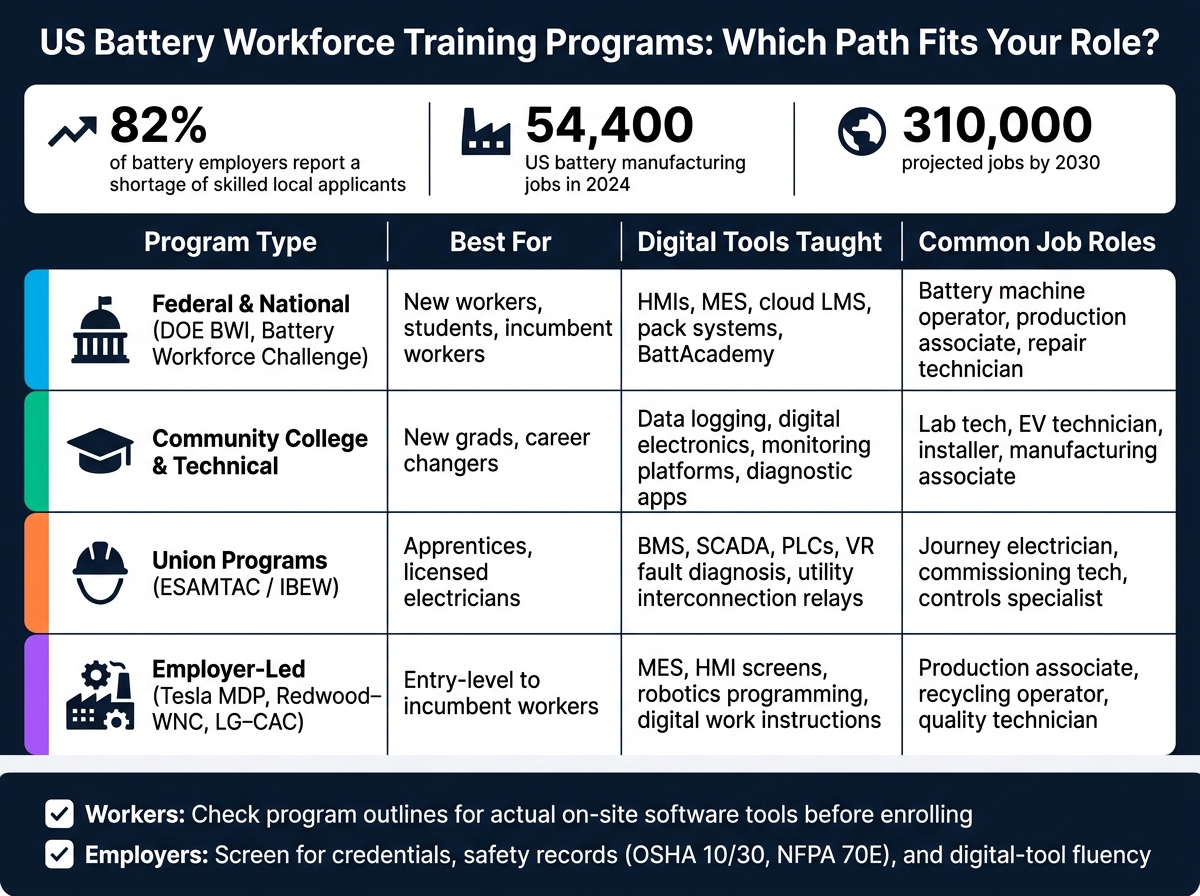
US Battery Workforce Training Programs: Which Path Fits Your Role?
Quick Comparison
| Program group | Main focus | Best fit for | Tool exposure | Common roles |
|---|---|---|---|---|
| Federal and national programs | Apprenticeships, EV battery learning, reskilling | New workers, students, current workers | HMIs, MES, cloud LMS, pack systems | Machine operator, repair tech, production roles |
| Community college programs | Labs, certificates, EV systems, installer prep | New grads, career changers | Data collection, digital electronics, monitoring platforms | Lab tech, EV tech, installer |
| Union programs | Storage, microgrids, controls, commissioning | Apprentices, electricians | BMS, SCADA, PLCs, VR tools | Electrician, commissioning tech, controls work |
| Employer-led programs | Plant work, recycling, gigafactory roles | Entry-level and current workers | MES, HMI screens, robotics, digital tracking | Production associate, recycling operator, quality tech |
Bottom line: if you’re a worker, check whether a program teaches the exact systems used on the job. If you’re an employer, screen for credentials, safety records, and software-tool use before you hire.
sbb-itb-aa28329
Federal and National Programs Building Battery Workforce Skills
Three U.S. efforts sit at the center of battery workforce training: DOE’s Battery Workforce Initiative, the Battery Workforce Challenge, and NYSERDA-backed storage training. All three lean on digital tools, automation, and job-linked credentials. And each one lines up with different roles across plants, labs, installation work, and field service.
DOE Battery Workforce Initiative and Apprenticeship Pathways
Launched in March 2022 with a $5 million federal investment, the Battery Workforce Initiative (BWI) is a joint effort by the U.S. Department of Energy and the U.S. Department of Labor to standardize training for two core occupations: battery machine operator and battery machine repair technician. Its main output is National Guideline Standards (NGS), released in 2024 as DOL-certified apprenticeship guidelines.
Manufacturers, community colleges, and unions helped shape the standards, which matters because the skills list comes straight from plant-floor work. The NGS covers cathode and anode manufacturing, electrode preparation, cell assembly, and high-voltage safety testing.
It also reflects how battery plants run today, not how they ran ten years ago. The digital side includes operating automated production lines, checking equipment status through HMIs, following digital work instructions, and logging production data in manufacturing execution systems (MES). In plain English, BWI gives local training providers a clear apprenticeship model that blends classroom learning with hands-on work in a plant.
Where BWI sets a common path into plant roles, BWC opens the pipeline to a bigger mix of learners and workers.
Battery Workforce Challenge and Cloud-Based Career Learning
The Battery Workforce Challenge (BWC) takes a broader approach. Managed by Argonne National Laboratory and co-sponsored by Stellantis, it works as a training pipeline across CTE programs, university engineering, and regional reskilling hubs.
At the university level, teams build and integrate advanced EV battery packs for vehicle use. That gives students direct exposure to the kind of pack work they may see later in industry.
For vocational learners and workers in transition, the program also runs through Regional Workforce Training Hubs. These hubs support reskilling for EV battery manufacturing, recycling, and process roles in partnership with battery manufacturers, community colleges, and departments of labor. The cloud-based BattAcademy platform adds the online layer by delivering modular training, tracking progress, and linking workers to plant and recycling roles.
That setup is practical. A worker coming out of auto assembly, for instance, can take online modules on lithium-ion cell fundamentals and automated pack assembly, then move into a regional hands-on training opportunity and, from there, into an open role, without relocating for long-term in-person training.
NYSERDA carries many of those same skills into grid storage, commissioning, and day-to-day operations.
State-Backed Energy Storage Training with Controls and Monitoring Skills
NYSERDA (New York State Energy Research and Development Authority) stands out as a state-backed example of storage training centered on controls and monitoring. Its programs draw on at least $4 million in storage workforce funding, along with a broader $50 million clean energy workforce commitment. That support goes toward curriculum development, technical skills training, and hands-on instruction for installers, commissioning technicians, and operations personnel.
The training itself focuses on the software and data side of storage work, not just the hardware. It covers BESS monitoring software, state-of-charge and alarm data, and utility and emergency communications. That matters because storage jobs now often involve screens, alerts, and remote system checks as much as tools in the field.
Two examples give a sense of scale:
- An IBEW Microgrid (ESM) Training initiative projected to train 129 electricians and contractors on energy storage and microgrid assembly, commissioning, maintenance, and decommissioning.
- A SUNY Polytechnic Institute program projected to train 146 workers – including engineers, technicians, and entry-level workers – in battery assembly, testing, post-mortem analysis, and recycling.
Taken together, these examples show how storage training is shifting toward monitored, data-driven operations.
Next, the roundup shifts to community colleges and technical programs that turn these skills into certificates and lab-based training.
Community Colleges and Technical Programs Teaching Battery Tools
Community colleges and technical schools offer battery training that mixes hands-on lab work with digital tools, data logging, diagnostics, and code-based instruction. The path usually starts with lab basics, then moves into monitoring, troubleshooting, and field work shaped by code and safety rules.
Battery Manufacturing and Lab Programs
SUNY Broome Community College offers non-credit Battery Technician labs focused on battery fundamentals. These are hands-on, 2-hour lab modules that cover cell cycling, pack assembly, pack disassembly, EV charging, and solar technology basics. The labs are free through New Energy New York and line up with roles like lab technician and battery trainee.
From there, the focus shifts from general lab work to manufacturing training built with employer input.
Guilford Technical Community College (GTCC) centers its program on manufacturing. Its 40-hour lithium-ion battery manufacturing course – built with the Carolina Battery Institute and manufacturer partner Soelect – covers battery materials and chemistry, electrode preparation, coin-cell assembly, testing protocols, and recycling and waste disposal. That employer input helps keep the course tied to entry-level battery assembly jobs.
EV Battery Diagnostics and Technician Certificates
Henry Ford College (HFC) offers an EV Battery Manufacturing Technology certificate that shows proficiency in EV battery fundamentals, safety, digital electronics, circuit analysis, and data collection. Students can also stack it into an associate degree in Electrical Engineering Technology.
Shelton State Community College offers a free 64-hour Battery Technology Technician course through the Alabama Energy Infrastructure Training Center and Network. The course covers battery chemistries, thermal management, state-of-charge monitoring, and safety systems, which makes it a short route into EV battery work.
Heartland Community College offers an Electric Vehicle Energy Storage certificate with courses in Introduction to Electric Vehicle Technology, Battery Technologies, and High Voltage Architecture. It also offers a 33-credit EV Technology certificate that adds DC and AC electronics, digital electronics and microprocessors, thermal management, high voltage architecture, and battery technologies. On top of that, its EVES Manufacturing Training Academy includes a second-life energy storage track, and the EVES certificate prepares students for the ASE L3 Hybrid and Electric Vehicle exam.
Energy Storage Installer Training and Code-Based Coursework
The last group shifts into field deployment, where installers need to understand both code and system monitoring.
Pellissippi State Community College is aimed at experienced installers and electricians moving into solar-plus-storage work. Its NABCEP-aligned course bundle costs $1,795 and includes 58 advanced NABCEP credits, while also preparing learners for the Energy Storage Installation Professional (ESIP) exam. Coursework covers energy storage markets, battery chemistries, system architecture, the National Electrical Code (NEC), building and fire codes, and monitoring platforms used to read dashboards and interpret alarms. That makes it a fit for solar-plus-storage installers, design support, system configuration, and field operations roles.
The table below shows how these programs compare by format, focus, and job fit:
| Program | Format | Primary Focus | Likely Job Fit |
|---|---|---|---|
| SUNY Broome Battery Technician Labs | Non-credit, 2-hour lab sessions; free through New Energy New York | Cell cycling, pack assembly/disassembly, EV charging | Lab technician, battery trainee |
| GTCC Lithium-Ion Battery Manufacturing | 40-hour course | Electrode prep, coin-cell assembly, testing, recycling | Battery assembly technician, manufacturing entry roles |
| Henry Ford College EV Battery Manufacturing Technology | Stackable certificate | Digital electronics, circuit analysis, data collection | EV battery technician, manufacturing associate |
| Shelton State Battery Technology Technician | 64-hour course, free | Thermal management, state-of-charge monitoring, safety systems | EV battery technician, maintenance technician |
| Heartland Community College Electric Vehicle Energy Storage certificate | 9-credit certificate | EV technology, battery technologies, high voltage architecture | EV service technician, maintenance technician |
| Heartland Community College EV Technology certificate | 33-credit certificate | Digital electronics, microprocessors, thermal management, battery technologies | EV technician, manufacturing/diagnostic roles |
| Pellissippi State NABCEP ESIP Prep | $1,795 course bundle, 58 advanced NABCEP credits | NEC, building/fire codes, system architecture, monitoring | Solar-plus-storage installer, design support, field operations |
Union, Employer-Led, and Regional Training Tied to Battery Jobs
Beyond community colleges, some of the most job-ready battery training comes from unions and employers that shape programs around actual project work and plant demand. These courses aren’t broad on purpose. They’re built for specific jobsites, production lines, and recycling tasks. That matters because the skills for a microgrid crew don’t look the same as the skills for a battery plant floor.
The next section shows which programs feed field crews and which feed plant floors.
Union Training for Microgrids, Storage Systems, and Controls
A major union path is ESAMTAC, developed by IBEW and NECA with Penn State University and EPRI. It is delivered through IBEW Joint Apprenticeship and Training Committees (JATCs) as a 40-hour specialty course. The training covers assembly, testing, commissioning, maintenance, repair, retrofitting, and decommissioning of large stationary battery systems, with hands-on work in BMS, SCADA, PLCs, and utility interconnection relays.
Because the program is linked to union hiring halls and dispatch, graduates can move into microgrid, solar-plus-storage, and utility battery projects. VR modules also give learners a way to practice fault diagnosis, lockout/tagout, and dashboard navigation without needing a physical lab.
California’s Low-Carbon Economy Workforce program added $1.25 million to expand ESAMTAC from 6 to 21 JATCs across the state and train up to 600 electricians and apprentices, with more than half coming from disadvantaged communities. New York Power Authority also provided $75,000 to support VR training tools for union electricians and technicians working on advanced storage and microgrid systems.
Employer Programs in Battery Manufacturing and Recycling
On the manufacturing and recycling side, employer-led programs are shaped around what a plant needs right now. Three programs stand out for both structure and scale.
Redwood Materials and Western Nevada College run three-day Battery Basics cohorts for about 32 students in WNC’s Mobile Manufacturing Lab on Redwood’s campus. Sessions cover safe disassembly, recycling, equipment monitoring, and digital feedstock tracking. Nevada’s Governor’s Office of Economic Development committed $740,000 to WNC to grow this into a credit-bearing program aimed at 108 students over two years, including $260,000 in new equipment, with support for jobs at Redwood Materials and companies like Aquametals.
Tesla’s Manufacturing Development Program is a multi-week, full-time course covering electronics, robotics programming, mechanical systems, and production best practices. Graduates earn Tesla Advanced Manufacturing Certification and move into Production Associate roles at Gigafactories, where they use MES, HMI screens, and digital work instructions on the plant floor.
LG Energy Solution and Central Arizona College have opened a training center near the Arizona battery plant to prepare workers for plant-specific roles as U.S. production ramps up.
Comparison Table: Program Types by Worker and Employer Need
The split is pretty simple: unions feed project dispatch, while employer programs feed plant hiring.
| Program Type | Entry Level | Training Length | Digital Skill Focus | Common Job Fit | Best Use |
|---|---|---|---|---|---|
| Federal/National (DOE BWI, Battery Workforce Challenge) | New entrants, students, incumbent workers | Varies | Online learning, apprenticeship standards | Battery machine operator, production associate | Foundational pipeline and apprenticeship prep |
| Community College/Technical Programs | New entrants, career changers | Short courses to credit-bearing certificates | Lab tools, data logging, code-based software, diagnostics | Lab technician, EV technician, installer | Entry-level plant and field roles; stackable credentials |
| Union (ESAMTAC/IBEW) | Apprentices, licensed electricians | Short specialty certification | BMS, SCADA, PLCs, compliance documentation | Journey electrician, commissioning technician, controls specialist | Field installation, utility-scale storage, microgrid projects |
| Employer-Led (Tesla MDP, Redwood–WNC, LG–CAC) | Entry-level to incumbent workers | Short bootcamps to multi-week intensives | MES, HMI, robotics, digital work instructions | Production associate, disassembly technician, recycling operator, quality technician | Plant-based manufacturing, recycling operations, gigafactory roles |
Next, match these pathways to hiring and deployment needs.
Matching Training to Hiring and Deployment Needs
After comparing program types, the next step is placement: which trained workers are ready to hire right now?
That’s the part that decides whether training pays off. A program can look good on paper, but if workers can’t move fast into the right jobs – on plant floors, storage sites, commissioning crews, and recycling operations – it doesn’t solve the hiring problem. Battery hiring is tight. Manufacturing employment reached 54,400 in 2024, and demand is projected to hit 310,000 by 2030.
What Employers Should Look for After Training
Employers should screen for three things: credential match, safety records, and digital-tool fluency.
Credential alignment comes first. DOE/DOL-aligned apprenticeships or certificates give employers a clear signal for battery-machine operator and repair-technician readiness. For field and storage installation roles, state electrical licenses, battery-specific certifications, and NEC/energy-storage endorsements are strong signs that a worker is ready for installation work.
Safety documentation comes next. Look for OSHA 10/30, NFPA 70E, lithium-ion safety, and hazmat awareness with documented records. In a sector where 82% of employers reported shortages of skilled local applicants, safety credentials help employers sort candidates fast.
Digital system exposure can make a big difference. Workers who have used SCADA, PLCs, BMS monitoring, or plant data systems during training can get up to speed faster in battery facilities, where production tracking, diagnostics, and compliance all run through software.
It also helps to screen for shift readiness and travel flexibility. Workers with experience in shift-based or project-based industrial settings are often better prepared to step in fast.
Once those signals are clear, employers still need a simple way to move workers into open jobs.
Where ABLEMKR Fits After Workers Complete Training

That’s where workforce-deployment tools come in. ABLEMKR matches pre-vetted workers to battery and energy job sites based on certifications, safety training, availability, and geo-location. Employers get real-time visibility into worker status, integrated payroll workflows, and embedded compliance tracking.
For battery storage installations, utility-scale projects, and industrial energy roles across the U.S., ABLEMKR’s mobile-first matching helps crews deploy fast – whether the need is a planned ramp-up or an urgent deployment.
Conclusion: Choosing the Right Battery Training Path and Moving into Work
Across this roundup, one thing keeps coming up: training has to match the job and the software used on site. There isn’t one program that works for every worker or every role.
Plant roles lean more toward process controls and MES/LIMS fluency. Field roles lean more toward electrical work and site skills. Recycling roles focus more on materials handling and compliance. Controls roles call for SCADA and BMS proficiency.
For employers, training credentials are hiring signals, not promises. Still, they can be useful filters. DOE/DOL-aligned apprenticeships, community college certificates, and union programs like ESAMTAC each point to something different about a candidate’s readiness. The main task is simple: know which signals line up with which roles at your facility or on your project sites.
Key Points to Remember
Use these three filters when choosing a path:
- Battery jobs now run on software as much as hardware, so focus on programs that teach the actual tools used on site, such as BMS dashboards, SCADA, diagnostic apps, MES, or cloud-based learning systems.
- Workers should check course outlines for software tools before enrolling.
- Employers should map open roles to the credentials, safety records, and digital skills they need.
FAQs
Which battery training path fits my career goals?
Your battery storage path depends on your experience and where you want to go.
If you’re new to the field, a common starting point is OSHA 10 or OSHA 30 safety training, along with an entry-level credential like the NABCEP Associate. That gives you a solid base and helps you get familiar with jobsite safety and core battery storage concepts.
If you want a hands-on role, apprenticeships are often a strong match. They combine classroom learning with fieldwork, so you’re not just reading about the job, you’re doing it.
As you build experience, advanced certifications like NABCEP ESIP can help you move into installer, maintenance, or project management roles. If your goal is engineering or senior management, CEM plus advanced design or grid integration training can make more sense.
What software skills matter most for battery jobs?
The software skills that matter most depend on the job.
Technicians and installers usually need solid digital basics: mobile reporting apps, simple digital troubleshooting, and monitoring or configuration software. In day-to-day field work, those tools are the nuts and bolts of getting the job done.
For operations and maintenance roles, SCADA, data logging, and communication protocols like MODBUS/TCP are a big part of the work. These systems help teams track performance, spot issues, and keep equipment running the way it should.
Engineering, design, and consulting roles call for a different toolset. That often includes energy modeling and simulation software such as MATLAB, Simulink, PSCAD, PSS/E, HOMER Energy, RETScreen, PowerFactory, and CAD. Data analysis skills also matter here, especially with Python, SQL, and R.
Which credentials help candidates get hired faster?
Candidates often get hired faster when they already have pre-vetted, industry-recognized certifications and safety training. It tells employers something simple: this person can step in and get to work.
That usually includes:
- OSHA 10 or OSHA 30
- NABCEP credentials such as ESIP or ESS
- Electrical or compliance qualifications tied to energy storage work, including NEC compliance training
- For broader renewable roles, NABCEP PVIP and PVA


