
If you’re planning energy hiring in 2026, the short answer is this: clean energy is adding most new jobs, while coal and some oil and gas roles face the most loss risk.
I see three clear takeaways in the data. Total U.S. energy employment moved from 8.10 million in 2022 to 8.35 million in 2023, and clean energy made up much of that growth. The biggest hiring pressure sits in construction and manufacturing, especially for electricians, welders, HVAC techs, lineworkers, equipment operators, and site supervisors. At the same time, job cuts are hitting coal, parts of gas extraction, and some refining-heavy areas.
If I boil the article down, here’s what matters most:
- Where jobs are growing: solar, wind, energy efficiency, battery storage, EV charging, grid work, and EV/battery plants
- Where risk is highest: coal mining, coal power, parts of onshore gas extraction, and some refining roles
- Which regions are shifting most: the South, Midwest, and Southeast are adding jobs; Appalachia, parts of Wyoming, Montana, North Dakota, and some Gulf Coast areas face more pressure
- What workers need: more training in electrical controls, high-voltage safety, battery systems, digital tools, and site certifications
- What project managers should do: hire early, verify credentials before mobilization, map labor by region, and line up training before crews arrive
Here’s the core idea: the jobs being added are often not in the same place, or even the same trade path, as the jobs being lost. That gap is what makes 2026 workforce planning harder than a simple headcount exercise.
| Topic | What the data shows |
|---|---|
| Job growth | Clean energy added much of the new U.S. energy employment |
| Main hiring lanes | Construction and manufacturing |
| Fast-growth roles | Electricians, wind techs, HVAC installers, welders, lineworkers |
| Highest loss risk | Coal first, then parts of gas extraction and refining |
| Top growth regions | South, Midwest, Southeast |
| Main training gaps | Controls, high-voltage safety, storage systems, compliance docs |
I’d treat this article as a plain-language staffing guide: where to hire, where risk sits, and what training gaps can slow a 2026 project.
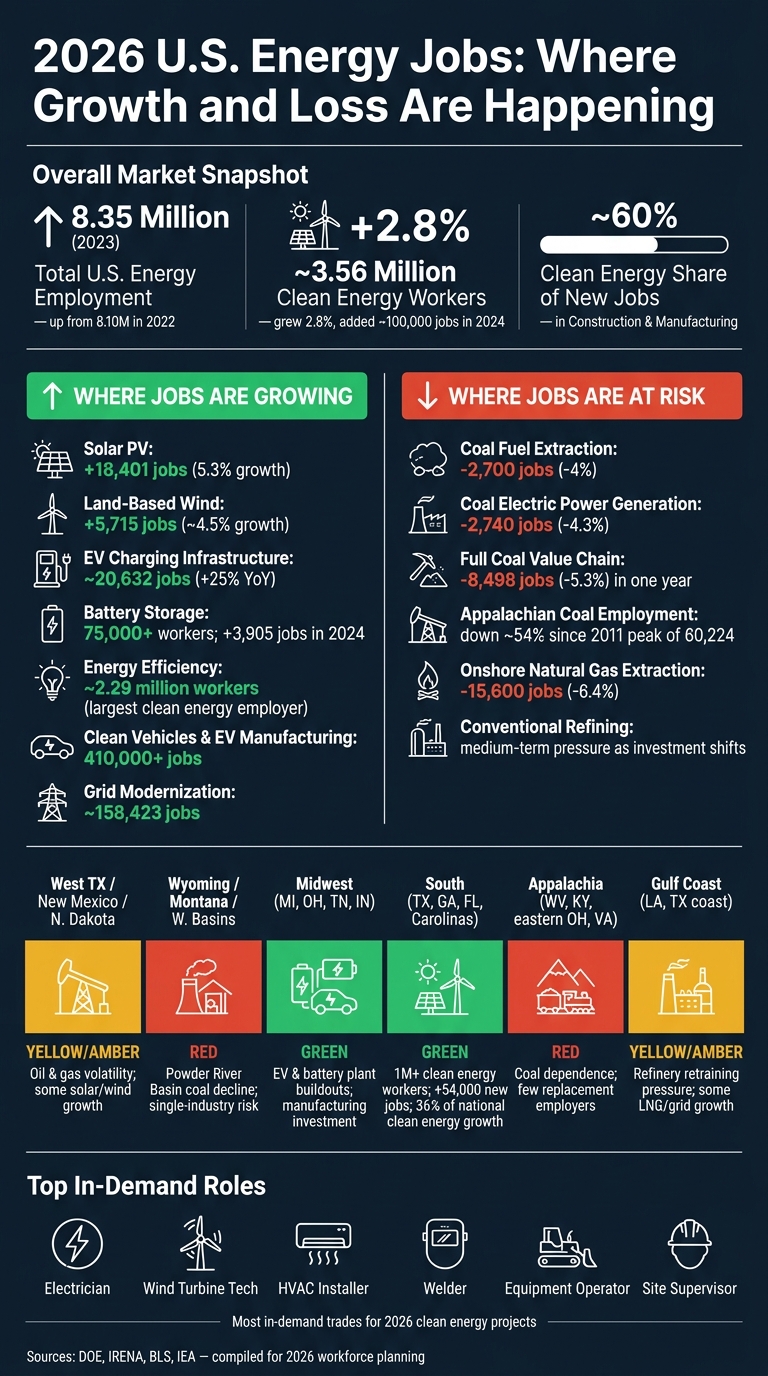
2026 U.S. Energy Jobs: Where Growth and Loss Are Happening
Where Energy Jobs Are Growing Fastest
Clean energy sectors leading hiring gains
Clean energy stayed the main hiring engine in 2024. The sector added nearly 100,000 jobs, grew 2.8%, and reached about 3.56 million workers.
On the power generation side, solar led the way. It added 18,401 jobs in 2023, equal to 5.3% growth. Land-based wind added 5,715 jobs.
The biggest employment base, though, is energy efficiency. That part of the market employs about 2.29 million workers. EV charging infrastructure also moved fast, growing about 25% year over year to roughly 20,632 jobs in 2023. Battery storage employed more than 75,000 workers, and battery storage occupations added 3,905 jobs in 2024.
Put simply, the fastest job growth isn’t just happening in one lane. It’s showing up across solar, wind, charging, storage, and the huge energy efficiency workforce.
Construction and manufacturing roles driving the numbers
About 60% of clean energy jobs sit in construction and manufacturing. That tells you where the action is: on job sites, in plants, and out in the field, not mainly at desks.
The biggest hiring needs are for workers who build, install, run, and maintain projects. That includes:
- Electricians
- Wind turbine technicians
- HVAC installers
- Welders
- Equipment operators
- Site supervisors
These roles are in demand across utility-scale solar farms, transmission upgrades, battery storage sites, and EV charging corridors.
Manufacturing is also turning into a major hiring channel. EV and battery factory buildouts, pushed by federal incentives, are bringing in production workers, industrial electricians, maintenance mechanics, quality control technicians, and logistics staff.
For a lot of workers, that matters. Factory jobs are often steadier and last longer than project-by-project construction work. They’re also clustering in industrial parts of the Midwest and South that have pulled in large clean-tech investments.
These are the jobs shaping 2026 hiring plans, and they point straight to the training gaps and labor shortages employers are trying to solve.
Table: Growth areas, job types, and typical U.S. pay ranges
| Subsector | 2023–2024 Job Growth | Common Occupations | Typical U.S. Pay |
|---|---|---|---|
| Energy Efficiency | About 2.29 million workers, the largest clean energy employer | HVAC technicians, insulation installers, energy auditors, retrofit crews | Varies by role and region |
| Solar PV | 18,401 jobs added in 2023; 5.3% growth | Solar installers, electricians, project supervisors, O&M technicians | Solar installers often in the mid-teens to mid-$20s per hour; electricians can earn mid- to high-$20s per hour or more |
| Land-Based Wind | 5,715 jobs added in 2023; about 4.5% growth | Wind turbine technicians, electricians, crane operators, site supervisors | Median annual wage about $62,580–$64,120 (roughly $30 per hour) |
| Battery Storage | More than 75,000 jobs; battery storage added 3,905 jobs in 2024 | Storage technicians, manufacturing workers, electrical installers | Trade-level wages |
| EV Charging Infrastructure | About 20,632 jobs in 2023; roughly 25% year over year growth | Electricians, construction laborers, project managers | Electricians often earn mid- to high-$20s per hour or more |
| Clean Vehicles & EV Manufacturing | Over 410,000 jobs | Assembly workers, industrial electricians, mechanics, quality technicians | Competitive with traditional auto manufacturing wages |
| Grid Modernization & Storage | About 158,423 jobs | Lineworkers, substation technicians, metering specialists, civil crews | Often above-average; high-voltage work commands premium pay |
These wages make transition jobs competitive with other skilled-trade work. At the same time, the shift is putting more pressure on fossil fuel regions, where job growth is slower and losses are more concentrated.
sbb-itb-aa28329
Where Job-Loss Risk Is Highest and Which Regions Are Most Exposed
Fossil fuel roles facing the most pressure
Not all energy jobs are moving in the same direction. Coal mining and coal-fired power generation are under the most pressure. Between 2023 and 2024, coal fuel extraction jobs fell by about 2,700 (-4%), and coal electric power generation jobs dropped by about 2,740 (-4.3%). That was the sharpest decline among major generation technologies during that stretch. Across the full coal value chain, total employment dropped by 8,498 jobs (-5.3%) in just one year.
This isn’t just a bad year tied to prices. It’s a longer shift. In Appalachia, coal employment reached about 60,224 workers in 2011 and has since fallen by roughly 54%. Places that rely on coal feel this the most, especially when one industry carries a big share of the local economy.
Onshore natural gas extraction is following a different path, but it’s still moving down. While gas-fired power generation has added jobs, onshore natural gas fuel employment fell by about 6.4%, a loss of roughly 15,600 jobs between 2023 and 2024. Some conventional refining jobs also face medium-term pressure as demand growth cools and investment shifts toward petrochemicals, LNG, or low-carbon fuels.
That uneven pattern matters because the workers losing jobs are often not in the same places, or in the same occupations, as the workers being hired.
How job gains and losses are spreading across U.S. regions
Clean energy growth is not showing up evenly across the country.
The South is now the largest clean energy region in the country, with more than 1 million clean energy workers and over 54,000 new clean energy jobs added. That equals about 36% of all national clean energy job growth. Texas, Georgia, Florida, and the Carolinas account for much of that growth, driven by utility-scale solar, grid modernization, and clean vehicle manufacturing. The Midwest and Southeast are also picking up jobs from EV and battery plant buildouts, with states such as Michigan, Ohio, Tennessee, and Georgia drawing major manufacturing investment.
At the same time, Appalachia, parts of Wyoming and Montana, western North Dakota, and Gulf Coast refining hubs are dealing with a very different labor picture. Jobs opening up in Sun Belt solar corridors or Midwest battery plants are not arriving at the same speed in these areas.
That gap is a big part of why employers are running into retraining issues heading into 2026.
Communities facing the hardest transition pressure
The places under the most strain tend to have a few things in common: they rely on one or two large employers, they don’t have much industry mix, and they lack nearby replacement jobs with similar pay. When a coal mine or coal plant shuts down in a county where it anchors the local economy, the shock doesn’t stop with the workers on site.
Coal mine closures have a job-loss multiplier of about 2, meaning each direct loss leads to about one more local job loss. A worker-level study found that coal workers with the highest exposure to industry contraction lost earnings equal to about 1.6 years of their pre-decline wages.
The path back is often tough. New jobs may call for different credentials, or they may pay less than the unionized or hazard-rated fossil roles workers are leaving behind. Moving isn’t always a workable option either. Housing, family ties, and limited savings can keep workers rooted in place. An MIT study found that 124 U.S. counties depend heavily on fossil fuel jobs but do not qualify for IRA transition aid, which leaves some of the hardest-hit areas with less policy support than many people assume.
Table: Regional job gains, loss risk, and transition pressure points
The table below shows where job growth and job-loss risk split apart most clearly.
| Region / State | Main Subsectors Adding Jobs | Subsectors Under Pressure | Key Transition Challenges |
|---|---|---|---|
| South (TX, GA, FL, Carolinas) | Utility-scale solar, grid modernization, clean vehicles, energy efficiency | Conventional refining (Gulf Coast), some fossil extraction | Matching fossil workers to new roles; wage alignment |
| Midwest (MI, OH, TN, IN) | EV and battery manufacturing, component supply chains, energy efficiency | Conventional auto and fuels manufacturing | Skills retraining for manufacturing transitions |
| Appalachia (WV, KY, eastern OH, VA) | Energy efficiency | Coal mining, coal-fired power generation | Coal dependence and few replacement employers |
| Wyoming / Montana / Western Basins | Some renewables and grid work | Coal mining (Powder River Basin), coal generation | Remote geography; single-industry dependence |
| West Texas / New Mexico / North Dakota | Utility-scale solar, wind | Long-term oil and gas extraction risk | Oil and gas volatility; policy uncertainty |
| Gulf Coast (LA, TX coast) | LNG, low-carbon fuels, grid projects | Conventional refining, older fossil generation | Refinery workforce retraining; proximity to new projects varies |
Those county-level gaps set up the retraining and staffing choices covered in the next section.
Evolving Workforce Needs in Clean Energy- June 10, 2026
Retraining Needs and What Project Managers Should Do With the Data
The jobs going away and the jobs being added often aren’t in the same place. That’s the core problem. Workers in fossil-fuel regions may need help moving into new roles, while clean-energy growth areas need people with licenses and training that local labor pools may not yet have.
For project managers, this data matters because it points to two things at once: where labor is tight and what training gaps will slow mobilization.
Skills that carry over into energy transition jobs
A lot of workers already have a head start.
Core wiring, distribution, and protection skills move well into grid modernization, transmission upgrades, and utility-scale solar and wind work. The main add-ons are training in high-voltage systems, inverter technologies, and modern protection and controls.
Workers with mechanical and equipment experience can shift into wind turbine installation, battery manufacturing, and pipeline remediation. But they usually need focused training on precision assembly standards and environmental remediation procedures.
HVAC technicians also have a clear path. They can move into heat pumps, building electrification, and smart controls with added instruction in advanced diagnostics and updated refrigerants.
The U.S. Department of Energy’s workforce strategy makes the same point: broad job training should map transferable skills from shrinking sectors into growing ones.
Where retraining gaps show up most often
Research keeps pointing to the same three problem areas: electrical and controls knowledge, high-voltage safety, and battery-storage systems training.
On the electrical and controls side, many seasoned workers know mechanical systems well but haven’t been trained in power electronics, SCADA, relay protection, or modern substation automation. That gap can become a bottleneck fast.
High-voltage safety is another common weak spot. Workers may need training in arc-flash analysis, lockout/tagout for complex electrical systems, safe distances around live equipment, and PPE standards.
Battery and storage work comes with its own learning curve. Before deployment, workers need to understand lithium-ion chemistries, thermal runaway prevention, battery management systems, and emergency response protocols.
There’s also a less obvious issue: digital and compliance readiness. Field work now often includes tablet-based work orders, remote monitoring systems, digital models, and data logging for predictive maintenance. Supervisors also need a working grasp of environmental permits, community consultation requirements, local land-use rules, and federal and state safety rules.
Then there are site-specific certifications. Workers coming from conventional sectors are often missing items like NERC-related training, utility-approved switching and tagging, confined-space and fall-protection certifications for wind towers, and hazardous-materials training for remediation sites.
Workforce planning steps for 2026 projects
For 2026 projects, start with the fastest-growing trades in your region. Then build a role-by-role inventory that includes certification needs and peak demand timing.
A few actions tend to matter most:
- Recruit early for hard-to-fill roles. Open requisitions well before mobilization, and work with local unions and training providers ahead of time.
- Match training to project milestones. Workers should finish critical certifications before they arrive on site, not after.
- Check credentials before dispatch. Self-attestation isn’t enough, and pre-mobilization verification has been linked to lower incident risk and fewer schedule delays.
- Plan by geography. Labor shortages are often regional, so projects in remote or constrained markets may need relocation support, travel planning, and per diem built into the budget.
Using ABLEMKR to support hiring and compliance

Once you know where the skill gaps are, the next job is moving people into place without getting buried in admin work. ABLEMKR can help by bringing worker matching, credential checks, mobilization, and payroll into one workflow. Its pre-vetted matching engine lets project managers source certified electricians, lineworkers, welders, and heavy-equipment operators quickly, with safety training and licensing already validated before the first call.[ABLEMKR]
| Workforce-Planning Task | Common Labor Challenge | ABLEMKR Capability |
|---|---|---|
| Fill specialized field roles fast | Shortage of certified high-voltage and renewable techs | Pre-vetted matching by trade, certification, and location |
| Verify credentials before mobilization | Incomplete or outdated training records | Centralized certification and safety tracking |
| Staff remote or emerging-region projects | Local labor supply is insufficient or misaligned | Location-based worker search and mobilization |
| Track workforce readiness by project phase | Unclear view of who is ready, traveling, or deployed | Real-time worker status dashboards |
| Retain skilled workers in tight markets | Payment delays and administrative friction | Integrated payroll workflows and on-time payments |
For project managers, the value is simple: less paperwork, faster mobilization, and a cleaner compliance record before crews reach the job site.[ABLEMKR]
Conclusion: What the 2026 Studies Mean for Employers and Workers
Taken together, these studies show one clear hiring pattern for 2026: clean energy and related infrastructure are driving most U.S. energy job growth. That includes solar, wind, grid modernization, battery storage, and clean manufacturing. And this isn’t a brief bump. It reflects steady investment over time.
At the same time, fossil fuel job risk isn’t spread evenly across the market. It’s more concentrated. The pressure is heaviest in coal and in select upstream oil and gas roles, especially in places where one employer or one industry carries the local economy.
Location matters just as much as the job itself. The South is leading clean-energy hiring, while fossil-heavy regions are facing slower, tougher transitions.
For workers, portable credentials are the bridge. The IEA estimates that about half of fossil fuel workers at risk of displacement already have transferable skills. What they often need is formal proof of those skills so they can move into new roles without losing time. For workers, credentials open doors. For employers, early verification helps avoid delays.
That puts more weight than ever on pre-vetted workforce deployment. For employers and project managers, the takeaway is straightforward: verify credentials early, staff earlier, and use ABLEMKR to mobilize compliant crews faster. At this point, the data matters less as a forecast and more as a staffing plan.
FAQs
Which energy jobs look safest in 2026?
In 2026, the safest energy jobs will likely be the ones tied to specialized technical certifications instead of a standard four-year degree.
The steadiest roles are expected to be in utility-scale installation, maintenance, and grid modernization. That includes solar PV installers, wind turbine technicians, battery storage specialists, high-voltage electricians, and substation technicians.
People who hold recognized credentials like OSHA 30, NCCER, NABCEP, or API certifications should be in the best spot for steady demand.
Can fossil fuel workers switch to clean energy jobs easily?
Yes. Many fossil fuel workers can move into clean energy jobs by using transferable skills, though they often need some extra training.
Take a coal plant electrician. The core electrical know-how is already there, and that can carry over into solar work with the right next step. The same idea applies across other roles too.
What helps most is making the path easy to see. That can include:
- clear career maps
- certifications
- tools that match a worker’s current skills to clean energy roles
With that kind of support, workers can shift into fields like wind, hydrogen, and carbon capture.
Which U.S. regions are hardest to staff?
Staffing problems hit hardest in places where project demand outpaces local training capacity. That gap is most visible in rural areas and in specialized energy corridors.
The Permian Basin and Gulf Coast are under heavy strain, especially for roles like rig managers and technicians. The Rockies and Midcontinent, including Denver, Oklahoma City, and Tulsa, also face deep technical shortages. And when projects are far from major population centers, the problem gets tougher: housing, transportation, and worker mobility all become part of the hiring issue.


