
Worker misclassification in the construction industry – labeling employees as independent contractors – can lead to severe financial and legal consequences. Misclassification affects 10-19% of U.S. construction workers, with over $12 billion in annual losses tied to unpaid benefits like Social Security, unemployment insurance, and workers’ compensation. Companies engaging in this practice face steep penalties, unpaid payroll taxes, and lawsuits, while law-abiding firms struggle to compete.
Key points to know:
- Misclassification Costs: $5-10 billion annually in taxpayer burden and $5 billion in unpaid workers’ compensation premiums.
- IRS/DOL Guidelines: Worker classification depends on behavioral control, financial control, and the working relationship’s nature.
- Penalties: Firms owe back taxes (15.3% of wages), penalties, and interest – even if workers pay their own taxes.
- Legal Risks: Misclassified workers lose wage, safety, and anti-discrimination protections, exposing companies to lawsuits.
Audits are common in construction due to the industry’s high misclassification rates. Avoid pitfalls by reviewing worker statuses regularly, documenting decisions, and using tools to ensure compliance. Misclassification isn’t just a tax issue – it’s a risk to your business’s stability.
Working Wise: Tips for Avoiding Independent Contractor Misclassification
sbb-itb-aa28329
Employee vs. Independent Contractor: What’s the Difference?
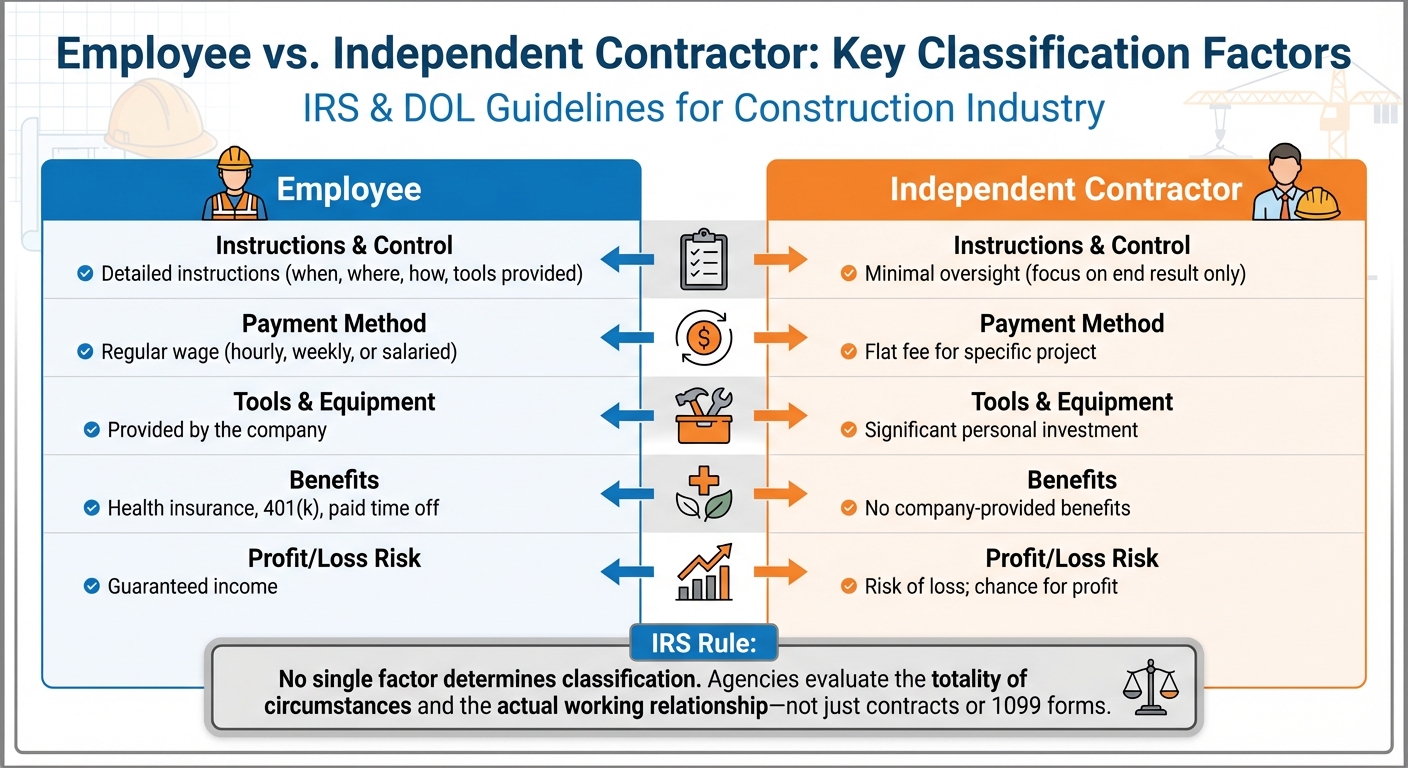
Employee vs Independent Contractor Classification Factors in Construction
What Determines Worker Classification
When it comes to figuring out whether someone is an employee or an independent contractor, the IRS and Department of Labor focus on the real working relationship, not just job titles or signed agreements. They evaluate this relationship through three key areas: behavioral control, financial control, and the overall type of relationship.
Behavioral control is about how much say your company has over how the work gets done. Do you tell workers when to show up, what tools to use, or the exact steps to follow? If so, you’re exercising a level of control that aligns more with an employee relationship.
"The general rule is that an individual is an independent contractor if the payer has the right to control or direct only the result of the work, not what will be done and how it will be done." – IRS
Financial control dives into who takes on the economic risks. Independent contractors typically invest in their own tools, cover their own expenses, and face the possibility of profit or loss. They’re often paid a flat fee for a specific project. Employees, however, receive regular wages – whether hourly, weekly, or salaried – and usually have work-related expenses reimbursed.
The relationship type focuses on factors like written agreements, benefits, and the duration of the relationship. A long-term, open-ended arrangement points to an employee relationship. In contrast, work tied to specific projects leans toward contractor status. However, the Department of Labor clarified in its March 11, 2024 rule that short-term jobs, like those in construction, don’t automatically make someone a contractor. Seasonal work patterns, for instance, don’t necessarily establish independence.
| Factor | Employee Indicator | Independent Contractor Indicator |
|---|---|---|
| Instructions | Detailed (when, where, how, tools) | Minimal (focus on end result only) |
| Payment Method | Regular wage (hourly, weekly, salaried) | Flat fee for a specific project |
| Tools/Equipment | Provided by the company | Significant personal investment |
| Benefits | Health insurance, 401(k), paid time off | No company-provided benefits |
| Profit/Loss | Guaranteed income | Risk of loss; chance for profit |
Misinterpreting these guidelines often trips up companies, especially in industries like construction. Let’s explore why.
Why Construction Firms Get Classification Wrong
Many construction firms misclassify workers because they confuse specialized skills with independence. Just because a worker, like a welder or electrician, has a high level of expertise doesn’t mean they’re automatically an independent contractor. If they’re not actively marketing their services, setting their own rates, or making independent business choices, they’re more likely employees.
Construction’s project-based nature also adds to the confusion. Firms often assume that because work is temporary or tied to a specific project, workers must be contractors. However, this assumption ignores that such temporary arrangements are often standard in the industry and don’t necessarily reflect true independence.
Another common mistake is the "1099 myth." Some companies believe issuing a Form 1099 or having a signed agreement is enough to establish contractor status. But government agencies look beyond paperwork to the actual working relationship. As the IRS explains, "There is no ‘magic’ or set number of factors that ‘makes’ the worker an employee or an independent contractor and no one factor stands alone in making this determination". If your company controls the work’s details, provides the tools, sets the schedule, and the work is integral to your operations, that worker is likely an employee – regardless of what the contract says.
The Department of Labor’s 2024 rule stresses the importance of evaluating the "totality of the circumstances." This means looking at whether a worker is economically dependent on your company. If they rely on you for their livelihood, they’re considered an employee under the Fair Labor Standards Act – even if both parties agreed otherwise on paper.
Tax Penalties and Financial Costs of Misclassification
Unpaid Payroll Taxes and Penalties
If the IRS determines that an independent contractor has been misclassified as an employee, the financial consequences for construction firms can be severe. The company becomes responsible for all unpaid employment taxes, which include federal income tax withholdings that should have been deducted from paychecks, as well as both the employer’s and employee’s shares of Social Security and Medicare taxes. Together, these taxes total 15.3% of wages.
"If the IRS reclassifies an independent contractor as an employee, harsh consequences may follow. You could be held liable for back taxes – including income taxes that should have been withheld, and both the employer and employee shares of payroll taxes – plus penalties and interest." – M&J CPA
In addition to these unpaid taxes, firms must also retroactively pay Federal Unemployment Tax (FUTA) and state unemployment insurance contributions. Penalties and interest only add to the financial burden. Even if the misclassified worker has already paid their taxes as a self-employed individual, the employer is still liable for penalties and interest on their portion of payroll taxes.
The financial impact doesn’t stop at federal taxes. Construction companies may also face unpaid workers’ compensation premiums. Across the industry, misclassification is estimated to result in $5 billion in evaded premiums annually. If a misclassified worker suffers an injury on the job, the company could be held directly responsible for medical expenses and lost wages that would otherwise have been covered by insurance.
These costs, combined with penalties and interest, can quickly snowball, putting significant strain on a company’s finances.
Cumulative Tax Liabilities
The longer a worker is misclassified, the greater the tax liabilities become. For instance, consider a construction worker earning $39,720 annually. The employer’s share of FICA taxes for that worker is $3,039 per year. If five workers are misclassified over three years, the back taxes owed could amount to $45,585 – before adding penalties and interest.
"Tax agencies would rather deal with employees than independent contractors because it’s generally easier to collect taxes from a single employer than from many independent contractors." – M&J CPA
This is one reason construction firms are frequently targeted for audits. Tax agencies can recover more revenue by auditing a single employer with dozens of misclassified workers rather than pursuing individual contractors. The longer misclassification goes unchecked, the larger the liability grows, making the company an even bigger target for audits. Knowing how these violations are detected is key to avoiding such costly mistakes.
Legal Risks Beyond Tax Penalties
Misclassification of workers doesn’t just lead to tax headaches – it opens the door to a host of legal challenges, particularly in areas like wage laws and workplace safety.
Wage and Hour Law Violations
When workers are misclassified as independent contractors instead of employees, they lose critical protections under federal wage and hour laws. For example, employees are entitled to minimum wage and overtime pay under the Fair Labor Standards Act (FLSA), but independent contractors are not. Even if workers sign contracts agreeing to contractor status, they cannot legally waive these rights.
"Misclassifying employees as independent contractors is a serious problem because misclassified employees may not receive the minimum wage and overtime pay to which they are entitled under the FLSA or other benefits and protections to which they are entitled under the law."
- U.S. Department of Labor
For workers, the financial impact of misclassification can be devastating. On average, a misclassified construction worker loses up to $19,526 annually in income and benefits. In 2021 alone, the industry saw an estimated $1.9 billion in lost overtime pay due to these practices. This often stems from "off-the-clock" work or labor brokers failing to deliver promised wages.
For firms, these violations can lead to lawsuits demanding back wages, unpaid overtime, and other damages. As the U.S. Department of Labor warns, allowing employees to waive FLSA rights would harm both individual workers and the broader goal of fair competition in commerce.
But wage-related issues are just the tip of the iceberg. Misclassification also strips workers of essential safety protections and benefits.
Workers’ Compensation and Benefits Claims
Misclassification has serious implications for workers’ access to benefits like workers’ compensation, unemployment insurance, and employer-sponsored health coverage. In a high-risk field like construction, the absence of workers’ compensation coverage can leave firms directly liable for medical expenses and lost wages when injuries occur. In 2021, construction firms avoided about $5.0 billion in workers’ compensation premiums through misclassification practices.
"Construction is a notoriously dangerous vocation… Absent the security provided by employer-sponsored health insurance or workers’ compensation coverage, injured workers and their families too often must rely on public services for medical care and financial survival."
The impact extends beyond individual workers. Misclassification costs state unemployment insurance funds approximately $791 million annually. When misclassified workers file unemployment claims, firms can face retroactive liabilities for unpaid taxes and penalties. Additionally, misclassified workers often lose protections against workplace discrimination and the right to unionize under the National Labor Relations Act, leaving construction firms vulnerable to further legal challenges.
| Protection/Benefit | Employee Status | Independent Contractor Status |
|---|---|---|
| Minimum Wage & Overtime | Guaranteed under FLSA | Not eligible |
| Workers’ Compensation | Employer-provided coverage | Worker bears full risk of injury |
| Unemployment Insurance | Eligible for benefits | Not eligible |
| Anti-Discrimination Laws | Protected in most states | Often excluded |
| Right to Unionize | Protected under NLRA | Not protected |
How Government Agencies Find Misclassification
Government agencies like the IRS and the Department of Labor (DOL) actively search for worker misclassification using audits, complaints from workers, and advanced data analysis. Construction companies often find themselves in the spotlight due to the industry’s unique structure and practices. This focus highlights the importance of understanding both targeted audits and the common pitfalls surrounding worker classification.
Why Construction Gets Audited More Often
The construction industry is a frequent target for audits because of its reliance on subcontractors and labor brokers, which creates multiple layers where misclassification can occur. Agencies find it more efficient to collect back taxes from a single employer rather than pursuing numerous independent contractors.
"Tax agencies would rather deal with employees than independent contractors because it’s generally easier to collect taxes from a single employer than from many independent contractors."
- Yount, Hyde & Barbour
Data from states like Rhode Island and Massachusetts underscores the extent of the issue, with misclassification rates reaching 8.4% and 6.6%, respectively. These figures drive the IRS and DOL to prioritize audits in construction, aiming to recover lost tax revenue.
To determine worker classification, the IRS uses a "right to control" test, focusing on how tasks are directed, including behavioral and financial controls. The DOL, on the other hand, employs a six-factor "economic reality" test, evaluating aspects like profit opportunities, worker investments, the permanence of the relationship, and the level of control exercised. Under a DOL rule effective March 11, 2024, no single factor is weighted more heavily than others; instead, agencies assess the "totality of circumstances".
Worker complaints also play a significant role in triggering audits. For instance, filing IRS Form 8919 alerts the agency to potential misclassification. Additionally, construction companies face heightened scrutiny regarding the Qualified Business Income (QBI) deduction, a 20% tax break for contractors. This deduction can reduce federal tax revenue, making it a focal point for IRS monitoring.
While audits effectively identify misclassification, misconceptions about compliance can further increase risk.
Why Form 1099 Doesn’t Protect You
A common myth in the construction industry is that issuing Form 1099 to workers guarantees compliance and protects against reclassification. This misunderstanding can lead to costly consequences.
"There’s a widespread misconception that the IRS and state tax authorities won’t challenge the classification of a worker as an independent contractor if the employer files Form 1099 and the worker meets his or her tax obligations."
- Yount, Hyde & Barbour
The reality is that Form 1099 alone doesn’t shield companies from audits or penalties. The IRS and DOL focus on the nature of the working relationship, not just the paperwork. If an audit reveals that your company controlled how, when, or where work was performed – or if the worker’s role is deemed central to your business – reclassification as an employee is likely. When this happens, employers are responsible for both the employer and employee portions of payroll taxes, along with interest and penalties, even if the worker has filed their own taxes correctly.
Attempts to reclassify employees as contractors also raise red flags with the IRS. Regulations often reclassify such workers as employees for at least three years, further increasing scrutiny. This makes it clear that relying on paperwork alone is a risky approach.
How to Classify Workers Correctly and Stay Compliant
With the tax and legal risks we’ve discussed, getting worker classification right is non-negotiable. The process involves carefully evaluating behavioral control, financial control, and the overall nature of the work relationship. According to the IRS, the key factor is whether you have the right to direct and control not just the results, but also how the work is done.
"The keys are to look at the entire relationship and consider the extent of the right to direct and control the worker. Finally, document each of the factors used in coming up with the determination."
- IRS
There’s no single factor that seals the deal. Agencies look at the full picture, which means staying proactive is critical.
Review Your Workforce Classification Regularly
Conducting regular internal audits can help uncover misclassifications before they lead to penalties. Start by looking at behavioral control: Do you set work schedules, dictate methods, or provide specific training? Next, assess financial control: Who supplies the tools and equipment? How are workers paid? Finally, evaluate the relationship itself: Are there written contracts? Do workers receive benefits? Is the relationship ongoing or tied to a specific project?
If you’re still uncertain about a worker’s status, you can request an official determination from the IRS using Form SS-8. Keep in mind, this process can take six months or more. If you discover a misclassification, the Voluntary Classification Settlement Program (VCSP) offers a way to fix it. By filing Form 8952, you can reclassify workers as employees going forward and receive partial relief from federal employment taxes.
Make sure to document every factor that supports your classification decisions. For those seeking Section 530 relief, it’s essential to show a reasonable basis for your classifications and to file all required federal forms – like Form 1099 – for workers in similar roles. Once you’ve verified your classifications, digital tools can help you maintain compliance over time.
Use Technology to Track Compliance
While internal audits are key, technology can simplify ongoing monitoring and documentation. Under the Department of Labor’s rule effective March 11, 2024, how you use technology matters. Using software or devices to oversee how work is performed – beyond just verifying legal compliance – could indicate an employer-employee relationship.
"Actions taken by the potential employer for the sole purpose of complying with a specific, applicable federal, state, tribal, or local law or regulation are not indicative of control."
- U.S. Department of Labor
Platforms like ABLEMKR address this issue head-on. By offering W2 employment for all workers, they eliminate the guesswork around classification. Their integrated payroll workflows ensure proper tax withholding from day one, while compliance tracking keeps documentation audit-ready. The system also provides real-time visibility into worker status, reducing the gray areas often associated with contractor arrangements.
Additionally, using technology to enforce company-specific rules – like quality control or safety standards beyond legal requirements – can signal an employee relationship. However, when workers are classified as W2 employees, this level of oversight is entirely acceptable.
Create Clear Contracts and Keep Good Records
While written contracts are important, they don’t override the actual working relationship. Contracts should outline key details like who provides tools and equipment, how payments are handled, whether workers can hire assistants, and the expected duration of the relationship. That said, if everyday practices differ from the contract, auditors will focus on what’s really happening.
Avoid cash payments. Off-the-books transactions are a major red flag for auditors and contributed to an estimated $12.8 billion in reduced payroll in the construction industry alone in 2021. Also, double-check the documentation of labor brokers and subcontractors you work with. As a general contractor, you could be held jointly liable if your subcontractors misclassify workers, so verifying their payroll and insurance records is essential.
Keep thorough records of tool provisions, expense reimbursements, and all Forms 1099 to back up your classification decisions. Also, document that independent contractors actively market their services to other companies and operate their own businesses. This kind of paper trail can serve as your defense during an audit, showing that your decisions were based on a detailed review of the working relationship.
Conclusion
Misclassifying workers in the construction industry can lead to serious financial and legal consequences. Companies found guilty of misclassification may face liabilities for unpaid Social Security, Medicare, and unemployment taxes, as well as back pay for minimum wage and overtime violations. In cases of intentional misclassification, the repercussions escalate to potential criminal charges and even prison time.
The Department of Labor’s updated rule, effective March 11, 2024, introduces an "economic reality" test that evaluates the entire working relationship. This makes regular classification reviews and detailed documentation not just important but absolutely necessary. With the increasing complexity of compliance, having a strong system in place is no longer optional.
Platforms like ABLEMKR provide a practical solution by offering W2 employment for all workers, removing any uncertainty around classification. Its integrated payroll workflows, compliance tracking, and real-time worker status updates ensure accurate tax withholding and audit-ready documentation from the start. For industries with strict regulations, this approach transforms compliance from a challenge into a protective measure.
To avoid hefty penalties and safeguard your business, implementing effective compliance systems is a step you can’t afford to overlook.
FAQs
What’s the fastest way to tell if a worker should be W-2 or 1099?
To figure out whether a worker should be classified as W-2 or 1099, consider whether they rely economically on the employer or function independently. The main factors to evaluate include behavioral control, financial control, and the overall nature of the relationship. These criteria align with guidelines from the IRS and the Department of Labor.
How far back can the IRS/DOL go if workers were misclassified?
The IRS and DOL generally have the authority to review up to three years of records when conducting audits for worker misclassification. However, if they uncover evidence of fraud or deliberate misclassification, they can extend this review period and enforce stricter penalties.
If a subcontractor misclassifies workers, can my firm be liable?
If a subcontractor misclassifies workers, your firm can still be held accountable for violations of tax and employment laws. Federal regulations place responsibility on employers, meaning you could face penalties and other legal consequences. To protect your business, it’s crucial to ensure workers are properly classified and that all applicable laws are followed.


