
Misclassifying workers can cost your business thousands of dollars in fines and penalties. Understanding the difference between employees and independent contractors is critical to avoiding audits, legal troubles, and financial risks. Here’s what you need to know:
- New rules from the U.S. Department of Labor: Effective March 11, 2024, with updates proposed for February 26, 2026, these changes affect how workers are classified.
- Key factors for classification: The DOL evaluates six factors, including behavioral control, financial control, and the nature of the working relationship.
- Tax responsibilities: Employers must withhold taxes for W-2 employees but not for 1099 contractors. Starting in 2026, payments over $2,000 to contractors must be reported.
- Risks of misclassification: Penalties range from $15,000 to over $100,000 per worker, with potential audits spanning up to six years.
- Industries at high risk: Construction and energy sectors face unique challenges due to project-based work and high turnover.
The stakes are high, but tools like ABLEMKR can simplify compliance by automating tax withholdings and ensuring proper worker classification. Protect your business by staying informed and proactive.
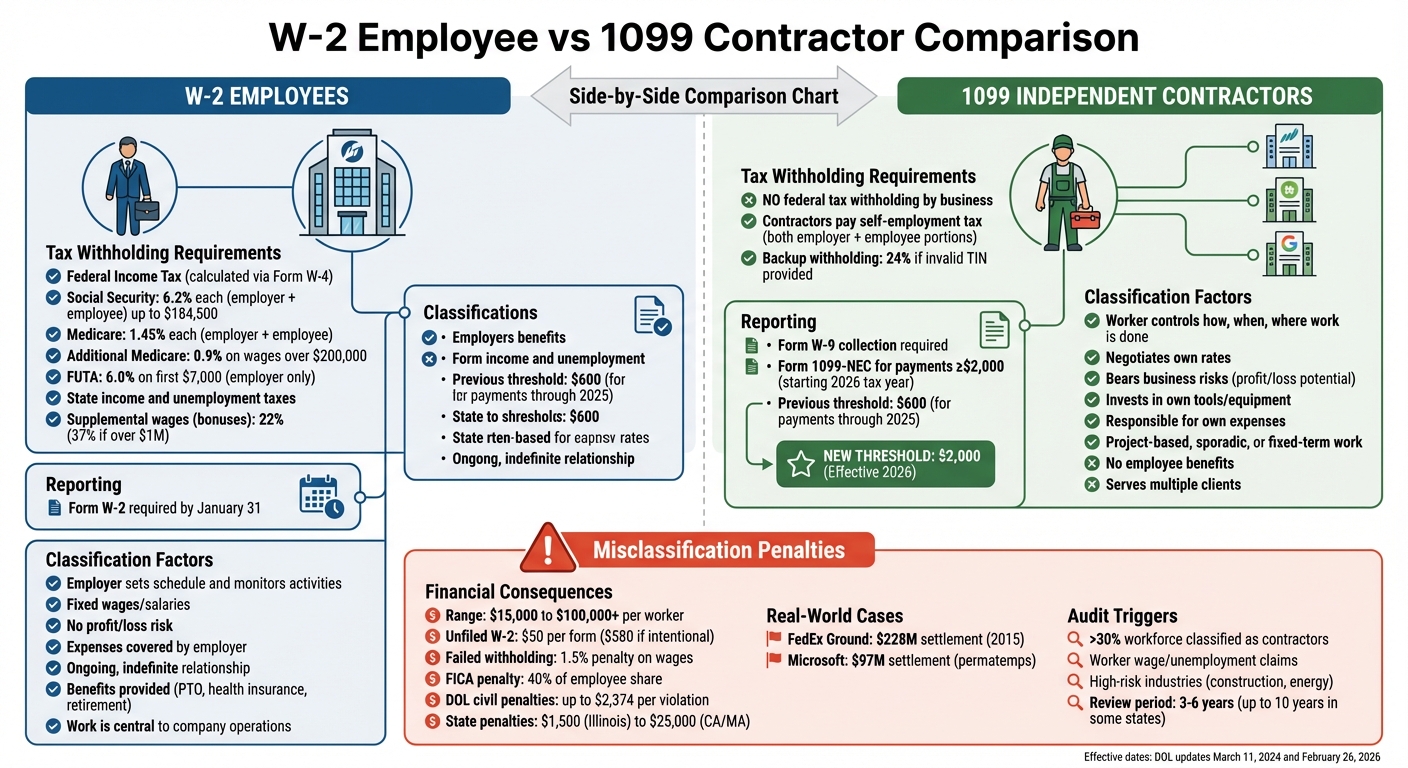
W-2 Employee vs 1099 Contractor: Tax Withholding Requirements and Classification Factors
Worker Classification 101 employee or independent contractor
sbb-itb-aa28329
Employee vs Independent Contractor: Understanding the Difference
The U.S. Department of Labor (DOL) uses a "totality-of-the-circumstances" approach to classify workers. Instead of focusing on a single factor, this economic reality test evaluates whether a worker relies economically on a business (as an employee) or operates independently (as an independent contractor). Six key factors are analyzed: profit/loss potential, entrepreneurial investments, relationship permanence, degree of control, work integration, and worker initiative.
As of March 11, 2024, the DOL’s updated rule requires a balanced consideration of all six factors, moving away from prioritizing just two core elements. This updated framework impacts tax obligations and legal responsibilities. For employers – especially in industries like construction or energy, where crews often work across multiple sites – it’s essential to understand that a worker who seems independent on paper might legally qualify as an employee based on how their work is directed and integrated into the business.
Here’s a closer look at the factors that distinguish these classifications.
Behavioral Control: Who Directs the Work
Behavioral control focuses on who decides how, when, and where tasks are performed. If a business sets a worker’s schedule, monitors activities (e.g., through GPS or time-tracking apps), or limits their ability to work for other clients, these actions suggest employee status. However, oversight strictly for regulatory compliance, such as ensuring safety certifications, doesn’t automatically establish an employment relationship. The critical question is whether the employer dictates the specifics of how the job is done.
Financial Control: Payment Structure and Business Expenses
Financial control examines how workers are paid and who bears financial risks. Employees typically receive fixed wages or salaries and don’t face the risk of profit or loss. Independent contractors, on the other hand, negotiate their rates and take on business risks. For instance, if a worker invests in tools or equipment to serve multiple clients, it supports independent contractor classification. Employees usually have their expenses covered by the employer, while independent contractors are responsible for their own costs.
Relationship Type: Contracts and Work Arrangements
The nature of the working relationship is another key factor. An ongoing, indefinite, or exclusive arrangement often points to employee status. In contrast, project-based, sporadic, or fixed-term engagements suggest independent contractor classification. While written contracts can clarify expectations, the actual day-to-day work practices carry more weight in determining classification. Additionally, offering benefits like paid time off, health insurance, or retirement plans, along with performing tasks central to the company’s core operations, further leans toward employee status.
Employer Tax Withholding Requirements
When it comes to tax obligations, everything starts with correctly classifying your workers. This classification determines whether you’re dealing with W-2 employees or 1099 independent contractors, and each group comes with its own set of responsibilities. For employees, you’ll need to manage tax withholding and employer contributions. Contractors, on the other hand, handle their own taxes, requiring less oversight from your end. Getting this right is crucial for staying compliant.
W-2 Employees: Withholding Federal and State Taxes
For your employees, you’re required to withhold federal income tax, which is calculated using the employee’s Form W-4. The IRS offers two methods for these calculations, detailed in Publication 15-T: the Percentage Method and the Wage Bracket Method. Beyond income tax, both you and your employees contribute to Social Security (6.2% each, up to $184,500) and Medicare (1.45% each). For wages exceeding $200,000, you’re required to withhold an additional 0.9% Medicare tax from the employee’s earnings.
Federal Unemployment Tax (FUTA) is solely the employer’s responsibility. It’s calculated at a standard 6.0% rate on the first $7,000 of each employee’s wages and reported annually using Form 940. Additionally, state income and unemployment tax requirements vary depending on your location, so it’s essential to follow local guidelines.
For supplemental wages like bonuses in 2026, the withholding rate is 22%. If an employee’s supplemental wages exceed $1 million during the year, the withholding rate jumps to 37%.
1099 Independent Contractors: Reporting Requirements
Independent contractors operate under a different set of rules. As the IRS Taxpayer Advocate Service explains:
"A business does not generally have to withhold or pay any federal taxes on payments made to independent contractors".
Contractors are responsible for paying self-employment taxes, which cover both the employer and employee portions of Social Security and Medicare.
Your primary responsibility is to collect a completed Form W-9 from each contractor to obtain their Taxpayer Identification Number (TIN). Starting with the 2026 tax year, you’ll need to issue a Form 1099-NEC to any contractor you paid $2,000 or more (up from the previous $600 threshold for payments made after 2025). If a contractor provides an invalid TIN, you’re required to withhold 24% of their payments as backup withholding. To avoid errors, you can use the IRS TIN Matching Program to ensure the contractor’s name and TIN align with IRS records.
These tax withholding measures are integral to maintaining compliance and reducing risks, helping to safeguard your business from potential penalties.
Classification Challenges in Construction and Energy Industries
Common Issues in Construction and Energy Sectors
Employers in the construction and energy industries often face unique hurdles when it comes to worker classification. The project-based nature of these fields, combined with the temporary duration of many jobs, creates confusion about whether a worker qualifies as an employee or an independent contractor. The U.S. Department of Labor sheds light on this issue:
"Short-term jobs for multiple employers may be due to the seasonal or temporary nature of the work or industry, and not the worker’s business decision to market their services to multiple entities, and therefore may indicate employee status." – U.S. Department of Labor
For example, even if a pipeline welder is hired for a three-month project, they might still be classified as an employee if the short-term nature of the job reflects industry norms rather than their personal business choices.
Another common misconception is that technical skill alone defines independent contractor status. In a March 2024 case, the U.S. Department of Labor determined that a highly skilled welder was an employee, not a contractor. Despite their expertise, the worker didn’t engage in activities typically associated with running a business – like bidding for projects, purchasing materials, or hiring assistants. Instead, they followed instructions on what work to do and where to do it. This illustrates that independent contractor status often hinges on managerial independence, not just technical ability.
Federal guidelines further clarify that the ability to supervise or discipline workers – even remotely through digital tools – can indicate an employment relationship. Workers who lack the autonomy to manage their own business operations are generally considered economically dependent employees under the Fair Labor Standards Act. These complexities highlight the importance of adopting streamlined solutions to navigate compliance.
Using Technology to Manage Compliance and Payroll
Tackling these classification challenges requires dependable technology. Workforce platforms now offer solutions to simplify compliance and payroll management. For instance, ABLEMKR pre-classifies all workers as W-2 employees, removing the guesswork about whether someone is an employee or contractor. This approach ensures clarity from the start.
ABLEMKR’s platform goes further by automating payroll workflows. It handles federal and state tax withholdings, including Social Security, Medicare, and income tax, based on the worker’s W-4 details. This automation reduces the risk of errors and misclassification while streamlining payroll processes. The system also tracks compliance in real time, eliminating the need for separate tools to monitor work duration, location, or tax deductions. Employers can easily view certifications and employment details through a centralized dashboard.
For industries dealing with remote job sites and high turnover, ABLEMKR’s mobile-first platform offers additional benefits. It matches pre-vetted workers to job sites using factors like certifications, safety training, availability, and geo-location. Workers are guaranteed on-time payments with proper tax withholdings, while employers gain peace of mind with included workers’ compensation coverage – avoiding the gaps often seen with contractor arrangements. This all-in-one solution helps reduce the risk of costly misclassification penalties.
Misclassification Risks and Compliance Steps
Penalties and Legal Consequences of Misclassification
Misclassifying workers can lead to hefty financial and legal consequences, with liabilities ranging from $15,000 to over $100,000 per worker. These costs include unpaid FICA taxes, IRS penalties, state fines, and legal fees. In some cases, cumulative penalties can surpass $80,000 per worker.
The IRS imposes specific fines, such as $50 for each unfiled Form W-2 (rising to $580 if the misclassification is intentional). Additionally, there’s a 1.5% penalty on wages for failing to withhold federal income tax and a 40% penalty on the employee’s share of FICA taxes. The Department of Labor may levy civil penalties of up to $2,374 per violation for willful or repeated offenses, while under the Fair Labor Standards Act, liquidated damages can double the back wages owed. State-level penalties vary widely, from $1,500 per violation in Illinois to as much as $25,000 in states like California or Massachusetts.
Real-world examples highlight these risks. In 2015, FedEx Ground settled for $228 million in California after misclassifying delivery drivers as independent contractors. Factors such as requiring uniforms, enforcing schedules, and mandating the use of branded vehicles contributed to the ruling. Similarly, Microsoft paid $97 million to settle claims involving "permatemps" – long-term contract workers who were denied employee benefits despite performing similar roles to full-time staff.
Misclassification can also spark a chain reaction of audits and investigations. An initial audit by one agency often leads to further scrutiny from state tax authorities, the Department of Labor, and workers’ compensation boards. Common triggers include having over 30% of the workforce classified as contractors, worker-filed wage or unemployment claims, and operating in industries like construction or energy, which are subject to higher scrutiny. Audits typically review three to six years of records, although some states allow reviews going back up to ten years. In severe cases, willful misclassification can result in criminal charges, including fines up to $10,000 and potential imprisonment.
These penalties underscore the importance of proactive measures, like regular audits, to avoid costly mistakes.
Auditing Worker Status and Maintaining Compliance
Conducting regular audits of worker classifications is essential to identifying potential risks before they escalate into major violations. A thorough review should assess the degree of behavioral and financial control over workers and ensure proper documentation is in place. Written records – such as role descriptions, invoices, and evidence of worker independence – carry more weight than simply labeling someone as a contractor.
Using cost calculators can help estimate potential liabilities when engaging contractors for long-term projects. This approach allows businesses to identify high-risk scenarios and make informed decisions about worker classifications. Regular reviews are especially critical for roles that may shift over time from independent contractor arrangements to employee-like relationships, a common issue in industries like construction and energy.
Technology can simplify the auditing process and reduce compliance risks. For companies managing large, dispersed workforces, leveraging tools that centralize compliance efforts can make a big difference. For example, ABLEMKR’s system pre-classifies all workers as W-2 employees, eliminating the guesswork in classification. Its integrated payroll workflows handle federal and state tax withholdings automatically, while built-in compliance tracking offers real-time updates on worker status. This streamlined approach reduces administrative overhead and minimizes the risk of penalties from audits.
Conclusion
Getting worker classification right goes beyond just avoiding penalties – it’s about creating a workforce that’s both compliant and dependable, a foundation for smooth business operations. By understanding the core factors – behavioral control, financial control, and working relationships – you can shield your business from audits and legal troubles while maintaining a stable workforce.
Tax responsibilities also differ significantly between W-2 employees and 1099 contractors. For employees, you’re required to withhold federal income tax, Social Security, Medicare, and state taxes, as well as provide W-2 forms by January 31. Independent contractors, on the other hand, handle their own taxes, but businesses must report payments over $600 using Form 1099-NEC. Missing these deadlines or misclassifying workers can result in serious fines and legal consequences. This distinction becomes especially critical in industries with complex staffing requirements.
Certain industries, like construction and energy, face added risks due to the nature of their work, such as project-based demands, location-specific needs, and specialized safety requirements. These sectors experience misclassification rates as high as 15–20%. However, following IRS guidelines for audits and maintaining thorough documentation can reduce these risks by up to 70%.
Thankfully, technology has made compliance easier. Tools like ABLEMKR simplify the process by pre-classifying workers as W-2 employees, removing any uncertainty. Integrated compliance tracking offers real-time updates on worker statuses across various job sites, ensuring that your workforce remains aligned with regulations and your projects stay on schedule.
FAQs
How can I quickly tell if a worker is really an employee?
To figure out whether a worker qualifies as an employee, the IRS focuses on three main factors: behavioral control, financial control, and the nature of the relationship.
Employees generally work under specific instructions and supervision, often receiving benefits like health insurance or paid leave. They also depend on their employer for tools, equipment, and covering work-related expenses. On the other hand, independent contractors usually enjoy more freedom. They handle their own expenses, supply their own tools, and take on the risks (and rewards) of profit or loss. It’s important to carefully examine contracts and working arrangements to ensure everything is clearly defined.
What paperwork is required for W-2 employees vs. 1099 contractors?
For W-2 employees, employers need to collect a W-4 form during onboarding. This form helps determine the appropriate tax withholdings. Employers are required to withhold income, Social Security, and Medicare taxes from employees’ paychecks. At the end of the year, wages and withholdings are reported on Form W-2.
For 1099 contractors, employers should collect a W-9 form to obtain their taxpayer identification number. If a contractor earns more than $600 in a year, the employer must report these payments on Form 1099-NEC. Unlike employees, contractors are responsible for managing their own taxes, including self-employment tax.
What should I do if I think I misclassified someone in past years?
If you think a worker might have been misclassified in previous years, tools like the IRS’s Form SS-8 and the Voluntary Classification Settlement Program (VCSP) can be helpful. These resources allow you to address the issue proactively, potentially lowering penalties or reducing back taxes. It’s important to review your classification decisions carefully, keep detailed records of your processes, and seek professional advice if necessary to stay compliant and avoid financial risks.


