
The U.S. Department of Labor‘s proposed 2026 worker classification rule introduces two core factors – control over work and opportunity for profit or loss – as the primary criteria for determining if a worker is an employee or independent contractor. This simplifies the previous 2024 rule’s broader balancing test and eliminates confusion around compliance-related control, like safety protocols or insurance requirements.
Key changes:
- Core factors prioritized: Control and profit opportunity now outweigh secondary factors like skill, permanence, and business integration.
- Investment focus: Evaluates only the worker’s investment, not a comparison with the employer’s.
- Unified standards: Applies across multiple federal laws (FLSA, FMLA, MSPA).
The rule aims to provide clearer guidelines but doesn’t override stricter state laws, such as California’s "ABC test." Businesses must act quickly to review contracts, train managers, and ensure compliance before the public comment period ends on April 28, 2026.
Independent Contractor Rule Slated to Change in 2026: What Employers Need to Know | HR Hot Topics
sbb-itb-aa28329
What Changed in the 2026 Rules
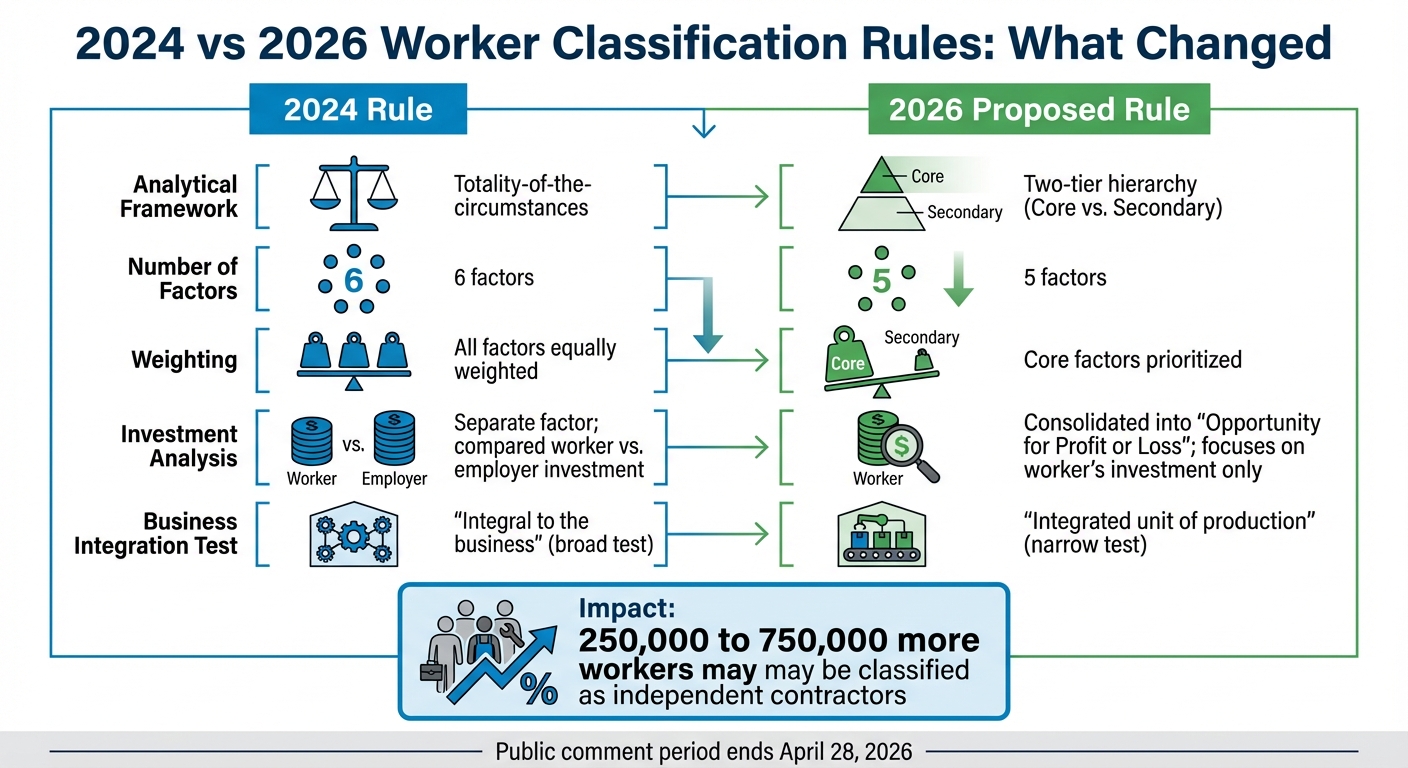
2024 vs 2026 Worker Classification Rules: Key Differences
On February 27, 2026, the Department of Labor (DOL) proposed new rules that reshape how businesses classify workers. This updated framework replaces the 2024 "totality-of-the-circumstances" approach with a five-factor test that emphasizes two key factors above the others.
The Five-Factor Economic Reality Test Explained
The 2026 rule introduces a two-tier system that categorizes factors as either "core" or "secondary." The two core factors – nature and degree of control and opportunity for profit or loss – carry significantly more weight than the three secondary factors.
Here’s a breakdown of the five factors:
| Factor | Category | What It Examines |
|---|---|---|
| Nature and Degree of Control | Core | Who determines schedules, selects projects, and whether the worker can engage with competitors |
| Opportunity for Profit or Loss | Core | If a worker can influence earnings through managerial skill, initiative, or investments |
| Amount of Skill Required | Secondary | Whether the work demands specialized skills not provided by the employer |
| Degree of Permanence | Secondary | Whether the relationship is ongoing or sporadic |
| Integrated Unit of Production | Secondary | Whether the worker is part of the production process or provides an independent service |
The rule introduces a pivotal shortcut: if both core factors point to the same classification, that classification is likely correct. This simplifies the process for businesses, allowing them to focus primarily on these two factors.
Additionally, the rule clarifies that employer control is not defined by mandatory safety or insurance requirements.
Another adjustment concerns how investments are evaluated. Previously, comparing worker and employer investments created challenges for capital-intensive roles. Under the new rule, only the worker’s investment is considered. As Bracewell LLP observed:
"The Proposed Rule’s return to evaluating the worker’s investment on its own terms removes this structural disadvantage".
How the 2026 Rule Differs from the 2024 Rule
The 2026 proposal builds on the economic reality test but introduces clearer guidelines compared to the 2024 approach. The earlier rule treated all six factors equally, requiring a broad balancing test. The 2026 rule, however, creates a weighted hierarchy that simplifies the classification process.
| Feature | 2024 Rule | 2026 Proposed Rule |
|---|---|---|
| Analytical Framework | Totality-of-the-circumstances | Two-tier hierarchy (Core vs. Secondary) |
| Number of Factors | 6 factors | 5 factors |
| Weighting | All factors equally weighted | Core factors prioritized |
| Investment | Separate factor; compared worker vs. employer investment | Consolidated into "Opportunity for Profit or Loss"; focuses on worker’s investment |
| Business Integration | "Integral to the business" (broad test) | "Integrated unit of production" (narrow test) |
According to the DOL, this updated framework could lead to 250,000 to 750,000 more workers nationwide being classified as independent contractors. The DOL criticized the 2024 rule for lacking clarity and predictability, stating:
"fails to provide an analysis for distinguishing between independent contractors and employees under the FLSA that is sufficiently clear and leads to predictable outcomes".
The 2026 rule also extends its reach beyond the Fair Labor Standards Act (FLSA). For the first time, the DOL proposes applying this classification standard across three federal laws: the FLSA, the Family and Medical Leave Act (FMLA), and the Migrant and Seasonal Agricultural Worker Protection Act (MSPA). This unified approach determines worker eligibility for minimum wage, overtime pay, and family leave benefits.
Finally, the rule underscores the importance of "actual practice" over contractual terms. As the DOL explained:
"The actual practice of the parties involved is more relevant than what may be contractually or theoretically possible".
This means businesses need to align their daily operations – such as worker flexibility and the ability to take on other clients – with the terms outlined in their contracts.
Impact on Construction and Energy Industries
The 2026 rule changes bring notable operational and financial challenges for construction and energy companies. These industries depend heavily on independent contractors for tasks like drilling, pipeline maintenance, mining, and heavy infrastructure projects. By focusing on core factors, the new rules simplify compliance compared to the 2024 framework, paving the way for adjustments in tax and operational protocols.
Tax and Compliance Changes You Need to Know
Misclassifying workers can lead to severe penalties, including unpaid overtime, minimum wage violations, liquidated damages, and payroll tax liabilities under the Fair Labor Standards Act (FLSA). The stakes are even higher now that the 2026 rule applies a uniform classification standard under the FLSA, the Family and Medical Leave Act, and the Migrant and Seasonal Agricultural Worker Protection Act.
Under the 2024 rule, Bracewell LLP highlighted how comparing a contractor’s minimal tool investment to a utility’s massive infrastructure costs often resulted in a bias toward employee classification. The 2026 rule eliminates these structural disadvantages by focusing solely on the worker’s own investment. Additionally, it reinstates the principle that "compliance is not control." This means requiring contractors to follow safety protocols, maintain insurance, or meet health standards no longer qualifies as employer control.
At the state level, stricter "ABC" tests in places like California, Massachusetts, and New Jersey add another layer of complexity. With worker classification rules shifting three times in five years, legal experts warn of potential "regulatory whiplash." As Skadden explained:
"Worker classification remains a high-stakes compliance issue for employers, with significant legal, financial and operational consequences for misclassification".
These regulatory changes demand that companies reevaluate their tax strategies and operational practices. Conducting classification audits, revising contracts, and training hiring managers to align with the updated core factors test are now critical steps. Rachel Powitzky Steely, Partner at Foley & Lardner LLP, emphasized:
"Audits conducted in conjunction with legal counsel can provide a good faith defense to liquidated damages in the event a lawsuit is filed".
With these challenges in mind, businesses must also find ways to optimize workforce management.
How ABLEMKR Helps with Compliance and Workforce Management

Construction and energy companies face a tough balancing act: staying compliant while quickly mobilizing skilled workers for urgent projects. ABLEMKR offers solutions tailored to these needs, combining compliance tracking with efficient workforce deployment across sectors like oil & gas, mining, utilities, and heavy infrastructure.
The platform’s compliance tools provide real-time insights into worker status and integrate seamlessly with payroll workflows. For industries where contractors must meet strict safety certifications and insurance requirements – now excluded from the control factor under the 2026 rule – ABLEMKR’s pre-vetting system ensures workers are matched based on certifications, training, availability, and location. This ensures compliance documentation aligns with actual operations.
Additionally, workers on the platform are classified as W2 employees, complete with workers’ compensation coverage and guaranteed on-time payments. This eliminates classification uncertainties for employers. ABLEMKR’s mobile-first technology streamlines crew mobilization for last-minute shutdowns, remote pipeline repairs, or planned mine development – situations where documenting profit opportunities and control levels is crucial for meeting the core factors test. By modernizing workforce management, ABLEMKR helps companies navigate the new rules while maintaining efficiency and compliance.
State Laws and Federal Rules: What You Need to Know
Federal Rules Don’t Override State Laws
Even with updates at the federal level, state laws still play a major role in worker classification. The 2026 federal rule sets a baseline standard, but it doesn’t replace stricter state requirements. For example, states like California, Massachusetts, Illinois, and New Jersey enforce the more stringent "ABC test", which goes beyond federal guidelines. As Nelson Mullins points out:
"A favorable federal rule does not override state law worker classification standards. For example, contractors in states like California, Massachusetts, or New Jersey must still satisfy more rigorous ‘ABC’ classification tests."
This means businesses must follow both federal and state laws. While the federal "core factors" test emphasizes control and profit opportunity, the state-level ABC test requires proof that the worker operates independently, performs work outside the hiring company’s usual business, and runs their own enterprise. Akin Gump Strauss Hauer & Feld LLP cautions:
"The proposed rule would not preempt stricter state-law standards or eliminate misclassification risk."
For industries like construction and energy, which often operate across state lines, this creates a tricky compliance landscape. A contractor who qualifies under federal rules in one state could still be considered an employee under another state’s stricter ABC test.
Successfully managing these overlapping requirements requires careful planning and attention.
How to Stay Compliant
To navigate this dual-layered compliance system, businesses need to take proactive steps:
- Conduct classification audits: Review every contractor relationship using both the federal "core factors" and relevant state tests. Rachel Powitzky Steely, Partner at Foley & Lardner LLP, advises conducting these audits with legal counsel to build a solid defense against potential misclassification claims.
- Update contracts: Ensure contracts accurately reflect the actual working relationship. Courts and regulators prioritize real-world practices over theoretical contract terms.
- Train managers: Provide training on federal and state-specific classification rules. This helps prevent misclassification during hiring and ensures daily operations align with worker designations.
- Keep up with legislative changes: Regularly monitor updates to state laws to maintain compliance.
Conclusion: Getting Ready for New Worker Classification Rules
The 2026 rule introduces a clearer framework with a two-tier system that emphasizes control and profit opportunity as the main factors, replacing the broader "totality-of-the-circumstances" approach from 2024. With the public comment period set to close on April 28, 2026, there’s no time to waste in preparing for these changes.
Here’s how to get started:
- Audit contractor relationships: Take a close look at how much control you exert over schedules and whether workers have real opportunities to earn profit through their own managerial decisions and investments. As Bracewell explains:
"The Proposed Rule follows a common-sense approach by focusing on the core factors that presumably will favor more predictable classification outcomes".
- Focus on actual practices, not just contracts: Federal agencies and courts prioritize what happens in day-to-day operations over what’s written in agreements. Update contracts and train managers to ensure your practices align with the new classification criteria.
- Ensure compliance at all levels: Federal standards don’t override stricter state laws like California’s ABC test. If your business spans multiple states, double-check that classifications meet both federal and state requirements. Tools like ABLEMKR can simplify compliance tracking and provide real-time updates on worker status, which is especially useful for managing multi-state operations in industries like construction or energy.
The stakes are high. Misclassification can lead to hefty penalties, including back wages, liquidated damages, and legal fees under the Fair Labor Standards Act, as well as liabilities under laws like the Family and Medical Leave Act. By understanding this updated framework, conducting thorough audits, and staying on top of both federal and state regulations, you can safeguard your business while fostering the entrepreneurial independence that the 2026 rule seeks to encourage.
FAQs
What counts as “control” under the 2026 rule?
Under the 2026 rule, control focuses on how much authority a worker has over the way tasks are carried out. This includes evaluating whether the worker decides the methods and tools used to complete their work. These factors are crucial in determining the nature of the working relationship and ensuring proper classification standards are met.
How can a contractor show a real profit or loss opportunity?
A contractor can uncover opportunities for profit or loss by carefully analyzing their profit and loss (P&L) statement. This financial document lays out revenue and expenses, making it easier to pinpoint which areas are driving profit and where costs might be running too high. By keeping a close eye on factors like labor, materials, permits, and overhead expenses, contractors can spot areas for greater efficiency or potential cost savings. Regular reviews of the P&L can lead to smarter decisions, improved pricing strategies, and better cost management, ultimately helping to boost profit margins or reduce losses.
How do I comply if my projects span ABC-test states?
To work within ABC-test states, it’s crucial to stay informed about the latest changes in worker classification rules. The U.S. Department of Labor’s proposed rule highlights factors like control over work and the opportunity for profit or loss. Ensure your practices align with both federal and state laws, as individual states may have their own specific requirements. Regularly check for updates and seek advice from legal experts to stay on track.
Platforms like ABLEMKR can simplify compliance by connecting you with pre-vetted workers. They also support compliance efforts with tools like certifications, safety training, and geo-location tracking.


