
Misclassifying workers in the energy sector can cost your business over $100,000 per worker in penalties, back taxes, and fines. Between 2021 and 2026, federal rules around worker classification shifted multiple times, complicating compliance for companies relying on independent contractors for roles like pipeline welding or wind farm installations. Here’s what you need to know:
- Federal Tests: The Department of Labor (DOL) applies the Economic Reality Test, focusing on economic dependency, while the IRS uses the Common Law Test, emphasizing control.
- State Variations: States like California enforce strict ABC Tests, assuming workers are employees unless proven otherwise, while Texas and Pennsylvania offer more flexibility.
- Key Risks: Misclassification can trigger audits, lawsuits, and retroactive costs, including unpaid wages, overtime, and benefits.
- Best Practices: Regular audits, detailed documentation, and compliance with both federal and state standards are critical to avoid penalties.
Accurate classification is not just about contracts – it’s about the actual working relationship. Missteps can lead to severe financial and legal consequences, making adherence to these guidelines essential.
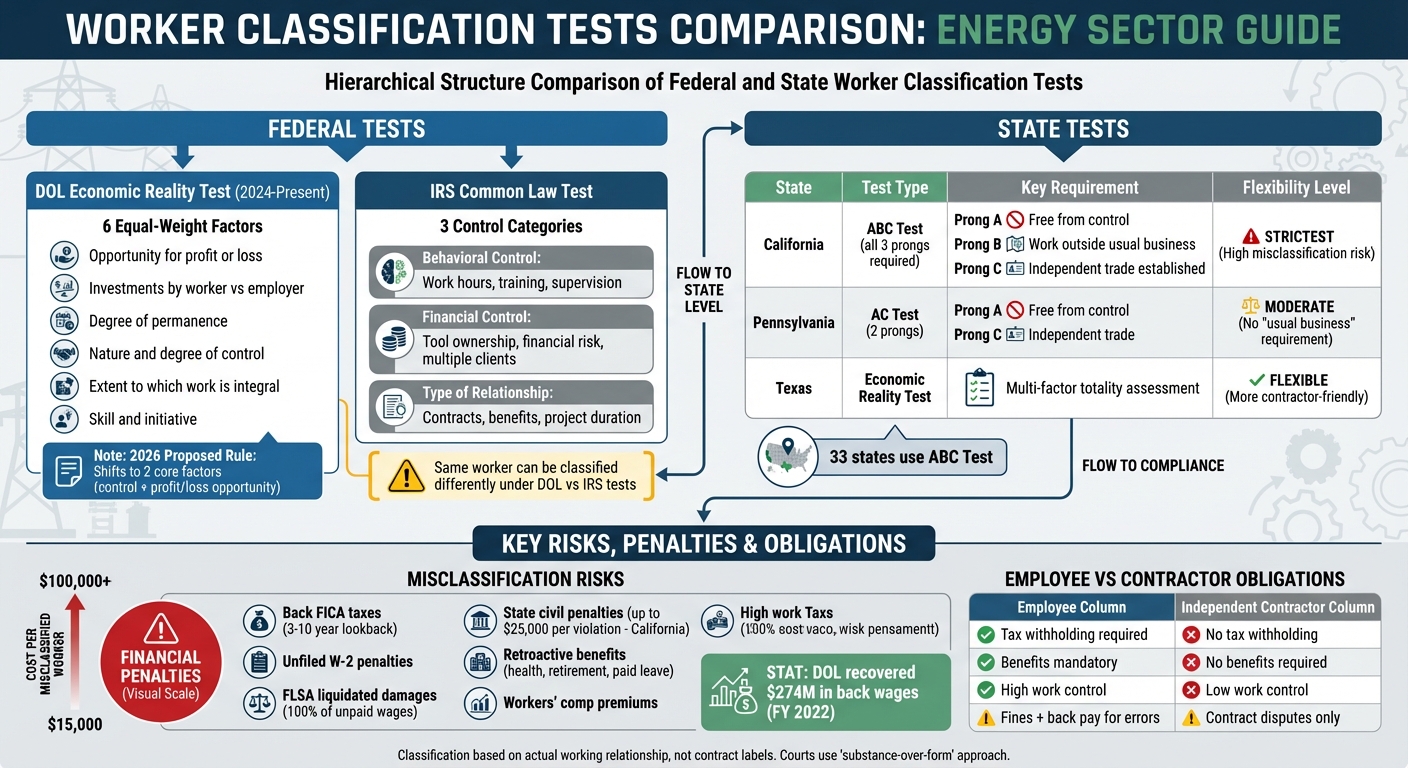
Worker Classification Tests Comparison: Federal vs State Requirements for Energy Projects
How to Properly Classify Employees and Independent Contractors
sbb-itb-aa28329
Federal Worker Classification Tests
The Department of Labor (DOL) and the Internal Revenue Service (IRS) use different methods to classify workers involved in energy projects. It’s crucial to comply with both, as a worker might be considered an independent contractor for IRS tax purposes but still qualify as an employee under the Fair Labor Standards Act (FLSA).
The stakes are high because the FLSA doesn’t override other worker protection laws. As the DOL explains:
"The FLSA does not preempt any other laws that protect workers, so businesses must comply with all federal, state, and local laws that apply and ensure that they are meeting whichever standard provides workers with the greatest protection".
This means companies must meet the strictest standard applicable.
The Economic Reality Test Under FLSA
The DOL’s Economic Reality Test centers on a key question: Is the worker economically dependent on the company, or are they essentially running their own business? Since March 11, 2024, the DOL has applied a six-factor analysis, giving equal weight to each factor:
- Opportunity for profit or loss: Looks at whether the worker can increase earnings through independent business decisions.
- Investments by the worker and employer: Compares the worker’s investments to determine if they reflect entrepreneurial risk.
- Degree of permanence: Suggests employee status if the relationship is ongoing or exclusive rather than tied to a specific project.
- Nature and degree of control: Examines who controls schedules, methods, and pricing.
- Extent to which work is integral: Evaluates if the work is essential to the company’s core operations. This can be a challenge for energy companies, where tasks like pipeline maintenance or oilfield services are often considered central to the business.
- Skill and initiative: Considers whether the worker uses specialized expertise in a business-like way.
On February 26, 2026, the DOL proposed returning to a "core factor" model, emphasizing control and profit opportunity as the most critical indicators. Brian G. Patterson, a partner at Bracewell, explained:
"If a company can demonstrate that it does not control the manner and means of how work is performed… and that the worker has a genuine opportunity for profit or loss… those two core factors should carry the day in most cases".
This proposal also adjusts the "integral part" test and evaluates a worker’s investment independently of the employer’s resources. The comment period for this proposed rule closed on April 28, 2026.
While the DOL focuses on economic dependency, the IRS uses a completely different framework centered on control.
IRS Common Law Test
The IRS evaluates worker classification through a lens of control, using criteria grouped into three categories: Behavioral Control, Financial Control, and Type of Relationship. This approach, based on Revenue Ruling 87-41, assesses whether your company has the "right to control" how, when, and where work is performed – even if that control isn’t actively exercised.
- Behavioral Control: Looks at whether the company dictates work hours, provides training, or supervises work methods. For energy projects, setting safety and insurance requirements is usually seen as specifying results rather than controlling the process.
- Financial Control: Considers whether the worker invests in their own tools, takes on financial risk, and works for multiple clients. For example, owning specialized equipment like directional drilling rigs or hot-shot trucks often signals independent contractor status.
- Type of Relationship: Examines factors like written contracts, benefits, and whether the work arrangement is project-specific or ongoing.
These tests can lead to different outcomes for the same worker. Take a pipeline welder who owns their rig and works for multiple operators in a month: they might qualify as an independent contractor under IRS rules but still be considered an employee under the FLSA if their work is integral to your business. Because these tests operate independently, it’s essential to document compliance with both to avoid legal and financial risks.
State-Specific Worker Classification Rules
While federal guidelines offer a general framework, state laws often impose stricter and varied standards. For example, a worker classified as an independent contractor in Texas might legally be considered an employee in California, which could lead to hefty penalties. Douglas Oldham highlights this challenge:
"A one-size-fits-all approach does not work because a worker may properly be classified as an independent contractor in one state, but be an employee in another, and penalties for misclassification can be astronomical".
This patchwork of regulations creates unique hurdles for energy companies operating across multiple states. Instead of relying on the laws of your headquarters’ location, it’s essential to evaluate workers based on the specific rules of each state.
One of the most defining state-level tests is the ABC Test, which plays a major role in determining contractor status.
Understanding the ABC Test
The ABC Test is known for being one of the strictest worker classification standards in the U.S. States like California, Massachusetts, Connecticut, and Illinois use this test, which starts with the assumption that every worker is an employee. To classify someone as an independent contractor, you must meet all three of these conditions:
- Prong A (Control): The worker operates free from your control and direction while performing their work.
- Prong B (Course of Business): The work performed is outside your usual business activities.
- Prong C (Independent Trade): The worker is engaged in an independently established trade, occupation, or business of the same nature.
Failing to meet even one of these prongs means the worker will be classified as an employee. Prong B often poses the biggest challenge for energy companies. For instance, routine tasks like pipeline maintenance, even when performed by contractors with their own tools and multiple clients, may still be considered part of your core business. As Contractor Industry News explains:
"The ‘B’ prong is particularly restrictive for contractors – a roofing company cannot classify roofers as independent contractors under ABC states’ rules".
Some states, like Pennsylvania, Colorado, and Georgia, use a modified version called the AC Test, which eliminates Prong B entirely. This makes it easier to classify contractors, as you only need to prove the worker operates independently and is free from control.
Classification Rules in Major Energy States
The top three energy-producing states – Texas, California, and Pennsylvania – each have distinct worker classification rules, presenting different compliance challenges.
- Texas applies the Economic Reality Test, which looks at the overall relationship between the business and the worker. Factors include control, equipment ownership, financial risk, and the relationship’s permanence. This test generally allows more flexibility for independent contractor arrangements in the energy sector.
- California enforces the full ABC Test, which places the burden on employers to satisfy all three prongs. Most workers involved in core energy tasks – like drilling or solar installation – are likely to be classified as employees because their work is integral to the business. This makes California one of the most restrictive states for contractor classifications.
- Pennsylvania uses the AC Test, which removes the "usual course of business" requirement. Employers only need to show that workers operate independently and are free from control. This approach offers a middle ground between the flexibility in Texas and the stricter rules in California.
| State | Test Type | Key Requirement | Impact on Energy Projects |
|---|---|---|---|
| Texas | Economic Reality | Multi-factor, totality of circumstances | More flexibility for independent contractor arrangements |
| California | ABC Test | Must prove all three prongs (A, B, C) | High risk of misclassification for core tasks |
| Pennsylvania | AC Test | Must prove control freedom and independence | Easier classification; no "usual course of business" rule |
For companies operating across state lines, it’s critical to conduct state-specific audits wherever workers are deployed. Collect and document evidence of a worker’s independent business – such as ownership of equipment, multiple clients, business licenses, and decision-making authority. This documentation is especially important in ABC Test states, where the burden of proof falls entirely on the employer.
With these state-specific rules in mind, the next step is to follow a detailed guide for accurate worker classification.
Step-by-Step Guide to Classifying Workers in Energy Projects
Now that you’re familiar with the federal and state rules, let’s dive into how to put them into action. It’s essential to evaluate the actual working relationship, not just what’s outlined in contracts. Courts and agencies often use a "substance-over-form" approach, focusing on how work is performed in reality.
Step 1: Review Job Tasks and Responsibilities
Start by examining who controls the work. For instance, if your company sets schedules, provides training, or supervises the quality of tasks, that points to an employee relationship. On the other hand, contractors are typically told what work needs to be done but have autonomy over how they do it.
Next, look at financial control. Does the worker invest in their own tools – like specialized welding equipment or design software? Do they serve multiple clients, hire their own assistants, or negotiate pay to manage costs? These are hallmarks of an independent contractor.
Finally, analyze whether the worker’s role is central to your operations. Are they deeply involved in production processes, or are they providing an external service? For example, someone handling routine pipeline maintenance is likely integral to your core operations, whereas a person managing non-payroll accounting services would not be.
Use these insights about task control and financial independence to determine which federal and state tests apply.
Step 2: Apply Federal and State Tests
Once you’ve gathered information, apply the relevant classification tests. The 2026 Proposed Rule emphasizes two key factors: control and the worker’s opportunity for profit or loss. The Department of Labor explains:
"If the economic realities show that the worker is economically dependent on the employer for work, then the worker is an employee".
For state-level compliance, use the ABC Test in states like California and Massachusetts. Keep in mind, all three prongs of the test must be satisfied, and Prong B – whether the worker performs tasks within your usual course of business – can be particularly challenging. In Texas, the Economic Reality Test offers more flexibility, while Pennsylvania’s AC Test eliminates the business-course requirement altogether.
It’s important not to rely solely on contract labels. As Contractor Industry News points out:
"A contract label does not override the economic and behavioral reality of the relationship. Courts have routinely found employee status despite explicit contract language to the contrary".
After determining the classification, make sure to document your findings thoroughly to protect your business.
Step 3: Document and Maintain Compliance Records
For every worker, create a classification memo that outlines factors like control, financial arrangements, and the tests you applied. This memo can serve as a defense during audits.
Keep detailed records, including contracts, certified payroll (DOL Form WH-347), worker IDs (name, address, Social Security number), wage rates, hours worked, and benefit calculations. These should be retained for at least three years after the project ends. Even independent contractors must appear on certified payroll for Davis-Bacon projects, with a note stating that FICA and taxes were not withheld.
Conduct quarterly audits to catch and fix any classification errors before the IRS or DOL does. Workers can prompt formal audits by filing IRS Form SS-8 to request a status determination. If you realize you’ve misclassified someone, consider using the IRS Voluntary Classification Settlement Program (VCSP) to correct the issue with reduced penalties.
Finally, remember that classification isn’t a one-and-done decision. If the scope of a project, its duration, or the level of supervision changes, you need to reassess the worker’s status. These steps are a key part of maintaining compliance and avoiding costly penalties down the road.
Avoiding Worker Misclassification Risks
Worker misclassification can set off multiple audits across various agencies, significantly increasing compliance risks. This is particularly true for energy projects, where contractors play a critical role in operations. As discussed earlier, accurate worker classification is a must to steer clear of these hefty risks.
The cost of misclassification can climb above $100,000 per worker. For instance, the IRS might demand back FICA taxes for a lookback period ranging from 3 to 10 years, along with penalties for each unfiled W-2. Under the Fair Labor Standards Act (FLSA), liquidated damages can match 100% of unpaid wages, effectively doubling the back-pay liability. On top of that, states like California impose civil penalties that can hit $25,000 per violation.
But it doesn’t stop there. Employers may also be liable for retroactive benefits, such as health insurance, retirement plans, and paid leave. Misclassified workers could file private lawsuits or join class-action cases for unpaid overtime or minimum wage violations. Additionally, employers might owe back workers’ compensation premiums for the relevant period. In Fiscal Year 2022 alone, the Department of Labor’s Wage and Hour Division recovered $274 million in back wages tied to misclassification and other violations.
Employee vs. Independent Contractor Obligations
To grasp the risks, it’s important to understand the key differences between employee and contractor obligations. Here’s a quick breakdown:
| Factor | Employee Obligations | Independent Contractor Obligations |
|---|---|---|
| Tax Withholding | Required | Not Required |
| Benefits (e.g., health) | Mandatory | Not Required |
| Work Control | High | Low |
| Penalties for Errors | Fines and back pay | Potential contract disputes |
The U.S. Department of Labor makes this clear:
"The parties’ labels are not controlling under the economic reality test."
In other words, calling someone a "contractor" in a contract doesn’t necessarily make it so. If the actual working relationship mirrors that of an employee, both the IRS and the Department of Labor (DOL) will classify the worker as an employee.
Best Practices for Compliance
To reduce the risks associated with misclassification, consider these practical steps:
- Conduct Regular Audits: Annually or semi-annually review contractor roles to catch "scope creep", where a contractor’s tasks begin to resemble those of an employee.
- Use Written Questionnaires: For every new engagement, document key indicators of independence – behavioral, financial, and relational – through written questionnaires.
- Train Front-Line Managers: Educate managers to focus on deliverables rather than dictating how contractors perform their work, which could inadvertently trigger employee classification.
- Maintain Separate Records: Keep contractor documentation – like invoices, EINs, and insurance certificates – separate from employee personnel files to prevent confusion during audits.
- Verify Market Independence: Collect proof that contractors work with other clients, such as business cards, websites, or advertisements, to support their independent status.
- Address Misclassification Quickly: If an error is found, consider using the IRS Voluntary Classification Settlement Program (VCSP) to resolve the issue with reduced penalties. Section 530 Safe Harbor relief may also apply if you can show a reasonable basis for the original classification, such as a prior audit or longstanding industry practices.
These steps help solidify compliance efforts and ensure your classification practices remain on solid ground. By staying proactive, you can avoid costly penalties and maintain operational integrity.
How Technology Supports Worker Classification and Compliance
Technology has become a key tool for managing the complex regulatory landscape surrounding worker classification. Recent changes, such as the shift from the 2021 core-factor rule to the 2024 six-factor rule and the upcoming 2026 Proposed Rule, have increased the need for precise, audit-ready records. Advanced platforms now provide the structure and tools necessary to tackle these challenges effectively.
Using ABLEMKR for Workforce Management

ABLEMKR offers a comprehensive solution to worker classification issues by automating credential verification and centralizing compliance tracking. The platform ensures that workers are pre-vetted, confirming certifications, licenses, and safety training – like OSHA cards – before they are assigned to energy projects. This upfront verification creates audit-ready documentation from the very beginning.
One standout feature is the GPS-enabled time tracking, which records location-verified check-ins and check-outs. These time-stamped logs document work activities without requiring constant supervision from employers. Workers also manage their own profiles, including tools, equipment, and availability, reinforcing their status as independent contractors rather than integrated employees.
ABLEMKR simplifies compliance by consolidating all credentials, licenses, and agreements into a single, searchable digital archive. Every step – from job postings to final payments – is digitally recorded, creating a detailed audit trail. This is critical for regulatory reviews or audits by the Department of Labor’s Wage and Hour Division. As the National Human Resources Authority points out:
"When employment decisions lack contemporaneous written records, employers face an evidentiary disadvantage in administrative proceedings and litigation".
In addition, the platform ties invoicing and payments to documented project milestones or logged hours, directly supporting the "financial control" criteria of the IRS Common Law test. For energy companies operating remote sites like solar farms or wind projects, this real-time visibility ensures compliance and minimizes risks during audits.
Benefits of Automation in Classification
Beyond tracking, automation makes it easier to meet evolving classification standards. For example, the 2026 Proposed Rule emphasizes two "core factors" – control and opportunity for profit or loss. Automation helps companies document these factors accurately by tracking real-world practices like scheduling, supervision, and financial transactions. This ensures classifications align with actual operations, not just written agreements, which the Department of Labor prioritizes.
Automation also addresses the complexities of differing jurisdictional rules. While federal regulations evolve, 33 states enforce the stricter "ABC test", which tends to favor employee classification. Platforms like ABLEMKR can integrate federal requirements with state-specific criteria, ensuring compliance in states with tougher standards, such as California and New Jersey.
Another critical area automation tackles is the "integral part" risk. Under the 2024 rule, much of the work in the energy sector could be considered essential to the business. Technology helps companies demonstrate that contractors provide "outside services" by clearly defining project scopes, deliverables, and worker independence.
The platform also generates weekly compliance reports, flags expired certifications, and monitors insurance renewals for long-term projects. By simplifying these processes, technology turns workforce compliance into a manageable – and even strategic – aspect of operations.
Conclusion
Worker classification in energy projects is a critical compliance issue, with misclassification exposing companies to hefty penalties. These can include back FICA taxes, unpaid overtime, and state-imposed fines, which may range from $15,000 to $100,000 per worker over a two- to three-year review period.
Adding to the complexity, federal classification rules are changing quickly. For energy businesses operating in multiple states, the challenge grows even more daunting. Currently, 33 states enforce the ABC test – a stricter standard that can classify workers as employees even if they qualify as contractors under IRS guidelines.
"Misclassification carries back-tax liability, penalty assessments, and potential civil litigation, making classification rules one of the highest-stakes compliance questions in the contractor industry." – Contractor Industry News
To navigate these risks, maintaining detailed documentation is essential. Carefully record factors like control, independence, integration, and financial arrangements for every worker, regardless of which federal test applies. For energy sectors like oilfield services, pipelines, or renewable installations, keeping up-to-date written records can be a powerful safeguard during audits. Fortunately, modern tools make this easier than ever.
ABLEMKR, for instance, streamlines compliance by automating credential checks, GPS time tracking, and audit-ready documentation. This technology turns the challenge of workforce compliance into a structured process, allowing energy companies to deploy skilled teams efficiently while staying protected under both federal and state regulations.
FAQs
Can a worker be a contractor for IRS taxes but an employee under the FLSA?
Yes, it’s possible for someone to be classified differently under IRS rules and the Fair Labor Standards Act (FLSA). For tax purposes, the IRS looks at factors like behavioral control, financial control, and the overall nature of the relationship. On the other hand, the FLSA focuses more on the degree of control the employer has over the worker and whether the worker has a genuine opportunity for profit or loss. Because these laws assess different aspects of the work relationship, a person might be considered an independent contractor by the IRS but still qualify as an employee under the FLSA.
How do I classify contractors when my energy project spans multiple states?
To correctly classify contractors across various states, it’s crucial to account for both federal and state worker classification rules, as these can vary significantly. At the federal level, the "economic realities" test is commonly applied, evaluating aspects like the level of control exerted over the worker and their financial independence. On the other hand, state regulations can be more stringent. For example, California uses the ABC test, which sets stricter criteria for determining independent contractor status.
Proper documentation of relevant factors is essential to demonstrate compliance, and seeking advice from legal professionals is highly recommended. Tools like ABLEMKR’s platform can assist in simplifying the classification process and ensuring alignment with local requirements.
What records should I keep to defend a contractor classification in an audit?
When facing an audit, having detailed records is key to proving a worker’s status as an independent contractor. You need to show clear evidence of their independence, control over their tasks, and financial risk.
Here’s what to focus on:
- Contracts: Keep formal agreements that outline the worker’s responsibilities, payment terms, and acknowledgment of their independent status.
- Work Schedules: Document any flexibility in their work hours to highlight their autonomy.
- Payment Terms: Maintain records showing how they are paid (e.g., per project or milestone) rather than a regular salary.
- Communications: Save emails or messages that demonstrate their decision-making and control over how they complete their work.
It’s also important to document broader factors like the worker’s level of control, the type of work they do, and how integrated their role is within your business. These records collectively help you show compliance with the criteria for independent contractors.


