
Construction is one of the most dangerous industries in the U.S. Each year, thousands of workers face serious risks like falls, electrocutions, and equipment-related injuries. The OSHA 10 and OSHA 30 training programs are designed to address these dangers by teaching workers and supervisors how to recognize and prevent hazards.
- OSHA 10: A 10-hour course for entry-level workers focusing on basic safety practices.
- OSHA 30: A 30-hour course for supervisors emphasizing advanced safety management and compliance.
These certifications are often required by law for public construction projects in over 20 states, with noncompliance resulting in fines or worker removal. Beyond meeting legal requirements, OSHA training reduces accidents, lowers costs, and improves project timelines. Employers also benefit from having trained workers, as it minimizes delays and ensures compliance during audits.
Key Takeaway: OSHA training isn’t just about safety – it’s about protecting workers, avoiding costly penalties, and staying competitive in the construction industry.
What Economic Benefits Do OSHA Certifications Offer Construction? – Construction Jobs
Safety Problems on Construction Sites
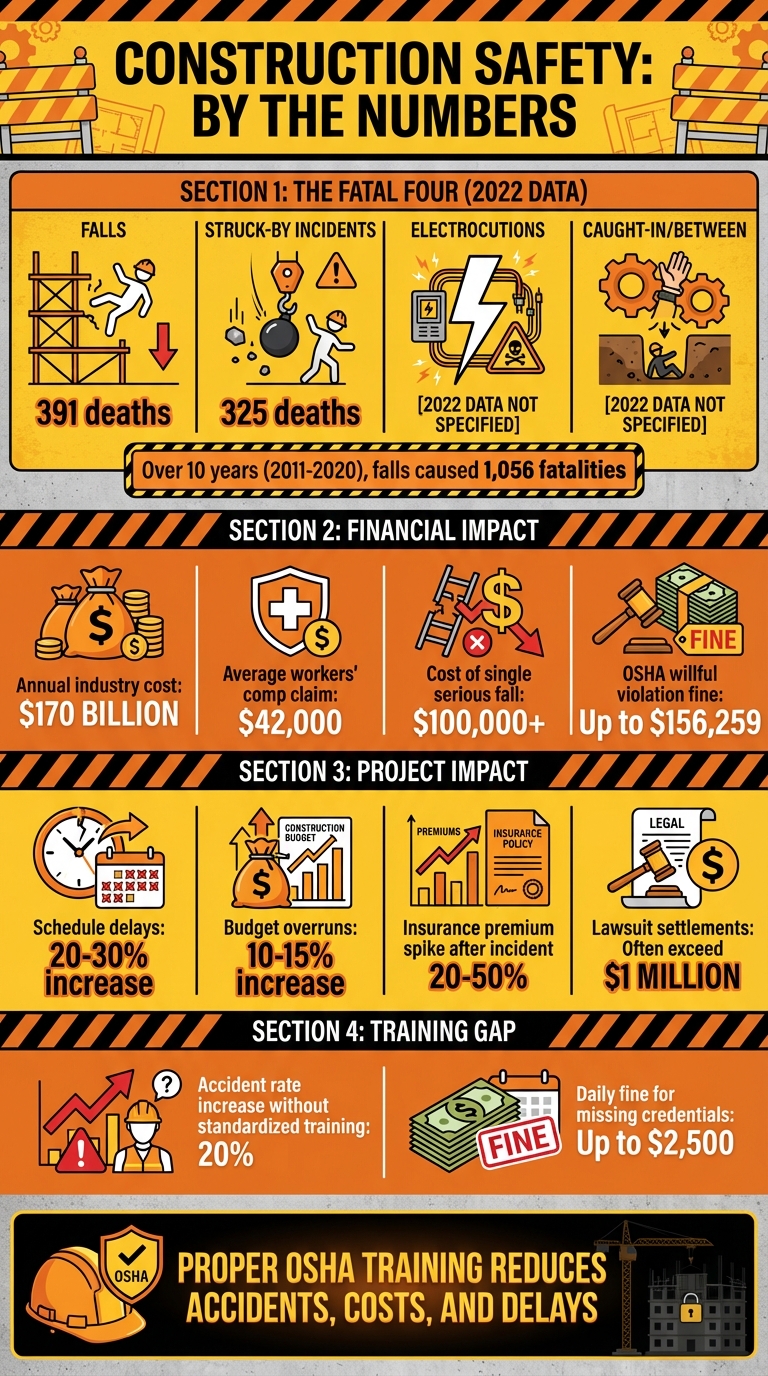
Construction Safety Statistics: OSHA Fatal Four Hazards and Industry Costs
Common Construction Hazards
Construction work is inherently risky, with workers exposed to life-threatening hazards daily. Falls remain the most dangerous threat, accounting for 391 deaths in 2022 alone. Over a decade (2011–2020), falls were responsible for 1,056 fatalities, often causing severe injuries like fractures or permanent spinal damage. Whether it’s falling from roofs, ladders, scaffolds, or unprotected edges, the danger is ever-present.
Struck-by incidents are another leading cause of fatalities. These occur when workers are hit by equipment like swinging cranes, tools dropped from heights, or reversing vehicles. In 2022, such incidents claimed 325 lives. Electrical hazards also rank high on the list of deadly risks. Workers face fatal shocks or serious burns from contact with overhead power lines while using boom lifts or from touching live wires during demolition tasks. Meanwhile, caught-in/between hazards, such as trench collapses or being trapped between machinery and structures, pose equally dire threats. To put it into perspective, a cubic yard of soil can weigh as much as a car, making unprotected trenches over 5 feet deep especially dangerous without proper safety measures like shoring or shielding.
Beyond these immediate dangers, heavy lifting and repetitive tasks take a toll on workers’ health. Back injuries and overexertion not only increase workers’ compensation claims but also leave teams short-staffed at critical times.
These risks highlight how crucial it is to prioritize safety training to protect workers and maintain smooth operations.
Training and Compliance Problems
A significant number of accidents stem from insufficient safety training. Workers who lack OSHA 10 or OSHA 30 certifications often fail to recognize hazards like unstable trenches, unguarded machinery, or other site-specific dangers. Companies that skip standardized training in favor of informal onboarding see accident rates rise by as much as 20%. This issue is particularly pronounced among small and mid-sized contractors, many of whom lack formal safety programs, regular training schedules, and systems to track employee certifications.
Documentation issues exacerbate these problems. Many employers neglect to verify current training certifications onsite, and missing or expired credentials can lead to fines of up to $2,500 per day. For projects valued at over $100,000, these lapses can force contractors to remove untrained workers, creating crew shortages and delaying progress.
The combination of untrained workers and poor documentation increases risks across the board, making accidents more likely and compliance violations more costly.
How Safety Failures Affect Business
When safety measures fall short, the consequences extend far beyond worker injuries – they can cripple a business financially and operationally.
Workplace accidents cost the construction industry a staggering $170 billion annually. This figure includes medical expenses, workers’ compensation claims (which average $42,000 each), and lost productivity. A single serious fall can result in costs exceeding $100,000, especially when OSHA fines for willful violations climb as high as $156,259. Accidents also disrupt project timelines, often adding 20–30% to schedules and inflating budgets by 10–15%.
Legal and insurance implications further compound these costs. OSHA investigations can halt work for days, while lawsuits from injured workers frequently settle for over $1 million. Insurance premiums often spike by 20–50% after serious incidents, adding long-term financial strain. Operationally, injuries or compliance-related worker removals create staffing gaps, delaying schedule-driven projects like highways or energy facilities. These delays can lead to liquidated damages running into six figures.
Reputation damage is another major consequence. Companies with poor safety records struggle to win future contracts, especially public projects that demand clean safety histories. In some cases, repeat violations result in blacklisting at the state level. On the flip side, firms with strong safety programs and well-documented training not only build client trust but also attract skilled workers who value a safe workplace.
What OSHA 10 and OSHA 30 Training Programs Cover
OSHA 10 vs. OSHA 30: Main Differences
The OSHA 10 Construction course is a 10-hour program tailored for entry-level construction workers. Its primary focus is on recognizing and preventing common on-site hazards, covering topics like fall protection, electrical safety, and the proper use of personal protective equipment (PPE). Upon completing the course, participants receive an official OSHA 10 card issued by the Department of Labor (DOL).
On the other hand, OSHA 30 Construction is a more intensive 30-hour course designed for individuals with supervisory or safety-related roles, such as forepersons, site supervisors, safety coordinators, and project managers. This course delves into advanced safety regulations, leadership, and safety management. While OSHA 10 equips workers with the knowledge to stay safe, OSHA 30 trains supervisors to manage safety proactively – planning tasks, conducting toolbox talks, addressing unsafe conditions, and ensuring compliance with OSHA standards. Both courses are part of OSHA’s Outreach Training Program and culminate in a DOL-issued certification card.
| Aspect | OSHA 10 | OSHA 30 |
|---|---|---|
| Audience | Entry-level workers and tradespeople | Supervisors and safety coordinators |
| Duration | 10 hours | 30 hours |
| Focus | Basic hazard recognition and prevention | Advanced safety management and enforcement |
| Certification | OSHA 10 DOL card | OSHA 30 DOL card |
Many companies encourage workers to advance from OSHA 10 to OSHA 30 as they take on leadership roles. These two programs cater to different levels of responsibility, providing a solid foundation for safety in construction.
Training Topics Covered
Both OSHA 10 and OSHA 30 courses address OSHA’s "Fatal Four" hazards, which include falls, electrocutions, struck-by incidents, and caught-in/between accidents. Core topics shared between the two programs include fall protection, electrical safety and lockout/tagout procedures, proper PPE usage, general safety guidelines, and an overview of workers’ rights and employer responsibilities.
OSHA 30 goes further by dedicating additional time to advanced topics like hazard identification, job hazard analysis, and site-specific safety measures. It also covers managing multi-employer worksites, effective safety leadership and communication, incident investigation, and detailed recordkeeping practices. Specialized topics such as excavation safety, scaffolding, and crane operations receive more in-depth attention in OSHA 30, focusing on enforcing and implementing safety practices rather than just understanding them.
Both programs teach the basics of hazard and incident reporting. However, OSHA 30 expands on this by including incident investigation, root-cause analysis, and the supervisor’s role in documenting and responding to injuries. This added depth is crucial for meeting the expectations of regulators, insurers, and clients.
Why U.S. Construction Projects Require OSHA Training
These courses are essential for meeting both regulatory requirements and industry expectations. While OSHA Outreach training is technically voluntary at the federal level, many state and local governments – and major contractors – require OSHA 10 or OSHA 30 certification for workers on their projects.
For instance:
- Connecticut mandates OSHA 10 for employees on public works projects over $100,000, with proof required 30 days before the award.
- Nevada requires OSHA 10 for all construction workers and OSHA 30 for supervisors within 15 days of hire.
- Missouri enforces OSHA 10 for public projects, imposing penalties of up to $2,500 plus $100 per employee per day for noncompliance.
Local governments often implement even stricter rules. In Philadelphia, OSHA 10 is mandatory for all construction and demolition workers on permitted projects, and at least one OSHA 30-trained supervisor is required per licensed contractor. Similarly, Miami-Dade County enforces OSHA training for high-value county-funded and select privately funded projects. Additionally, many large national contractors adopt internal policies requiring OSHA 10 for all workers and OSHA 30 for supervisory roles before granting site access.
Having an OSHA card not only makes workers more competitive in the job market but also ensures eligibility for public projects. For employers, it reduces onboarding delays, demonstrates compliance, and helps avoid fines for missing or outdated credentials.
sbb-itb-aa28329
How OSHA Training Improves Safety and Compliance
Teaching Workers to Recognize Hazards
The OSHA 10-hour training equips entry-level workers with the skills to spot, avoid, and prevent common hazards in construction. These include dangers like falls, struck-by incidents, caught-in or caught-between accidents, electrical risks, and improper use of personal protective equipment (PPE). The course uses real-world examples – such as unprotected floor openings, unguarded scaffolds, and energized electrical panels – to help workers understand risks. It also teaches simple but effective actions: stop work when safety is compromised, tag unsafe equipment, and report hazards through the appropriate channels.
This training has a direct impact on day-to-day activities. Workers take proactive steps like inspecting tools before use or ensuring they’re tied off securely when working at heights. Many employers reinforce these practices with regular toolbox talks and pre-task planning sessions, embedding OSHA 10 principles into the crew’s daily routine rather than leaving them as classroom-only knowledge.
Additionally, the course informs workers about their rights, how to file complaints, and protections against retaliation. This knowledge encourages employees to report hazards and near misses, leading to quicker corrections and safer job sites.
Preparing Supervisors to Manage Safety
The OSHA 30-hour training takes safety to the next level, focusing on supervisors’ responsibilities in creating and maintaining effective safety programs. Foremen and site managers learn to perform job hazard analyses, organize and lead toolbox talks, conduct inspections, and investigate incidents. They also gain skills in coordinating subcontractors, setting clear safety expectations, and addressing recurring issues – all while keeping production on track.
The course also dives into broader safety management topics, such as creating site-specific safety plans, interpreting OSHA standards, and integrating safety into preconstruction planning. Supervisors are trained to handle unsafe behaviors fairly, respond effectively to worker concerns, and enforce discipline when necessary. By embedding safety into every phase of a project, supervisors foster a culture where safety becomes a core part of operations, not just an afterthought. This is especially important on complex sites where multiple trades work side by side, ensuring consistent safety practices and reliable compliance documentation.
Providing Documentation of Training
Proper documentation is key to maintaining a safe and compliant workplace. Completing OSHA 10 or 30 training results in a U.S. Department of Labor (DOL) card, which serves as proof of safety training. Many jurisdictions require these certifications for workers on public projects.
During audits or inspections, OSHA inspectors and project representatives often request these cards. Failing to provide proof can lead to serious consequences, such as worker removal, fines, or penalties on contracts. Tools like mobile-first platforms – such as ABLEMKR – make it easier to track certifications and send renewal reminders. These systems ensure only trained and compliant workers are allowed on-site, giving managers real-time updates on training statuses during onboarding and site access checks.
Organized and accessible documentation not only keeps companies prepared for audits but also minimizes disruptions caused by expired credentials.
How Technology Supports Safety and Compliance
Tracking Worker Training and Certifications
Keeping track of worker training and certifications has always been a challenge, especially when records are scattered across spreadsheets, paper cards, and photos. This disorganized approach can cause major headaches when inspectors show up or incidents occur. Scrambling to find proof of compliance not only wastes time but can also lead to fines or even workers being removed from the job site.
This is where ABLEMKR steps in, simplifying compliance with centralized digital profiles. These profiles securely store OSHA 10 and OSHA 30 card details, including card numbers, issuing providers, completion dates, and even scanned certificates. The platform also tracks expiration dates – a critical feature in places like Nevada, New York City, and Connecticut, where cards must be renewed every five years. Managers can quickly filter workers by project and generate audit-ready, time-stamped reports. This real-time visibility ensures supervisors know exactly who is qualified before anyone sets foot on site.
For jurisdictions that require workers to carry proof of training, ABLEMKR provides QR codes linked to verified digital profiles. Safety staff or gate guards can scan these codes to instantly confirm training status, eliminating the risk of outdated or fraudulent credentials slipping through.
Simplifying Onboarding and Compliance
Traditional onboarding processes can be a time sink, with hours wasted verifying paperwork and chasing down missing documents. ABLEMKR transforms this process by offering a mobile-first, online solution. Workers can upload OSHA cards, complete digital forms, e-sign acknowledgments, and finish required e-learning modules – like fall protection basics or PPE rules – all from their phone or computer before their first day.
When setting up a project, safety and HR teams can define site-specific requirements, such as OSHA 10 for all workers or OSHA 30 for supervisors, along with any local mandates. ABLEMKR automatically screens workers against these rules, preventing anyone who doesn’t meet the criteria from being dispatched. On the first day, supervisors simply verify worker statuses using a tablet or phone and conduct a quick site-specific briefing. For returning workers, this process slashes onboarding time from hours to just minutes.
This streamlined approach is especially critical in states with strict public-project rules. For instance, in Missouri, non-compliance can result in fines of up to $2,500 plus $100 per employee per day. By centralizing documentation, ABLEMKR helps contractors stay ahead of deadlines and avoid costly penalties. Once onboarding is complete, contractors can focus on quickly deploying the right workers to the job.
Matching Qualified Workers to Jobs
When contractors need to fill a crew at the last minute or mobilize workers for emergency repairs, speed is everything. ABLEMKR uses real-time worker profiles to make this process seamless. The platform filters workers based on their current OSHA 10 or 30 status, additional certifications (like aerial lift or confined space), experience with specific project types, and geographic location. For example, if a contractor needs "12 carpenters with OSHA 10 in Houston for a six-week outage", the platform instantly identifies workers who meet the criteria and are available.
This geo-location and certification matching not only saves on travel costs but also ensures that only qualified workers are dispatched. Supervisors can further filter workers for high-risk tasks, such as working at height or performing hot work, and digitally document their choices. This traceability demonstrates due diligence in case of incidents and helps identify which training efforts lead to fewer safety issues over time.
For contractors operating across multiple states, ABLEMKR embeds jurisdiction-specific rules into project templates. This eliminates guesswork and reduces the risk of non-compliance, such as workers being removed from a site or contracts facing penalties. As ABLEMKR expands into industries like energy, mining, and utilities, its ability to provide digital proof of worker qualifications and enforce consistent safety standards is becoming a must-have for project owners and regulators alike.
Conclusion
OSHA 10 and OSHA 30 training have become a cornerstone of safety in the U.S. construction industry. These programs empower workers and supervisors to identify and address major hazards like falls, struck-by incidents, caught-in/between accidents, and electrocutions. For example, Massachusetts requires OSHA 10 certification for public projects exceeding $10,000, while Philadelphia mandates that every licensed contractor have at least one OSHA 30-trained supervisor on staff. These requirements make these credentials a practical must-have for staying competitive and maintaining safety standards in the industry.
But training alone doesn’t solve every challenge. The real hurdle lies in ensuring that workers with the right training are deployed when and where they’re needed, with credentials that are up-to-date, verified, and readily accessible for inspections. This is where workforce technology, like ABLEMKR, plays a critical role. By using centralized digital profiles, contractors can replace outdated paperwork with real-time compliance data. This allows them to filter workers by training status, block noncompliant workers from being dispatched, and generate audit-ready reports instantly.
Combining safety training with modern workforce management tools addresses these challenges head-on. It ensures that only qualified workers are on-site, simplifies documentation processes, and provides instant compliance verification for projects across multiple states. Supervisors save time, workers arrive prepared, and project owners gain the transparency they need. For contractors navigating varying state requirements and renewal timelines, this integrated approach not only minimizes risks but also keeps schedules on track and opens doors to lucrative projects requiring verified safety credentials.
FAQs
What’s the difference between OSHA 10 and OSHA 30 training in construction?
The OSHA 10 and OSHA 30 training programs serve different purposes and audiences in the construction industry.
The OSHA 10 course spans 10 hours and is geared toward entry-level workers. It provides a broad introduction to basic safety practices and helps workers recognize common hazards on the job. This training is perfect for those just starting out or anyone wanting to strengthen their understanding of workplace safety essentials.
In contrast, the OSHA 30 course is a more in-depth, 30-hour program designed for supervisors, managers, and seasoned workers. It covers advanced safety topics, hazard management strategies, and regulatory compliance. This course prepares participants to take on leadership roles in promoting and maintaining a safe work environment.
Both training options play a crucial role in boosting workplace safety, preventing accidents, and ensuring adherence to OSHA standards – key priorities for anyone involved in construction.
Why do construction workers and supervisors need OSHA certification?
OSHA certification plays a crucial role for construction workers and supervisors, providing them with the safety knowledge needed to prevent accidents, adhere to workplace regulations, and maintain a safer job site. This training not only helps protect lives and reduce injuries but also minimizes legal and financial risks for both employees and employers.
Through OSHA 10 or OSHA 30 training, workers learn practical skills to identify hazards, follow safety protocols, and handle emergencies effectively. Supervisors, on the other hand, gain advanced training that equips them to lead safety initiatives and ensure compliance across the job site.
How does OSHA training help control costs and keep construction projects on schedule?
OSHA training is essential for maintaining construction projects on schedule and within budget. By reducing workplace accidents and minimizing safety violations, it helps cut down on downtime, work stoppages, and insurance claims. The result? Projects run more smoothly with fewer interruptions.
When workers are equipped to identify and address potential risks, OSHA training also ensures better compliance with safety regulations. This reduces the likelihood of costly fines and delays. Beyond safeguarding workers, this proactive approach keeps projects running efficiently and avoids unnecessary expenses.


